
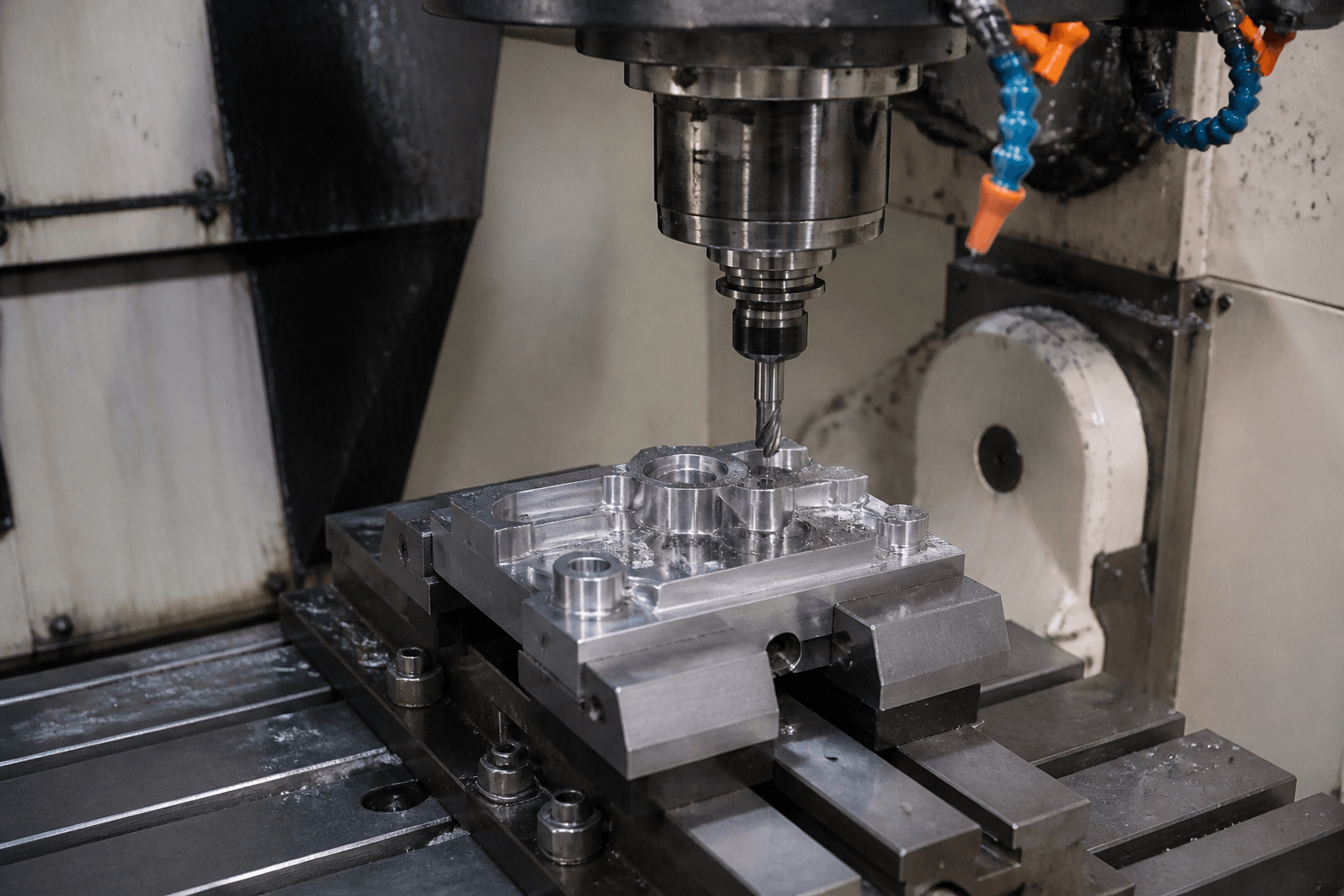
The main advantages of CNC machining are repeatable production, controlled dimensions, the ability to create complex machined features, efficient cycle execution, and reusable digital programs. These benefits come from programmed toolpaths and repeatable machine motion, but actual results still depend on the machine, tooling, workholding, material, setup, operator decisions, and inspection plan.
CNC machining is particularly useful when a component must be produced from solid stock with defined holes, pockets, bores, profiles, threads, contours, or turned diameters. It can support both prototype development and repeat production, although it is not automatically the lowest-cost or most suitable process for every metal part.
What CNC Machining Means in This Article
CNC stands for computer numerical control. In CNC machining, programmed instructions control the movement of a cutting tool, the workpiece, or both. Material is removed in a planned sequence until the required geometry is produced.
This definition covers several machining configurations. CNC milling generally uses rotating cutting tools to machine stationary or repositioned workpieces. It is commonly associated with faces, slots, pockets, hole patterns, profiles, and three-dimensional contours. CNC turning rotates the workpiece while cutting tools form diameters, shoulders, grooves, bores, threads, and other mainly rotational features.
Turning and milling are machining processes, not forms of sheet metal fabrication. A machined component may be assembled with a fabricated structure, but the processes remain conceptually distinct. The best manufacturing route should follow the component’s geometry, starting material, quantity, finish, and functional requirements.
The advantages of CNC therefore should not be interpreted as guarantees. A program can command a position, but programmed motion alone does not confirm that the finished part conforms to the drawing. Tool condition, fixture stability, thermal change, material behavior, machine condition, and measurement methods all influence the result.
How CNC Supports Consistency and Dimensional Control
Programmed motion reduces uncontrolled variation
In primarily manual machining, the machinist directly controls more of the tool movement and operation sequence. CNC transfers much of that repeated motion into a program. Once the process has been correctly developed, the machine can follow the same toolpath, feed sequence, coordinate system, and operation order for each cycle.
This repeatability can be valuable when several parts must share the same hole locations, mating surfaces, profiles, or assembly interfaces. It also helps when a prototype design moves into a production batch, because an approved process can be retained rather than recreated entirely from operator memory.
Reduced manual intervention during the controlled cutting cycle does not eliminate the need for skilled people. Operators and process engineers still need to establish datums, select tools, set offsets, secure the part, monitor cutting conditions, manage tool changes, and respond to wear or unexpected behavior. CNC relocates much of the skill from continuous hand control to process planning, setup, verification, and control.
Repeatability is not the same as conformance
A machine may repeat the same movement while still producing an incorrect feature if the program, offset, tool, or datum is wrong. Consistently making the same error is repeatability, but it is not drawing compliance.
Reliable dimensional control requires a stable relationship among the machine coordinate system, workholding, cutting tool, and inspection datum. Tool wear may gradually alter a bore or profile. Cutting heat can affect the tool, machine structure, or workpiece. Thin walls may move after material is removed, while a poorly supported part may deflect during cutting.
Inspection planning is therefore part of the manufacturing process. Critical dimensions, threads, bores, flatness relationships, and assembly interfaces should be identified on the drawing and checked with suitable measurement methods. The required tolerance must also be evaluated against the material, geometry, feature accessibility, setup sequence, and available equipment rather than assumed from the term CNC.
Which Part Features Benefit from CNC Machining?
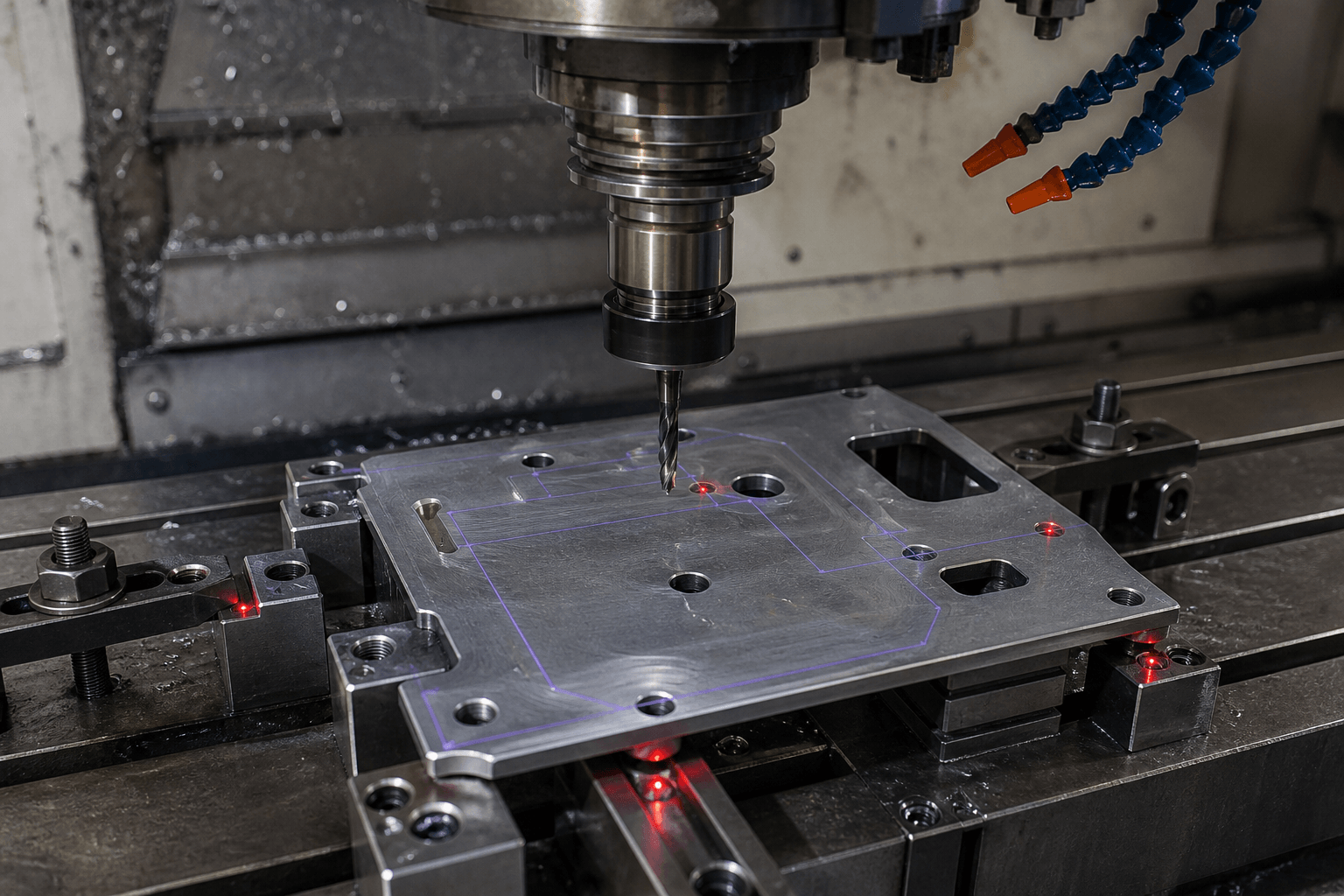
CNC machining expands practical design options because coordinated machine movement can create features that would be slow, difficult, or inconsistent to produce through direct manual control. Common examples include:
- Pockets, steps, slots, and external profiles produced by CNC milling
- Hole patterns with controlled positions relative to defined datums
- Bores, counterbores, countersinks, and threaded holes
- Curved surfaces and contours generated through coordinated tool movement
- Turned diameters, shoulders, grooves, internal bores, and external threads
- Machined interfaces for bearings, shafts, fasteners, seals, or assembled components
The design freedom is substantial but not unlimited. Every cutting tool needs access to the material. Internal corners are influenced by cutter geometry, deep pockets can restrict chip removal and tool stiffness, and long slender features may deflect. A feature that appears simple in a 3D model may require multiple orientations, special workholding, an additional setup, or a different machining configuration.
CNC milling and CNC turning also offer different advantages. Milling is usually the more natural choice for prismatic components with multiple faces, pockets, and non-rotational features. Turning is efficient for components organized around a rotational axis. Some parts require both methods, but that adds process transfers, datum considerations, and inspection requirements.
Machining should also be evaluated against the starting form. A solid block may be appropriate for a compact housing with pockets and precision interfaces, while a large, thin bracket may be better suited to sheet metal fabrication. For custom metal brackets built to drawings, process fit depends on thickness, formed geometry, machined interfaces, load paths, and quantity—not on the assumption that every bracket should be CNC machined.
Benefits from Prototype Revision to Repeat Production
Prototype development
CNC programs can be revised when a prototype changes, which supports controlled design iteration. A hole position, pocket depth, contour, or turned diameter may be updated through the manufacturing data without creating a dedicated production mold for every revision.
That flexibility does not mean revisions are effortless. A design change may affect tool access, stock size, fixture contact, setup count, cutting time, inspection, or downstream assembly. Revised files should be identified clearly so that obsolete drawings, models, and programs do not remain in use.
Programming and setup are separated from cycle execution
One of the most important CNC productivity advantages appears after programming, tooling, and setup have been completed. The machine can execute a defined operation sequence with less continuous manual control than a fully manual process. For repeated parts, this separation can improve production consistency and reduce the need to plan each tool movement again.
However, programming and setup consume time before the first conforming part is available. For a very simple one-off component, manual machining may sometimes be more practical. The balance changes when geometry is complex, dimensions must be repeated, or additional batches are expected.
Program reuse supports repeat orders
A controlled CNC program can be retained for future production, together with revision information, tooling requirements, setup instructions, and inspection records. This digital continuity can reduce process redevelopment when the same part is reordered.
Reuse still requires verification. Material condition, tooling, machine availability, fixture condition, software changes, and drawing revisions may differ between orders. The retained program is a process asset, not proof that the next batch will automatically meet specification.
When Each CNC Advantage Actually Matters
| CNC advantage | Conditions that strengthen it | Conditions that can reduce it |
|---|---|---|
| Repeatable tool movement | Stable workholding, controlled datums, proven programs, consistent stock, and monitored tools | Fixture movement, tool wear, thermal effects, variable material, or incorrect offsets |
| Dimensional and geometric control | Clearly defined critical features, practical tolerances, accessible geometry, and suitable inspection | Thin walls, deep features, poor datum definition, difficult access, or unrealistic specifications |
| Complex feature production | Parts with pockets, contours, hole patterns, bores, threads, or rotational profiles | Features that cannot be reached by available tools or require excessive setups |
| Efficient repeated cycles | Multiple identical parts, stable setup, reusable tooling, and repeat orders | Very low quantity, frequent design changes, long setup, or simple work suited to manual methods |
| Digital revision and program reuse | Controlled drawing revisions, documented setups, and repeat production | Weak file control, undocumented changes, obsolete programs, or changing production conditions |
CNC machining also has broader limitations. Subtractive machining can generate more material waste than processes that form parts close to their final shape. Machine travel and work envelope limit component size. Multiple setups can increase handling and create additional datum relationships. Complex inspection requirements can remain necessary even when cutting is automated.
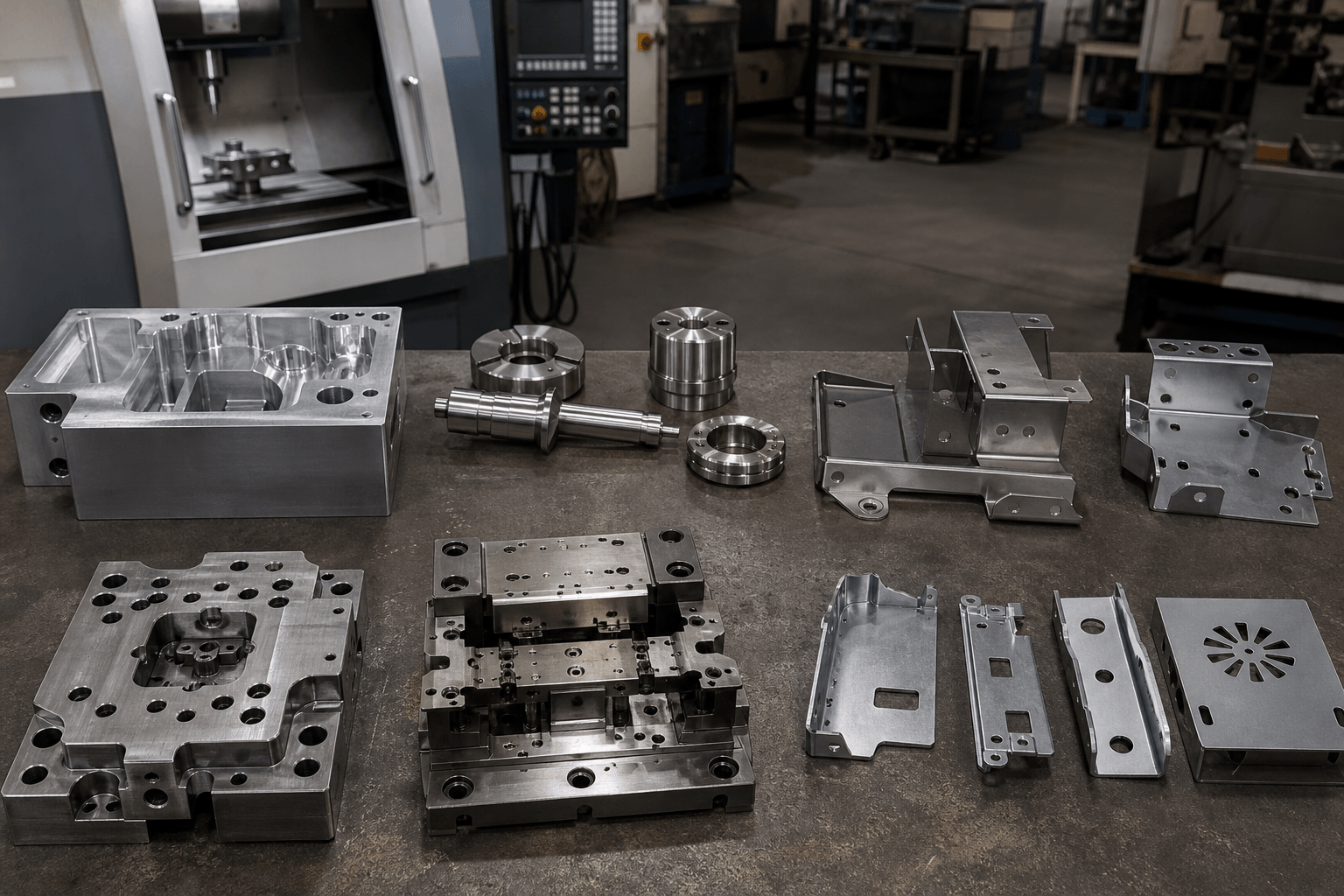
Alternative processes may offer a better fit under different conditions. Sheet metal fabrication is generally relevant when a component is made from sheet using cutting, bending, forming, and joining. Extrusion can suit long parts with a consistent cross-section. Die casting or injection molding may become attractive for suitable geometries and higher volumes that justify dedicated tooling. These processes should not be ranked as universally better or worse; they solve different manufacturing problems.
A useful process decision considers geometry, material, tolerance, quantity, surface finish, assembly requirements, lead-time priorities, and expected design stability. CNC is most advantageous when its programmable control and feature capability address genuine part requirements rather than merely adding a more automated process.
Frequently Asked Questions
What are the biggest advantages and disadvantages of CNC machining?
The main advantages are repeatable programmed movement, control of complex features, efficient cycle execution after setup, and reusable digital manufacturing data. The main disadvantages include programming and setup effort, tool-access constraints, material removal waste, machine size limits, and the continuing need for skilled setup and inspection.
Are the advantages of CNC milling and CNC turning the same?
They share benefits such as programmable movement, repeatability, and program reuse, but they suit different geometry. CNC milling is generally associated with prismatic parts, pockets, faces, and hole patterns. CNC turning is primarily suited to rotational features such as diameters, shoulders, grooves, bores, and threads.
Does CNC machining automatically produce tighter tolerances?
No. CNC provides controlled and repeatable motion, but achievable tolerance depends on the machine, setup, tooling, workholding, material, geometry, thermal conditions, and inspection method. A tolerance should be reviewed feature by feature rather than assumed to be achievable because a CNC machine is used.
When is CNC machining better suited than sheet metal fabrication or a tooling-based process?
CNC is often suitable for solid components with machined surfaces, pockets, bores, contours, threads, or precise assembly interfaces. Sheet metal fabrication is usually more appropriate for thin formed components, while tooling-based processes may become practical for stable designs at volumes that justify their upfront tooling requirements.