
Alloyed steel is steel whose chemical composition includes intentionally controlled alloying elements to achieve specified material characteristics. In normal industrial usage, alloyed steel and alloy steel refer to the same broad material category, but neither term alone guarantees strength, corrosion resistance, weldability, toughness, or suitability for a particular service environment.
To define the material correctly, engineers and buyers must look beyond the category name. The applicable material specification, grade, product form, manufacturing route, delivery condition, test evidence, and project requirements establish what is actually being supplied.
What Counts as Alloyed Steel?
Steel is fundamentally an iron-based alloy containing carbon and other controlled elements. Therefore, all commercial steel is technically alloyed at the chemical level. However, industry terminology does not classify every steel as alloy steel.
Plain carbon steel relies mainly on carbon, together with normal residual or processing elements, to establish its structure and properties. Alloy steel contains specified additions such as chromium, nickel, molybdenum, manganese, silicon, vanadium, or other elements beyond the limits used to define plain carbon grades under the governing classification. Exact boundaries depend on the standard and grade system being applied; they should not be inferred from a generic website definition. The American Iron and Steel Institute likewise distinguishes carbon steel from alloy steel while recognizing that many different compositions fall within the alloy category. ([steel.org](https://www.steel.org/steel-technology/steel-production/glossary/?utm_source=openai))
Stainless steel is also an alloyed form of steel, but it is normally treated as a separate category because its composition is designed to develop a passive, corrosion-resistant surface. Calling a material “alloyed steel” does not mean that it is stainless. Likewise, cast iron is an iron-carbon material family, but its composition, solidification behavior, microstructure, and manufacturing routes differ from those of wrought steels.
For purchasing and manufacturing purposes, the safest interpretation is simple: alloyed steel is a category description, not a complete material callout.
How Steel Alloys Are Produced and Conditioned
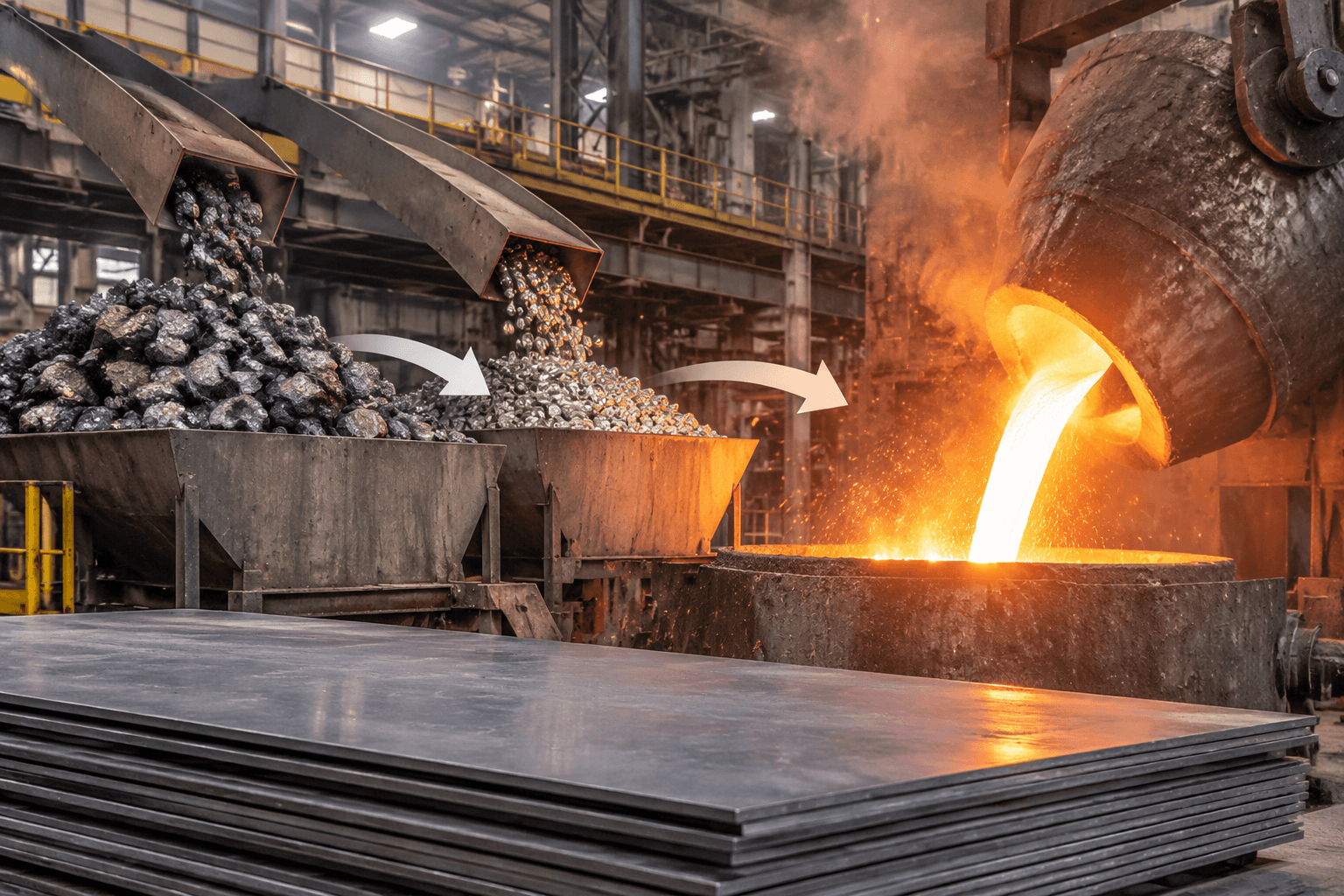
Alloying does not occur as a single isolated operation. The final material results from a sequence in which chemistry, refining, solidification, forming, and thermal history interact.
- Charge materials enter the steelmaking route. Depending on the production method, inputs may include hot metal, direct-reduced iron, steel scrap, fluxes, and other charge materials. Common industrial routes include basic oxygen and electric arc furnace steelmaking. ([worldsteel.org](https://worldsteel.org/about-steel/steelmaking-process/?utm_source=openai))
- The charge is melted and the base chemistry is established. Carbon and unwanted elements are controlled during melting and refining. The producer works toward the chemistry required by the applicable grade specification rather than simply adding a generic “alloy package.”
- Alloying additions adjust the melt. Selected additions may be made during melting, furnace treatment, or ladle metallurgy. Their timing and recovery must be controlled so that the finished heat meets the specified chemical limits.
- Secondary refining improves control. Ladle treatment, deoxidation, desulfurization, vacuum treatment, or other refining operations may be used when required by the production route and material specification.
- Molten steel is cast. The steel is commonly cast into semi-finished forms such as slabs, blooms, or billets. Solidification control matters because segregation, cleanliness, and internal quality can affect later processing and inspection.
- The semi-finished steel is formed. Hot rolling, forging, cold reduction, drawing, or another route converts the cast material into plate, sheet, coil, bar, section, tube, or another product form. Product form is important because a designation available for bar is not automatically equivalent to a similarly named sheet or plate product.
- Heat treatment may establish the delivered condition. Annealing, normalizing, quenching and tempering, stress relieving, or other controlled cycles can change microstructure and mechanical behavior without changing the nominal grade name. Heating temperature, holding time, cooling route, and prior processing history all influence the result. ([steel.org](https://www.steel.org/steel-technology/steel-production/glossary/?utm_source=openai))
This is why two products with related chemistry may behave differently during bending, machining, welding, or service. Composition is only one part of the material definition; processing route and delivered condition also matter.
How Alloy Steel Differs from Other Iron-Based Materials
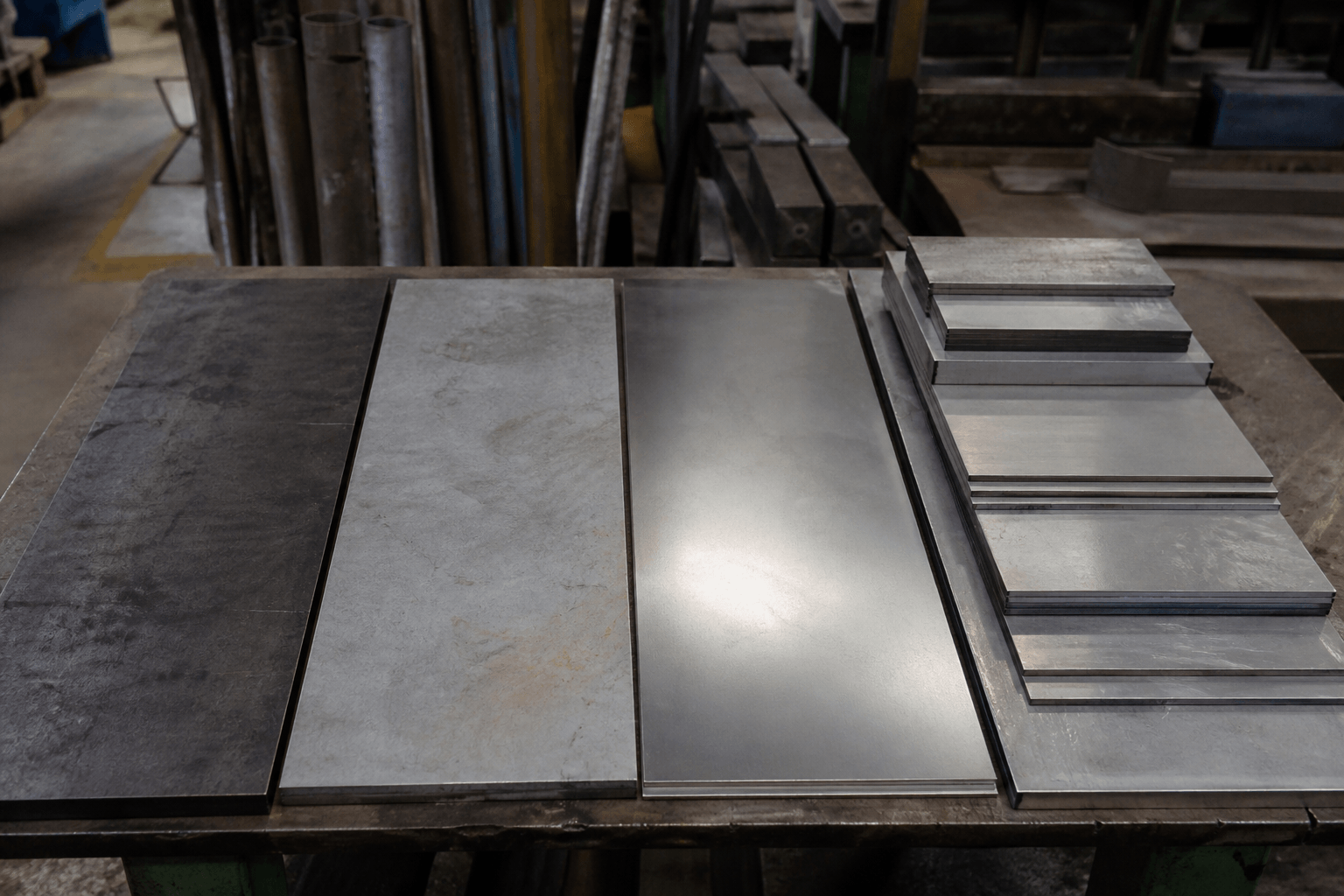
Steel classification systems vary by industry and specification. A commonly used high-level grouping is carbon steel, alloy steel, stainless steel, and tool steel. Cast iron should be kept outside that four-part steel grouping.
| Material category | Basic distinction | What the category does not prove |
|---|---|---|
| Plain carbon steel | Properties are established primarily through carbon content and processing, without the alloy additions used to classify alloy steels. | It does not automatically mean low strength, easy welding, or poor service performance. |
| Alloy steel | Contains specified alloy additions used with processing and heat treatment to meet a defined grade requirement. | The name alone does not establish corrosion, pressure, heat, impact, or welding performance. |
| Stainless steel | A separately recognized steel family designed to form a corrosion-resistant passive surface through its specified composition. | It is not immune to every corrosive environment, fabrication contaminant, temperature, or chemical exposure. |
| Tool steel | A specialized steel family developed for tooling, cutting, forming, wear, or related applications. | It should not be treated as a universal substitute for structural or fabricated steel. |
| Cast iron | An iron-carbon material family generally produced by casting, with composition and microstructures distinct from wrought steel. | It is not simply another name for high-carbon steel. |
The boundaries can overlap conceptually. Stainless and tool steels contain alloying elements, for example, but specifications and supply chains normally identify them as distinct families. For drawings and purchase orders, the governing grade designation is more useful than relying on an informal four-type taxonomy.
What the Material Label Tells You—and What Still Requires Verification
The term alloyed steel tells a buyer that composition is intentionally controlled beyond a broad plain-carbon definition. It does not reveal how the material will perform in a specific part.
| Proposed conclusion | Can the label confirm it? | What should be verified? |
|---|---|---|
| “It will resist corrosion.” | No. | Grade, environment, exposure duration, surface condition, coating, fabrication contamination, and any required corrosion test criteria. |
| “It is suitable for high temperature or pressure.” | No. | Applicable material and design specifications, temperature range, design pressure, product thickness, mechanical data, and required inspection. |
| “It will be easy to weld.” | No. | Actual chemistry, grade, thickness, delivery condition, joint design, restraint, hydrogen control, consumables, and qualified welding requirements. |
| “It has high impact resistance.” | No. | Required impact test method, test temperature, specimen orientation, acceptance criteria, and supporting test reports. |
| “The grade name proves low-temperature toughness.” | Not by itself. | Specified condition, section thickness, required test temperature, heat treatment, and documented impact results. |
| “A higher alloy content means better performance.” | No. | The combination of properties required for the application and the evidence defined by the governing specification. |
Weldability illustrates why broad claims are risky. Carbon content and other alloying elements influence hardenability and the behavior of the heat-affected zone. Carbon-equivalent concepts can help engineers assess composition-related cracking susceptibility, but the correct formula, limits, and controls depend on the material and governing procedure. Thickness, restraint, hydrogen, heat input, joint geometry, and delivery condition also matter. ([twi-global.com](https://www.twi-global.com/technical-knowledge/faqs/faq-what-are-low-alloy-steels-and-what-precautions-should-i-take-when-welding-them?utm_source=openai))
A quenched-and-tempered grade, for instance, may require attention not only to cracking risk but also to possible softening or property changes in the heat-affected zone. That observation does not provide a welding procedure. The procedure must be developed or qualified for the actual material, thickness, joint, and service requirements. ([twi-global.com](https://www.twi-global.com/technical-knowledge/faqs/faq-are-quenched-and-tempered-qt-steels-readily-weldable?utm_source=openai))
These distinctions are important in fabricated equipment. A bracket for a guarded indoor assembly may have different verification needs from a load-bearing component exposed to repeated impacts. Similar questions arise in material handling and logistics equipment, where loading, wear, joining, and inspection requirements should be defined by the design rather than assumed from the words “alloy steel.”
How to Write a Verifiable Material Requirement
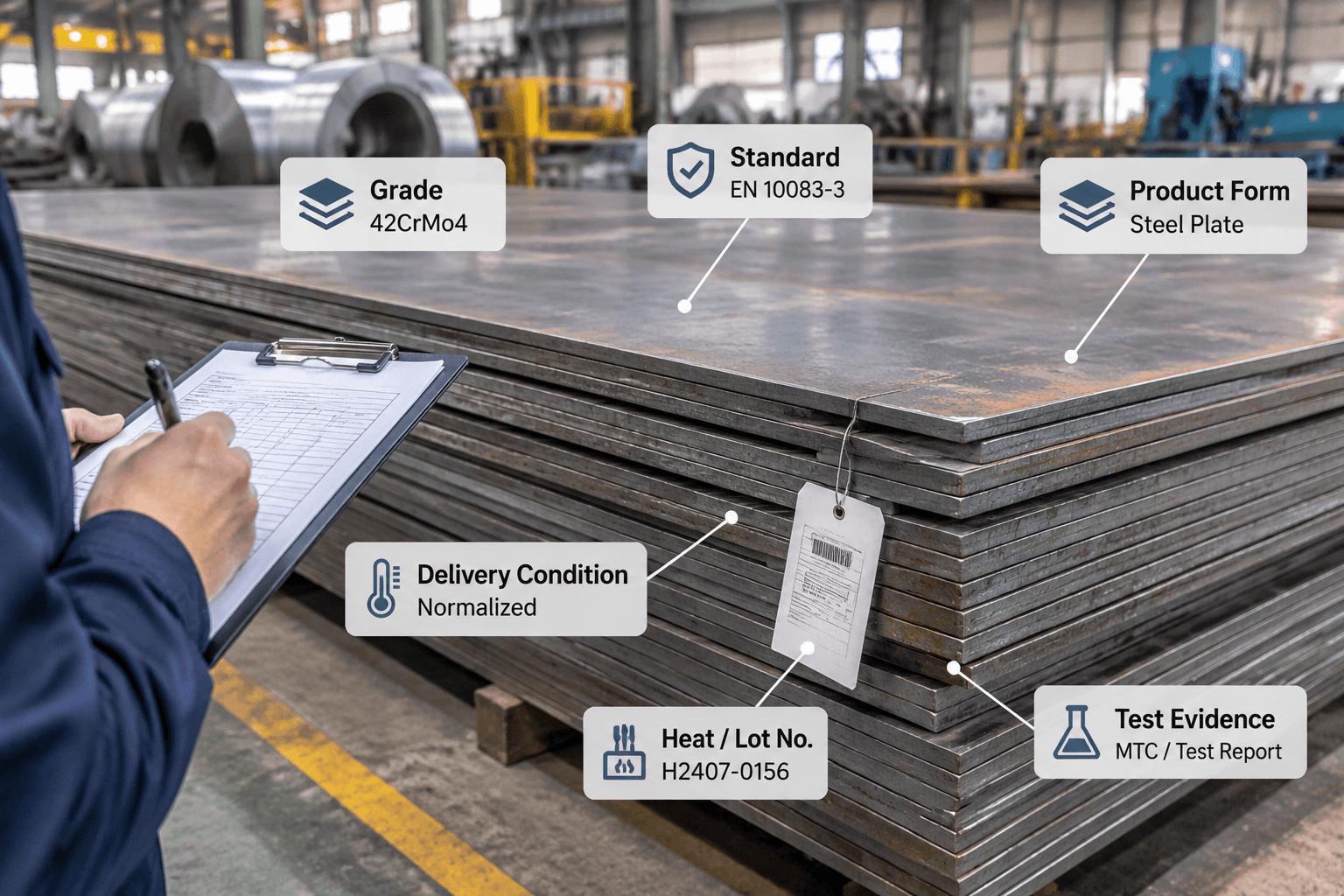
A usable material definition connects the drawing to a recognized specification and states the condition in which the product must be supplied. A callout might be organized as follows:
Material: [grade or designation] to [applicable material specification and revision, if controlled]
Product form: sheet, plate, bar, tube, forging, or other required form
Dimensions: nominal thickness or section size, including applicable dimensional tolerances
Delivery condition: as-rolled, annealed, normalized, quenched and tempered, or another specified condition
Required evidence: material test report showing required chemical and mechanical results
Traceability: heat, lot, or batch identification maintained to the level required by the project
Additional criteria: impact testing, hardness, surface condition, corrosion requirement, temperature requirement, nondestructive examination, or other project-specific acceptance criteria
Fabrication controls: applicable welding, forming, heat-treatment, coating, and inspection requirements developed for the actual grade and component
The bracketed fields cannot be completed responsibly from the phrase “alloyed steel.” They require engineering decisions based on the part function. This applies to drawing-defined products such as custom metal brackets: the component geometry may be clear while the material callout remains incomplete.
A material test report can support identification by reporting information such as the producing mill, heat or lot reference, specification, grade, chemistry, mechanical test results, product dimensions, and delivery condition, as applicable. The purchase specification should state which information and traceability level are required rather than assuming every shipment includes identical documentation.
Service requirements also need measurable definitions. Instead of writing “good impact resistance,” specify the applicable test, temperature, orientation, and acceptance criterion. Instead of “corrosion-resistant alloy steel,” identify the environment and required material or coating specification. Components used in automotive and transportation equipment may also require explicit joining, impact, loading, and traceability requirements, depending on the part’s function.
Frequently Asked Questions
Is steel the same as alloy steel?
No. Steel is the wider iron-based material family. Alloy steel is a category within that family containing specified alloying additions beyond the applicable plain-carbon definition. Although every steel contains controlled elements, not every commercial steel grade is classified as alloy steel.
What are six common alloying elements used in steel?
Six frequently encountered elements are chromium, nickel, molybdenum, manganese, silicon, and vanadium. Their effects are not universal or independent. The result depends on concentration, interactions with other elements, steelmaking practice, heat treatment, section size, and the property being evaluated.
How is alloyed steel different from stainless steel?
Alloy steel is a broad category, while stainless steel is a separately defined family with composition requirements intended to produce a passive corrosion-resistant surface. Stainless steel is technically alloyed, but an unspecified alloy steel should never be assumed to provide stainless-steel corrosion behavior.
Does higher carbon content always make alloyed steel difficult to weld?
No. Increasing carbon can raise hardenability and may increase cracking concerns, but weldability cannot be judged from carbon alone. Other alloying elements, thickness, restraint, hydrogen level, heat input, joint design, delivery condition, and the qualified welding procedure all influence the result.