
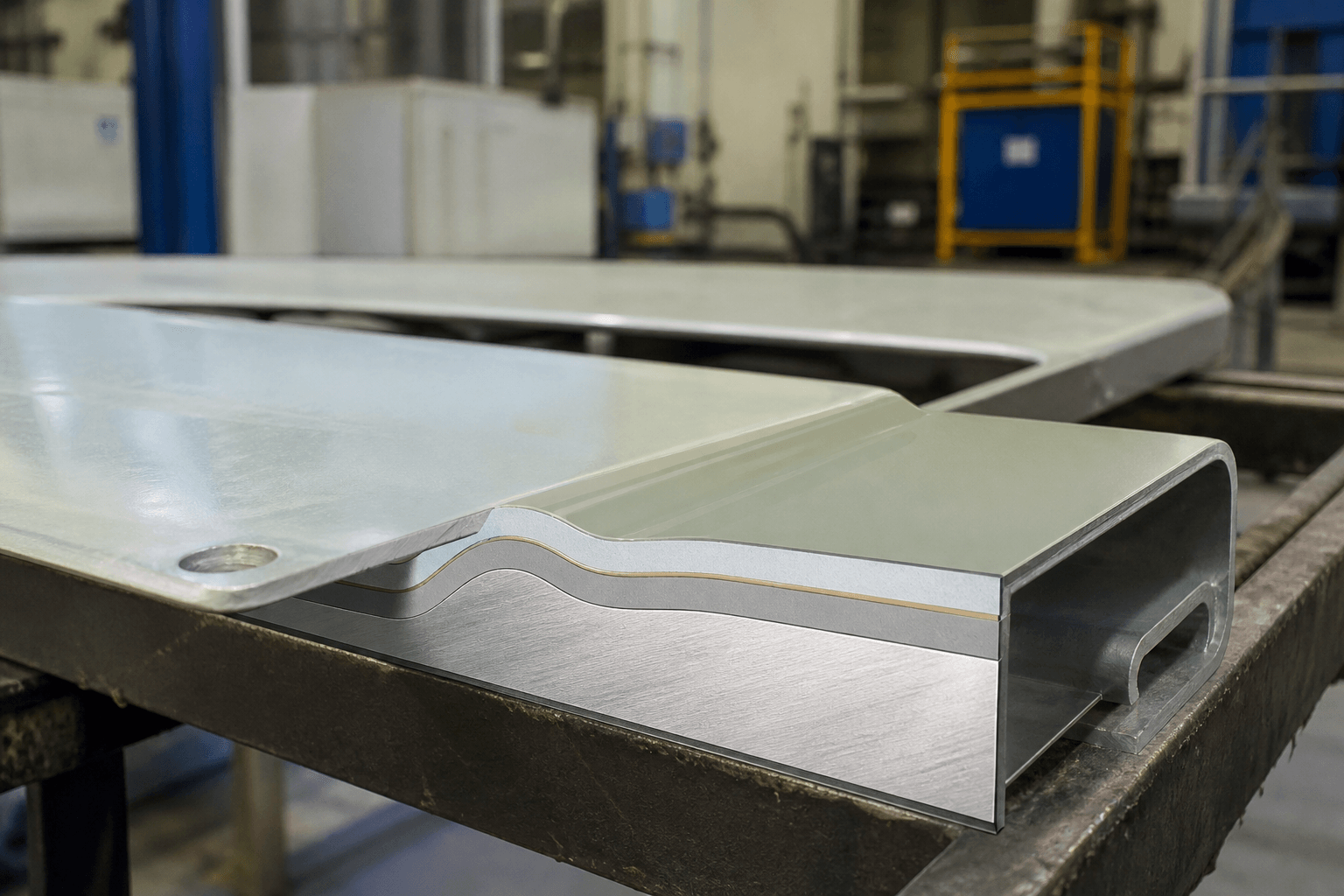
Alodine aluminum treatment is selected when an aluminum surface needs corrosion protection or paint preparation while preserving electrical conductivity and minimizing dimensional change. It is a chemical conversion coating, not a thick applied film, and it is not a substitute for anodizing where substantial abrasion or wear resistance is required.
The term Alodine is associated with branded metal-treatment products, although many drawings and workshops use “Alodine,” “chem film,” and “chromate conversion coating” as general descriptions. Chemical conversion coating is the broader technical process: a treatment solution reacts with the aluminum surface to form a protective conversion layer. “Aluminum passivation” is an even broader shop term and may refer to chromate, trivalent-chromium, or other conversion technologies, so it does not define the exact chemistry by itself. NASA process documentation similarly identifies chemical conversion coating as Alodining, chem film, or chromate conversion. ([nasa.gov](https://www.nasa.gov/wp-content/uploads/2023/03/prc-5006-current.pdf?utm_source=openai))
Engineers commonly consider this treatment for four functional reasons: improving corrosion resistance, maintaining relatively low electrical contact resistance, limiting dimensional impact, and preparing aluminum for primer or paint. The coating can be used as the final surface on suitable parts or as one layer within a larger protective system.
What Changes at the Aluminum Surface?
A conversion coating forms through a controlled chemical reaction with the aluminum substrate. Part of the existing surface participates in the reaction, producing a stable inorganic layer containing compounds determined by the treatment chemistry and alloy surface. This differs from paint, which deposits an organic film over the substrate, and anodizing, which electrochemically grows an aluminum oxide layer.
The conversion layer is generally selected when the designer wants surface protection without the coating buildup associated with many anodic or organic finishes. “Low dimensional impact,” however, should not be translated into a universal thickness allowance. The actual result depends on the product, preparation, alloy, application method, process conditions, and governing requirement.
| Surface system | How it forms | Typical functional emphasis |
|---|---|---|
| Chemical conversion coating | A treatment solution reacts with the aluminum surface | Corrosion protection, electrical contact, and paint preparation with limited dimensional impact |
| Anodizing | An electrochemical process grows an aluminum oxide layer | Corrosion protection, abrasion resistance, dielectric behavior, or decorative appearance |
| Paint or powder coating | An organic coating is applied and cured over a prepared surface | Barrier protection, color, appearance, and environmental isolation |
Anodic oxide has useful protective and decorative characteristics, but it is normally insulating compared with conversion-coated contact areas designed and verified for low electrical contact resistance. Anodizing is also available in processes intended for higher abrasion resistance. Paint and powder coating provide color and a physical barrier, but normally interfere with metal-to-metal grounding unless designated contact areas are masked or subsequently prepared. ([members.anodizing.org](https://members.anodizing.org/page/specifying-anodized-aluminum?utm_source=openai))
Hexavalent and trivalent chromium are different process families
Traditional chromate conversion processes may contain hexavalent chromium. Trivalent-chromium processes use different chemistry and are often considered when regulatory, customer, or supply-chain requirements limit hexavalent chromium. They should not be treated as automatically interchangeable. Their processing controls, appearance, approved products, qualification status, and compatibility with a customer’s specification may differ.
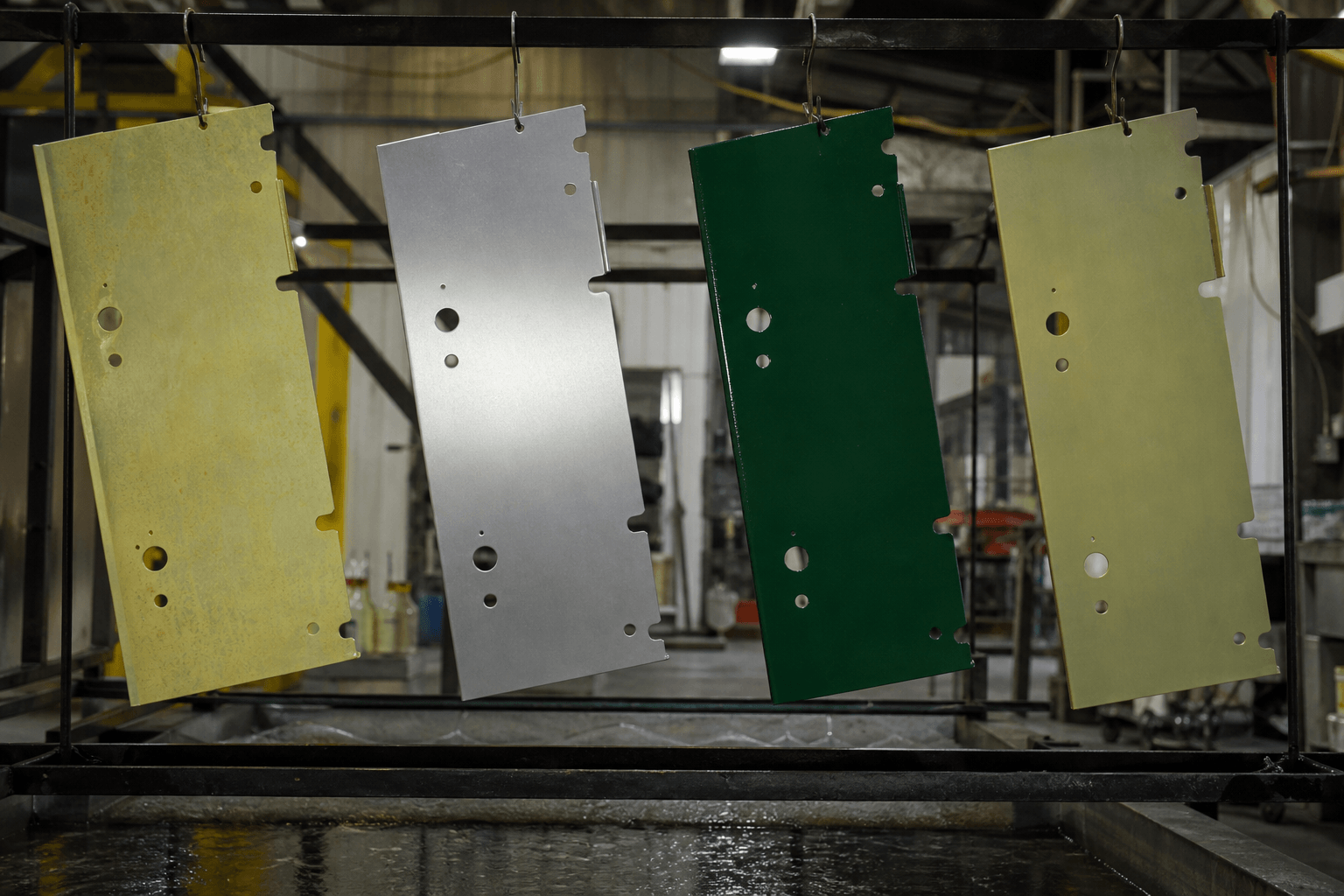
A drawing should therefore identify the required process or governing document rather than simply requesting “yellow Alodine” or “clear Alodine.” Color alone is not reliable evidence of the chemistry or performance. Some conversion coatings are nearly colorless, while others produce an iridescent or colored appearance that can vary with alloy, preparation, coating weight, and viewing conditions.
How the Alodine Aluminum Process Is Controlled
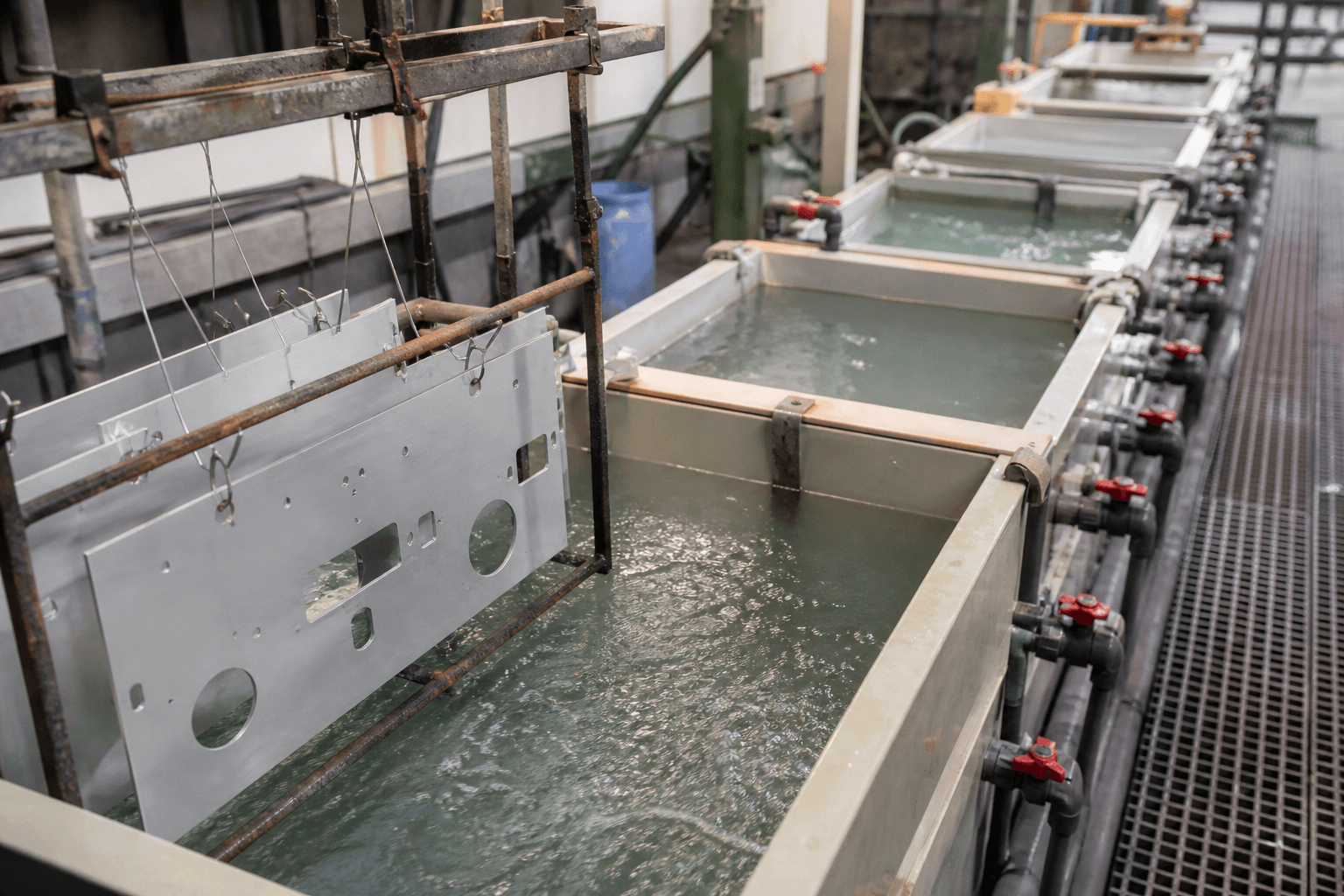
A consistent conversion coating depends as much on preparation and rinsing as on the treatment solution. A typical production sequence includes cleaning, surface conditioning when required, rinsing, conversion treatment, final rinsing, controlled drying, and inspection. Spray and immersion methods are widely used; some approved products may also permit brush or touch-up application. The product instructions and applicable process specification must govern the actual method. ([next.henkel-adhesives.com](https://next.henkel-adhesives.com/us/en/articles/chrome-based-conversion-coatings.html?utm_source=openai))
- Clean the aluminum. Oil, forming lubricant, polishing residue, shop dirt, fingerprints, and other contamination must be removed. A chemically active solution cannot produce a uniform conversion layer if it cannot contact the metal consistently.
- Prepare the surface. Depending on the alloy, fabrication history, oxide condition, and finish requirement, the process may include etching, deoxidizing, or desmutting. These operations remove unsuitable oxide and alloying-element residues. Over-processing can alter appearance, attack edges, or expose surface defects, so the sequence should match the material.
- Rinse between stages. Rinsing limits chemical carryover and prevents one bath from contaminating the next. Water quality, flow, part orientation, and trapped solution in hems, blind features, or joints can affect the result.
- Apply the conversion treatment. The aluminum is immersed, sprayed, or otherwise treated according to the approved product instructions. Bath concentration, pH where applicable, temperature, contact time, contamination, loading, agitation, and solution age can influence coating formation.
- Complete the final rinse. The required rinse depends on the chemistry and process instructions. Uncontrolled rinsing can leave residues, while an inappropriate rinse or excessive handling may disturb a newly formed surface.
- Dry without contaminating the part. Drying conditions must be controlled because excessive heat or rough handling can affect some conversion coatings. Parts should be protected from fingerprints, dirty racks, shop dust, moisture entrapment, and contact damage before painting or assembly.
- Inspect against the defined requirement. Inspection may include visual examination, verification of process records, coating-weight or corrosion testing, electrical-resistance evaluation, or paint-adhesion testing when the drawing or governing document requires them. Acceptance thresholds must come from that document, not from a generic description of Alodine.
Control point: Alloy and surface history matter. Sheet, machined plate, casting, and custom aluminum extrusion components may present different oxides, intermetallic particles, scratches, or residues. A pretreatment sequence that performs well on one alloy and product form should not be assumed to give an identical appearance on another.
Choose the Surface Treatment by What the Part Must Do
No single finish is best for every aluminum component. Selection should begin with the part’s function, exposure, contact interfaces, wear conditions, and appearance requirements.
| Design condition | Alodine or conversion coating | Anodizing | Paint or powder coating | Conversion coating plus paint |
|---|---|---|---|---|
| Electrical grounding or bonding | Often considered for designated contact surfaces | Normally insulating; contact areas may require masking or finish removal | Normally insulating | Use masking or omit topcoat at defined contacts |
| Abrasion, sliding, or repeated handling | Limited wear resistance | Usually the stronger candidate, especially with a suitable wear-focused process | Performance depends on coating system and mechanical exposure | Topcoat may protect broad surfaces but can still chip or wear |
| Very tight dimensional interfaces | Low dimensional impact is a key advantage | Coating growth and substrate consumption must be considered | Film buildup must be allowed for | Topcoat buildup governs many fits |
| Decorative color or controlled appearance | Usually functional rather than decorative | Suitable processes can provide durable decorative finishes | Broad color, texture, and gloss options | Topcoat provides the visible appearance |
| Paint adhesion required | Commonly used as pretreatment | Possible with a correctly specified system | Requires suitable surface preparation | Designed as a coordinated pretreatment and topcoat system |
| Bare corrosion protection | Suitable in defined environments and specifications | Often considered for greater durability or exposure | Provides a barrier if coverage remains intact | Combines pretreatment with an organic barrier |
Consider a hypothetical electronics enclosure with painted exterior surfaces and several chassis-ground locations. A conversion coating may be specified across the aluminum before painting, while grounding pads and threaded contact zones are masked from the organic topcoat. Coordinating these details early is important for custom sheet metal enclosures, because fabrication drawings must communicate which surfaces require paint, conductivity, masking, or cosmetic control.
For a guide rail, sliding bracket, or repeatedly handled component, conversion coating alone may not provide sufficient resistance to rubbing and scratches. Anodizing may be more appropriate when surface hardness and wear are primary concerns. If the requirement is primarily color, broad barrier protection, or resistance to a defined operating environment, a paint system may be preferable, often over a compatible pretreatment.
Transportation components illustrate why the environment must be considered as a system. Water traps, salts, dissimilar-metal contact, fastener interfaces, stone impact, cleaning chemicals, and electrical bonding may create competing finish requirements. In automotive and transportation metal fabrication, different areas of one assembly may therefore require conversion coating, masking, sealing, primer, topcoat, or anodizing rather than one finish everywhere.
Define the Requirement Before Parts Enter Finishing
A clear finish note should communicate function, not merely a familiar trade name. Before production, engineering and procurement teams should define these requirement categories:
- Base material: aluminum alloy, temper, product form, and any clad or cast condition.
- Required chemistry: hexavalent-chromium, trivalent-chromium, non-hexavalent, or another approved process where applicable.
- Governing requirement: the customer specification, drawing note, approved process, or other controlling document, including its current revision when required.
- Part function: corrosion protection, electrical bonding, paint adhesion, temporary protection, or a combination.
- Selective finishing: masking locations, grounding pads, electrical contacts, threads, holes, sealing surfaces, and areas that must remain paint-free.
- Topcoat system: primer, liquid paint, powder coating, adhesive, sealant, or no subsequent organic coating.
- Appearance expectations: whether color variation, iridescence, rack marks, or visible substrate differences are acceptable.
- Inspection and records: required lot traceability, certificates, process records, test coupons, adhesion tests, corrosion tests, or electrical checks.
For parts with threaded joints, press fits, conductive fastener paths, or adhesive bonding, finishing must also be coordinated with the assembly design. Masking a contact area can preserve function, but it may leave bare aluminum unless another approved protective treatment is specified. Conversely, applying paint over a grounding pad can prevent the completed assembly from meeting its electrical purpose.
Review the finishing requirement before production. For an engineering requirement review, provide the aluminum alloy and temper, part drawing or relevant finish callout, operating environment and corrosion exposure, electrical contact or grounding requirements, and any primer, paint, masking, or appearance instructions. Yishang can review whether these requirements clearly communicate the intended surface function before custom aluminum components move into production.
Frequently Asked Questions
Is Alodine hazardous, and what should be reviewed before handling it?
The answer depends on the specific product chemistry, concentration, exposure route, and how it is used. Hexavalent-chromium compounds require particular workplace controls and hazard communication; OSHA requires access to labels and safety data sheets for covered occupational exposures. Review the current SDS, product technical data, local regulations, ventilation and personal-protection requirements, wastewater controls, and disposal instructions before handling any treatment chemical. A trivalent or non-hexavalent product should also be evaluated using its own documentation rather than assumed harmless. ([osha.gov](https://www.osha.gov/laws-regs/regulations/standardnumber/1910/1910.1026?utm_source=openai))
Can Alodine aluminum be painted?
Yes. Chemical conversion coating is frequently used before primer or paint because it conditions the aluminum surface and can improve coating adhesion while contributing corrosion protection. Compatibility must be confirmed across the cleaner, conversion chemistry, rinse, primer, topcoat, adhesive, or sealant system. Processing intervals and contamination controls may also be important.
Does Alodine change part dimensions or interfere with grounding?
Conversion coating normally has less dimensional impact than anodizing or an organic topcoat, making it useful around close fits and detailed features. It is also commonly considered where low electrical contact resistance is needed. Exact dimensional and electrical acceptance criteria must still be defined by the drawing and verified using the required test method; conductivity should never be assumed solely because a surface looks conversion-coated.
Can 5052 aluminum be Alodined or anodized?
5052 aluminum can be processed with conversion coating or anodizing when the selected procedure is suitable for the alloy and the intended function. The correct choice depends on whether the part prioritizes conductivity, low dimensional impact, paint preparation, wear resistance, or appearance. Alloy composition, temper, surface condition, welding, forming marks, and prior processing can influence finish response, so approval should be based on the complete requirement rather than the alloy number alone.