
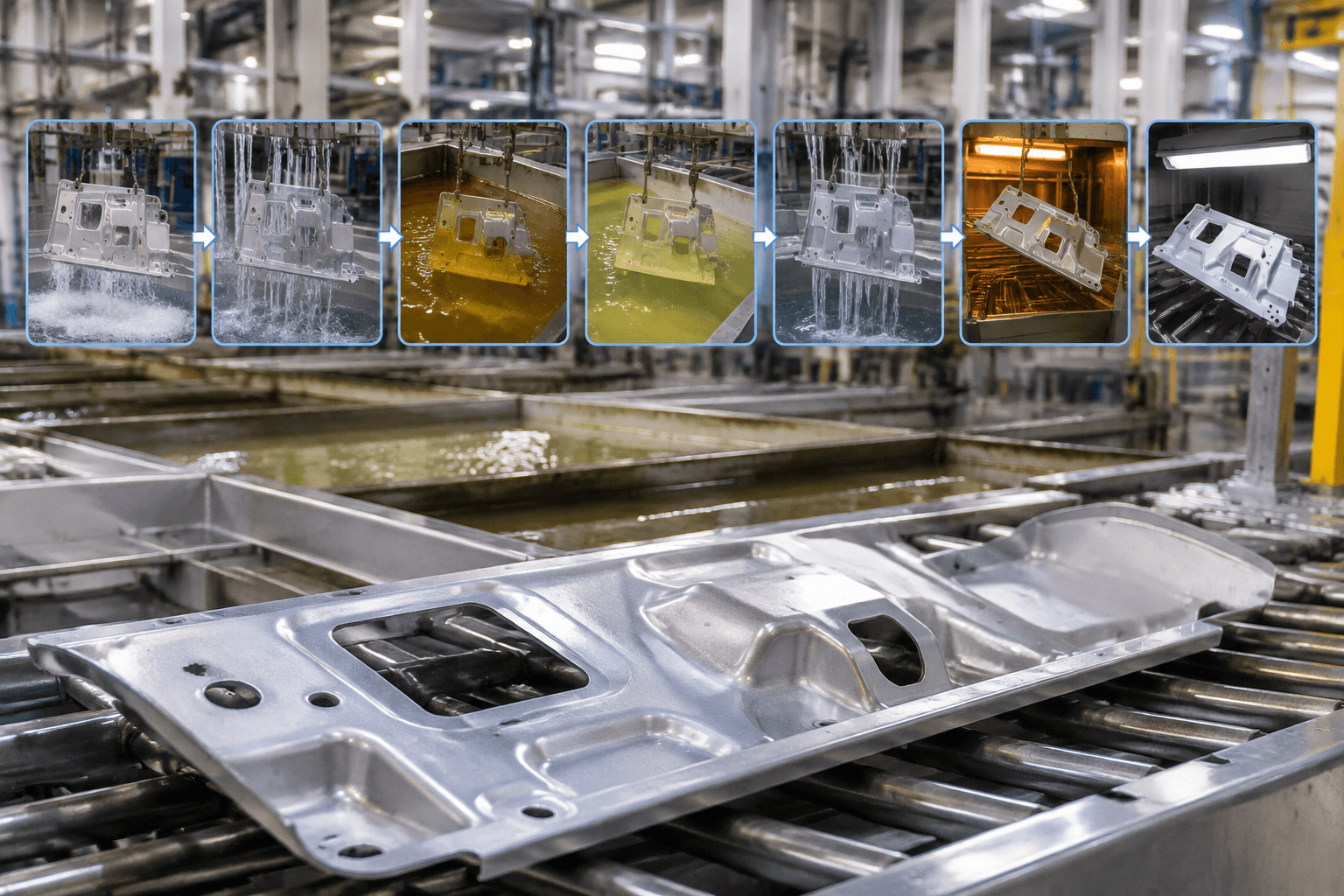
The Alodine process forms a chemical conversion layer by reacting a controlled treatment solution with a properly prepared aluminum surface. Its result depends not only on the conversion chemistry, but also on cleaning, rinsing, deoxidizing or desmutting, solution control, drying, and final verification.
Engineers commonly consider this process when a part needs corrosion protection, electrical contact performance, paint adhesion, or minimal dimensional change. It is not anodizing, and an aluminum conversion process should not be specified as a general coating for steel.
Alodine Process Scope and Functional Outcomes
Alodine is a Henkel trade name often used informally for chemical conversion coating. Depending on the supplier, drawing, and region, related terms may include chem film, chromate conversion coating, chemical conversion coating, or aluminum passivation. Because these terms are not always used identically, the drawing or purchase order should identify the required chemistry, performance, and governing specification rather than relying on a trade name alone.
The process is primarily associated with aluminum and aluminum alloys. The treatment reacts with the surface instead of depositing a relatively thick external layer. This produces a thin conversion film that can retard corrosion, support paint or primer adhesion, and preserve useful electrical contact characteristics when the selected system and acceptance requirements are designed for that purpose. Recognized aluminum conversion-coating specifications distinguish corrosion-oriented applications from applications requiring low electrical resistance. ([quicksearch.dla.mil](https://quicksearch.dla.mil/qaDocDetails.aspx?ident_number=5499&utm_source=openai))
Because the film is thin, it generally causes less dimensional change than anodizing or a multilayer paint system. That can be useful around fitted interfaces, threads, grounding locations, enclosure joints, or other features where added coating build must be limited. However, the actual dimensional effect depends on the selected process, alloy, surface preparation, and specification. It should not be represented by one universal thickness value.
Chemical conversion treatments are also available for magnesium, but the aluminum procedure, chemistry, and acceptance criteria should not automatically be transferred to a magnesium part. The base alloy must be identified so that a suitable, approved treatment can be selected.
Alodine and anodizing are not interchangeable. Anodizing is an electrochemical process that builds an oxide layer and may be selected for different corrosion, wear, cosmetic, or insulation requirements. Chemical conversion coating is usually much thinner and can be preferred where conductive contact or low dimensional impact is important. Neither finish should be selected without considering abrasion: a thin conversion film is not a substitute for a finish specifically designed for high wear.
The Complete Alodine Process Sequence
- Review and incoming inspection. The processor confirms the alloy, part condition, finish requirement, masking instructions, cosmetic surfaces, electrical contact areas, and downstream paint system. Parts are checked for oxidation, oils, shop dirt, embedded abrasive, fingerprints, previous finishes, and damage that could prevent uniform treatment.
- Cleaning. Oils, lubricants, polishing compounds, and other soils are removed with a cleaner suitable for the alloy and production route. A surface can look clean while still retaining contamination, so cleaning effectiveness must be controlled rather than judged only by casual observation.
- Rinsing. The first rinse removes cleaner residue and displaced contamination. Insufficient rinsing can carry alkaline or acidic material into the next tank, alter its condition, and create stains or nonuniform conversion.
- Deoxidizing or desmutting. Aluminum oxide and alloy-related surface residues are removed or conditioned so that the conversion solution can react consistently with the base metal. The required chemistry varies with alloy and surface condition. Castings, machined surfaces, formed sheet, and extrusions may not enter this stage with the same oxide or residue profile.
- Intermediate rinsing. Residual deoxidizer, dissolved metal, and loosened smut are removed. Water quality, rinse loading, drainage, and transfer time matter because contaminants carried forward can interfere with coating formation.
- Conversion treatment. The prepared part contacts the selected solution by immersion, spray, brush, wipe, or another approved technique. The chemical reaction develops the conversion layer. Contact time, solution condition, temperature, concentration, pH where applicable, agitation, drainage, and part orientation must follow the selected product instructions and governing process specification.
- Final rinsing. Where the approved system requires rinsing, the part is rinsed to remove residual processing chemicals without damaging the newly formed film. Some specialized products are designed as dry-in-place systems, so the exact final-rinse sequence must follow the approved chemistry rather than a generic shop routine. ([store.astm.org](https://store.astm.org/b0921-08r23.html?utm_source=openai))
- Drying and protected handling. Parts are dried under controlled conditions and handled in a way that avoids fingerprints, abrasion, staining, or contact with contaminated racks and packaging. Fresh conversion films should not be rubbed or stacked carelessly.
- Inspection and documentation. Coverage, appearance, specified electrical characteristics, paint-system compatibility, and required test evidence are reviewed. The finished part is accepted against the drawing, purchase order, named specification, or approved process plan—not against an assumed color alone.
Material form and prior manufacturing history can change the preparation requirements. Extrusions may retain extrusion lines, cutting fluids, or machining residue, while cast parts may present porosity, release agents, alloy-related smut, or other surface conditions. These factors should be reviewed before applying a generic conversion-coating note.
Alodine Process Stages: Purpose, Control Point, and Common Failure Signal
| Stage | Main purpose | Important control point | Possible warning signal |
|---|---|---|---|
| Incoming review | Confirm substrate and finish instructions | Alloy, prior finish, masking, contact areas | Unknown alloy or conflicting drawing notes |
| Cleaning | Remove oils and manufacturing soil | Cleaner condition, exposure, part loading | Water breaks, oily patches, uneven wetting |
| Rinsing | Prevent chemical carryover | Water quality, flow, contamination, drainage | Residue, staining, rapid rinse contamination |
| Deoxidizing or desmutting | Prepare a reactive aluminum surface | Alloy response, solution condition, exposure | Persistent smut, patchy appearance, excessive attack |
| Conversion treatment | Form the functional conversion film | Chemistry, concentration, pH, time, temperature | Bare areas, powdery film, streaking, nonuniform color |
| Final rinse | Remove residue where required | Approved water quality and rinse sequence | Deposits, spots, staining after drying |
| Drying and handling | Complete processing without film damage | Drying condition, gloves, racks, packaging | Fingerprints, rub marks, scratches, trapped moisture |
| Verification | Confirm specified functional result | Defined sampling and acceptance criteria | Visual pass but failed resistance, adhesion, or corrosion test |
These variables are process controls, not automatic acceptance values. For example, a processor may monitor bath concentration and temperature to keep the process stable, while the buyer accepts the part based on coverage, electrical resistance, adhesion, or corrosion-test criteria. The process plan should connect both levels without treating an in-range bath reading as proof that every finished part complies.
Alloy composition also affects the surface reaction. Copper-rich, silicon-rich, wrought, cast, and other aluminum conditions may differ in color and treatment response. Therefore, uniform function does not always mean perfectly identical color, while identical color does not prove equivalent performance.
Trivalent and hexavalent systems must also be kept distinct. Hexavalent-chromium-containing materials and materials containing no hexavalent chromium are recognized as separate types in aluminum conversion-coating specifications. ([quicksearch.dla.mil](https://quicksearch.dla.mil/Transient/C2DC8261558345B898F9626EA82C731C.pdf?utm_source=openai)) A trivalent or other non-hexavalent system should not be substituted merely because the appearance seems similar. The engineer should identify the required type, product approval constraints, downstream paint compatibility, electrical requirement, testing, and applicable environmental or workplace rules.
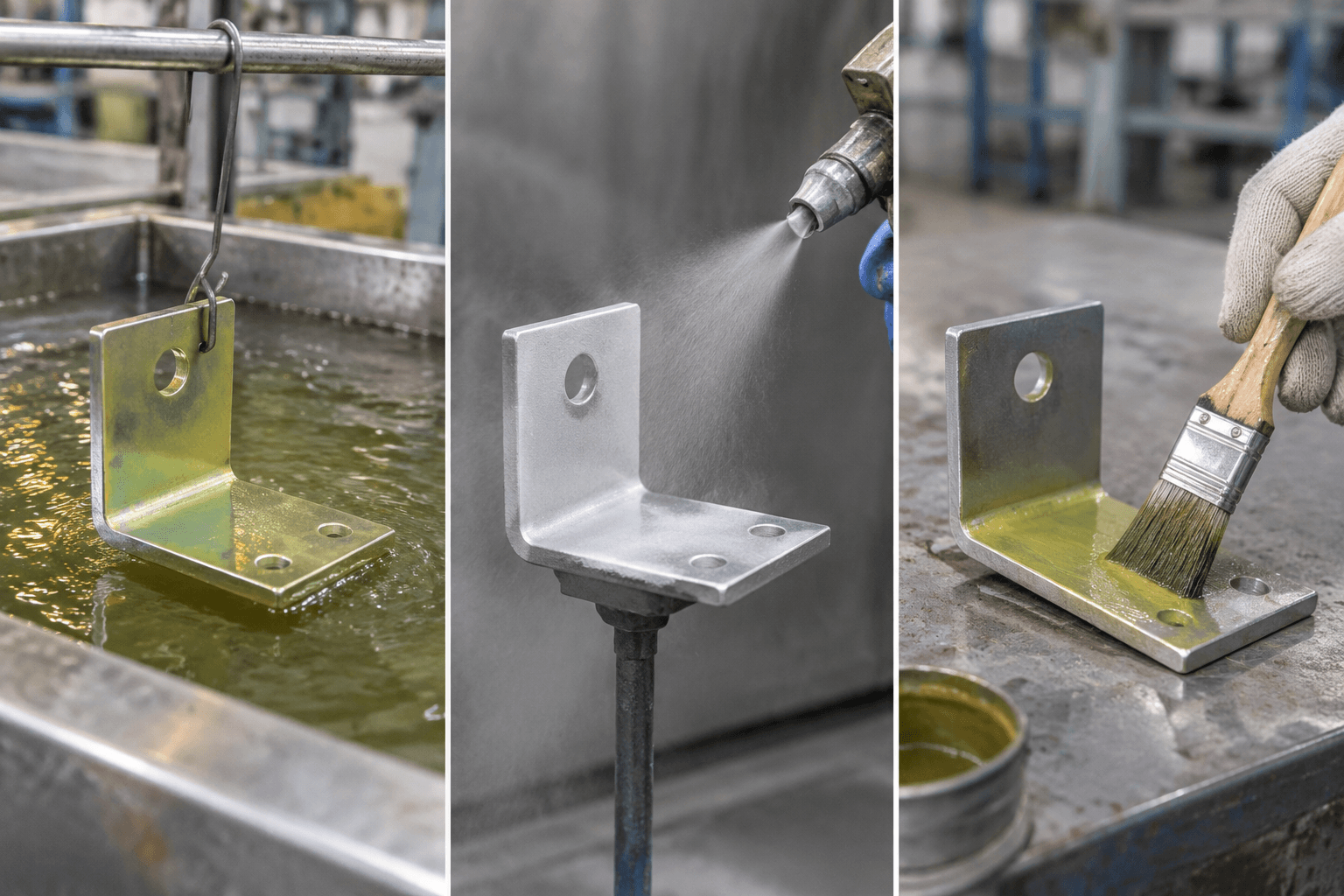
Immersion, Spray, or Brush: Matching the Method to the Part
| Application method | When it may be considered | Points requiring review |
|---|---|---|
| Immersion | Batch processing, complex geometry, recesses, and parts that can be fully submerged | Air pockets, drainage, racking marks, solution carryover, tank size, and treatment of internal cavities |
| Spray | Production lines, larger surfaces, or parts suited to directed coverage | Nozzle access, shadowed areas, flow pattern, runoff, overspray, and repeatable exposure |
| Brush or wipe | Localized treatment, touch-up, repair, or parts impractical to immerse | Overlap marks, wetness, applicator contamination, edge coverage, and whether the method is approved |
Immersion can provide access around many edges and features, but trapped air may prevent solution contact inside upward-facing pockets or blind recesses. Spray application can provide controlled flow over accessible surfaces, yet geometry can create shadowed zones. Brush or wipe treatment can be practical for localized work, although operator technique and overlap become significant variables.
Industry documents and commercial product instructions recognize multiple application routes, including dipping, spraying, and wipe-on techniques. They also show that some products are restricted to a particular method while others permit several. ([store.astm.org](https://store.astm.org/b0921-08r23.html?utm_source=openai)) The correct method is therefore the one supported by the selected material, approved procedure, part geometry, production volume, and governing requirements—not whichever method is most convenient.
How to Verify the Finished Conversion Coating
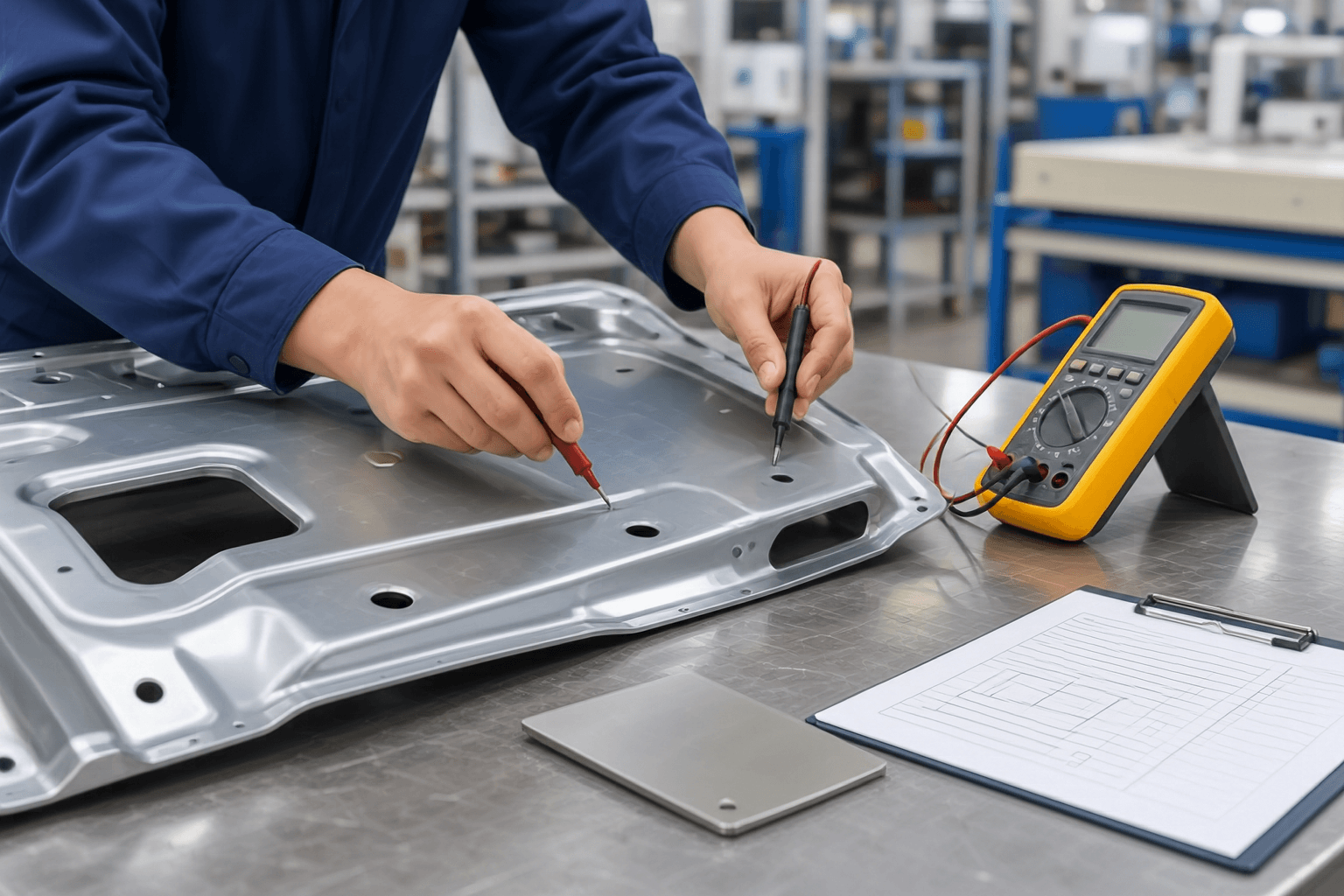
Verification should move from documentation to visual inspection and then to the functional tests required by the drawing or specification.
- Confirm traceability. Check the base alloy, conversion material or approved process, chemistry type, lot identification, processing date, and any required bath-control records or certificate.
- Inspect coverage and condition. Look for untreated areas, stains, powdery deposits, scratches, fingerprints, heavy streaking, or residue. Appearance limits should account for the selected chemistry and alloy. A clear or lightly colored film may be intentional, so color intensity alone is not a reliable coating gauge.
- Check defined electrical points. If grounding or bonding matters, measure resistance or contact performance at specified locations using the required fixture, probe pressure, surface condition, and test method. Do not take an arbitrary multimeter reading on an unspecified area and treat it as formal acceptance.
- Verify downstream adhesion. Where conversion coating is a paint or primer pretreatment, evaluate the completed finish system using the specified adhesion method. Conversion coating can improve the base for organic finishes, but the cleaner, conversion layer, primer, paint, cure, and handling steps work as one system. ASTM guidance for non-hexavalent coatings includes corrosion protection, organic-film preparation, and low contact-impedance functions. ([store.astm.org](https://store.astm.org/b0921-08r23.html?utm_source=openai))
- Perform specified corrosion testing. Use the named test method, specimen or production-part sampling plan, exposure condition, duration, and pass/fail threshold. No universal corrosion-test result applies to every alloy, chemistry, coating class, or end-use environment.
- Protect accepted parts. Packaging and assembly controls should prevent abrasion, contamination, and moisture exposure from damaging the treated surface before use.
For custom aluminum sheet metal enclosures, drawing notes may need to coordinate conductive seams, grounding points, masked threads, cosmetic faces, and painted exterior areas. A single instruction such as “Alodine all over” may be inadequate when different surfaces serve different functions.
Review the conversion-coating requirement before production planning. Provide the part drawing, base alloy, required coating terminology or named specification, electrical-contact requirements, paint or primer system, and all masked or untreated areas. Yishang can review whether the drawing clearly communicates the substrate, application constraints, functional requirements, and acceptance criteria before the process route is planned.
Frequently Asked Questions
Can the Alodine process be used on steel?
Not as the aluminum chemical conversion process described here. Steel uses different pretreatments and conversion systems. If an assembly contains aluminum and steel, each metal should receive a compatible, separately specified treatment.
Are Alodine and anodizing the same process?
No. Alodine-type treatment is a chemical conversion process, while anodizing is electrochemical and creates a different oxide layer. They differ in dimensional impact, electrical behavior, wear characteristics, appearance, and process control.
How do trivalent and hexavalent conversion coatings differ?
They use different chemistries and may fall under different specification types, product approvals, process instructions, and acceptance requirements. Selection should be based on the named specification and functional needs, not an assumed universal advantage.
When should immersion, spray, or brush application be used?
Immersion can suit batch parts and complex geometry, spray can suit accessible surfaces and production lines, and brush or wipe treatment can suit approved localized work. Product instructions and the governing specification may restrict the method.
How is conductivity checked after conversion coating?
Conductivity-related performance is normally checked through a defined resistance or contact test at specified points. The drawing or specification should state the method, fixture conditions, sampling, and acceptance limit because visual inspection cannot verify electrical performance.