
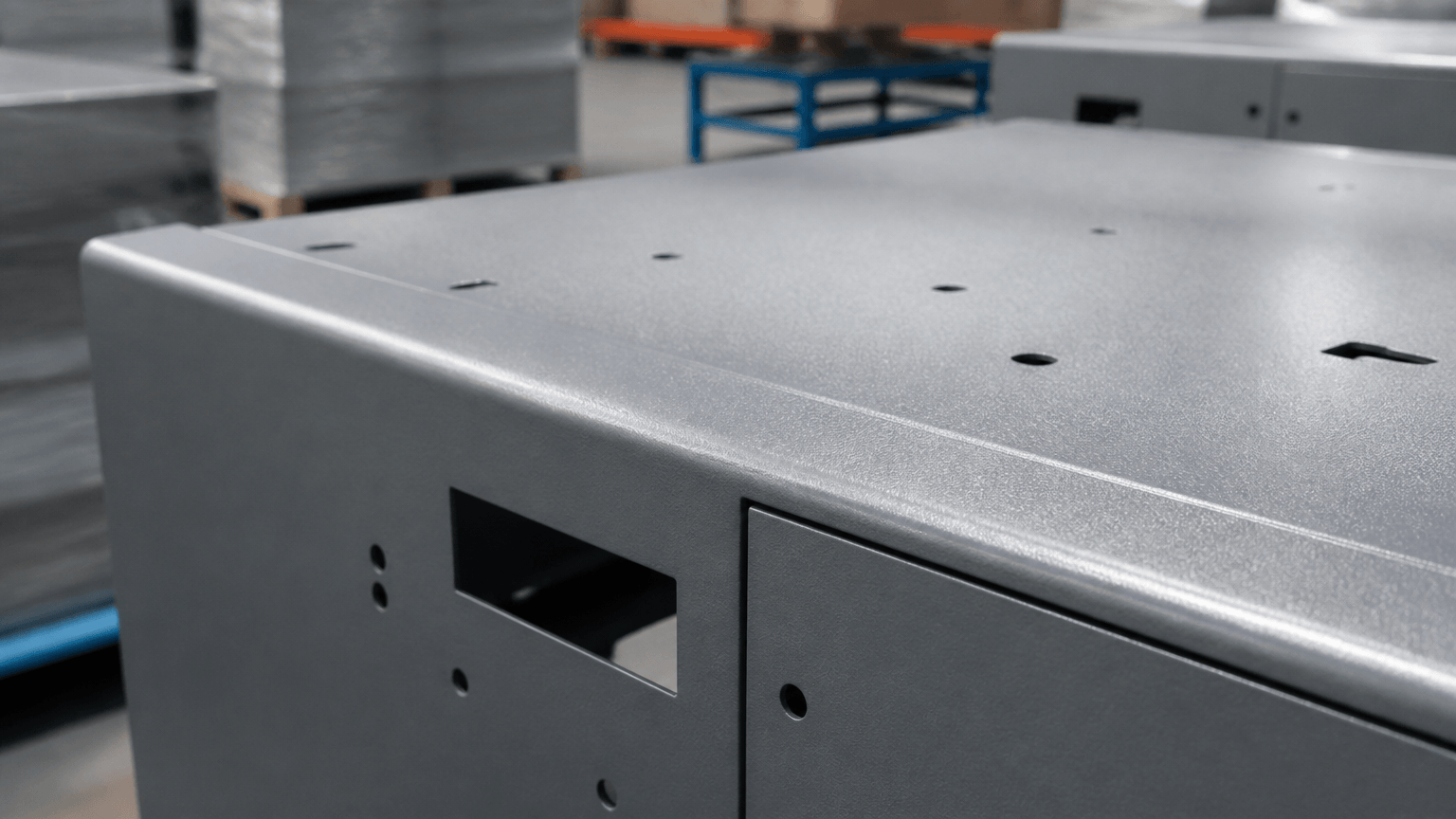
Artistic powder coating is an appearance-led powder-coating requirement for OEM metal parts, enclosures, cabinets, frames, displays, and welded assemblies. It defines a visual target—such as a particular color, gloss, texture, metallic effect, or controlled variation—rather than one universal coating grade.
When an OEM drawing calls for a matte metallic cabinet, a textured equipment frame, or a deliberately varied display panel, the key purchasing task is to convert that visual idea into requirements a supplier can quote, sample, inspect, and reproduce. Otherwise, fabrication details such as welds, edges, holes, and assembly interfaces can change the finished appearance or prevent the parts from fitting.
Direct answer: Artistic powder coating is a way to specify a distinctive powder-coated appearance for an OEM metal product. It becomes production-ready only when the visual concept is supported by a reference sample, substrate and preparation details, masking and assembly requirements, agreed inspection conditions, and an approved first article.
What artistic powder coating means for an OEM product
For a B2B metal product, artistic powder coating means that appearance is a primary design requirement rather than a final detail added after fabrication. This matters when a cabinet door, frame, display face, or equipment panel must present a controlled visual identity while still meeting dimensional and assembly requirements.
A standard solid-color powder specification may identify a color reference, substrate, coating system, and functional requirements. An artistic brief may also control texture, gloss, metallic depth, visual variation, edge appearance, or a deliberately layered or distressed look.
Terms such as premium, industrial, vintage, or high-end do not tell a fabricator how to prepare the surface, apply the powder, mask an interface, inspect the part, or judge batch variation. The same description can therefore produce different interpretations during quoting and sampling.
The manufacturing route should remain clear. Sheet-metal fabrication cuts, punches, bends, and forms the part; welding joins components into a welded assembly; powder coating is a downstream surface-finishing operation; and assembly brings coated or uncoated components together. If a CNC-machined insert, mounting block, or other machined component is used within the product, its geometry, contact surfaces, and fit should be specified as a separate interface rather than treated as sheet-metal fabrication.
Powder coating is not interchangeable with decorative liquid paint, anodizing, plating, polishing, patina, or hand-finishing. Each route has different substrate limitations, visual behavior, process controls, and assembly implications. Some artistic effects may suit powder coating, while others may require another finish or a combined process, so feasibility should be validated on the actual product rather than assumed from a photograph.
Turn the visual concept into a measurable finish brief
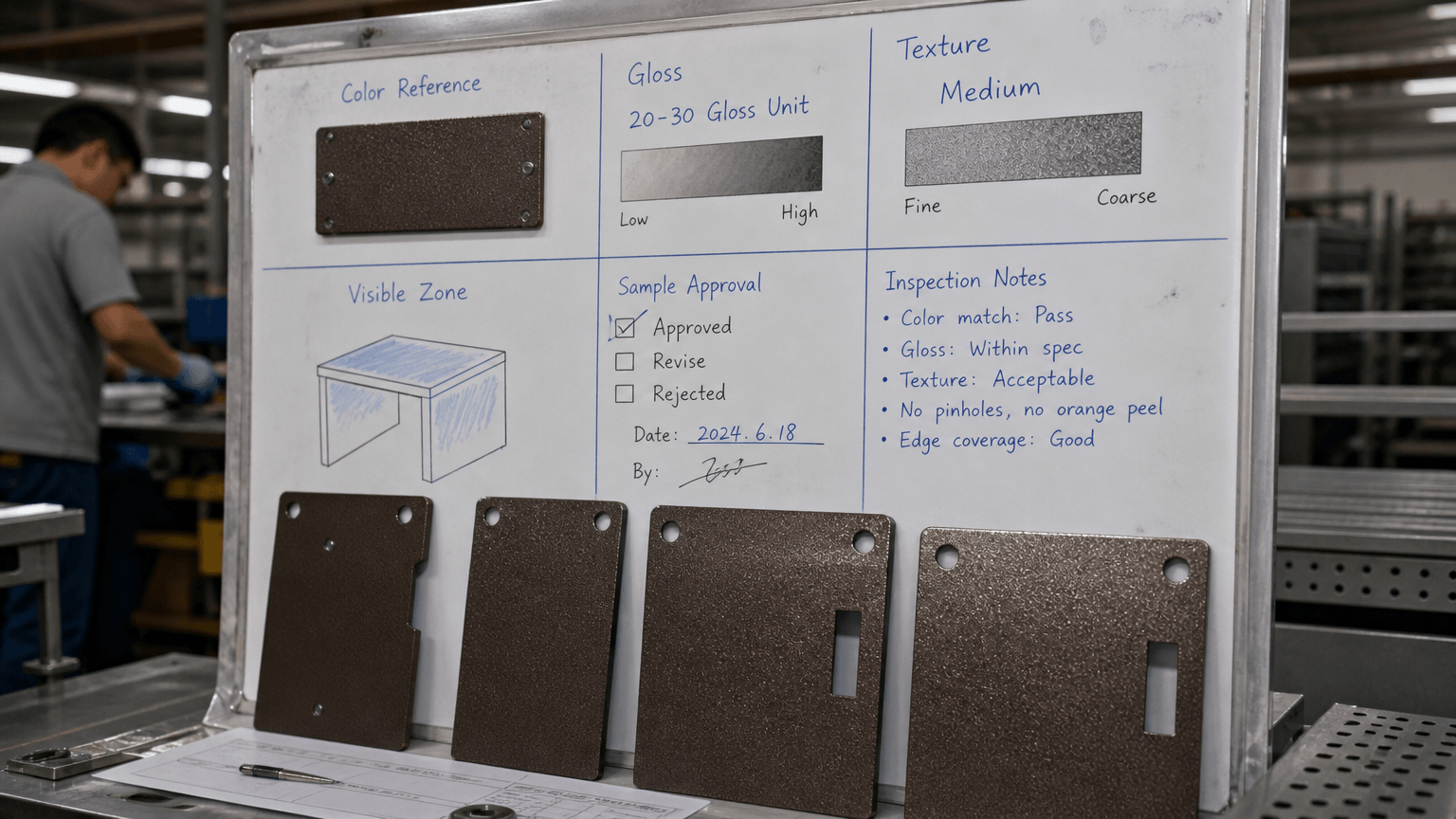
Begin by separating the appearance into individual attributes. A physical swatch or approved master sample is generally more useful than a photograph alone, while a recognized color reference can provide an additional comparison point where one applies.
| Attribute | Buyer definition | Production significance |
|---|---|---|
| Color | Reference, sample, visible color zones, and whether adjacent parts must match | Substrate, powder system, lighting, and batch conditions can influence visual comparison |
| Gloss | Gloss description or agreed measurement method, plus viewing conditions | Gloss changes how color, texture, scratches, and surface waviness are perceived |
| Texture | Smooth, fine texture, coarse texture, or another specified surface feel | Texture affects coverage, cleaning, masking visibility, and the appearance of bends and welds |
| Metallic or special effect | Metallic, mica-like, layered, visually deep, or other effect description | Effect feasibility and repeatability depend on the selected powder system and supplier validation |
| Coverage | Coated visible faces, internal faces, recessed areas, and hidden zones | Part geometry and application access can create differences between open and concealed surfaces |
| Edge behavior | Edge, corner, hem, seam, and hanging-mark expectations | Sharp or exposed features may show different visual coverage or handling marks |
| Variation | Uniform, intentionally varied, masked, or distressed appearance and acceptable range | Variation must be judged against an approved reference and agreed inspection conditions |
Also state the normal viewing distance, lighting expectations, part orientation, and critical appearance zones. A display face, cabinet door, or equipment panel may require a stricter visual review than an internal bracket, so identify where uniformity is essential and where variation is acceptable.
If visual depth, tonal movement, or intentional variation is important, describe where it is allowed and where it is not. A request based only on words such as artistic or premium is not yet a complete production requirement.
Coating build should be treated as both a finish characteristic and an interface consideration. The applicable guidance should come from the selected powder system and the supplier’s validated process, especially where holes, threads, sliding covers, hinges, or close-fitting parts are involved.
Validate the substrate and fabricated surface
A textured finish that looks acceptable on a flat steel panel may reveal weld transitions, grinding marks, or edge differences on the production part. Before sampling, confirm the substrate identity, thickness, surface condition, oxide state, contamination, and fabrication history.
The same artistic powder coating can look different on mild steel, aluminum, stainless steel, galvanized steel, or another compatible metal. Mixed materials or mixed surface conditions may require separate validation even when the intended color is the same.
Cleaning and pretreatment are intended to remove oil, handling contamination, oxides, and other surface conditions that can interfere with adhesion or appearance. The route may include an appropriate chemical preparation, mechanical preparation, or blasting where applicable; the selected substrate, powder system, operating environment, and supplier process data should determine the preparation route.
Application and curing conditions should be established from the powder manufacturer’s technical data and the supplier’s validated process. These sources should also guide film-build requirements and resistance testing or documentation where the operating environment calls for them. Do not approve an artistic finish only on a flat test panel if the production part will include laser-cut edges, punched features, bends, welds, grinding, or recessed sections.
| Fabrication condition | Possible appearance or fit concern | Useful control |
|---|---|---|
| Laser-cut or punched edges | Burrs, edge condition, or different coverage can remain visible | Define edge preparation and inspect representative cut features |
| Bends, hems, seams, and recesses | Sharp edges, narrow gaps, internal corners, or limited access may affect coverage and visual uniformity | Include formed features in the sample and coating-access review |
| Welds and weld cleanup | Discoloration, spatter, porosity, grinding marks, or uneven transitions may show through | Specify weld cleanup and include weld areas in the sample review |
| Oil, dust, or handling marks | Contamination can contribute to visible defects or inconsistent adhesion | Control handling and confirm cleaning before coating |
| Different substrates | Color, texture, and surface response may not match automatically | Validate each significant substrate and fabrication condition |
For a broader view of the route, see Yishang’s Surface Finishing service information.
Review sheet-metal DFM before coating
A part can meet its nominal dimensions before finishing and still fail at assembly after coating. Review the sheet-metal design with the coating route in mind: cutting, punching, bending, and welding establish the geometry; preparation and powder coating change the surface; and assembly determines whether the finished interfaces remain usable.
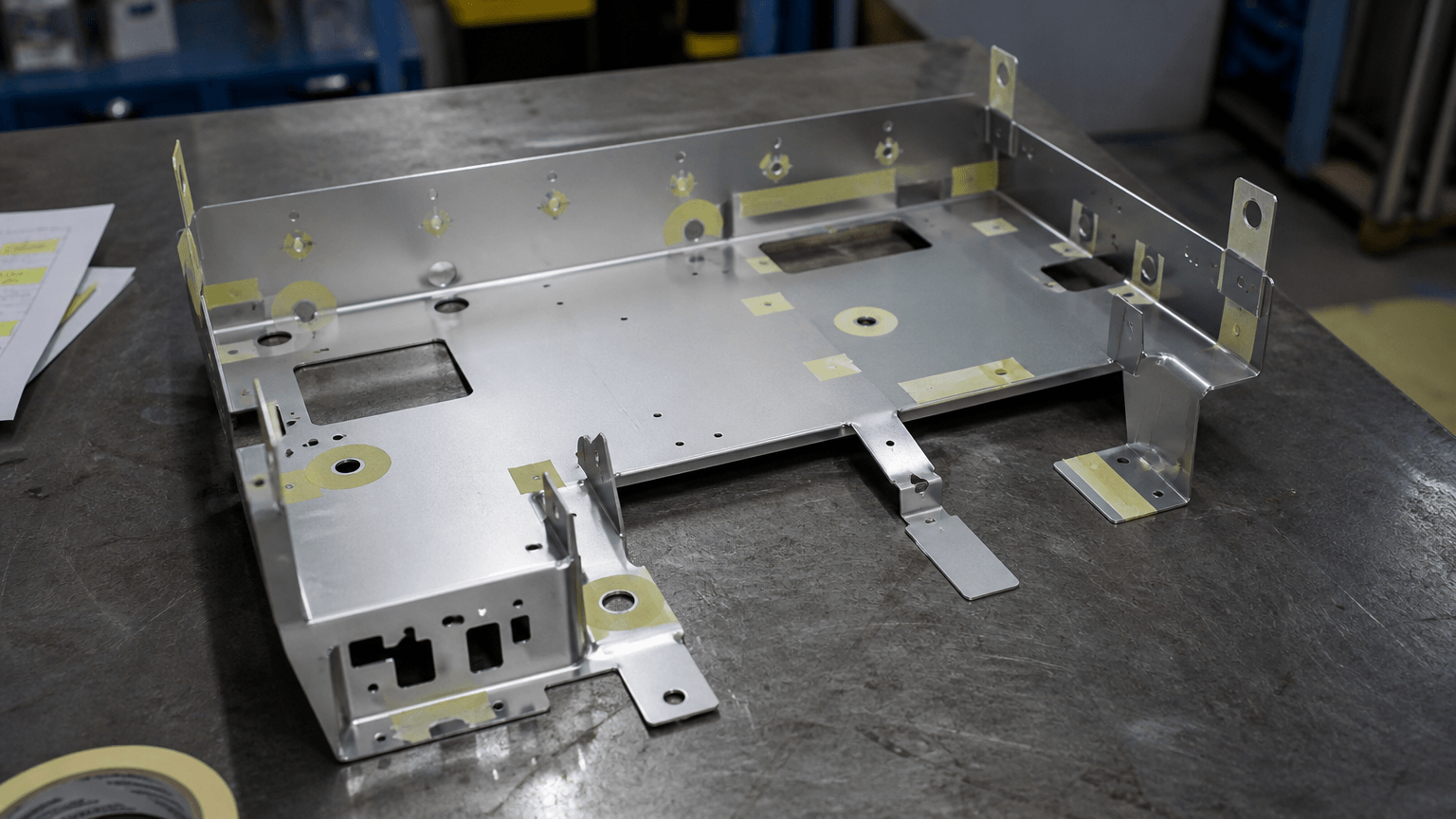
Before drawing release, mark every area that must remain free of coating or must receive controlled coverage:
- Threads and precision holes: identify whether they need masking, post-coating cleanup, or a different assembly method. Do not assume that a hole remains usable after coating.
- Grounding and electrical contacts: define grounding points, conductive surfaces, connector interfaces, and test contacts as coating keep-out zones where required.
- Mating and sliding areas: review covers, hinges, fasteners, rails, inserts, and close-fitting parts for coating build and assembly clearance. Use the supplier’s actual validated specification rather than a universal allowance.
- Bends, hems, seams, and recesses: check sharp edges, internal corners, narrow gaps, and deep pockets for access, edge coverage, and visible variation.
- Welded assemblies: define weld interfaces, cleanup expectations, and whether transition marks are located in a visible zone.
- Hanging and contact points: select practical contact points and state whether marks, hooks, or rack impressions may appear on visible surfaces.
- Machined components: if a CNC-machined insert, mounting block, or mating part is used with the sheet-metal structure, identify which component receives coating and which datums or contact surfaces must remain controlled. CNC machining defines that component’s geometry; it does not replace sheet-metal forming or coating controls.
- Assembly order and protection: decide which parts are coated separately and which are assembled afterward. Protect finished faces from scratches during handling and final assembly.
These decisions are easier and less expensive before fabrication begins. A DFM review connects fabrication, masking, coating, and assembly without treating them as one process.
Yishang’s custom sheet-metal structures and assemblies information provides relevant context for the upstream design route.
Approve the finish from sample to batch
When appearance is part of the product identity, late disagreement over a sample can delay both approval and production. A controlled sequence makes the visual target, functional checks, and batch comparison visible to both the buyer and the supplier.
- Issue the visual brief: provide drawings or models, substrate and fabrication details, the color reference or physical sample, effect description, visible zones, and functional requirements.
- Complete a feasibility review: confirm whether the proposed powder route, geometry, masking plan, and assembly interfaces can be sampled on representative material and fabrication conditions.
- Approve a sample: use a sample panel for an isolated appearance decision or a representative prototype when bends, welds, holes, edges, and fit are visually important.
- Confirm the first article: inspect the first production article for appearance, coverage, masking, contact areas, dimensional fit, and assembly function before releasing the batch.
- Compare production batches: retain the approved reference where practical and agree how later batches will be compared, including lighting, viewing distance, orientation, and visible zones.
Appearance and function should be recorded separately. Appearance review can cover color, gloss, texture, special effect, uniformity, edge behavior, contamination, pinholes, exposed substrate, scratches, overspray, uneven texture, and visible hanging marks. Functional review can cover required coverage, adhesion or other specified tests, protection of grounding points, hole and thread condition, and assembly fit.
Acceptance limits should be agreed for the project rather than invented as universal values. Retained references, inspection records, and batch comparison controls should be used where the buyer and supplier agree that those controls are available.
Yishang’s prototyping support can be relevant when the finish must be assessed on a real fabricated part. Inspection planning can also be coordinated with the company’s Quality Control resources.
Artistic powder coating brief: a production worksheet
Use these fields in a drawing note, finish schedule, or RFQ attachment. They give the supplier a common reference for sampling, inspection, and batch planning.
- Product and substrate: part number, metal grade, thickness, fabrication state, weld condition, and surface-preparation expectations.
- Appearance: color reference, physical swatch or master sample, gloss, texture, metallic or special effect, and uniformity requirement.
- Visible zones: customer-facing faces, internal visible faces, hidden zones, viewing distance, lighting, and orientation.
- Interfaces and tolerances: threads, holes, grounding points, electrical contacts, labels, weld interfaces, mating faces, critical dimensions, and required keep-out zones.
- Approval: sample type, first-article requirement, inspection conditions, defect categories, and acceptable variation.
- Commercial plan: prototype quantity, production quantity, batch grouping, packaging, assembly stage, and target delivery stage.
Flag a request for additional review when it relies only on photographs, combines multiple colors or effects, requires intentional visual variation, places the finish on tight fits, or expects the same appearance across different substrates without separate validation.
Plan cost and lead time around the complete part route
Artistic powder coating is priced as part of the complete metal-product route. The finish itself is only one variable; preparation, masking, sample iterations, handling, inspection, packaging, and assembly can also affect cost and schedule.
| Project input | Potential cost or schedule effect | RFQ decision |
|---|---|---|
| Material, size, and surface area | Changes preparation, handling, coating access, and material consumption | State grade, thickness, dimensions, and which faces are visible |
| Geometry and welded complexity | May increase masking, inspection, touch-up risk, and handling effort | Share 2D drawings, 3D models, weld details, and critical surfaces |
| Cleaning and masking | Preparation requirements and coating keep-outs can add operations or rework risk | Identify contamination concerns, interfaces, and masking quantity |
| Color changes and special effects | Can add setup, cleaning, sample work, and changeover planning | Identify finish count, effect requirements, and whether parts can be grouped |
| Samples and first articles | Iterations or late approval can extend the project schedule | Define sample type, approval owner, and release point |
| Quantity and batch grouping | Influences setup efficiency, scheduling, and batch comparison | State prototype and production quantities without assuming an MOQ or fixed lead time |
| Packaging and post-coating assembly | Can affect scratch risk, inspection, labor, and delivery sequence | Describe protection, assembly timing, and inspection documentation |
A complete project package should state the finish reference, substrate, fabrication condition, visible and critical zones, masking plan, assembly clearances, inspection basis, packaging needs, quantity, and required delivery stage. This allows the supplier to separate normal production work from sample iterations, finish changes, and potential rework.
Planning an artistic powder-coated prototype or production batch? Send Yishang your 2D drawings and available 3D models, metal grade and thickness, critical tolerances, welded-assembly details, color reference or sample, gloss and texture requirements, visible zones, masking and grounding needs, assembly clearances, quantities, packaging expectations, inspection basis, and target schedule. Yishang supports B2B OEM and ODM custom manufacturing, prototype review, powder coating, and batch production, with more than 26 years of custom metal-product experience and exports to more than 50 countries. The team can review the finish brief and help define a manufacturable sheet-metal route and sample plan.
Frequently Asked Questions
For an OEM preparing a prototype or RFQ, these questions help clarify whether the requested appearance is defined well enough for sampling and production review.
Is artistic powder coating a separate coating process or a way of specifying a decorative powder-coated appearance?
It is generally a descriptive or commercial term for an appearance-led powder-coating requirement, not one formally standardized coating category. The actual process depends on the substrate, surface preparation, selected powder system, geometry, application controls, and approved visual reference.
Can a photograph or phrase such as matte metallic, premium texture, or vintage finish define the production requirement by itself?
No. A photograph or descriptive phrase can begin the discussion, but it does not fully define color, gloss, texture, coverage, variation, lighting, or acceptable defects. Add a physical sample or suitable reference, identify critical zones, and approve a representative sample before batch production.
Can artistic powder coating be applied consistently to welded and bent sheet-metal parts with holes, threads, and assembly interfaces?
It can be evaluated for those products, but consistency depends on preparation, weld cleanup, part access, masking, hanging points, coating build, and assembly clearance. Threads, grounding points, precision holes, and contact surfaces may require masking or subsequent cleanup, so they should be marked during DFM review.
What should an OEM request to verify color, gloss, texture, durability requirements, and batch-to-batch consistency?
Request a documented finish brief, representative sample or first article, agreed inspection lighting and viewing conditions, appearance and functional criteria, and a method for comparing later batches with the approved reference. Durability requirements should identify the operating environment and any agreed tests or documentation without assuming that one powder system suits every application.