
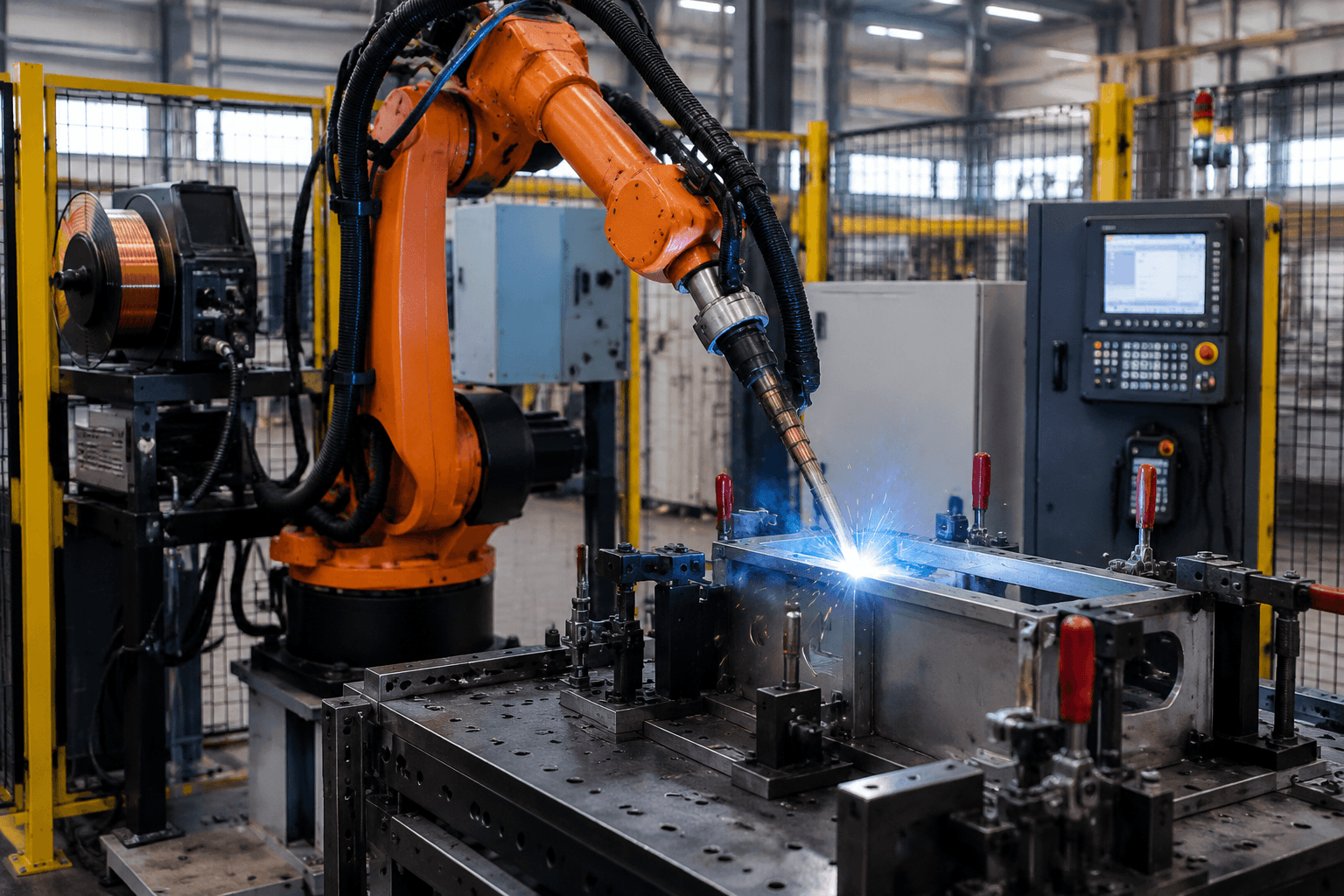
The benefits of robotic welding include repeatable weld placement, steadier cycle performance, potentially less rework and consumable variation, more predictable production planning, and lower exposure to arc, fumes, heat, or awkward positions when safeguards are properly designed. These benefits are strongest when the workload is repetitive, accessible, consistently presented, and large enough to justify programming, fixtures, and cell costs; robotic welding is not automatically best for every custom job.
In a typical arc-welding cell, an articulated robot moves the torch through programmed three-dimensional positions, a wire feeder supplies filler wire where required, and a control box stores paths and parameters. Operators start and monitor the cycle; fixtures locate the assembly, while optional vision or position sensing can help manage known presentation variation. The robot repeats programmed movements, but people still prepare parts, load the cell, develop or revise programs, supervise operation, maintain equipment, respond to faults, and perform separate inspection.
Turn Robotic Welding Benefits into Measurable Production Outcomes
Treat each claimed benefit as a testable operating outcome, not a guaranteed feature. Compare the same part family and production conditions with a baseline that includes loading, waiting, inspection, rework, and downtime—not just arc-on time.
| Potential benefit | Operating mechanism | Measure against baseline |
|---|---|---|
| Repeatability | Programmed path, torch angle, and parameters reduce manual motion variation. | First-pass acceptance, weld-location variation, and rework hours. |
| Stable cycle performance | The sequence is repeatable once loading and part presentation are controlled. | Cycle-time distribution, accepted assemblies per shift, and unplanned downtime. |
| Controlled consumable use | Controlled travel and settings can reduce avoidable variation in wire, electrode use, and weld-related scrap. | Material or wire use per accepted assembly, scrap, and cleanup. |
| Lead-time predictability | Planned cycles and fewer rework loops can make scheduling more reliable. | Schedule adherence, queue time, and recovery time. |
| Lower operator exposure | The robot can perform the weld inside a properly safeguarded cell rather than placing a person at every arc position. | Operator exposure time, task-risk observations, and incident or near-miss records. |
| Flexibility within a part family | Programs can be revised for related parts, although engineering and changeover effort remains. | Programming hours, changeover time, and verified family variants. |
Repeatability does not equal defect-free welding. Fit-up, contamination, distortion, consumables, parameter selection, and fixture condition still affect results, so first-pass acceptance and specified inspection remain necessary. Safety value is similarly conditional: enclosure, fume extraction, interlocks, procedures, personal protective equipment, and trained supervision remain part of the control strategy. The practical question is whether the robot reduces variation or exposure in the particular task.
Arc or Resistance Welding: Which Workload Fits?
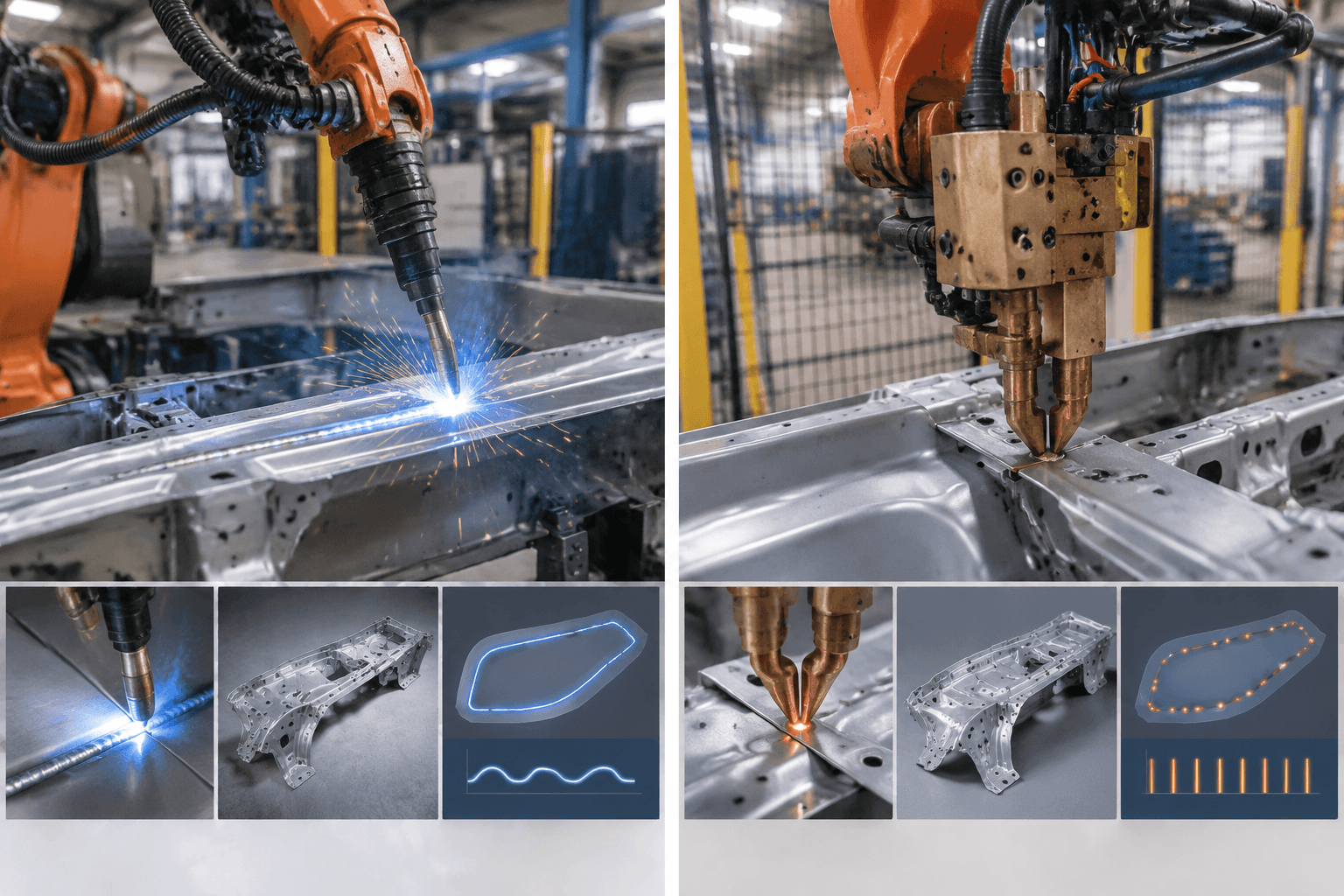
Process choice comes before robot selection. Arc and resistance welding solve different joint problems and require different tooling, access, and part presentation.
| Process | Movement and heat source | Typical fit pattern | Important design checks |
|---|---|---|---|
| Arc welding | A torch creates an arc and may feed filler wire. | Continuous or sequenced seams on frames, transportation structures, and equipment assemblies. | Torch angle, robot reach, joint gap, shielding, weld order, and fixture rigidity. |
| Resistance welding | Electrodes apply force and current to create point or spot joints. | Repeatable overlapping sheet joints where the stack-up and equipment are compatible. | Electrode access, material and thickness stack, surface condition, current path, and part presentation. |
An equipment frame with repeated seams may be a candidate for robotic arc welding if all welds are reachable without excessive repositioning. Transportation structures and material-handling assemblies may also fit when joint design and presentation are consistent; see welded metal frames for equipment, automotive and transportation metal fabrication, and material handling and logistics equipment fabrication for broader application context. These application categories do not prove that every part is robot-ready. Frequent design changes, variable gaps, hidden joints, low volume, or manual repositioning can shift the balance toward manual welding or a hybrid cell.
The Robot Cell Still Needs Programming, Fixtures, and People
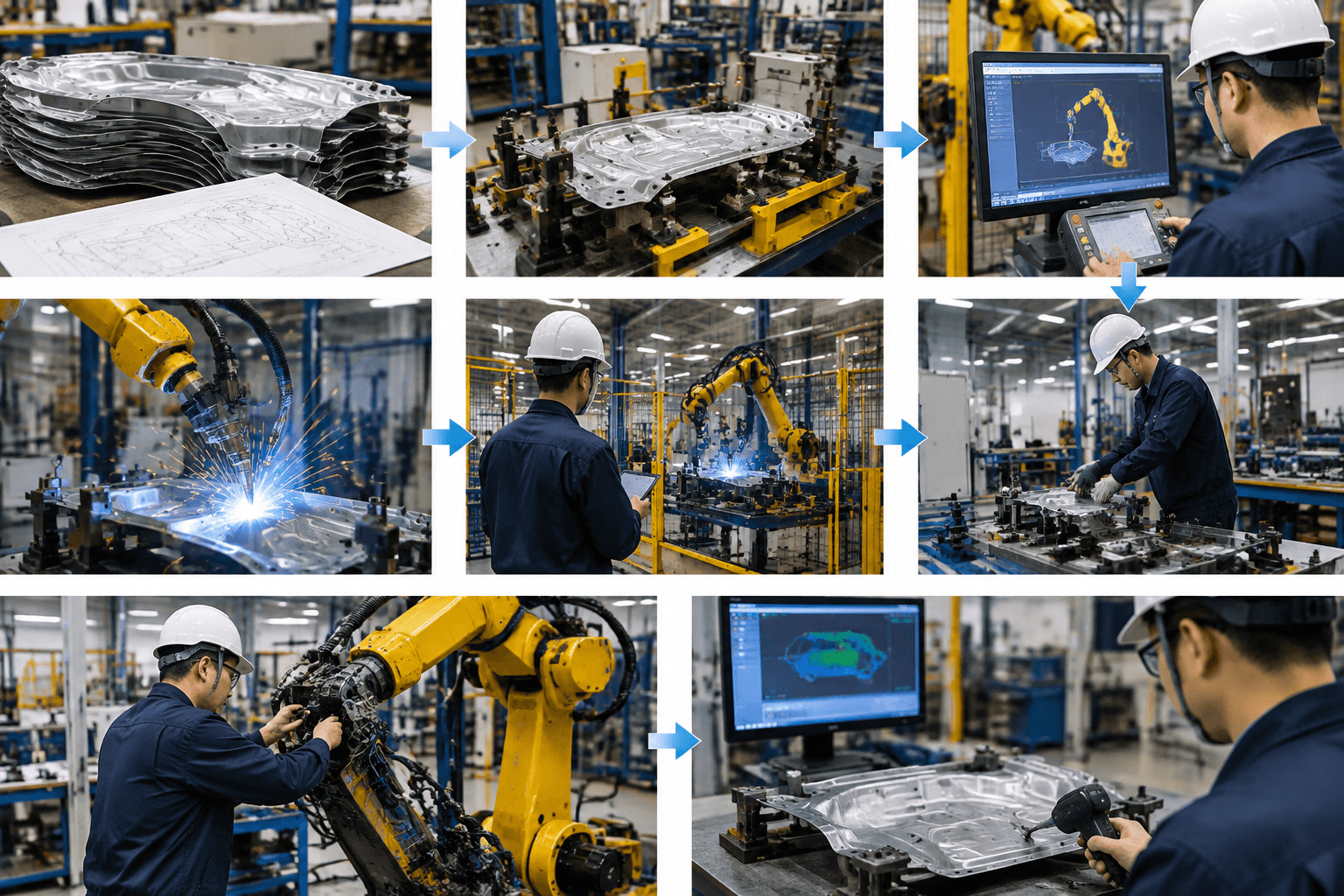
A robot cell is a system, not an isolated arm. The supporting sequence typically looks like this:
- Drawing and part preparation: Cutting, forming, machining interfaces, and cleaning create components in the required design condition; these remain separate upstream processes.
- Fixture and loading: A fixture establishes datums, clamp points, orientation, and repeatable loading.
- Programming: The engineer defines weld order, travel path, parameters, torch access, and collision limits. New parts require programming and verification.
- Weld cycle: The robot, torch or electrodes, feeder where applicable, controls, and safeguards execute the approved sequence.
- Supervision: An operator monitors loading, wire or electrode condition, alarms, spatter, and part presentation.
- Changeover and maintenance: Teams change fixtures or programs, manage utilities and consumables, clean tooling, and plan maintenance.
- Inspection and integration: Separate dimensional and weld-quality checks release the assembly to downstream assembly or finishing as specified.
Part consistency is critical. A robot can repeat a programmed path while repeating the wrong path for a shifted or distorted part. Vision or joint tracking may help with defined variation, but it does not replace sound fixturing, datum control, setup discipline, maintenance, or human response to abnormal conditions. Integration also matters: loading time, fixture exchange, material flow, and inspection capacity can become the constraint.
Robotic-Welding Fit Matrix and Total-Cost Decision
Whether robotic welding is worth it depends on utilization and total cost, not the robot alone. A high-repeat family can spread fixed engineering and cell effort across many accepted assemblies; a low-volume, high-mix workload may spend too much time on setup, reprogramming, and changeover.
Robotic-welding fit matrix: repetition, access, part presentation, and changeover
| Screening factor | Stronger fit | Requires review | Potentially weak fit |
|---|---|---|---|
| Volume and repetition | Repeated parts or families with planned demand. | Mixed demand with uncertain utilization and programming load. | One-off prototypes or repair work where manual welding may be more practical. |
| Part presentation | Stable dimensions and joint fit-up. | Manageable variation supported by sensing or adjustable workholding. | Inconsistent gaps, distortion, or frequent manual correction. |
| Weld access | Torch or electrode reaches joints with few reorientations. | Extra positioners or loading steps may be needed. | Blocked, hidden, or awkward joints that the cell cannot approach consistently. |
| Workholding | Dedicated, repeatable fixture with controlled datums. | Modular fixture requiring validation across variants. | Unstable manual positioning or unreliable clamping. |
| Changeover | Planned family changeovers using verified programs. | Frequent changes with reusable tooling and controlled setup. | Constant redesign, repositioning, or reprogramming. |
Build a business case with annual volume, manual labor content, expected utilization, cycle time, first-pass acceptance, rework, consumables, changeover time, maintenance, downtime, training, and inspection requirements. Include cell preparation, fixtures, programming, safeguarding, integration, and utilities. Do not assume savings from nominal welding time if loading or inspection governs output. Model stable demand, demand loss, product changes, and downtime rather than using a universal payback claim.
Cost and operating trade-offs to model
| Investment or condition | What it means for the decision |
|---|---|
| Fixed preparation | Cell, fixtures, safeguarding, programming, integration, and utilities require enough workload to justify them. |
| Ongoing operation | Maintenance, consumables, cleaning, downtime recovery, and inspection remain part of the operating burden. |
| Quality and flexibility | Repeatability helps stable families but does not correct poor fit-up or remove separate inspection. High mix adds engineering effort. |
| Workforce | Operators, programmers, maintenance staff, supervisors, and weld specialists remain necessary; roles may change rather than disappear. |
To request a technical robotic-welding suitability review, share part drawings or 3D files; material, thickness, joint type, and weld locations; expected production volume and part-family variation; fixture and loading concepts; access and changeover requirements; and inspection expectations. These inputs allow a comparison among robotic arc welding, resistance welding, manual welding, or another route before an automation commitment. Yishang supports OEM and ODM custom manufacturing projects, with more than 26 years of experience in custom sheet metal parts and metal products, so the discussion can focus on the part and its upstream and downstream interfaces rather than assuming that a robot is the answer.
Frequently Asked Questions
What are the five main benefits of robotic welding?
Five commonly evaluated benefits are repeatable weld placement, stable cycle performance, lower rework risk, controlled consumable use, and reduced exposure to arc and awkward positions in a properly safeguarded cell. Verify each benefit against baseline data; none is universal.
Is robotic welding worth it for low-volume or high-mix custom work?
It can be, but setup, fixture, programming, and reprogramming effort must be included. For one-off parts, prototypes, repairs, or constantly changing designs, skilled manual welding may be more practical. A repeatable low-volume family with accessible joints can still justify automation when changeovers are controlled.
What are the main disadvantages or limitations of welding robots?
Key limitations include fixed cell and fixture costs, engineering time, programming, maintenance, integration, downtime, and sensitivity to part variation. A robot also needs safe operation, reliable loading, suitable weld access, and separate quality inspection. Poor utilization can erase its potential production benefit.
Will robots replace welders, or will the required roles change?
Robots do not eliminate the need for welding knowledge. Human roles generally remain in part preparation, fixture setup, programming, supervision, troubleshooting, maintenance, and inspection. Weld specialists may spend less time holding the torch and more time controlling the process, verifying quality, and supporting production.