
Black powder coated metal is a metal substrate finished with electrostatically applied black powder that is heated according to the coating system’s curing requirements to form a solid film. The term identifies the general process and color, but it does not define the resin chemistry, gloss, texture, durability, corrosion protection, or suitability for outdoor service.
For OEM parts, the result depends on the complete finishing system: substrate condition, pretreatment, powder formulation, application, curing, part geometry, handling, and inspection requirements. Buyers should therefore specify more than simply “black powder coat.”
How the Black Powder-Coat Process Works
Powder coating is a finishing process, while sheet metal fabrication produces the underlying part. Fabrication steps such as cutting, bending, welding, grinding, and machining can influence the final appearance, but they are not part of the coating process itself.
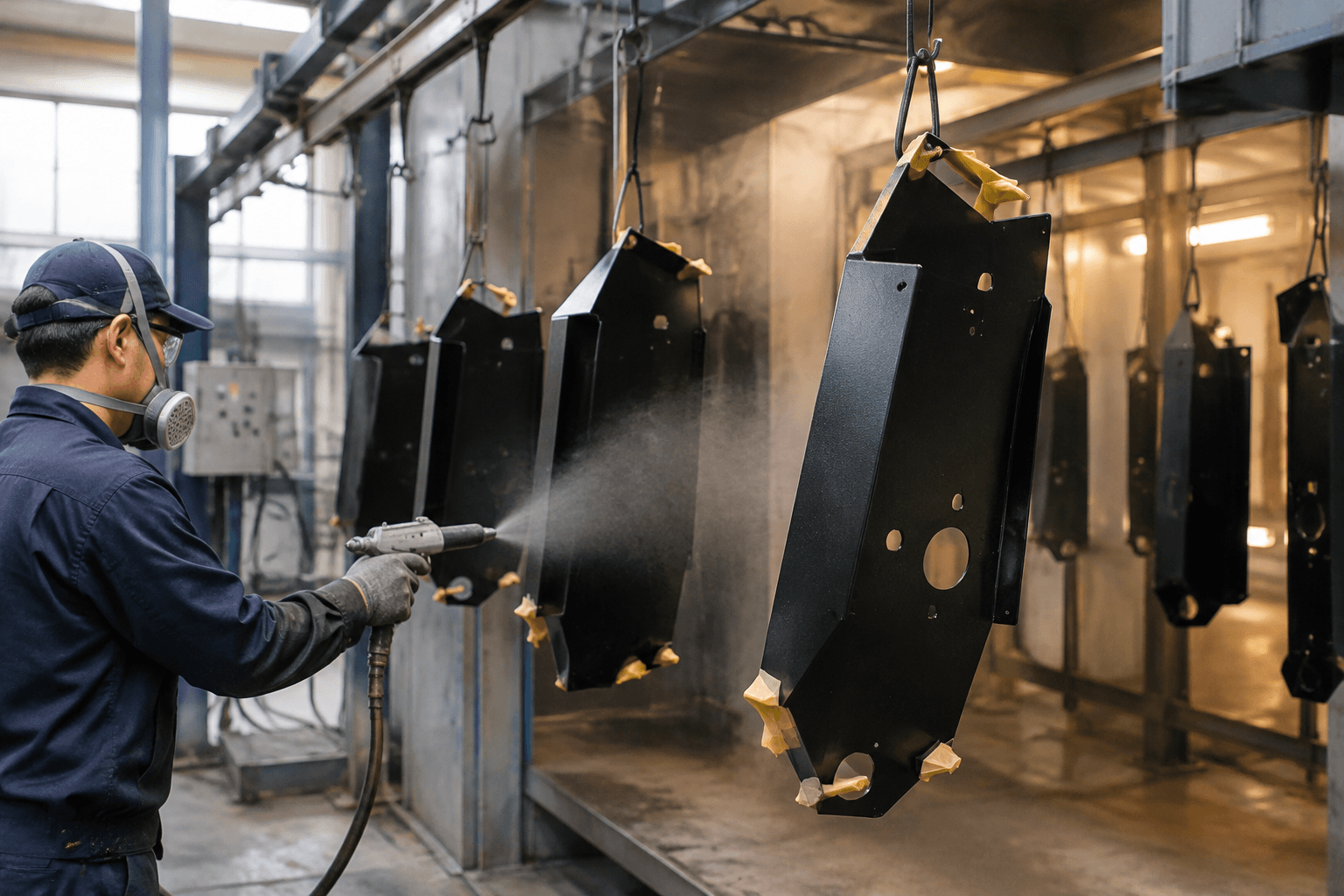
A typical sequence begins with cleaning and pretreating the metal to remove oil, fabrication residue, oxidation, and other contamination. Dry powder is then sprayed toward a grounded part, usually using an electrostatic charge to encourage deposition. The coated part enters an oven, where heat allows the powder to flow and cure as required by the selected product’s technical data.
Masking must be planned before application. Threads, electrical contact points, grounding locations, bearing fits, gasket surfaces, and other functional interfaces may need to remain uncoated. Hanging orientation also matters because hooks require contact points, and deep recesses or enclosed areas can be difficult to coat uniformly.
The required pretreatment and cure conditions are not universal. They must be established from the coating supplier’s documentation and adjusted to the substrate, part mass, geometry, and production process.
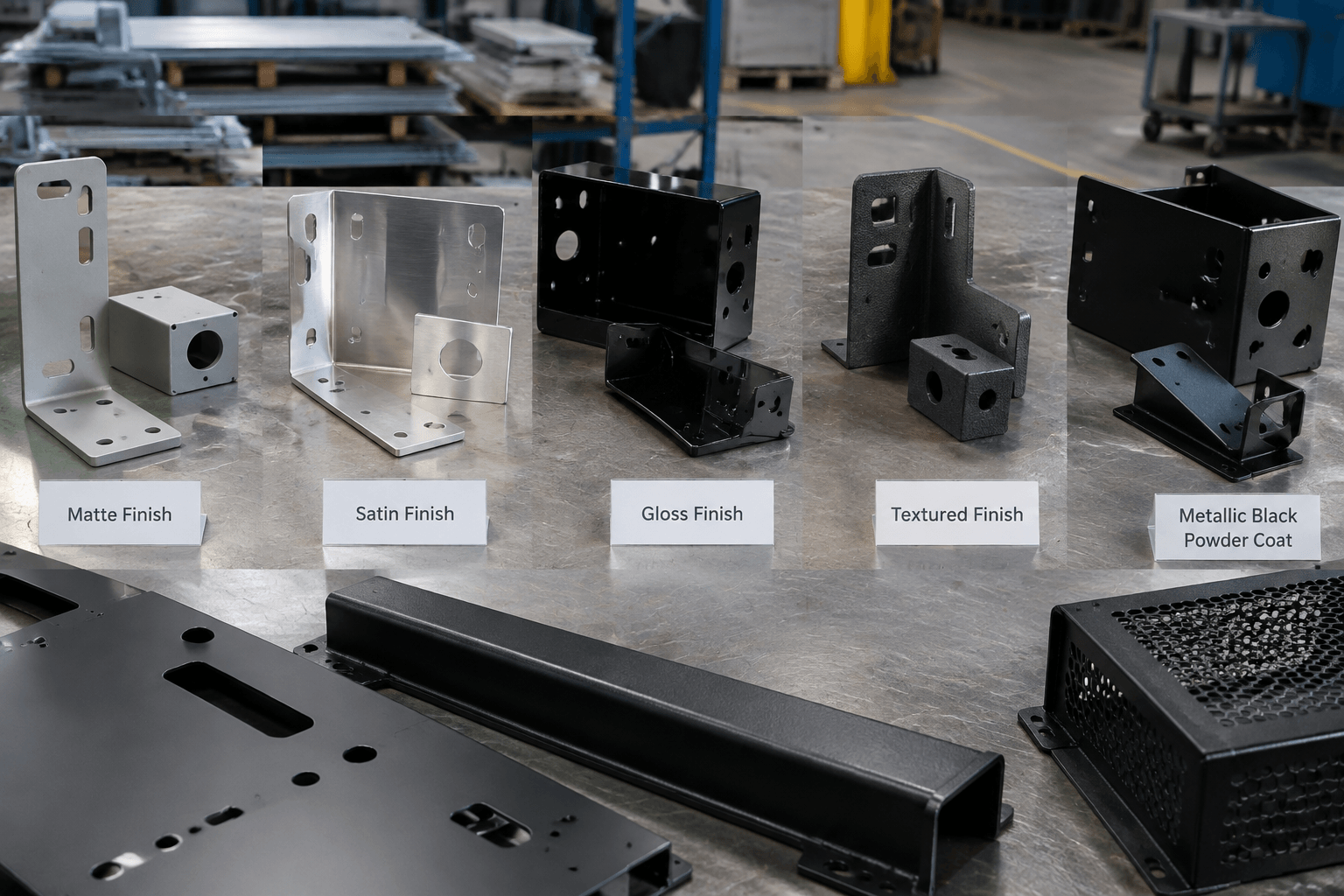
Choosing the Visual Character of Black
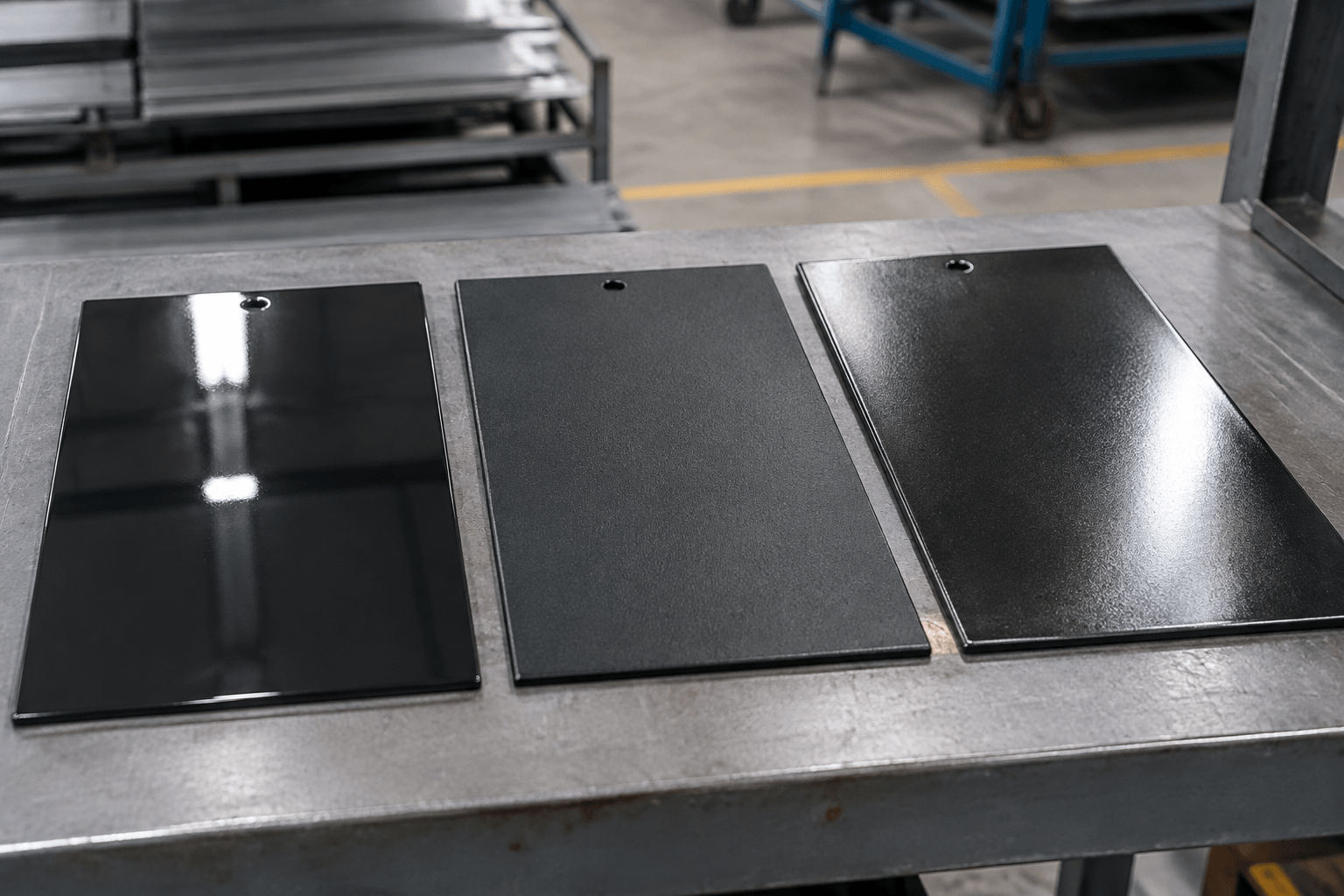
Black finishes can look substantially different under the same lighting. A physical swatch or approved sample is more reliable than a screen image, especially when matching adjacent components or evaluating metallic effects.
| Finish | Visual character | Practical considerations |
|---|---|---|
| Smooth matte | Low-reflection, restrained appearance | Can reduce glare, but oils, polishing from repeated contact, and surface irregularities may still be visible. |
| Smooth satin | Moderate sheen between matte and gloss | Often balances cleanability and subdued reflection. The acceptable sheen still needs an approved reference. |
| Smooth gloss | Strong reflections and deeper-looking black | May make fingerprints, dust, waviness, grinding transitions, and other substrate conditions easier to see. |
| Fine or coarse texture | Deliberately patterned surface | May make minor visual variation less prominent, but it does not repair dents, deep scratches, weld distortion, or poor preparation. |
| Metallic black | Black base with visible metallic particles or sparkle | Appearance can shift with lighting, viewing angle, application technique, part orientation, and batch. Sample approval is important. |
| Special-effect black | Wrinkle, hammer, or other formulated effect | The effect should be identified by a supplier product reference rather than by a broad color description. |
Gloss terminology is not sufficiently precise by itself. One supplier’s “satin” may not visually match another supplier’s satin. Where appearance is critical, define the coating product, approved swatch, acceptable sample, viewing conditions, and whether parts from different production batches will be assembled side by side.
This is particularly relevant for retail and commercial metal equipment, where customers repeatedly see and handle doors, shelves, brackets, and display structures.
Matching the Coating System to the Part and Environment
A black color does not establish performance. Suitability comes from the interaction of several project-specific factors.
- Substrate and surface condition: Steel, aluminum, galvanized material, castings, and previously coated parts can require different preparation. Scale, oxidation, silicone contamination, weld residue, sharp burrs, and trapped oils can undermine appearance or adhesion.
- Pretreatment: Cleaning and chemical preparation must be compatible with the metal and intended exposure. Powder applied over inadequately prepared metal should not be expected to compensate for the missing preparation.
- Powder formulation: Different resin systems are designed for different combinations of weathering, flexibility, chemical exposure, and appearance. Outdoor suitability, UV stability, food-contact status, and chemical resistance must be confirmed for the exact product rather than assumed from its black color.
- Application and geometry: Recesses, narrow channels, welded corners, overlapping seams, and boxed sections can restrict access or create electrostatic shielding effects. Sharp edges may retain less coating than broad flat surfaces. The drawing should identify surfaces that are both difficult to reach and functionally important.
- Curing: Oven settings alone do not prove that the coating has received the required cure. Part-metal temperature and time at the specified condition depend partly on material thickness, total mass, loading, and geometry. The powder supplier’s data governs the selected system.
Indoor decorative components generally face different demands from outdoor housings, garden structures, or frequently handled commercial products. For outdoor fabricated metal products, the review should include sunlight, rain, humidity, standing water, salts, temperature cycling, and opportunities for drainage. Frequently handled parts also need consideration of abrasion, skin oils, cleaners, and contact at edges.
Any required adhesion, appearance, weathering, or corrosion verification should be stated by the buyer or engineering specification. Inspection confirms compliance with those defined requirements; it does not create performance that was absent from the coating system.
Limitations, Cleaning, and Visible Repairs
Powder coating can provide a consistent production finish, but it is not immune to damage or process variation.
- Impact chips and edge damage
- A hard impact can break the coating and expose the substrate. Edge design, handling, packaging, installation, and service conditions all influence this risk. Deburring and suitable edge geometry can support application, but no edge should be assumed damage-proof.
- Coverage in difficult areas
- Deep recesses, inside corners, seams, threads, and overlapping joints may not receive the same deposition as open faces. These locations should be reviewed before fabrication and coating, particularly when coverage is functionally important.
- Variation between parts
- Color, gloss, texture, and metallic-particle orientation can vary with the powder batch, film application, cure, lighting, and viewing angle. Mixing unmatched lots on one visible assembly can make small differences more noticeable.
- Visible touch-up
- Field repair materials may differ from the factory-applied powder in texture, sheen, weathering, and color. Aerosol products described as black powder coat spray paint may actually be liquid repair coatings; their labels and compatibility guidance should be checked. Repairs are often more visible on smooth gloss or metallic surfaces.
For routine care, follow the coating manufacturer’s instructions. A mild cleaner, soft cloth, and clean-water rinse may be appropriate for some systems, but this should not be generalized to every powder. Test any detergent or solvent on an inconspicuous area first, avoid unapproved abrasive tools, and remove deposits before they remain on the surface for extended periods. Damaged areas should be assessed promptly, especially where bare metal is exposed to moisture.
Cost Drivers and a Practical Finish Specification
There is no meaningful universal black powder coated metal price. Cost depends on the part and production requirements, not only on the amount of powder consumed.
| Cost input | Why it matters |
|---|---|
| Part size, mass, and quantity | Affect line loading, oven use, handling, and batch efficiency. |
| Geometry and hanging | Large, awkward, enclosed, or difficult-to-rack parts require more handling and process planning. |
| Substrate and condition | Oil, scale, oxidation, weld residue, or prior coatings can increase preparation work. |
| Finish selection | Stock smooth black may be simpler to source than a custom match, metallic effect, or special texture. |
| Masking | Numerous threads, holes, contacts, and fitted interfaces add material and labor. |
| Appearance criteria | Class-A surfaces, sample approval, batch control, and defined inspection increase process control needs. |
| Packaging | Visible surfaces and projecting edges may need separation or protective packaging to avoid transit damage. |
Define the Black Powder-Coat Finish Before Production
Use the following worksheet for drawings, finish notes, or supplier discussions:
- Base metal, grade if relevant, and material condition
- Part dimensions, quantity, and expected production batches
- Black color reference or selected coating product code
- Smooth, textured, metallic, or other finish family
- Matte, satin, gloss, or approved physical appearance reference
- Indoor or outdoor location and expected sunlight, moisture, chemical, abrasion, and handling exposure
- Surfaces that are appearance-critical or will be assembled next to matching parts
- Threads, fits, contacts, grounding points, sealing faces, and other masking requirements
- Sample or swatch approval method and viewing conditions
- Buyer-defined inspection, testing, packaging, and documentation requirements
On custom sheet metal enclosures, this information helps separate cosmetic exterior requirements from masked threads, grounding points, gasket interfaces, hinges, and assembly surfaces.
Frequently Asked Questions
How long does black powder coating last?
There is no universal lifespan. Service life varies with substrate preparation, pretreatment, powder chemistry, film application, cure, sunlight, moisture, chemicals, abrasion, impacts, design details, and maintenance. Ask the coating supplier for information relevant to the exact product and exposure, then define any required project verification separately.
What is the difference between matte, satin, gloss, textured, and metallic black powder coat?
Matte, satin, and gloss describe general levels of reflection; textured finishes create deliberate surface patterns; metallic powders include particles that change the visual effect with lighting and viewing angle. These names do not establish identical appearance across suppliers, so use a physical swatch, approved sample, or product reference when consistency matters.
What are the main disadvantages of black powder coated metal?
Impacts can chip the finish, sharp edges and deep recesses can be difficult to cover, and smooth black surfaces may reveal fingerprints or substrate defects. Metallic appearance can vary with application and orientation, while liquid touch-ups may remain visible because they do not reproduce the original factory finish exactly.
What determines the cost of a black powder coated custom part?
Key factors include quantity, dimensions, mass, geometry, substrate condition, pretreatment, finish availability, color matching, masking, hanging, appearance criteria, inspection, and protective packaging. A supplier needs the drawing and finish requirements before assessing cost meaningfully; retail powder prices alone do not represent the cost of a finished custom component.