
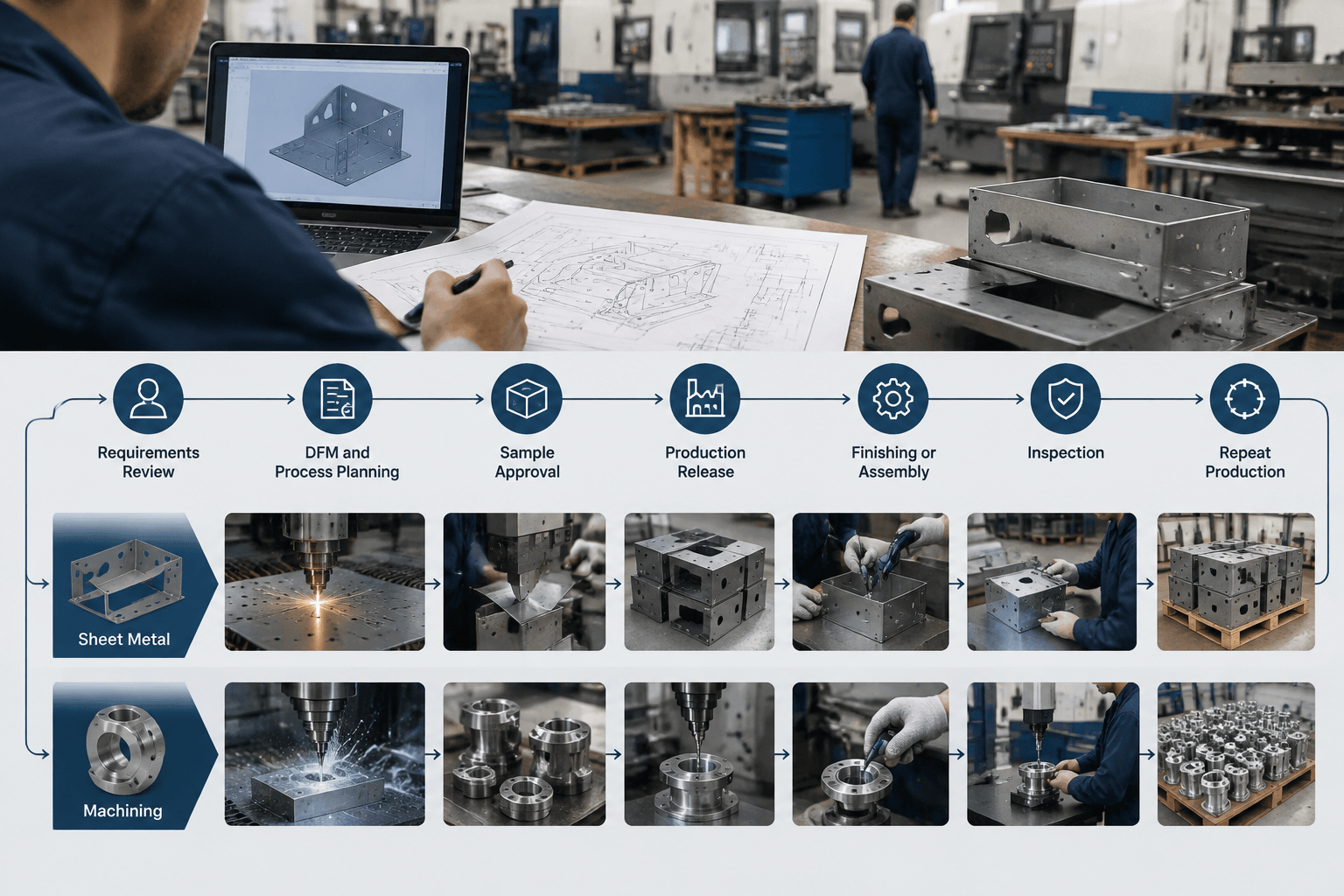
Contract metal manufacturing is the outsourced production of custom metal parts or products to a buyer’s drawings, specifications, and agreed acceptance requirements. Unlike a standard product purchase or isolated fabrication job, an ongoing contract relationship normally adds process coordination, approvals, controlled revisions, and repeat orders.
For an OEM, ODM, or purchasing team, the important question is not simply whether a supplier can make metal parts. It is whether the supplier can manage the required process mix, production stage, documentation, and repeat-order controls without losing the approved design intent.
What contract metal manufacturing includes—and what it does not
Contract metal manufacturing is a sourcing model rather than one particular production method. A manufacturer produces custom parts, assemblies, or finished metal products against agreed drawings, material requirements, tolerances, surface specifications, quantities, and acceptance criteria. The work may involve sheet metal fabrication, machining, welding, finishing, assembly, inspection, or only a selected combination of these activities.
A single job shop order can also produce a custom part, but it may end after one delivery. A contract manufacturing program usually establishes a continuing production relationship, with an approved revision, defined handoffs, repeat-order expectations, and a method for controlling changes. A standard product purchase is different again: the supplier generally owns the product design, while the buyer selects an existing item and quantity.
Contract manufacturing versus one-off fabrication: what changes for the buyer
| Buyer concern | Contract manufacturing relationship | One-off or standard purchase |
|---|---|---|
| Continuity | Planned repeat or phased production is expected. | Usually one delivery, or a catalog item is reordered without a custom production program. |
| Design responsibility | OEM requirements guide production; an ODM supplier may also contribute to product design. | The buyer typically supplies job instructions or selects a supplier-owned design. |
| Process coordination | Multiple steps and handoffs can be managed under one production plan. | The buyer may coordinate separate fabricators, finishers, and assemblers. |
| Approval controls | Sample approval, production release, and revision control may be required. | Acceptance may focus on the immediate order. |
| Documentation | Inspection records, traceability, and other documents can be defined for the program. | Documentation is often limited to the order requirement. |
| Change control | Drawing and process changes are reviewed before repeat production. | Changes may be handled separately for each new job. |
In an OEM arrangement, the buyer commonly controls the product requirements and approved design. In an ODM arrangement, the manufacturer may provide more product-development or design input, but design ownership, approvals, and permitted changes still need to be agreed. A supplier described as a job shop or fabricator may support either model; the label alone does not confirm the depth of its program-management capability.
How a custom metal project moves from design release to repeat orders
The exact gates vary with product complexity, volume, customer procedures, and regulatory context. A practical lifecycle often follows this sequence:
- Requirements and DFM review. The supplier reviews drawings or CAD files together with material or gauge, function, geometry, critical dimensions, tolerances, surface finish, quantity, and inspection needs. Design-for-manufacturing feedback should identify unclear datums, difficult features, forming risks, or avoidable process steps before release.
- Process planning. A route is selected for the part: sheet metal fabrication, CNC machining, turning, milling, welding, finishing, assembly, or a combination. The plan should identify important handoffs, inspection points, tooling needs where applicable, and whether any operation is performed by a controlled external partner.
- Prototype or sample approval. A prototype or production sample may be used to check fit, function, appearance, and manufacturability. If the OEM requires PPAP, its scope, submission timing, and approval documents should be agreed before production. PPAP is project-dependent, not an automatic part of every order.
- Production release. The approved drawing revision, bill of materials, process instructions, acceptance criteria, and purchase requirements are released to production. This gate prevents an earlier CAD file or informal email change from becoming the working specification.
- Manufacturing and downstream operations. The selected fabrication or machining route is completed, followed by specified welding, finishing, and assembly steps where needed. Responsibility for each handoff should be clear, especially when several suppliers are involved.
- Inspection and documentation. Inspection verifies the agreed dimensions, appearance, material, finish, and assembly requirements. The buyer and supplier should define whether inspection reports, material or finish evidence, traceability, and nonconformance records are required for shipment.
- Repeat-order control. Future orders should reference the approved revision and acceptance requirements. A design, material, process, or finish change should follow a documented review and, when necessary, renewed sample or OEM approval.
This lifecycle is not a promise that every project needs every stage. A simple machined part may not require welding or assembly, while a regulated OEM product may have more formal approval gates.
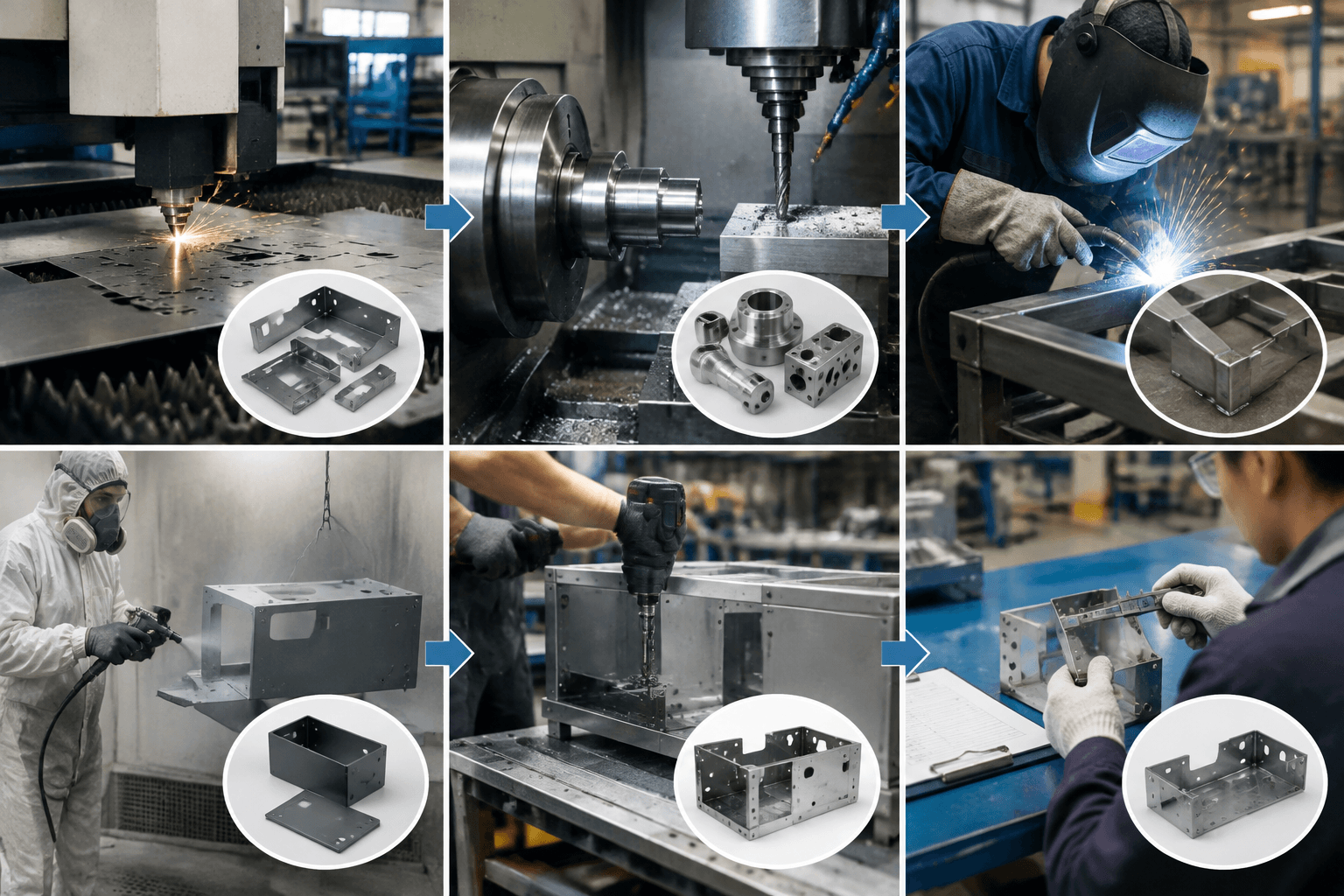
How the main metal processes contribute to one product
Keeping process roles separate helps buyers evaluate a supplier accurately. Turning and milling are CNC machining methods; they are not forms of sheet metal fabrication. Welding joins components, finishing treats a surface, assembly combines parts, and inspection verifies compliance.
| Process | Primary role | Possible output or handoff |
|---|---|---|
| Sheet metal fabrication | Cuts and forms sheet or plate into designed features. | Panels, brackets, covers, cabinets, or enclosure components. |
| CNC machining | Removes material through programmed cutting operations. | Machined housings, mounts, interface features, or finished components. |
| CNC turning | Rotates the workpiece while cutting tools create mainly round features. | Shafts, bushings, pins, or other turned parts. |
| CNC milling | Uses rotating cutters to create flats, pockets, holes, and prismatic features. | Brackets, blocks, fixtures, and detailed machined surfaces. |
| Welding | Joins separate metal components into a weldment. | A frame or fabricated structure ready for finishing or assembly. |
| Finishing | Applies a specified surface treatment for appearance or surface performance. | A coated, treated, or otherwise finished part ready for inspection. |
| Assembly | Combines manufactured and purchased components into a defined configuration. | A completed subassembly or product, if assembly is within the agreed scope. |
| Inspection | Checks whether the product meets the drawing and acceptance requirements. | Approved parts and the inspection evidence required by the buyer. |
A hypothetical product route might combine formed enclosure panels, a CNC-machined mounting interface, a welded support, specified finishing, and final assembly. Another project may need only turning and inspection. For more detail on the machining stage, see custom CNC machining from first sample to repeat production. For an example of a fabricated product where finishing and assembly readiness can connect, see custom sheet metal enclosures that arrive ready to assemble.
What should buyers verify before selecting a contract metal manufacturer?
Start with the drawing and expected production pattern, then ask the supplier to map its actual capabilities to the project rather than presenting a generic list of processes.
Technical fit: Confirm suitable materials and alloys, sheet thickness or gauge, geometry, part envelope, forming limits, machining access, and relevant equipment. Review critical and general tolerances, datums, weld distortion risks, and surface-finish requirements against the proposed route. A supplier should explain conditions and limitations instead of implying that one capability covers every design.
Volume and scalability: Share estimated quantities, lot sizes, demand pattern, and possible ramp-up. Ask how the proposed route, tooling, inspection effort, and external processes would respond to higher or phased demand. A single quoted quantity does not prove repeatability or available capacity for later orders.
Engineering and approvals: If the design is still developing, determine what DFM or product-development support is available. Confirm whether prototypes, samples, OEM approval, or PPAP can be supported for this specific project and what documents each gate requires.
Quality evidence: Ask about inspection methods, measurement records, traceability, certification scope, and nonconformance handling. Inspection reports or other quality documents should be tied to agreed requirements; a certification by itself does not demonstrate fit for every part or program.
Coordination: Clarify who controls finishing, welding, assembly, packaging, outsourced operations, revision changes, and communication. This is particularly important when the buyer needs a completed product rather than an unfinished fabricated or machined component.
When is contract metal manufacturing the right sourcing model?
An ongoing contract relationship is usually worth evaluating when a project has several of the following characteristics:
- Custom geometry or controlled design requirements rather than a standard catalog specification.
- Recurring, phased, or forecast-based demand.
- A process mix involving fabrication, machining, joining, finishing, assembly, or documented inspection.
- A need to move from prototype or approved sample into repeat production.
- Customer-specific documentation, OEM approval, or change-control requirements.
A standard-product purchase or isolated job may be sufficient when the item is already available, the buyer has no need for design coordination, and there is no expectation of repeatable custom supply. Contract manufacturing is not automatically cheaper or risk-free; it adds coordination and approval work. Its value comes when those controls reduce ambiguity across development and production.
Yishang states that it serves B2B wholesale and custom manufacturing projects only, supports OEM and ODM manufacturing, has more than 26 years of experience making custom sheet metal parts and metal products, exports to more than 50 countries, and holds ISO and RoHS certifications. These are stated company facts, not a substitute for verifying the process route, capacity, documents, and approval needs of a particular project.
Frequently Asked Questions
Is contract metal manufacturing the same as using a job shop or metal fabricator?
Not exactly. A job shop describes a supplier that handles custom work, while a metal fabricator usually emphasizes cutting, forming, and joining. Contract manufacturing describes the broader buyer-supplier relationship, including specifications, approvals, coordination, and repeat-order control. The models can overlap, so scope must be checked directly.
Is contract manufacturing risky, and which controls reduce avoidable problems?
Outsourcing always requires control because design interpretation, process handoffs, and changes can introduce risk. Clear drawings, DFM review, approved samples, revision control, defined inspection evidence, documented nonconformance handling, and regular communication reduce avoidable problems. No supplier model removes the need for buyer oversight.
What are the three types of metal fabrication?
There is no single universal three-part classification. A common practical grouping is cutting, forming, and joining, but a complete sourcing review should also distinguish sheet metal fabrication from CNC machining, including turning and milling, as well as finishing, assembly, and inspection. These activities may connect in one project but perform different functions.
Can one contract manufacturer support prototypes, production, finishing, assembly, and repeat orders?
Sometimes, but this must be verified for the supplier and project. Confirm which operations are performed directly, which are coordinated through qualified partners, and which documents are available at each stage. Prototype support, production ramp-up, finishing, assembly, PPAP, and OEM approval are not universal inclusions.
Planning a custom metal program? Share the drawings, CAD files, or product specifications; intended function; material or gauge; estimated quantities or demand pattern; critical dimensions and tolerances; inspection or approval requirements; and any finishing, welding, assembly, prototype, or PPAP needs. This information allows a project-fit discussion about the right process mix, production stage, and documentation to evaluate.