
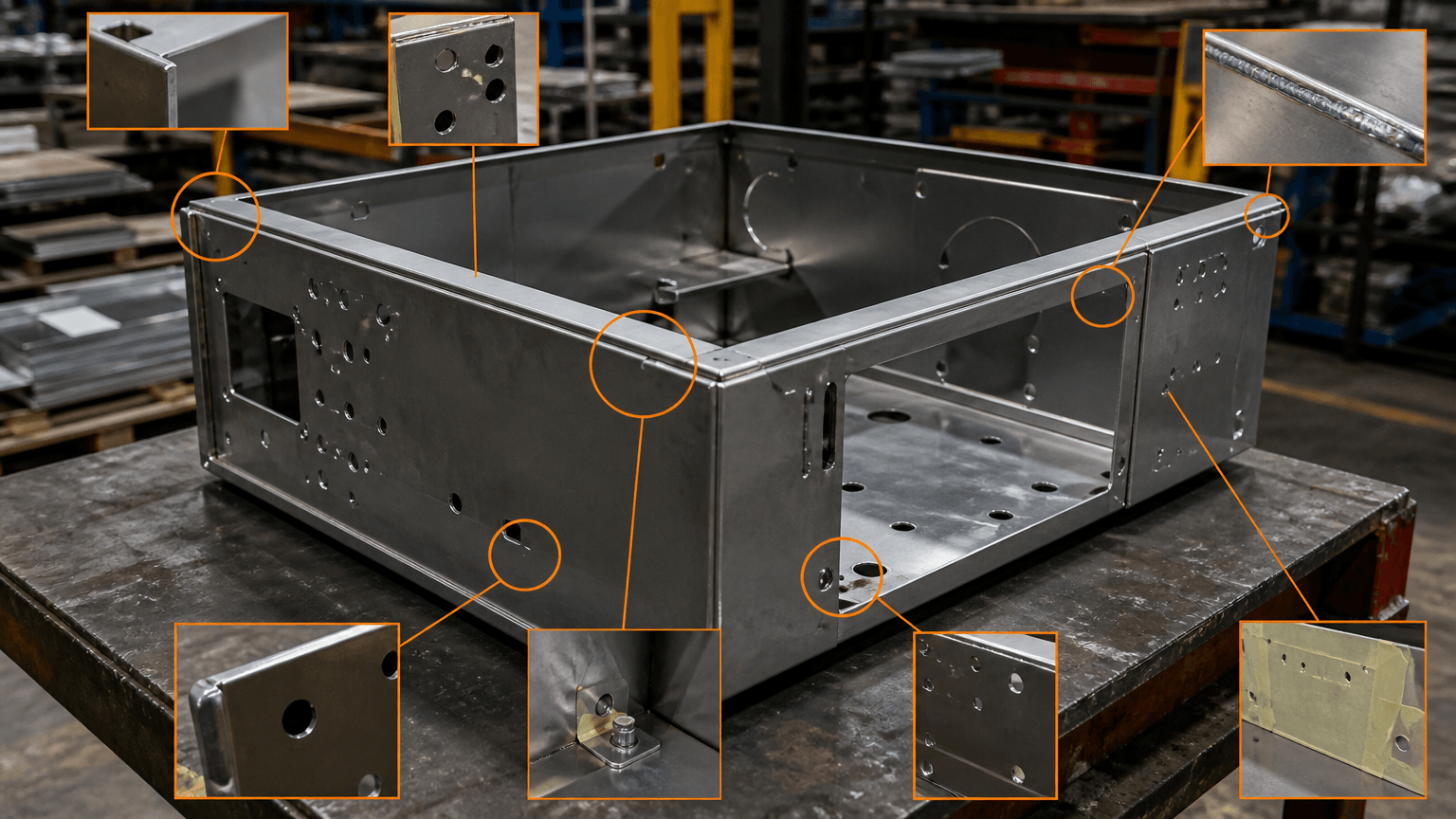
Powder coating is not inherently unsuitable for OEM sheet metal. Its disadvantages become important when cure heat, spray access, added film, repair expectations, service exposure, or production pattern conflict with the part. For a buyer reviewing a bent-and-welded enclosure, the outside face may be easy to finish while threaded holes, mating flanges, grounding points, or a heat-sensitive insert create the real decision.
The practical question before prototype approval or RFQ submission is not whether powder coating is good or bad in general. It is whether the selected powder system, conductive substrate, geometry, assembly sequence, operating environment, and order pattern can be controlled together.
Short answer: Powder coating can suit repeat metal parts with accessible surfaces and compatible materials. Risk increases with deep recesses, internal cavities, threads, tight fits, heat-sensitive components, demanding field repairs, severe exposure, or several low-volume colors.
- Review coverage and masking at edges, holes, cavities, welds, and contact areas.
- Check the powder supplier’s cure schedule against the complete part or assembly.
- Allow for film build in threads, sliding features, and dimensional stacks.
- Define appearance, repair, environmental, and inspection requirements before production.
Keep the process boundaries clear: cutting, bending, and welding establish fabricated sheet metal geometry; CNC machining may make a separate precision insert; powder coating is a downstream finish; assembly and inspection verify finished interfaces. A defect can therefore be a design limitation, a preparation or masking problem, a cure issue, or a supplier process-control failure. The corrective action depends on that distinction.
Geometry, masking, and grounding create coverage risk
When an OEM project must preserve a closure fit or clean appearance, a simple-looking enclosure drawing can conceal finishing problems. Broad exterior faces are generally easier to access than deep returns, narrow channels, blind features, or complex welded areas. Review these features while the sheet metal design can still be modified, rather than discovering a coverage or masking issue after fabrication.
Sharp edges and bend lines: Edge coverage and film control can differ from a broad face, and exposed edges may be more vulnerable during handling.
Recesses and internal corners: Deep pockets, narrow returns, channels, and cavities can create Faraday-cage effects that reduce access to the deepest surfaces.
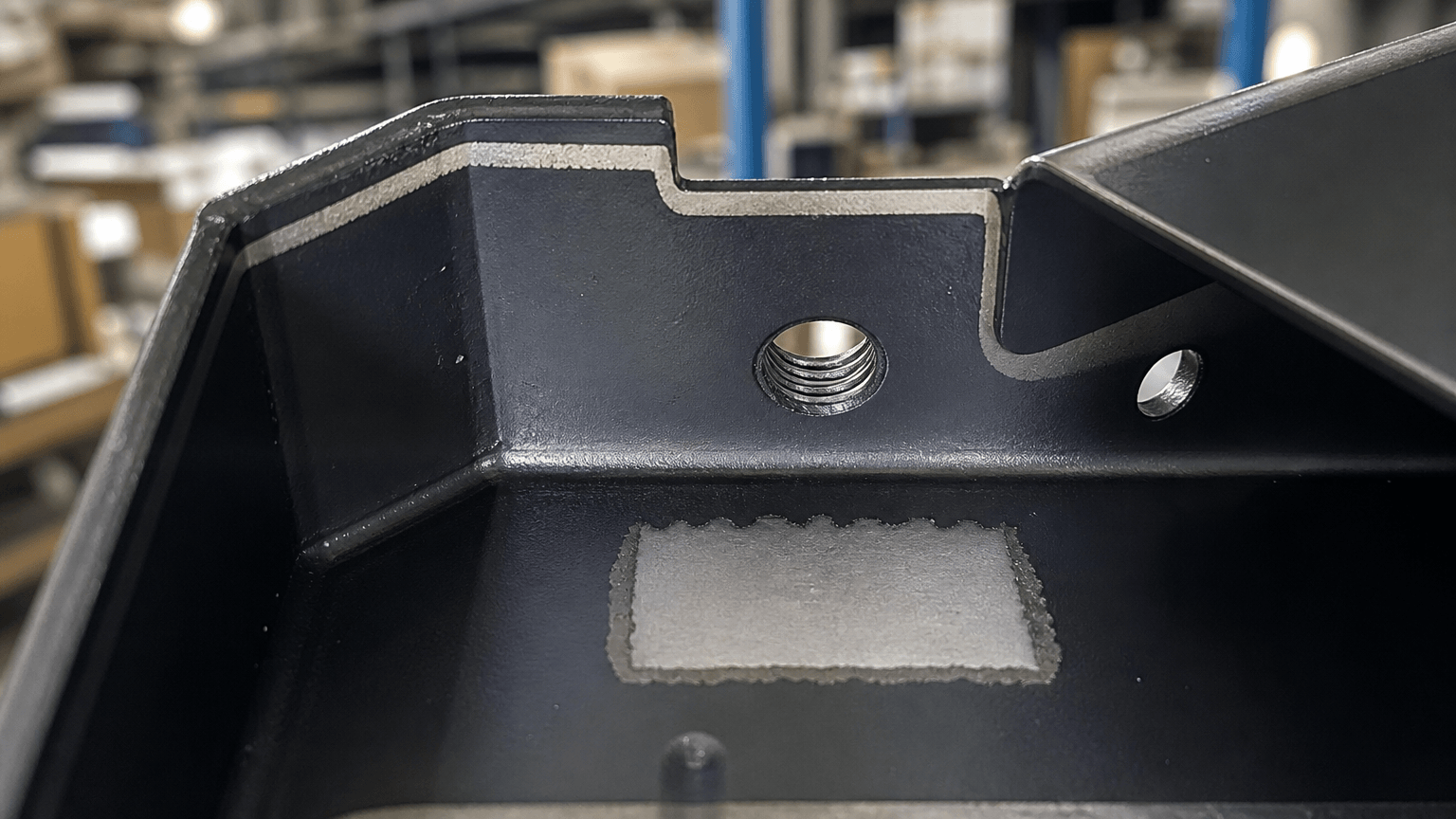
Holes and threads: Powder may enter blind holes or build on threads that must accept a fastener. These features may need masking, post-coating cleaning, or a finished-fit check.
Weld seams: Spatter, residue, sharp transitions, and uneven seam geometry can affect preparation and visual continuity.
Grounding points: Electrical contacts, bonding surfaces, or hanging points may need to remain bare or be cleaned after coating so continuity is preserved.
Datums and mating surfaces: Locating faces, flanges, sealing areas, and sliding interfaces may require defined no-coat zones.
Electrostatic deposition depends on a suitably conductive workpiece and reliable electrical grounding. If the substrate, surface condition, contact point, or pretreatment is uncertain, deposition and adhesion need specific review. Oil, oxides, weld residue, or an unsuitable pretreatment can create problems even when visible coverage appears acceptable. The finish specification should identify coated and uncoated surfaces, internal-face expectations, masking locations, and the inspection method. See surface-finishing options for custom metal parts for broader finish-selection context.
Cure heat and film build can change assembly fit
For a cover assembled around seals, adhesives, electronics, or inserts, the cure stage can become a design constraint. Powder is applied dry and then melted and cured according to the selected powder supplier’s schedule. That schedule should be checked against the actual part, substrate, exposure time, and component arrangement rather than an assumed universal condition.
| Design condition | Potential disadvantage | Engineering check |
|---|---|---|
| Seals, adhesives, electronics, inserts, or assembled parts | Cure heat or time may exceed a component’s thermal limits. | Check compatibility and determine whether coating must occur before assembly. |
| Threads, holes, and press fits | Film build can reduce clearance or hinder installation. | Define protection or post-coat cleaning and check the finished fit. |
| Sliding or tight mating surfaces | Build on multiple faces can accumulate through the dimensional stack. | Review coated dimensions and assemble a representative prototype. |
| Grounding and datum faces | Film can interrupt continuity or alter a locating relationship. | Mark no-coat zones and inspect contact and alignment. |
Film build belongs in the finished-part tolerance review, not only on the bare-metal drawing. If a CNC-machined insert interfaces with a fabricated enclosure, decide whether it will be coated separately, masked, or installed after cure. A precision interface needs a defined coating boundary and fit review. Prototype review for coating and assembly fit is valuable when a threaded cover, press-fit panel, sliding part, or closely aligned flange is involved.
Cross-section check: Review coating build around threaded holes, bend edges, flanges, and other mating faces.
Assembly boundary: Mark contact surfaces, critical datums, and grounding areas before deciding whether parts are coated together or separately.
Repair, color changes, and batch matching reduce flexibility
If a launch plan includes several colors, intermittent batches, or field handling, powder coating can be less flexible after the first production run. Factory rework, local touch-up, and complete recoating are different responses and should not be treated as interchangeable.
| Situation | Why it can be difficult | Planning response |
|---|---|---|
| Local scratch or impact | Touch-up may differ in color, gloss, texture, edge transition, or adhesion. | State whether the repair is functional only or must meet a cosmetic standard. |
| Factory rework | Preparation, masking, handling, and recoating can alter the final appearance. | Define rework limits and inspect the complete repaired part. |
| Several colors or textures | Cleaning and changeover control can add cost or scheduling burden. | Plan the sequence and approve a representative appearance sample. |
| Low-volume or intermittent batches | Repeat-batch appearance matching may be less predictable. | Review the quantity pattern and retain a master appearance reference. |
Powder type, film build, cure history, substrate, handling, and batch variation can all affect the appearance of nominally similar parts. For visible panels, approve a sample that defines color, gloss, texture, and acceptable variation. If field touch-up is expected, specify it separately instead of assuming a local repair will blend into the original finish.
Service exposure determines whether the system is suitable
An indoor control enclosure and an outdoor housing exposed to moisture or salt place different demands on a finish. Powder coating by itself does not establish corrosion, UV, chemical, moisture, impact, or abrasion performance. The relevant question is whether the complete coating system matches the substrate, preparation, geometry, and actual service environment.
Review the substrate, surface condition, pretreatment, powder chemistry, film continuity, cure, and coverage at edges, welds, cavities, and masked transitions. Define the substances that may contact the part, temperature pattern, appearance-retention needs, acceptance criteria, and validation method. If the proposed system cannot be shown to fit those requirements, modify the design or compare another finish route rather than relying on the coating name alone.
Powder-coating suitability matrix for OEM sheet metal
Use this project screen before releasing a prototype or production batch. It separates conditions that may support powder coating from those requiring design controls, sample approval, or comparison with another route.
| Project trigger | Main risk | Required check | Route decision |
|---|---|---|---|
| Suitable conductive sheet metal, accessible faces, repeat production, and no heat-sensitive assembly | Risk centers on preparation, masking, and appearance control. | Confirm the coating system, grounding, finish specification, and sample approval. | Use powder coating when the agreed system fits the application. |
| Uncertain substrate condition or pretreatment | Adhesion and corrosion performance may vary. | Confirm material, surface condition, preparation, pretreatment, and validation criteria. | Resolve the process before releasing the finish. |
| Deep recesses, blind holes, cavities, narrow channels, or complex welds | Coverage, access, powder accumulation, or masking may be difficult to verify. | Review sections, masking, internal coverage, and inspection method. | Modify or control the design; compare another route if critical areas remain unverifiable. |
| Threads, press fits, sliding parts, grounding points, or precise mating faces | Film build may cause interference or loss of continuity. | Mark no-coat zones, review the finished stack, and conduct a prototype fit check. | Use with controls or separate coating and assembly operations. |
| Seals, adhesives, electronics, inserts, or other heat-sensitive components | The cure schedule may exceed component limits. | Obtain the supplier’s schedule and verify every component coated together. | Coat before assembly or compare another route if compatibility is uncertain. |
| Outdoor, salt, chemical, UV, impact, or abrasion exposure | The selected system may not meet durability needs at every feature. | Define exposure, acceptance criteria, complete system, and validation method. | Use after validation; compare alternatives if the requirement is not demonstrated. |
| Prototype, low-volume, multicolor, or frequent-repair production | Changeovers, rework, handling, and batch matching may reduce flexibility. | Review quantities, color sequence, repair expectations, and appearance reference. | Use when planned; compare routes when flexibility is the priority. |
Release checks before prototype or RFQ
Convert the identified disadvantages into drawing notes, sample requirements, and finished-part inspection criteria:
- Material: Record base material, thickness, surface condition, welds, and separate machined components.
- Geometry: Mark threads, holes, cavities, grounding points, datums, mating faces, and no-coat zones.
- Cure and assembly: Check the supplier’s cure schedule, component limits, assembly sequence, and finished clearances.
- Appearance and repair: Define color, gloss, texture, film-build requirement, master sample, acceptable variation, and repair method.
- Service: State exposure conditions, durability criteria, and validation method.
- Production and inspection: Confirm quantities, colors, changeovers, coverage, appearance, dimensions, grounding continuity, and final fit. The quality control for finished metal products should reflect those agreed requirements.
Technical next step: Share a 2D drawing or 3D model, base material and thickness, critical dimensions, threads, mating surfaces, grounding points, no-coat areas, and assembly sequence. Include the target color, gloss, texture, film-build requirement, appearance reference, operating environment, validation criteria, prototype and batch quantities, and number of colors. Yishang can review custom sheet metal geometry and finishing requirements before production. For enclosure work, also review custom sheet metal enclosures with coating and assembly considerations and prototype review for coating and assembly fit. When powder coating is appropriate, the review can support an OEM or ODM production quotation.
Frequently Asked Questions
These questions address finish decisions that commonly appear in OEM drawings, RFQs, prototype reviews, and assembly plans.
Is powder coating a bad choice for outdoor metal parts?
Not necessarily. Suitability depends on the substrate, pretreatment, powder chemistry, cure, coverage, and actual exposure to moisture, salt, UV, chemicals, impact, or abrasion. Define application-specific acceptance and validation criteria instead of relying on the term powder coating alone.
Can powder coating be applied over threaded holes, bend features, and inner cavities?
These features need a defined masking and access plan. Threads and holes may need protection or cleaning, bend returns can restrict access, and deep cavities may receive uneven deposition. Mark no-coat areas, grounding points, fit requirements, and internal coverage expectations.
Why can powder coating cause assembly interference?
The cured film adds material to the bare-metal dimensions. Coating on both sides of a mating feature can consume clearance, while buildup in threads, press fits, or sliding interfaces can accumulate across the dimensional stack. A finished-part prototype fit check helps expose these risks.
Can a scratched powder-coated part be touched up?
A local repair may be possible, but it may not match the original color, gloss, texture, edge transition, or adhesion. Specify whether the repair is functional or cosmetic; strict appearance requirements may require complete recoating or an approved repair method.
Is powder coating economical for prototypes or orders with several colors?
It depends on quantities, color count, changeover effort, handling, rework, and batch-matching expectations. A low-volume or multicolor project should have a planned sequence and representative appearance sample before the route is approved.