For procurement managers in industrial manufacturing, the quality of a single component can dictate the success of an entire product line. When sourcing stainless steel tubing, specifying bent components over welded assemblies is a strategic move to enhance structural integrity, improve performance, and reduce long-term failure points.
However, the bending method—and more importantly, the partner you choose—can make or break your supply chain. Even small inconsistencies can ripple into costly disruptions or long-term quality problems.
This guide is designed as a comprehensive resource for procurement professionals. It aims to demystify the science behind stainless steel tube bending, empowering you to ask the right questions, identify capable suppliers like YISHANG, and ensure the components you source meet the highest standards of quality and consistency.
1. The Strategic Advantage: Why Bending is a Superior Choice for Quality-Driven Products
In any manufacturing process, the goal is to create a product that is both high-performing and cost-effective. While welding remains common, the benefits of tube bending present a more compelling case for applications demanding reliability and a lower total cost of ownership.
From a performance standpoint, the primary benefit is superior structural integrity. Every weld or mechanical fitting introduces a potential point of failure, especially in high-pressure or high-vibration environments. A smoothly bent tube forms a continuous structure with uninterrupted material grain flow, significantly enhancing its resistance to stress.
From a procurement perspective, the economic rationale is equally strong. While custom tooling may require an initial investment, these costs are often offset by savings elsewhere. Each welded fitting adds to your bill of materials, and every weld requires both labor and inspection. By designing with bent components, you reduce part counts, minimize labor, and simplify your supply chain.
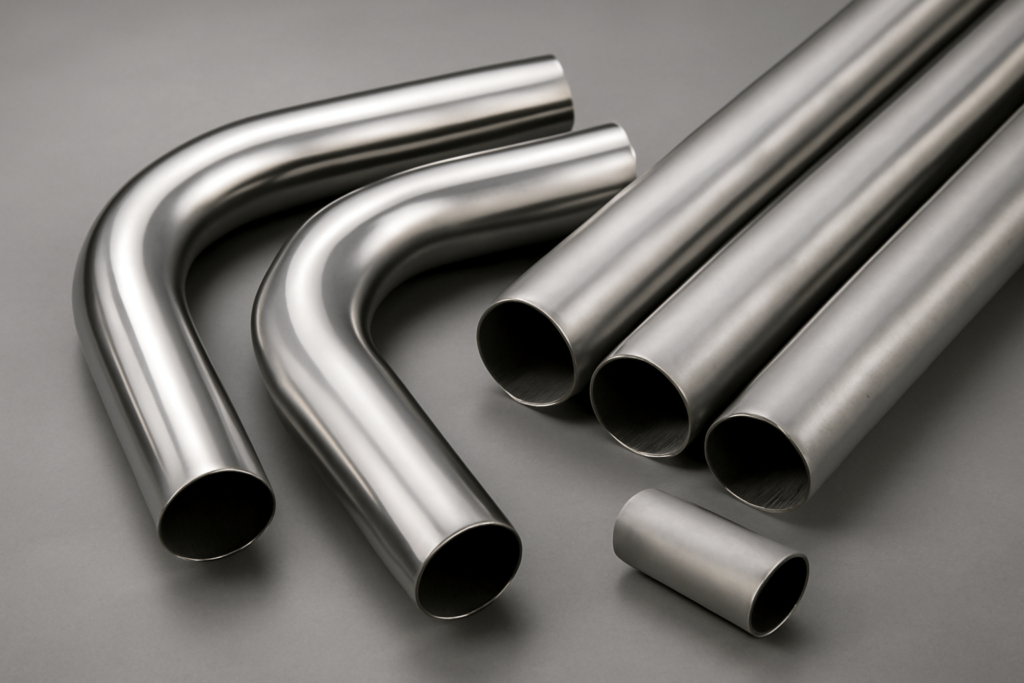
2. Before You Specify: Understanding Stainless Steel’s Three Core Bending Characteristics
A successful bending project begins with a deep understanding of the material. Stainless steel is not a single entity; it is a family of alloys. Its renowned strength and corrosion resistance are the very properties that make it challenging to form. A capable supplier must demonstrate mastery of these characteristics to ensure defect-free production.
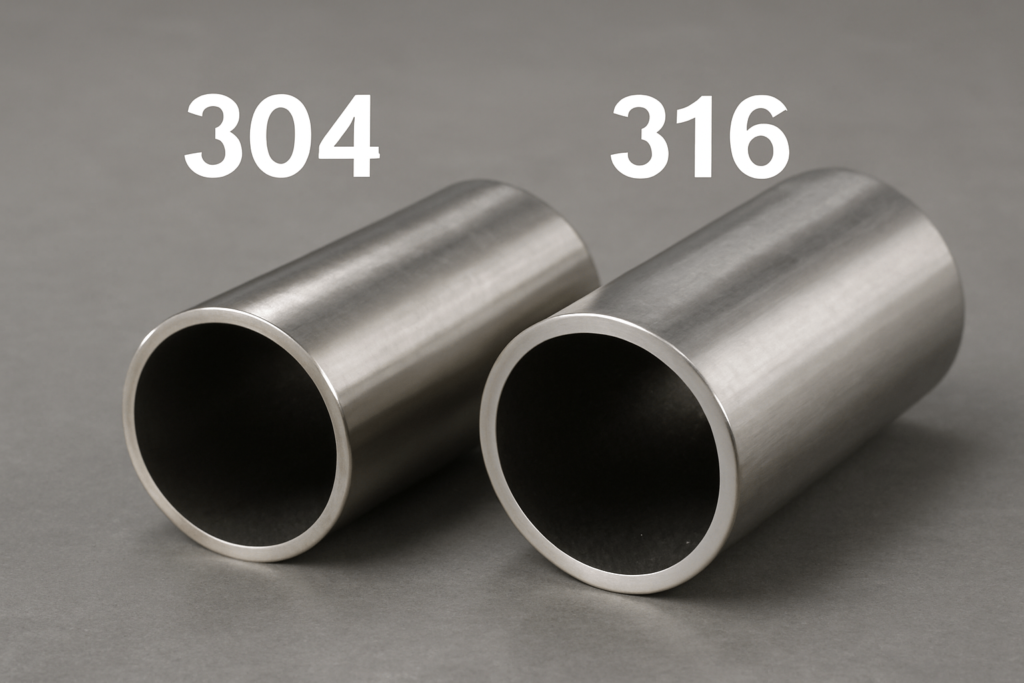
2.1 Know Your Material: 304 vs. 316 – A Critical Choice for Performance and Fabricability
The two most prevalent austenitic stainless steel grades are Type 304 and Type 316. The critical difference between 304 and 316 stainless steel lies in their chemical composition, which governs their behavior during fabrication. Type 304, the industry workhorse known as “18/8” stainless, offers excellent ductility and broad corrosion resistance.
Type 316, however, contains 2–3% molybdenum, which dramatically enhances its corrosion resistance, particularly against chlorides. This makes 316 ideal for harsher applications, though its added durability creates fabrication trade-offs. The molybdenum increases both tensile and yield strength, requiring more force to bend and resulting in greater springback.
| Property | Type 304 Stainless Steel | Type 316 Stainless Steel | Implication for Procurement & Sourcing |
|---|---|---|---|
| Composition | ~18% Cr, ~8% Ni | ~16% Cr, ~10% Ni, 2–3% Mo | Molybdenum in 316 is key for harsh environments. |
| Tensile Strength | 73,200 psi | 79,800 psi | 316 requires a supplier with more powerful equipment. |
| Yield Strength | 31,200 psi | 34,800 psi | 316’s higher springback demands advanced process control for dimensional accuracy. |
| Ductility (Elongation) | ~70% | ~60% | 304 is slightly more forgiving for designs with extremely tight bends. |
| Corrosion Resistance | Excellent | Superior (especially against chlorides) | The service environment of the final product dictates the grade selection. |
| Cost | More economical | 20–75% higher | The higher cost of 316 must be justified by the need for superior corrosion resistance. |
2.2 The “Work Hardening” Trap: Why Material Science Dictates Production Reliability
A defining trait of what is austenitic stainless steel is its tendency to work harden rapidly. This means the material becomes stronger, harder, and less ductile as it is being bent—a fundamental property that must be understood and managed by a competent fabricator.
This hardening occurs at the microscopic level. The act of bending creates defects in the steel’s atomic lattice called dislocations. As these dislocations accumulate, the material’s internal resistance to deformation increases. Simultaneously, strain energy may trigger phase transformation. Some of the ductile austenite can transform into a harder martensitic structure, making the tube even more challenging to form accurately.
2.3 Seamless vs. Welded Tubing: A Key Specification for High-Integrity Applications
The final pre-bend consideration is the tubing type. Seamless tubing is extruded from a solid billet, while welded tubing is formed from a flat strip. This choice has direct implications for both performance and cost.
For high-pressure hydraulic systems or tight bend radii, seamless tubing is ideal. The absence of a weld seam ensures structural uniformity, eliminating a potential weak point. Welded tubing, while more economical, remains reliable for structural and low-pressure applications.
3. The Bending Playbook: Matching the Process to the Part for Optimal Results
The method used to bend stainless steel tube is a strategic decision. A top-tier fabrication partner will offer various capabilities and select the process that best aligns with your project’s precision, volume, and cost requirements.
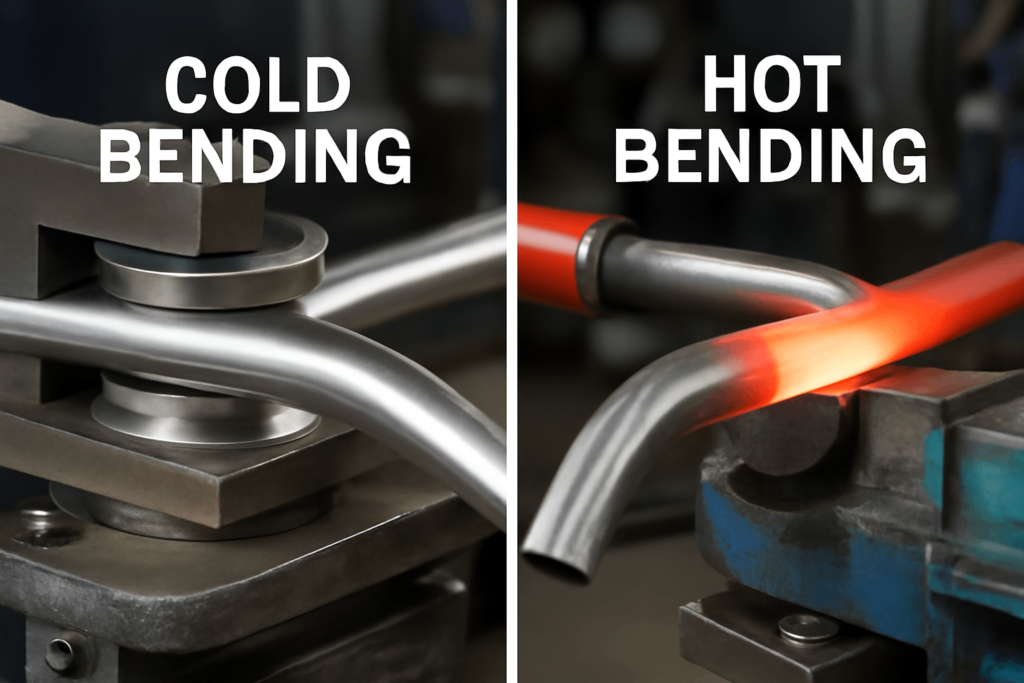
3.1 The Main Event: Cold Bending (The Standard for Precision and Finish)
Cold bending shapes the tube at room temperature and is the preferred method for most applications. It offers superior dimensional accuracy and surface finish. Since no heat is applied, the metal’s structural integrity is preserved and surface scaling is avoided.
This method allows for tight tolerances and consistent results, making it ideal for production runs. Additionally, the work hardening that naturally occurs during cold bending can enhance the strength of the final part.
3.2 The Specialist Solution: When is Hot Bending Absolutely Necessary?
Hot bending is a specialized solution for scenarios that exceed the limits of cold forming. This involves heating the tube (typically 900–1100°C) to reduce the mechanical force required for shaping.
It becomes essential when dealing with thick-walled or large-diameter tubes, high-strength alloys, or extremely tight bend radii that would otherwise risk cracking during cold processing.
3.3 Process Match-Up: A Guide to Bending Techniques and Their Applications
Understanding these applications helps evaluate a supplier’s capabilities:
- Rotary Draw & Mandrel Bending – Ideal for high precision and tight radii. A rotating die forms the bend, and a mandrel supports the tube’s interior for thin walls.
- Roll Bending – Best for large, sweeping curves. It uses multiple rollers for gradual forming, ideal in architectural or industrial contexts.
- Press Bending – A fast, cost-effective option where a hydraulic ram presses the tube against dies. Less precise but efficient.
- Induction Bending – An advanced hot bending method using high-frequency coils to heat and form heavy-duty parts with narrow heated zones.
4. The Secret Weapon: Why Mandrel Bending Mastery is a Mark of Quality
For procurement managers sourcing high-spec components, understanding mandrel bending is crucial. A supplier’s command of this technique reflects their capacity to deliver defect-free, dimensionally accurate parts.
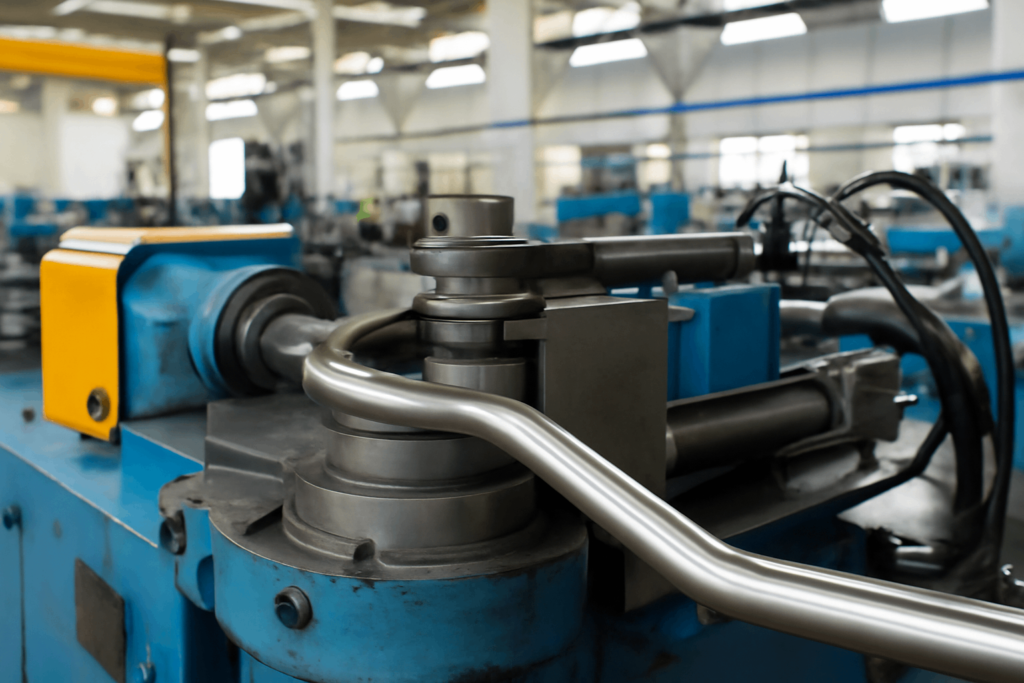
4.1 The Tooling Ecosystem: The 5 Essential Mandrel Bender Components
Perfect mandrel bends depend on five core tooling components working in harmony. Quality suppliers invest in top-grade, precisely matched tooling:
- Bend Die – Sets the centerline radius (CLR).
- Clamp Die – Holds the tube firmly in place.
- Pressure Die – Maintains contact between the tube and bend die.
- Wiper Die – Prevents wrinkles by supporting the inner radius.
- Mandrel – Internally supports the tube to prevent collapse and flattening.
4.2 The Expert’s Technique: “Forward Mandrel, Low Pressure”
Success in bending is about finesse, not brute force. The “Forward Mandrel, Low Pressure” technique places the mandrel nose just ahead of the bend start for maximum internal support.
This setup allows minimal use of pressure die force. In contrast, excessive force—common among less experienced operators—accelerates tool wear and degrades consistency. A skilled supplier can produce better results with fewer defects.
4.3 Lubrication Strategy: The Unsung Hero of a Defect-Free Bend
Bending stainless steel creates significant friction, risking galling and scratches. Proper lubrication strategy is critical: high-pressure lubricants are applied inside the tube and on the mandrel, while gripping surfaces remain clean to prevent slippage.
5. Design for Manufacturability: Engineering for Accuracy and Repeatability
A good supplier doesn’t just bend metal—they partner with you to optimize your design for manufacturability. Early collaboration can significantly impact quality, cost, and lead time.
5.1 Developed Length Calculation: Precision Starts in the Design Phase
Before bending begins, the supplier must calculate the developed length of the tube. This refers to the actual length of material required to form the finished part. Getting this wrong leads to inaccurate bends and inconsistent part dimensions.
Developed length depends on:
- The bend angle
- Tube outside diameter (OD)
- Centerline radius (CLR)
- Wall thickness
- The type of material and expected springback
Skilled suppliers use CAD tools and compensation formulas to account for elongation and compression during bending. Inaccuracy at this stage leads to costly downstream rework or non-conforming parts.
5.2 Springback Compensation: Why It Separates Amateurs from Experts
Springback refers to the material’s tendency to partially return to its original shape after bending. Stainless steel’s elasticity, especially in Type 316, means significant compensation is required to achieve the target angle.
Quality suppliers run test bends, measure the springback, and then program compensations into their CNC bending equipment. This iterative feedback loop is essential for maintaining dimensional accuracy.
6. Common Bending Defects (and How to Avoid Them)
Even with proper tools and processes, defects can occur. Procurement managers should know the most common issues so they can spot red flags during sample inspections.
- Wrinkling – Typically caused by insufficient support at the inner radius. Prevented by proper wiper die and mandrel placement.
- Flattening – Occurs when the tube collapses at the bend. Often due to excessive pressure or improper mandrel setup.
- Surface Scratches – Usually the result of improper lubrication or tooling wear.
- Out-of-Tolerance Angles – Caused by inaccurate springback compensation or poor machine calibration.
Preventing these issues requires both engineering insight and skilled labor—a combination that differentiates capable suppliers from average ones.
7. Standards and Specifications: What to Look For in Quality Assurance
No bending project is complete without a robust inspection and validation process. Ensure your supplier works to recognized standards and follows verifiable procedures.
- Material Certifications – Your supplier should provide full traceability to the stainless steel’s origin and grade.
- Dimensional Inspection – Confirm the use of precision gauges, CMM equipment, and documentation protocols.
- Surface Quality Checks – Especially for visible components, surface defects must fall within defined tolerance limits.
- Passivation or Pickling – For corrosion-critical applications, ASTM A967-compliant treatments ensure surface cleanliness.
8. Packaging and Delivery: The Final Step in Protecting Quality
Even a perfect part can arrive damaged if packaging is subpar. Look for a supplier who understands how to protect delicate tube bends.
- Use of foam inserts, custom trays, or shrink wrap
- Bend-end caps to prevent ovalization
- Moisture barriers or VCI bags for corrosion prevention
- Clearly labeled packaging for inventory control
Packaging should be discussed early, not treated as an afterthought.
9. Frequently Asked Questions
Q: How tight can I bend stainless steel pipe without deformation?
A: It depends on tube OD, wall thickness, and grade. For 304 stainless with 1.5mm wall, a 2D CLR is generally safe using mandrel bending.
Q: Is seamless tubing always better than welded for bending?
A: Seamless is structurally superior, but high-quality welded tubing can perform well in non-critical or structural applications.
Q: What’s the typical lead time for custom bent tubing?
A: Depending on complexity and volume, 2–4 weeks is standard. Add time for prototyping or surface finishing.
Q: Can I send CAD drawings for quote?
A: Absolutely. A 3D model (STEP or IGES format) speeds up DFM checks and quotation.
Q: How does YISHANG handle high-mix, low-volume orders?
A: With in-house tooling, rapid prototyping, and flexible scheduling, we support both prototypes and batch runs.
10. Final Thoughts: Bending is More Than Just a Process—It’s a Strategic Advantage
Stainless steel tube bending is a process that blends art, science, and precision. For procurement professionals, understanding the full picture—from material selection to final delivery—is key to making informed sourcing decisions.
YISHANG specializes in providing high-quality, custom metal fabrication solutions. With over 26 years of experience and exports to 50+ countries, we understand the standards global buyers expect. Whether you’re sourcing industrial enclosures, architectural tubing, or stainless steel frameworks, we’re ready to collaborate.
Contact us today to discuss your project or request a quote.