
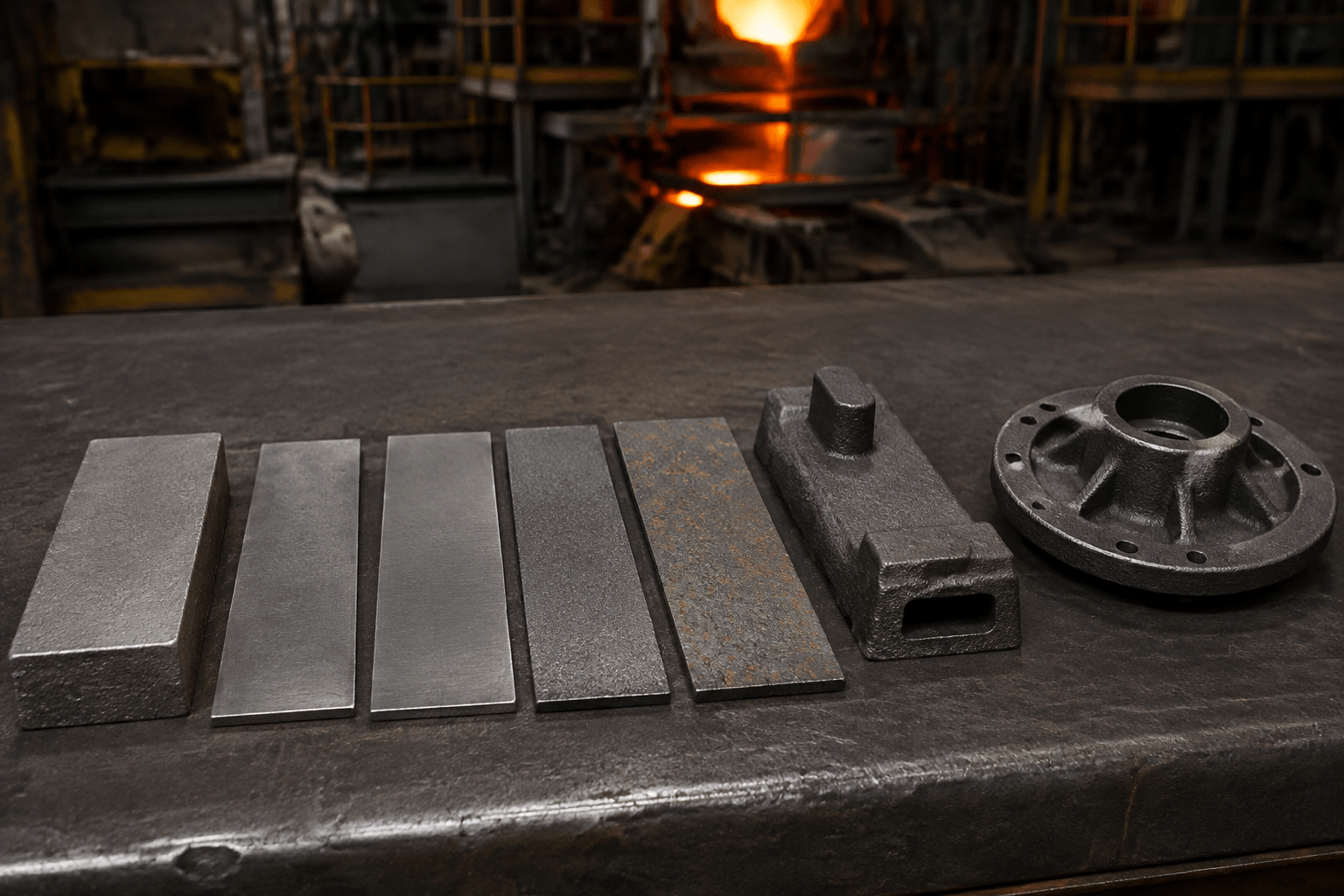
An alloy of iron and carbon is generally called steel when its composition and structure fall within the steel range, or cast iron when it contains more carbon and is produced for casting behavior. There is no single chemical formula for an iron-carbon alloy because steel and cast iron are families of materials defined by composition ranges, microstructure, processing route, and grade requirements.
Carbon steel, alloy steel, and stainless steel are related classifications, but they are not interchangeable names. Carbon steel relies mainly on controlled carbon content, alloy steel contains deliberate additions that modify performance, and stainless steel requires substantial chromium for corrosion resistance.
Is an Alloy of Iron and Carbon Steel or Cast Iron?
Iron and carbon form the basis of two principal engineering-material families: steel and cast iron. In a simplified iron-carbon diagram, steels occupy the lower-carbon region, while cast irons occupy the higher-carbon region. A traditional approximate boundary is around 2% carbon by weight, although specifications, other alloying elements, and microstructure determine how a commercial material is classified. ([nvlpubs.nist.gov](https://nvlpubs.nist.gov/nistpubs/legacy/mono/nbsmonograph88.pdf?utm_source=openai))
This distinction explains why the phrase alloy iron and carbon formula can be misleading. An alloy is not normally described like a molecule with one fixed ratio of atoms. Instead, a steel grade specifies permitted ranges for carbon and other elements. It may also define product form, delivery condition, heat treatment, mechanical properties, testing, or dimensional requirements.
Cementite, an iron carbide phase written as Fe3C, does have a chemical formula. However, a steel component is not simply a solid block of Fe3C. Its microstructure can contain different proportions and arrangements of ferrite, pearlite, cementite, austenite, martensite, graphite, or other constituents depending on composition and thermal history.
How Carbon Content Changes Iron-Based Alloys
Nearly pure iron is relatively soft and ductile for many structural or wear-related applications. Adding controlled amounts of carbon changes how the iron crystal structure responds to cooling, deformation, and heat treatment. Carbon can increase hardness, strength, wear resistance, and hardenability, but these benefits commonly involve trade-offs in ductility, toughness, weldability, or forming performance.
The direction of change is important, but it is not a universal property curve. A normalized medium-carbon steel, a quenched-and-tempered part, and a cold-drawn bar with similar nominal carbon levels can behave differently. Cooling rate, section thickness, grain size, prior cold work, tempering temperature, and local geometry all influence the final result.
Increasing carbon generally provides more potential to form hard microstructures during suitable heat treatment. It can also raise the risk of brittle structures near a weld if the joint, preheat, filler, heat input, and cooling rate are not properly controlled. For bending and deep forming, lower-carbon sheet grades are often preferred because they can accommodate more plastic deformation before cracking. These are tendencies rather than permission to substitute one grade for another.
A Practical Map of Iron-Carbon Material Families
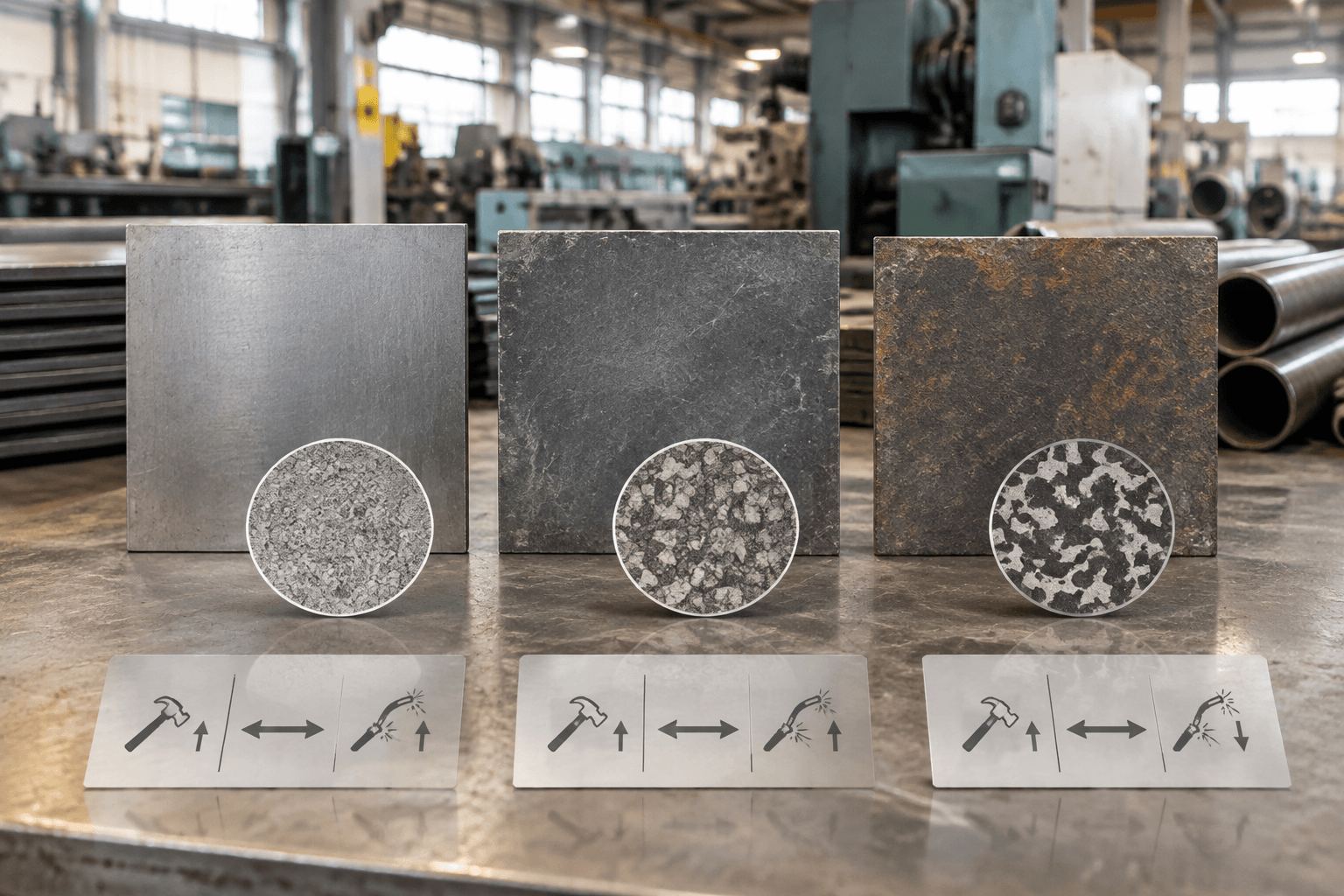
The following composition-to-behavior matrix is a planning guide, not a substitute for the applicable material specification. The carbon boundaries used for low-, medium-, and high-carbon steel vary somewhat among references and product types; commonly used broad groupings are below about 0.30%, approximately 0.30–0.60%, and above about 0.60%, respectively. ([scholarsjunction.msstate.edu](https://scholarsjunction.msstate.edu/metallurgy/?utm_source=openai))
| Material family | Typical composition description | Typical behavior and fabrication implications |
|---|---|---|
| Low-carbon steel | Usually below about 0.30% carbon | Generally favors ductility, bending, stamping, and welding. Strength and surface condition still depend on grade, rolling route, and cold work. |
| Medium-carbon steel | Approximately 0.30–0.60% carbon | Offers greater hardening potential and strength, but forming and welding normally require more process attention. |
| High-carbon steel | Generally above about 0.60% carbon within the steel range | Can provide high hardness and wear resistance after appropriate processing, with reduced ductility and more demanding welding or forming behavior. |
| Low-alloy steel | Iron-carbon steel with deliberate additions such as chromium, nickel, molybdenum, manganese, or vanadium | Alloying can improve hardenability, strength, toughness, wear performance, or elevated-temperature behavior. Results depend on the complete grade and heat treatment. |
| Stainless steel | Iron-based steel containing at least 10.5% chromium, plus carbon and potentially nickel, molybdenum, nitrogen, or other elements | Chromium supports a protective passive film. Corrosion performance, formability, weldability, and magnetism differ among stainless families and grades. ([worldstainless.org](https://worldstainless.org/about-stainless/properties/stainless-steel-standards/?utm_source=openai)) |
| Cast iron | Higher-carbon iron alloy, commonly also containing significant silicon | Designed around casting fluidity and solidification behavior. Graphite form and matrix structure strongly affect machinability, damping, strength, and toughness. |
SAE/AISI 1018 and 1045 illustrate why the grade matters. Published chemistry ranges commonly place 1018 at about 0.15–0.20% carbon and 1045 at about 0.43–0.50% carbon. ([dl.asminternational.org](https://dl.asminternational.org/alloy-digest/article-abstract/72/10/CS-261/28684/SAE-1018-SAE-1019-CEN-C17-ISO-C17Wrought-Low?redirectedFrom=fulltext&utm_source=openai)) Therefore, 1018 is a low-carbon grade, while 1045 is a medium-carbon grade with more hardening potential. This does not create one fixed set of mechanical properties: 1018 may be hot rolled, cold worked, normalized, or case hardened, while 1045 may be supplied as rolled, normalized, annealed, or hardened and tempered.
The word mild steel is often used informally for readily formed and welded low-carbon steels. It should not automatically be treated as an exact grade designation or as a synonym for every carbon steel. A drawing should state the required grade, specification, product form, and condition.
How Composition Affects Fabrication
Forming and bending
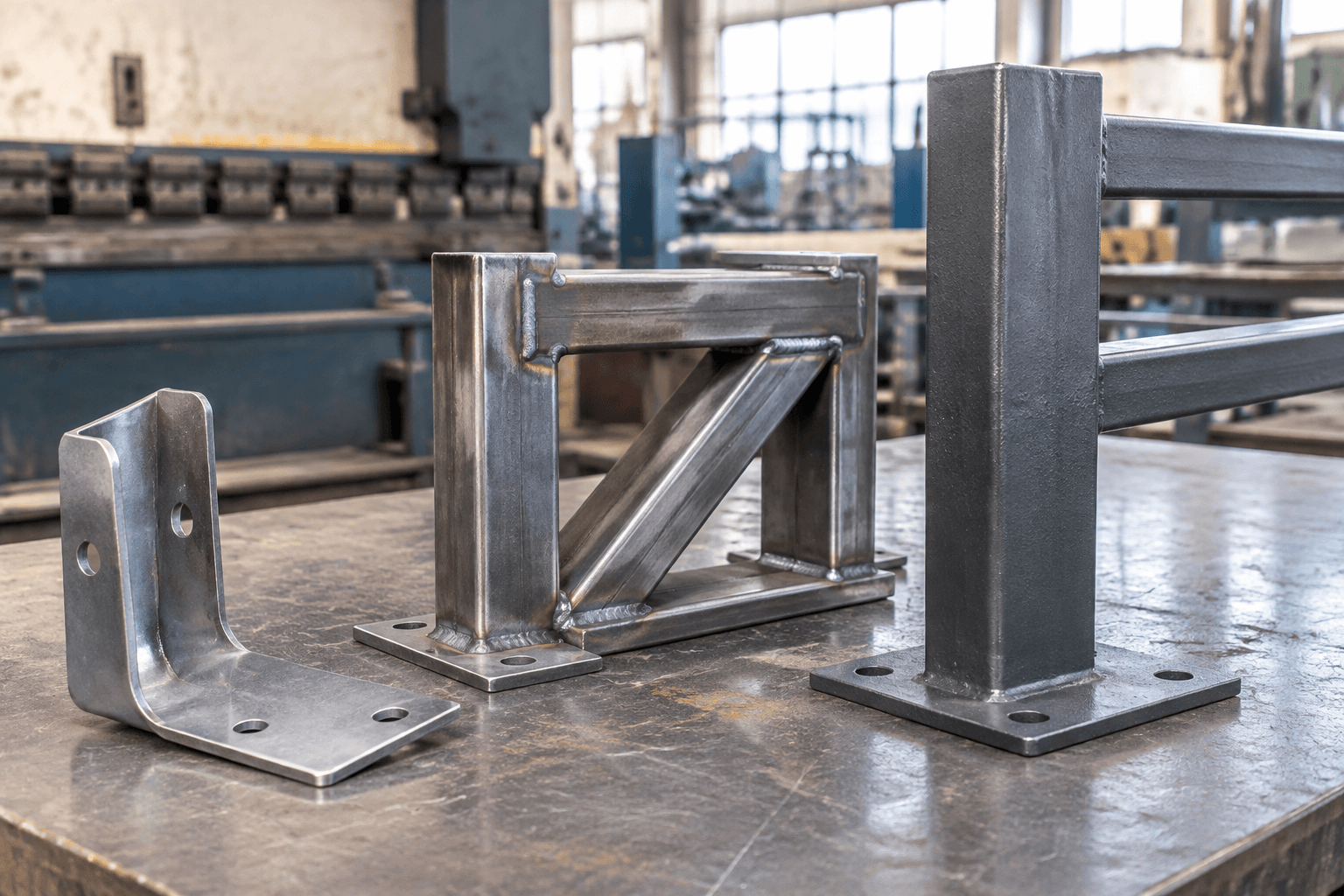
Lower-carbon sheet steels are commonly selected for brackets, covers, cabinets, and stampings because their ductility supports bending and forming. As carbon, strength, hardness, thickness, or prior cold work increases, the design may require larger bend radii, different grain orientation, intermediate annealing, or another manufacturing route. For custom metal brackets built to drawings, the load requirement must be considered together with hole-to-bend distance, bend direction, welding, and coating.
Welding
Weldability cannot be judged from carbon content alone, although carbon is a major factor. Other alloying elements contribute to hardenability, while joint restraint, thickness, preheat, heat input, hydrogen control, and cooling conditions influence cracking risk. A steel that machines or heat treats well may require a more controlled welding procedure than a lower-carbon forming grade.
Machining behavior
More carbon does not automatically mean easier or harder machining. Increased hardness can accelerate tool wear and raise cutting forces, but very soft, ductile material may produce long chips or built-up edge. Sulfur additions, cold-drawn condition, heat treatment, stock form, surface scale, and required finish also affect machining behavior.
Corrosion and finishing
Ordinary carbon and low-alloy steels can corrode when moisture and oxygen reach an unprotected surface. Carbon percentage alone does not determine field corrosion performance. Exposure to salt, humidity, chemicals, standing water, temperature cycles, crevices, and damaged coatings must be considered. Zinc finishes, painting, powder coating, plating, or a suitable stainless grade may be evaluated according to the environment.
Translating Part Requirements into a Steel Grade
Start with the service requirement rather than asking for generic steel. Define whether the part needs static strength, impact toughness, surface hardness, abrasion resistance, fatigue performance, dimensional stability, or resistance to a specific corrosive environment. Identify operating temperatures and whether the component will experience repeated loads or thermal cycles.
Next, review the manufacturing route. State the required stock form and thickness, the severity of bends or draws, welded-joint locations, machined features, heat treatment, surface finish, and coating system. Section changes and welded attachments can create local behavior that is not predicted by a bulk chemistry value.
The technical package should identify the material grade and condition when known, together with dimensions and the applicable material requirements. If substitutions are allowed, define which performance and fabrication characteristics must remain equivalent. A request such as “carbon steel, 2 mm” leaves unresolved questions about yield strength, forming quality, surface condition, coating compatibility, and required documentation.
For an early material review, B2B OEM and ODM buyers can provide Yishang with the part drawing or 3D model, requested material grade and condition if known, service environment and corrosion exposure, and critical strength, welding, forming, machining, or finishing requirements. Yishang can then review whether the specified grade and condition align with the part geometry, proposed manufacturing route, and end-use environment before detailed production planning.
Frequently Asked Questions
Is an alloy of iron and carbon always called steel?
No. Lower-carbon iron alloys are generally classified as steels, while higher-carbon compositions and casting-oriented structures are generally classified as cast irons. Additional elements and the governing specification also affect classification.
Does an iron-carbon alloy have a chemical formula?
No single formula represents all iron-carbon alloys. Commercial grades specify composition ranges. Fe3C is the formula for cementite, one possible phase within the material, not a formula for every steel or cast iron.
Why does more carbon make steel harder but often less ductile?
Carbon changes the phases and microstructures that can form in steel and increases its response to hardening treatments. Harder structures resist indentation and wear but usually permit less plastic deformation before cracking. The actual balance depends on heat treatment, section size, and grade.
Is stainless steel an alloy of iron and carbon?
Yes, stainless steel is iron-based and normally contains carbon, but it is not only an iron-carbon alloy. At least 10.5% chromium defines the stainless family, and many grades also contain nickel, molybdenum, nitrogen, manganese, or other elements.