
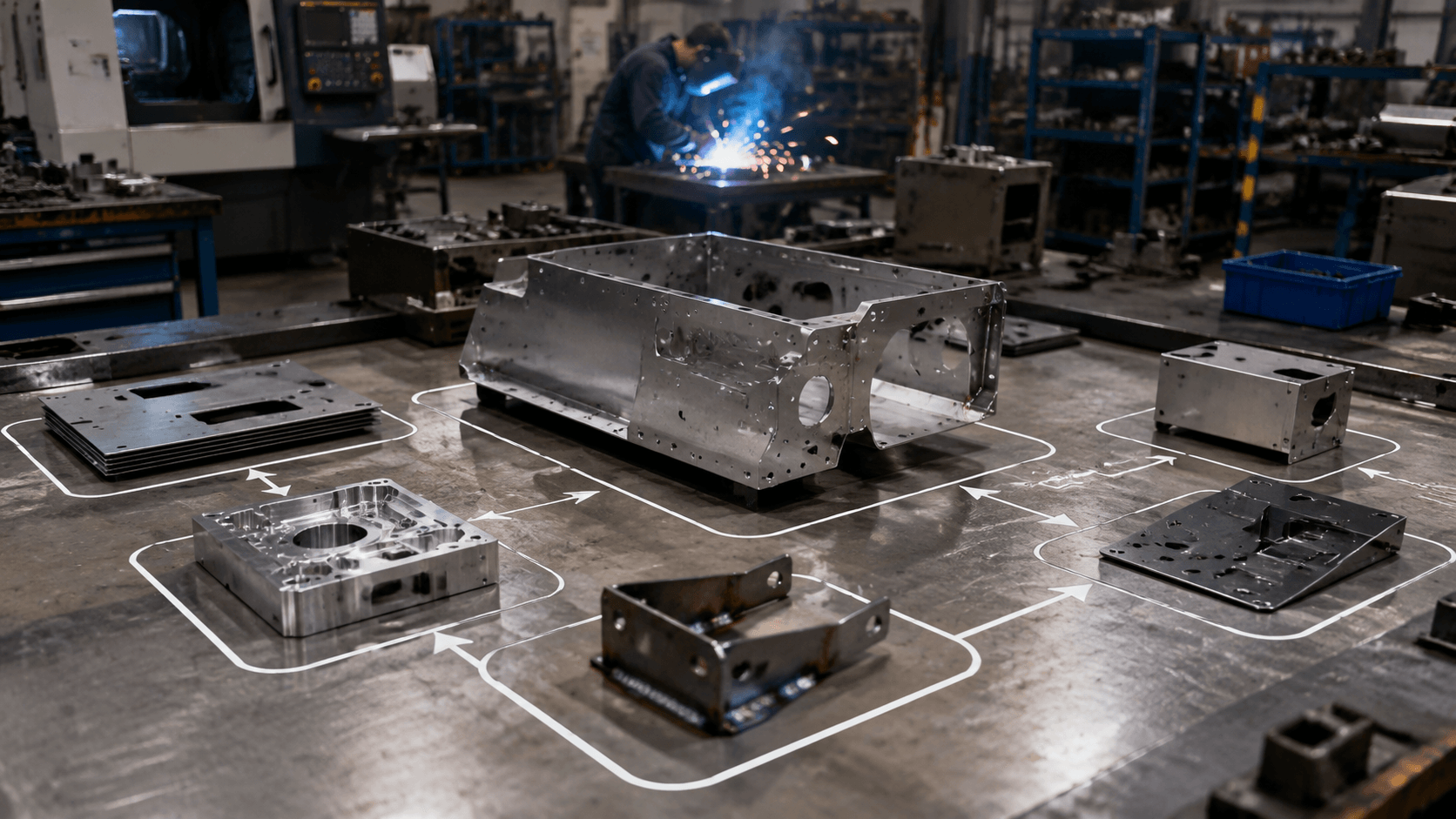
Mechanical fabrication is a context-dependent umbrella term in OEM manufacturing. It means converting metal stock into functional parts, structures, or assemblies through operations such as cutting, forming, joining, finishing, and sometimes machining.
Quick answer: Mechanical fabrication is not one universally standardized process name. Sheet metal fabrication, CNC machining, welding, finishing, and assembly describe different route components or scopes. The distinction matters when requesting a quote. A price for a cut-and-bent part is not comparable with a price for a welded, coated, inspected, ready-to-install assembly.
Mechanical Fabrication: Definition and Scope
The term becomes useful only when it is tied to the starting stock and final deliverable. Stock may be sheet, plate, tube, profile, bar, or another semi-finished metal form.
A route may include cutting, punching, forming, joining, finishing, inspection, and assembly. Machining can be added for a feature or interface, but it remains a distinct operation. Industry and supplier usage varies, so the term alone does not identify the material grade, stock thickness or size, geometry, tolerances, equipment, or inspection method.
For example, an equipment enclosure could start as sheet stock. It might go through laser cutting or CNC punching, metal bending, welded support installation, powder coating or polishing, and hardware assembly. A machined insert would follow a separate machining route before integration.
This is why an OEM should check a supplier’s stated scope against the actual part. The review should cover material form, geometry, critical features, joining requirements, finish, inspection, and the required deliverable.
From OEM Drawing to Finished Deliverable
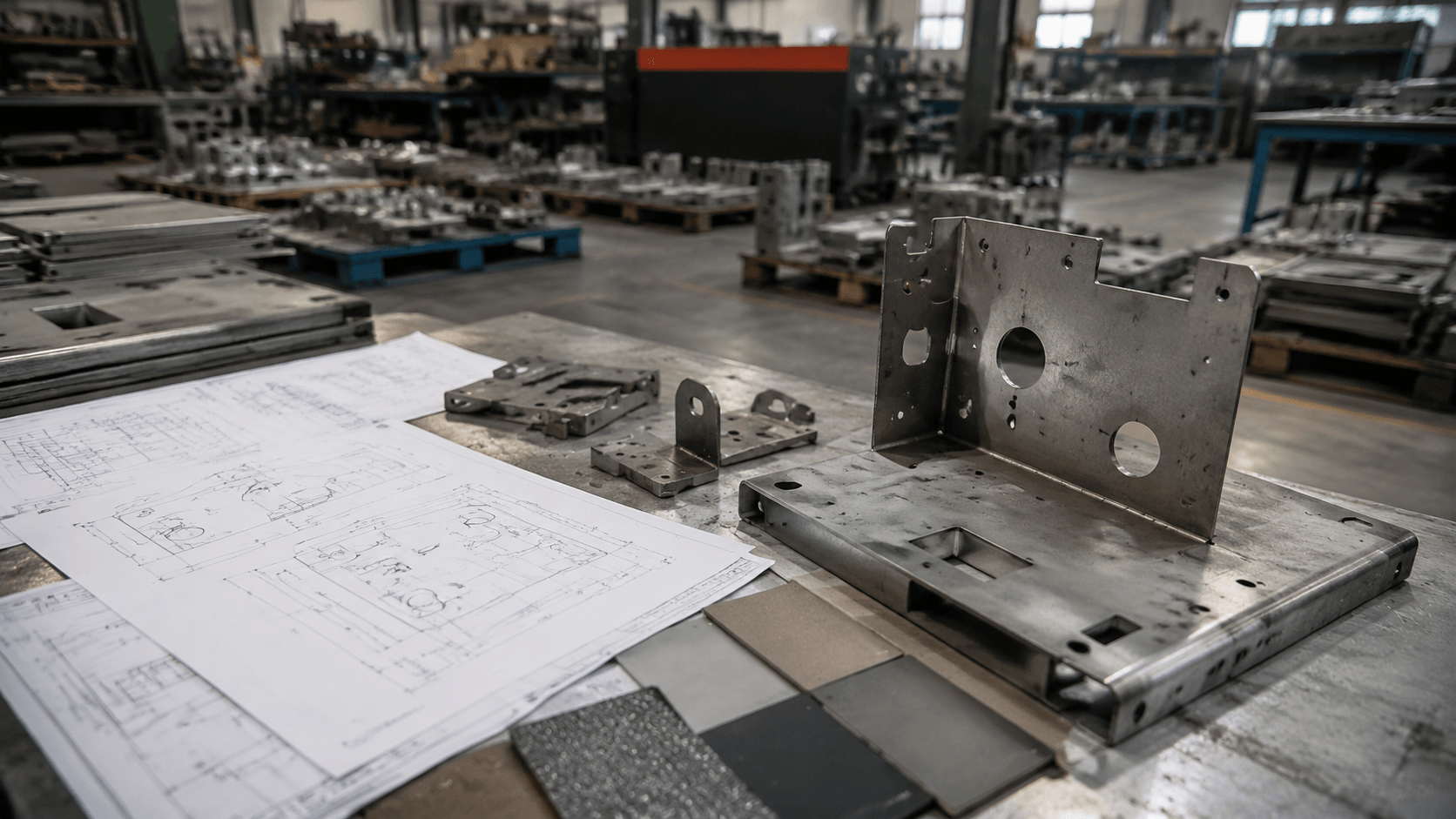
An OEM drawing does not automatically define the production sequence. A project review should connect design intent to stock, operations, interfaces, and checks before repeat production is released.
- Drawing and prototype review: Confirm the revision, material form, critical features, joining intent, finish, interfaces, and assembly requirements. Prototype review can expose ambiguity before batch production.
- Material and route definition: Material family or grade, stock form, thickness or stock size, geometry, and quantity help determine sheet processing, machining, structural fabrication, or a combined route.
- Sheet cutting: A sheet-based route may use laser cutting or CNC punching when the geometry and production conditions suit those operations. Holes, edge features, nesting, and secondary operations should be reviewed together.
- Forming and metal bending: The result depends on material, thickness, bend radius, bend sequence, and tooling assumptions. The relationship between bends and nearby holes also requires review.
- Welding and joining: Welding combines components, but it can introduce distortion and cosmetic or inspection requirements. Discuss joint access, visible welds, fixturing assumptions, and post-weld work.
- Finishing: Powder coating or polishing affects appearance, masking, protected interfaces, corrosion considerations, and fit. Define the finish before the route and quotation are finalized.
- Assembly and release: Fabricated components, hardware, and purchased parts are combined into the specified component, subassembly, or ready-to-install deliverable. Assign inspection, packaging, shipping, and batch-production responsibilities.
This is an illustrative route, not a universal sequence. Some parts need finishing before hardware installation. Others need post-weld machining or inspection before coating. The approved drawing and functional intent should establish the actual sequence and handoffs.
How Mechanical Fabrication Differs from Related Processes
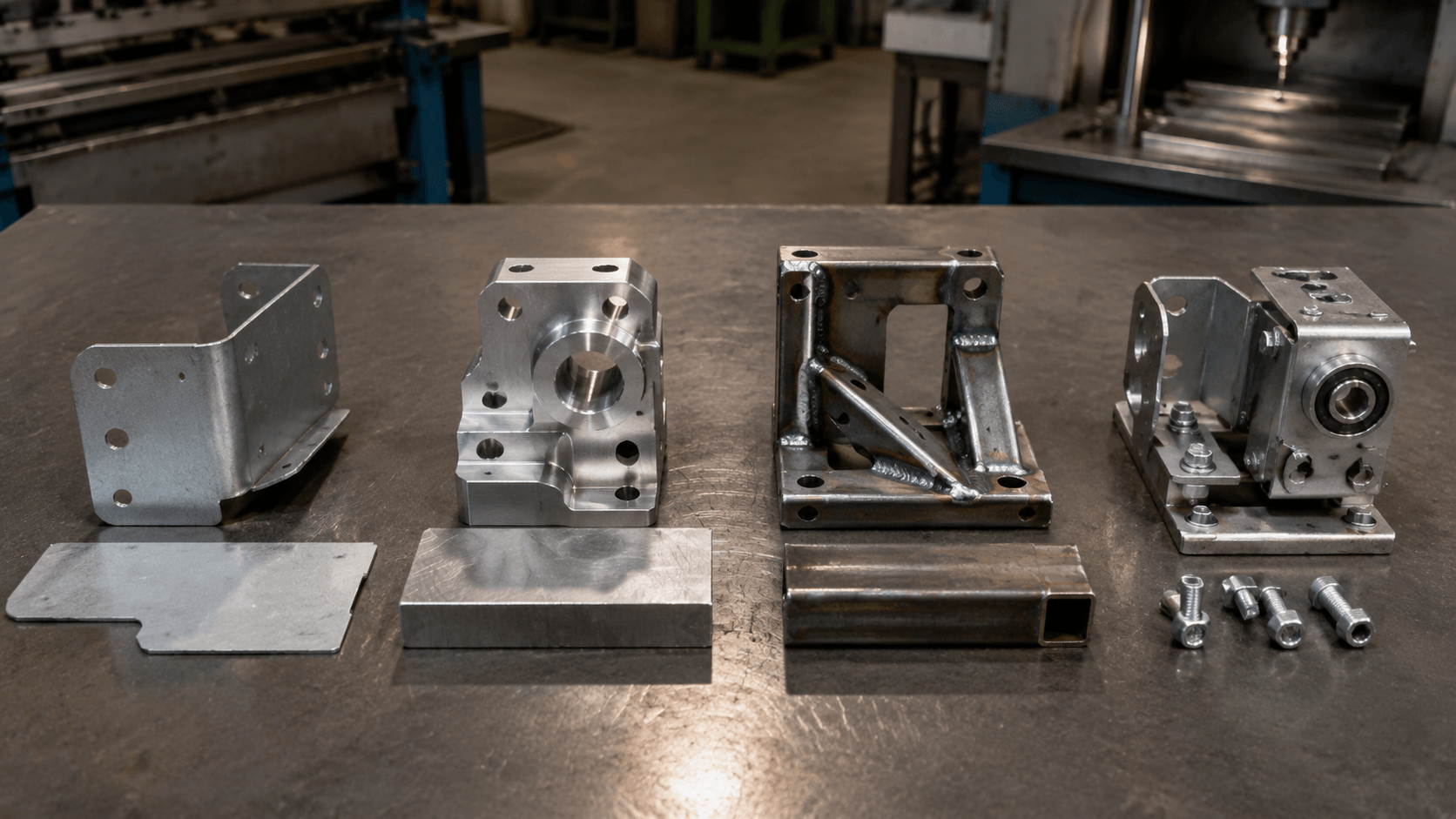
Two suppliers can interpret mechanical fabrication as a sheet part, welded structure, machined component, or complete assembly. Those interpretations change the starting material, dominant operation, and deliverable. Process names should therefore clarify scope rather than be treated as interchangeable.
| Scope | Starting material and primary operation | Typical deliverable |
|---|---|---|
| Mechanical fabrication | Broad category using sheet, plate, tube, profile, or other stock with multiple operations | A part, structure, subassembly, or finished metal product |
| Sheet metal fabrication | Primarily sheet stock; cutting, punching, bending, joining, and finishing | Panels, brackets, enclosures, cabinets, structures, or sheet metal parts |
| CNC machining | Solid or semi-finished stock; controlled material removal to create features | A component with detailed profiles, bores, pockets, threads, or interfaces |
| Welding fabrication | Plate, tube, profile, or prepared components; welded joining is central | A welded frame, support, chassis, or structural subassembly |
| Mechanical assembly | Fabricated parts, hardware, and purchased components; fastening and fitting | A functional unit or ready-to-install assembly |
These scopes can coexist. A sheet-metal assembly may include a separately machined insert and a welded frame. Final assembly then brings them together.
Confirm who owns each operation, interface, finish, inspection step, and shipping handoff. You can review the sheet metal fabrication route, CNC machining, and welding as separate scopes. The actual drawing still determines route fit.
Define the Route Before Requesting an RFQ
Before an OEM requests comparable pricing, define the information that determines the route. A clear package lets the supplier identify open decisions instead of applying different defaults.
- Design package: Send the current 2D manufacturing drawing, a 3D CAD model where available, the revision status, and intended prototype and production quantities.
- Material and stock: State the material family and exact grade or temper when relevant. Identify the sheet, plate, tube, profile, bar, or other stock form. Include the required thickness or stock size.
- Geometry and function: Provide overall dimensions, part size, datums, critical-to-function dimensions, geometric relationships, bend radii, holes, threads, cutouts, tolerances, and a surface-finish description.
- Joining and finishing: Include weld symbols, joint locations, visible-weld expectations, distortion limits, masking areas, and post-weld machining or finishing needs where applicable.
- Deliverable and control: Provide the assembly bill of materials, hardware and purchased-part details, fit requirements, and functional checks. State whether the deliverable is a component, welded subassembly, or ready-to-install product.
- Inspection and logistics: Define inspection expectations, documentation, packaging constraints, destination, and target production timing.
If a requirement is intentionally open, mark it for supplier review. Otherwise, suppliers may apply different assumptions to material, finish, assembly intent, or inspection. The resulting quotations will not describe the same scope.
Choose the Route and Control the Commercial Scope
At the screening stage, classify the project by starting stock, dominant geometry, and final deliverable. The matrix is an early decision tool. It is not a substitute for drawing review.
Mechanical fabrication route matrix
| Project pattern | Starting clue | Likely primary route | Clarify first |
|---|---|---|---|
| Flat or bent panel, enclosure, or bracket | Sheet stock | Sheet metal fabrication using cutting, punching, bending, and possible joining or finishing | Material, thickness, bend radii, interfaces, and finish |
| Solid-stock component with pockets, bores, threads, or detailed profiles | Solid or semi-finished stock | CNC machining | Stock, datums, critical features, and interfaces |
| Plate, tube, or profile frame | Members or prepared components | Welding fabrication | Joint design, visible welds, distortion, finish, and inspection |
| Several fabricated parts with hardware | Multiple component types | Mechanical assembly after fabrication | Bill of materials, purchased parts, fit, fastening, and functional checks |
| Sheet parts, machined interfaces, and a welded frame | Mixed stock forms | Combined manufacturing route | Process ownership, sequence, interfaces, inspection, and revision control |
Tube and profile processing may be more relevant when a project is not primarily sheet-based. Casting, extrusion, deep drawing, or injection molding may also warrant separate evaluation for other geometries or production economics. Do not infer in-house capability from related process names.
Why quotes and batches diverge
Quote differences may reflect material availability, part complexity, the number of operations, setup or tooling, fixtures, weld length, finishing, assembly labor, inspection, packaging, and shipping scope.
An offer is not comparable when hardware, coating, inspection documents, or export packaging are included in one scope but excluded from another. Unclear material, finish, tolerance, or assembly intent can lead to design changes, fit problems, rework, and batch inconsistency.
A prototype route may expose a bend-hole interference, inaccessible joint, or finish-related fit issue. Resolve those findings in an approved revision before scaling to repeat production.
| Potential batch risk | Control to clarify |
|---|---|
| Dimensional drift | Critical dimensions, first-piece approval, in-process checks, and final inspection |
| Welding distortion | Joint locations, distortion limits, fixture assumptions, and correction or machining needs |
| Finish variation or interference | Finish description, masking, protected interfaces, appearance expectations, and fit checks |
| Late engineering changes | Revision control, approval responsibility, and production-feedback process |
Evidence before award
- Drawing-based route review: Ask which listed processes apply to the actual part. Also ask which operations are subcontracted or assigned elsewhere.
- Responsibility map: Confirm responsibility for material, cutting, forming, joining, finishing, assembly, inspection, packaging, and shipping.
- Prototype-to-batch path: Establish how prototype findings become an approved revision. Confirm how that information is carried into batch production.
- Inspection approach: Request sample quality documentation or agree on an inspection approach tied to the drawing. The quality-control information can support this discussion without assuming a specific standard or result.
- Communication and change control: Confirm the process for OEM or ODM requirements, approvals, drawing changes, production feedback, quantities, and timing.
For overseas procurement, assign packaging and shipping scope, destination responsibilities, and the person who resolves drawing questions. Evidence should relate to the actual geometry and deliverable, not only to a generic capability list.
Frequently Asked Questions
What mechanical fabrication details should buyers define before requesting a quote?
Buyers should define the functional requirement, drawing notes, critical dimensions, material or process expectations, and any inspection points related to mechanical fabrication. This helps suppliers quote the same manufacturing scope instead of making different assumptions.
How can RFQ details affect cost, fit, or lead time?
RFQ details can change tooling, forming, welding, finishing, inspection, or rework requirements. If buyers do not clarify it early, two supplier quotes may look comparable while covering different production risks.
Why should drawing requirements be reviewed before prototype approval?
drawing requirements may look acceptable on a single sample but become harder to control during batch production. Buyers should confirm whether the prototype reflects the same process, finish, and inspection conditions expected for production.
What inspection points matter most for mechanical fabrication projects?
Important inspection points usually include fit-critical dimensions, holes or mating areas, cosmetic surfaces, finish build-up, welded or formed features, and any dimensions that affect downstream assembly. These points should appear in the RFQ or drawing notes.
How can buyers reduce prototype approval risk before batch production?
Buyers can reduce risk by clarifying drawings, locking key material and finish assumptions, defining inspection timing, approving a representative sample, and confirming which dimensions or surfaces require tighter process control.
How can Yishang help review mechanical fabrication requirements?
Yishang can review drawings, RFQ notes, material requirements, tolerance expectations, finish details, samples, and assembly needs to identify unclear assumptions before quoting or batch production.