
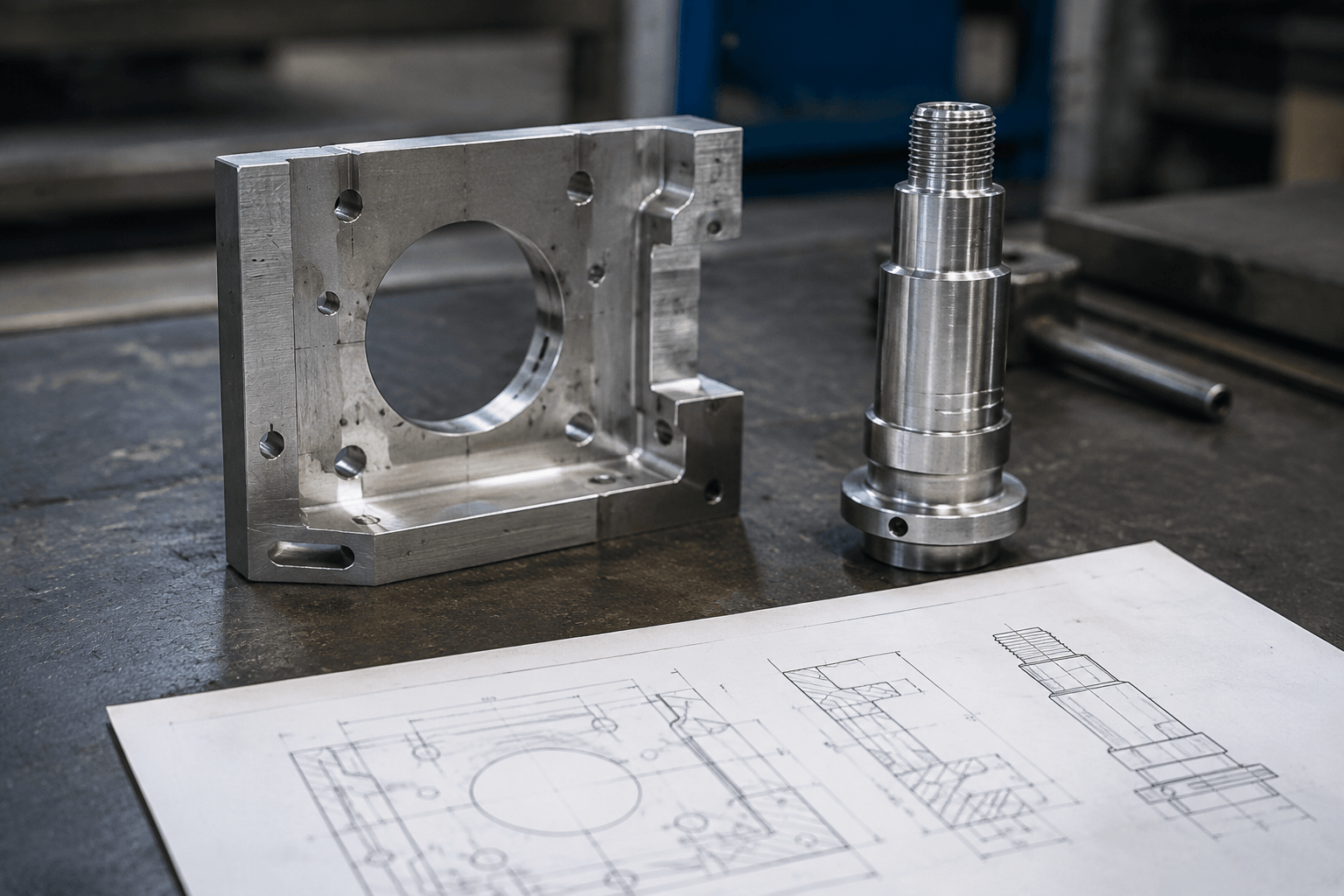
Metal CNC services generally refer to programmed milling and turning that remove material from metal stock according to CAD/CAM instructions.
For a buyer, the usable route, achievable tolerance, price, and schedule depend on the actual drawing, material, geometry, quantity, inspection requirements, and the supplier’s confirmed equipment and process scope.
Metal CNC services in practical terms
Metal CNC machining starts with block, plate, bar, or another suitable form of metal stock. CAM programming translates the design into tool paths and cutting operations, while workholding and inspection planning determine how the part can be made and checked. Deburring, surface treatment, and assembly are separate operations unless the quotation specifically includes them.
CNC milling uses a rotating, multi-edge cutting tool while the workpiece is secured in the machine. It is commonly considered for prismatic or non-axisymmetric parts with faced surfaces, pockets, steps, slots, holes, threads, profiles, and multiple datum relationships. Tool access and the number of workholding setups become more important when features are distributed across several faces.
CNC turning rotates the workpiece around a spindle while a single-point cutting tool controls outside diameters, inside diameters, and axial features. It is generally suited to rotational parts such as shafts, pins, bushings, and spacers. Drilling, boring, grooving, or threading may accompany turning, but the supplier should confirm which operations are included in the proposed route.
Mill-turn work is a supplier-dependent option that combines selected milling and turning features and may reduce repeated setups for some hybrid parts. It is not automatically the best solution. Confirm the equipment, feature access, part size, material range, tolerance strategy, and inspection plan before treating mill-turn as the production route.
Service names do not define the full capability. Before requesting a quote, check whether the supplier’s actual equipment, work envelope, tooling approach, material range, and inspection method fit the drawing.
Start with material, geometry, and tolerance
Material should be selected from the part’s functional requirements rather than from a generic list of metals. Alloy grade, temper or condition, stock availability, geometry, finish, and the supplier’s actual process range can all affect the result.
| Material candidate | Why it may fit | Checks before quoting |
|---|---|---|
| Aluminum | Low weight and generally good machinability; useful where strength-to-weight ratio, corrosion behavior, or conductivity matters. | Confirm alloy, required strength, temper, stock size, conductivity needs, and whether anodizing, painting, or another finish is required. |
| Steel | Often selected for load-bearing or wear-related requirements, with strength, machinability, and cost varying substantially by grade. | Review density, machinability, heat-treatment condition, raw-stock cost, tool wear, and corrosion-protection requirements. |
| Stainless steel | May suit parts where corrosion resistance, hygiene, or appearance is important. | Grade selection affects cutting behavior, work-hardening risk, cost, surface appearance, and any passivation or other finishing requirement. |
| Brass | May suit parts requiring good machinability, conductivity, corrosion resistance, or a particular visual finish. | Confirm the grade, structural strength, conductivity requirement, raw-stock price, and permitted surface treatment. |
Design review should flag thin walls, deep cavities, small or deep holes, internal corners, threads, undercuts, and difficult tool-access directions. Thin sections can be vulnerable to vibration or distortion. Deep cavities may require long tools or additional setups, while internal corners normally need a radius related to the cutting tool. Undercuts may need special access or a different process. Flatness, concentricity, and relationships between datums should be considered together rather than as isolated callouts.
Assign tight tolerances only to features that affect fit or function. Feasibility depends on the alloy, part size, geometry, datum strategy, machine route, workholding, temperature conditions, and measurement method. A tolerance copied from a general service page should not be assumed to apply to every metal part.
A machined part is not the same as a formed sheet-metal part
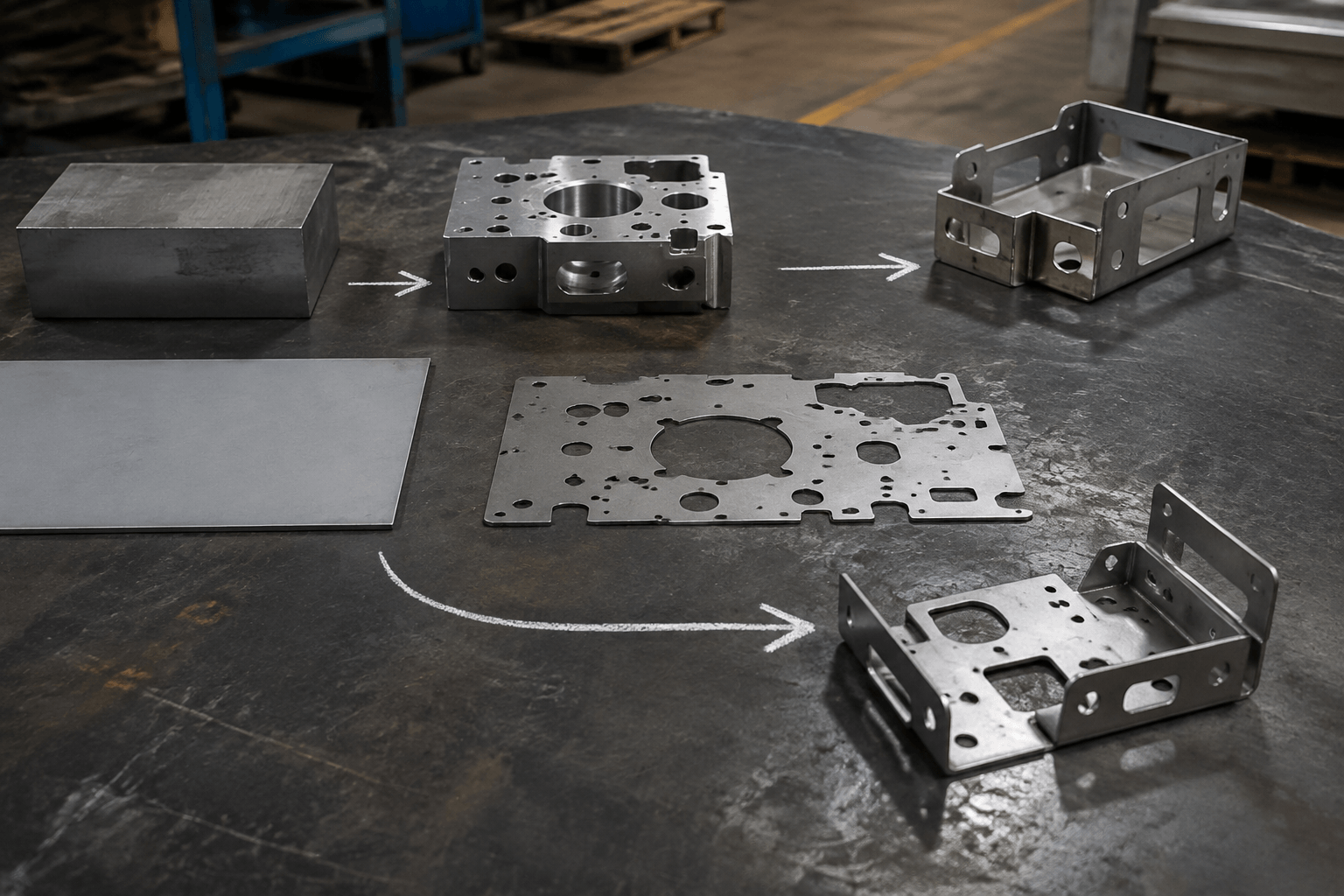
CNC machining and sheet metal fabrication can both produce custom metal parts, but they start from different stock and create geometry in different ways. CNC milling and turning remove material from block, plate, or bar. Laser cutting and CNC punching primarily create profiles and holes in sheet, while bending changes sheet geometry through forming rather than removing most of the part volume.
| Part requirement | Route to compare first | Main decision points |
|---|---|---|
| Three-dimensional body with pockets, steps, or cross-features | CNC milling from block or plate | Review material removal, tool access, stock waste, datum control, and setup count. |
| Round shaft, pin, spacer, or bushing | CNC turning from bar | Check diameter relationships, bores, threads, grooves, and any secondary milling or drilling. |
| Flat profile with through-holes in relatively uniform sheet | Laser cutting or CNC punching | Compare sheet thickness, hole and profile requirements, edge condition, material utilization, and secondary operations. |
| Bracket, tray, or enclosure with bend lines | Cutting followed by sheet-metal bending | Review bend allowance, springback, corner relief, flange access, and forming-tool constraints. |
| Formed shell with a machined interface | Multi-process route | Compare machining, forming, welding, or assembly as separate steps and control the interface datums. |
CNC punching is programmable sheet-metal blanking, not the same operation as CNC milling or turning. A formed sheet part may use less material and fewer cutting passes than a machined block, while a machined part may provide deeper three-dimensional features or more flexible internal geometry. Neither route is universally better. Compare the drawing, annual volume, functional surfaces, wall thickness, material waste, and total secondary-operation cost. For a parallel review, see custom sheet metal fabrication built to your drawings.
Price and schedule are built from more than cutting time
Material grade, stock dimensions, availability, and material utilization establish the starting cost. The quotation may then include programming, workholding, fixture preparation, setup count, tool changes, machining time, and toolpath complexity. A part requiring several orientations can cost more than one with similar overall dimensions but simpler tool access. Deep cavities, small features, and numerous tool changes can also increase process time.
Tolerances affect both production planning and inspection. Numerous critical callouts may require more measurement, additional setup control, or a more carefully defined machining sequence. Where applicable, separate recurring unit cost from nonrecurring programming, fixture, tooling, or setup charges. Quantity and repeat-order status can change how those costs are distributed, so the supplier should state the commercial assumption.
Deburring, edge treatment, surface finishing, secondary drilling or tapping, inspection reports, material documentation, special packaging, labeling, and shipping can all change the quoted total. Lead time depends on material availability, machine loading, geometry, quantity, approval cycles, and inspection requirements. A responsible quote should state what is included, what remains to be confirmed, and whether the schedule starts after drawing approval, material approval, or another agreed milestone.
Supplier evidence that matters on a real drawing
Before approving a metal CNC services supplier, request project-specific answers rather than relying on a broad capability list:
- Process route: Ask whether the part will use milling, turning, mill-turn, or a combination. Confirm that the proposed equipment, material range, part-size envelope, and feature access match the drawing.
- DFM feedback: Ask the supplier to identify thin-wall, deep-hole, undercut, corner-radius, datum, or distortion risks and suggest changes before production.
- Workholding and sequence: Request an explanation of how the part will be supported, oriented, and referenced when several faces or critical relationships must be controlled.
- Approval and inspection: Confirm whether first-piece or sample approval, in-process checks, final inspection, and agreed measurement records are available for the order.
- Documents and traceability: Ask which dimensional reports, material documents, batch identification, and inspection records can accompany the shipment.
- Nonconformance handling: Clarify how out-of-specification parts are segregated, reviewed, reworked, replaced, or accepted under an approved deviation.
- Export handling: Confirm packaging protection, labels, quantity identification, and how destination-specific shipping instructions will be handled.
For context, Yishang’s verified company background includes more than 26 years of custom metal-product manufacturing experience, exports to more than 50 countries, B2B wholesale and custom projects, OEM and ODM manufacturing support, and ISO and RoHS certifications. These company-level facts do not by themselves confirm specific CNC equipment or tolerance capability. Buyers should review the dedicated custom CNC machining service scope and request confirmation against the actual part.
Need an early process-fit review? Send a representative 2D drawing or 3D CAD file with the material, quantity, critical features, finish, inspection needs, and target timing. This gives both sides a basis for discussing the route and quote assumptions before a formal RFQ.
Metal CNC services RFQ checklist for overseas OEM buyers
A drawing-based inquiry is easier to review when the technical, commercial, and logistics inputs arrive together. Include the following:
- Drawing package: Provide the 2D manufacturing drawing and, when available, the 3D CAD model. State units, revision level, drawing status, and material callouts.
- Material: Specify the alloy grade and condition, or identify an approved equivalent for supplier review. Do not rely only on a color or general material name.
- Quantity: State prototype quantity, initial order quantity, expected annual demand, and whether the part is for repeat production.
- Critical features: Mark functional dimensions, datums, geometric tolerances, threads, hole requirements, flatness, concentricity, and mating interfaces.
- Edge and surface requirements: Define deburring, edge breaks, burr limits, visible-surface expectations, and required finish or secondary treatment.
- Inspection: List required inspection documents, sample-approval steps, material documentation, batch traceability, and any customer-specific acceptance record.
- Packaging and destination: State individual protection, bulk-packaging limits, labels, destination country, shipping address, and requested shipping terms when known. Yishang’s overseas shipping information can be reviewed alongside these requirements.
- Timing: Identify prototype, sample-approval, first-batch, and repeat-order timing needs, while allowing the supplier to base the schedule on material availability and capacity.
- Quote format: Ask the supplier to separate, where applicable, material, machining, setup or tooling, finishing, inspection, packaging, and shipping assumptions.
For quality-document expectations, buyers can also review quality-control and inspection considerations. The goal is not to demand every document on every order, but to agree in advance on what demonstrates conformity for the specific part and batch.
Request a qualified metal CNC services quotation: Submit the 2D drawing, 3D CAD file, material specification, initial and repeat quantities, critical dimensions, tolerances, datums, threads, inspection requirements, surface finish, deburring, packaging, destination, shipping requirements, and any prototype or sample-approval timing. Yishang can then review whether the project fits an available custom-metal route and base the quotation on stated assumptions rather than generic tolerance or delivery claims.
Frequently Asked Questions
Does metal CNC services mean milling, turning, or both?
It can mean either process or both, depending on the supplier’s service scope. Milling is generally used for prismatic features and turning for rotational features. A supplier may also propose mill-turn work or separate operations for a hybrid part, but the route must be confirmed against the drawing.
Are laser cutting and CNC punching the same as CNC machining?
No. Laser cutting and CNC punching are programmable sheet-metal cutting or blanking processes. CNC milling and turning remove material from block, plate, or bar using cutting tools. The processes may appear in one OEM project, but they should be quoted and evaluated as distinct routes.
Can a supplier apply one generic CNC tolerance to every metal part?
No. Tolerance feasibility depends on material, part size, geometry, datum strategy, workholding, machine route, temperature conditions, and inspection method. Critical features should be identified on the drawing and confirmed with the supplier rather than accepted from a generic service-page value.
Which cost and lead-time assumptions should appear in a metal CNC services quote?
The quote should state material and stock assumptions, quantity, programming or setup charges, machining, tooling or fixtures, finishing, inspection documents, packaging, and shipping. It should also explain the schedule basis, including material availability, approval timing, machine loading, inspection, and any exclusions.