
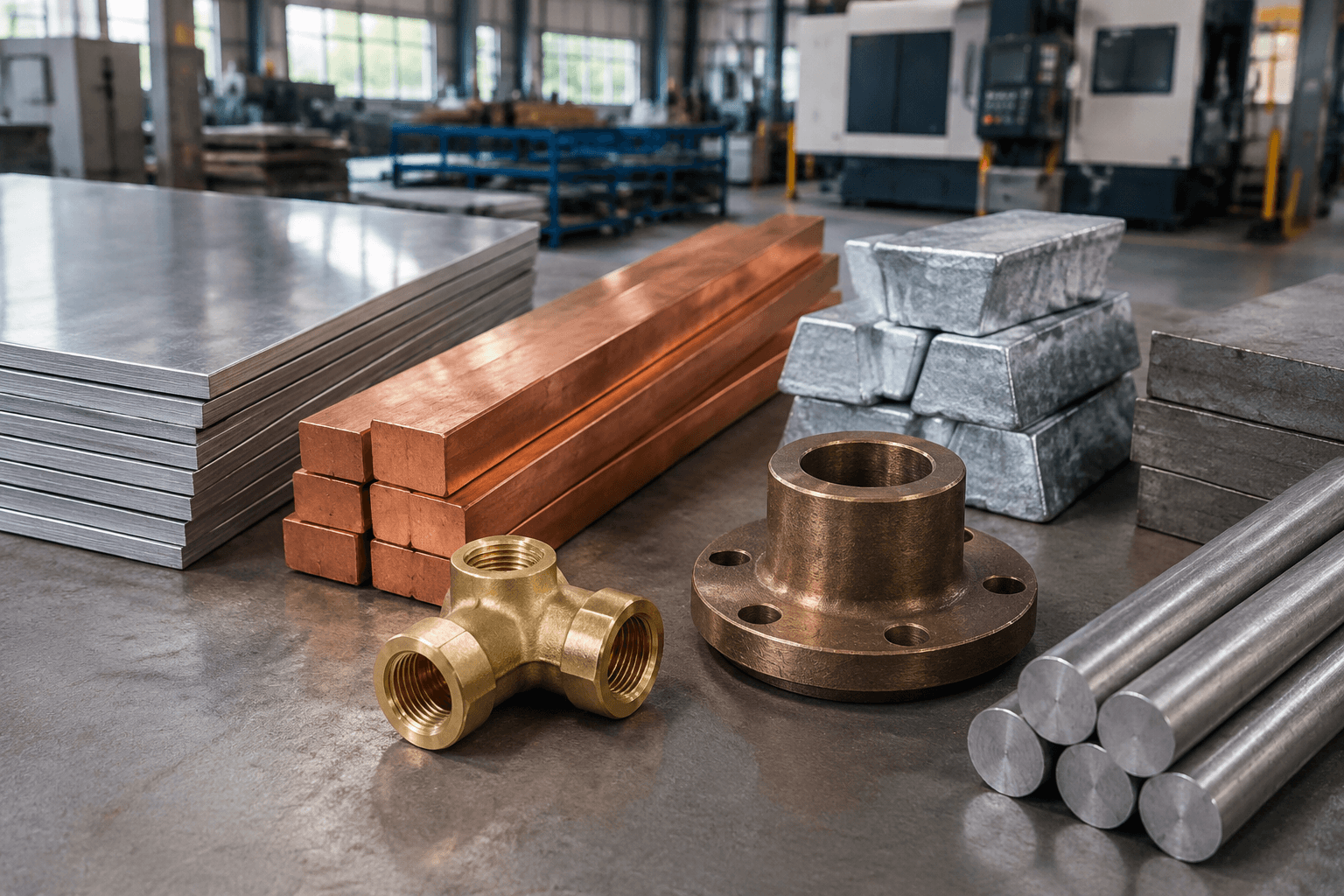
A non-ferrous metal is a metal or alloy in which iron is not the principal metallic constituent. The classification does not mean the material is absolutely iron-free, non-magnetic, lightweight, or corrosion-proof.
What Does Non-Ferrous Mean?
In metallurgy, ferrous generally describes iron-based metals, while non-ferrous describes metals in which iron is absent as the principal constituent. This is a compositional classification. A non-ferrous alloy may contain a controlled amount of iron or trace iron without becoming an iron-based material. What matters is the alloy system and its principal metallic base, not an absolute zero-iron rule.
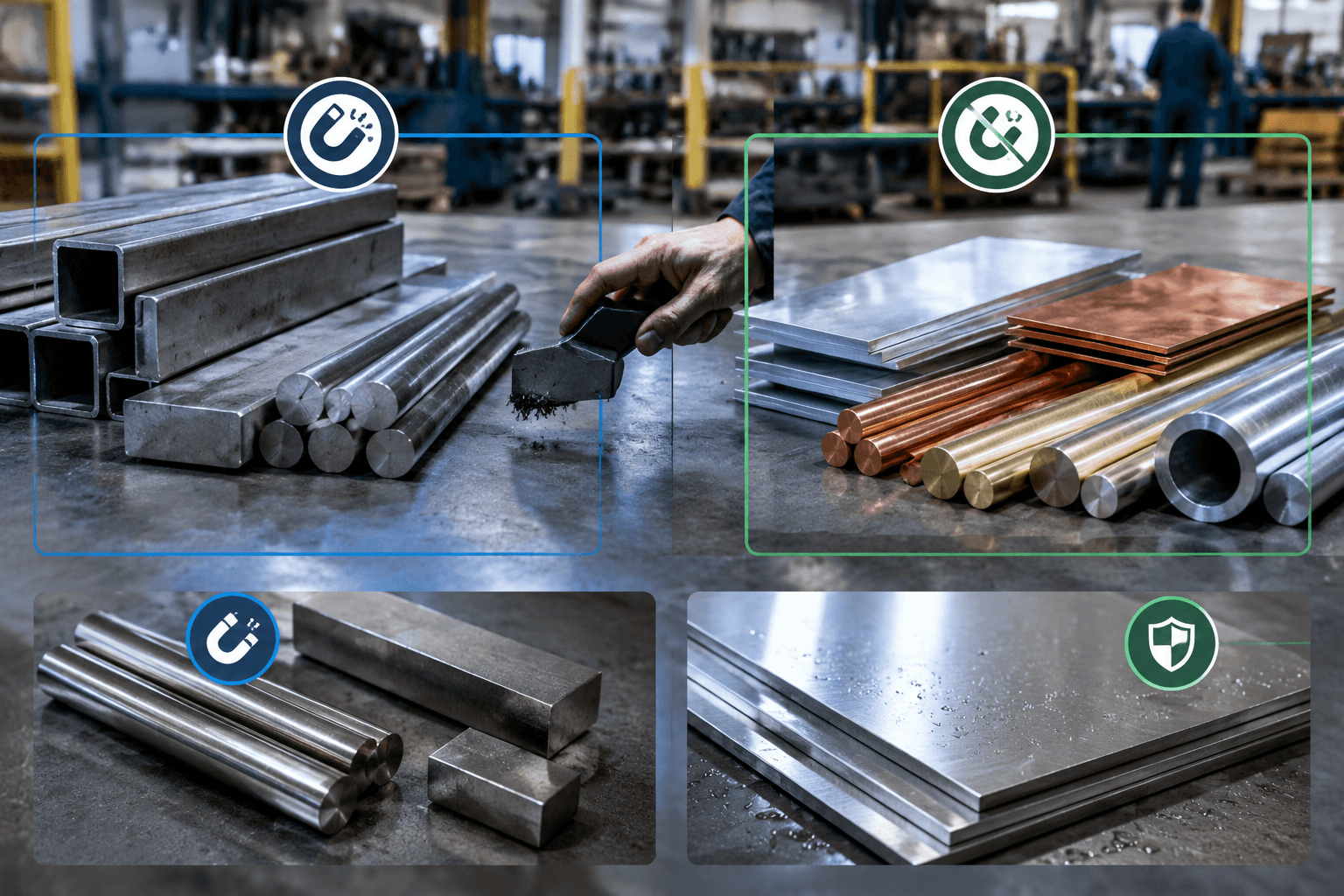
Ferrous and non-ferrous also should not be treated as synonyms for magnetic and non-magnetic. Some iron-based alloys are weakly magnetic or effectively non-magnetic in particular conditions, while nickel and cobalt can show strong magnetic behavior even though they are non-ferrous by composition. Heat treatment, cold work, phase structure, alloying, and temperature can further affect magnetic response.
Likewise, category-level tendencies require qualification. Aluminum is usually much less dense than steel, but lead and many nickel alloys are not lightweight. Copper is highly conductive, but titanium and lead are not selected for the same electrical role. Many non-ferrous alloys resist atmospheric corrosion well, yet their performance depends on the environment and can be reduced by galvanic coupling, chemicals, temperature, crevices, or surface damage.
Common Families and Where Brass and Bronze Fit
Several elemental metals form the basis of common non-ferrous material families. Their alloying additions are used to adjust strength, ductility, castability, conductivity, wear behavior, corrosion performance, or manufacturing response.
| Family or metal | Classification | Typical distinguishing traits |
|---|---|---|
| Aluminum | Elemental base and aluminum-alloy family | Low density in many grades, useful formability, and good corrosion behavior in suitable environments |
| Copper | Elemental base and copper-alloy family | High electrical and thermal conductivity in appropriate grades; ductile and widely formable |
| Zinc | Elemental base and zinc-alloy family | Useful corrosion-protection role, castability in suitable alloys, and relatively low melting temperature compared with many engineering metals |
| Titanium | Elemental base and titanium-alloy family | High specific strength and corrosion resistance in selected environments, with more demanding processing and cost considerations |
| Nickel | Elemental base and nickel-alloy family | Useful high-temperature and corrosion-resistant alloy systems; some nickel materials are magnetic |
| Lead | Elemental base and lead-alloy family | High density, softness, shielding value in certain applications, and significant health and regulatory constraints |
| Cobalt | Elemental base and cobalt-alloy family | Important high-temperature, wear, and magnetic material systems; generally not a lightweight choice |
| Brass | Copper-zinc alloy family | Often selected for machinability, appearance, formability, and service characteristics that depend on the grade |
| Bronze | Copper-alloy family, commonly with tin or other additions | Can provide useful wear, bearing, casting, or corrosion characteristics depending on the alloy |
Brass and bronze therefore belong in a discussion of non-ferrous metals, but neither is an elemental metal. Their properties cannot be inferred from the word copper alone. Zinc content, tin or other alloying elements, temper, casting method, and product form can materially change performance.
Ferrous and Non-Ferrous Metals in Practical Comparison
| Decision factor | Non-ferrous metals | Ferrous metals |
|---|---|---|
| Material basis | Usually based on aluminum, copper, zinc, titanium, nickel, lead, cobalt, or another non-iron system | Based primarily on iron, including carbon steels, alloy steels, cast irons, and stainless steel families |
| Density | Ranges widely. Aluminum is typically light, while lead, cobalt, and some nickel alloys are comparatively dense | Many common steels and cast irons are denser than aluminum, but density still varies by alloy |
| Corrosion behavior | Some form protective films or offer strong resistance in defined environments; others require coatings, isolation, or careful chemical assessment | Plain carbon steel can rust readily, while stainless and other alloy steels can provide substantial corrosion resistance |
| Electrical and thermal conductivity | Copper and selected aluminum grades are widely used where conductivity matters; other non-ferrous metals conduct much less effectively | Most steels have lower conductivity than copper or aluminum, although the exact comparison depends on grade and condition |
| Magnetic response | Often non-magnetic in common applications, but nickel, cobalt, and some alloys can be magnetic | Many iron-based materials are magnetic, but austenitic stainless steels and other conditions may show weak or limited response |
| Strength and stiffness | Can range from soft and ductile to very strong, temperature-resistant alloy systems | Often offers high stiffness and broad structural availability, but no single ferrous property applies to every grade |
| Product forms | Available as sheet, plate, bar, tube, wire, foil, extrusion, forging, casting, and machined stock depending on alloy and supply chain | Also available in extensive sheet, plate, bar, tube, forging, casting, and fabricated forms |
The comparison is a screening tool, not a substitute for a material specification. Stainless steel is a clear reminder that ferrous does not automatically mean poor corrosion resistance. Nickel and cobalt are reminders that non-ferrous does not automatically mean non-magnetic or low density. Titanium demonstrates that high specific strength can coexist with difficult machining and higher material cost. Lead demonstrates why density and application restrictions can outweigh other technical advantages.
Cost also needs careful treatment. A non-ferrous metal is not always more expensive because it is rare. Price depends on alloy chemistry, market conditions, product form, minimum order quantity, processing losses, availability, certification or documentation requirements, and the amount of fabrication required. A less expensive raw material may become the higher-cost component if it needs extensive coating, machining, joining, or inspection.
Where Common Non-Ferrous Materials Fit—and What to Check
| Material | Where it may fit | Important limitations and checks |
|---|---|---|
| Aluminum | Lightweight covers, frames, housings, heat-transfer parts, and formed or extruded components | Grade and temper affect strength and formability. Galvanic contact, surface damage, joining method, and thermal expansion require review |
| Copper | Busbars, electrical conductors, heat exchangers, plumbing-related parts, and thermal interfaces | High conductivity can be accompanied by greater weight and material cost than aluminum. Forming, machining, and joining behavior vary by grade |
| Zinc | Protective coatings, cast components, and applications needing useful casting behavior or dimensional detail | Strength, creep, corrosion behavior, and service temperature must be assessed for the selected alloy and process |
| Titanium | Components needing a favorable strength-to-weight relationship or strong corrosion performance in selected environments | Raw material and processing can be costly. Machining, joining, surface condition, and temperature limits need grade-specific review |
| Nickel | High-temperature, chemically demanding, or specialized magnetic and electrical applications | Nickel alloys can be dense and expensive. Some are magnetic, and machining or forming may be demanding |
| Lead | Specific shielding, ballast, sealing, or chemical applications where its density and softness are useful | Toxicity, exposure control, recycling, workplace rules, and end-use regulations may restrict selection |
| Brass | Fittings, connectors, decorative parts, machined components, and selected formed or cast products | Different copper-zinc grades have different machinability, dezincification resistance, strength, and joining behavior |
| Bronze | Bearings, wear components, marine-related parts, castings, and other applications suited to a specific bronze grade | Bronze is a broad family. Tin, aluminum, silicon, and other additions change strength, wear, corrosion, and processing characteristics |
Manufacturing route influences what can realistically be purchased and produced. Extrusion can create efficient constant profiles in suitable aluminum alloys, while custom aluminum extrusion components may need a design review for die geometry, wall transitions, and finishing. Die casting can suit selected zinc, aluminum, and other non-ferrous alloys when the geometry and production volume support it; it is one route, not a defining feature of the category. Sheet fabrication, machining, forging, and casting each impose different requirements on thickness, grain direction, draft, bend radii, tooling, and inspection.
A Requirement-Led Material Selection Path
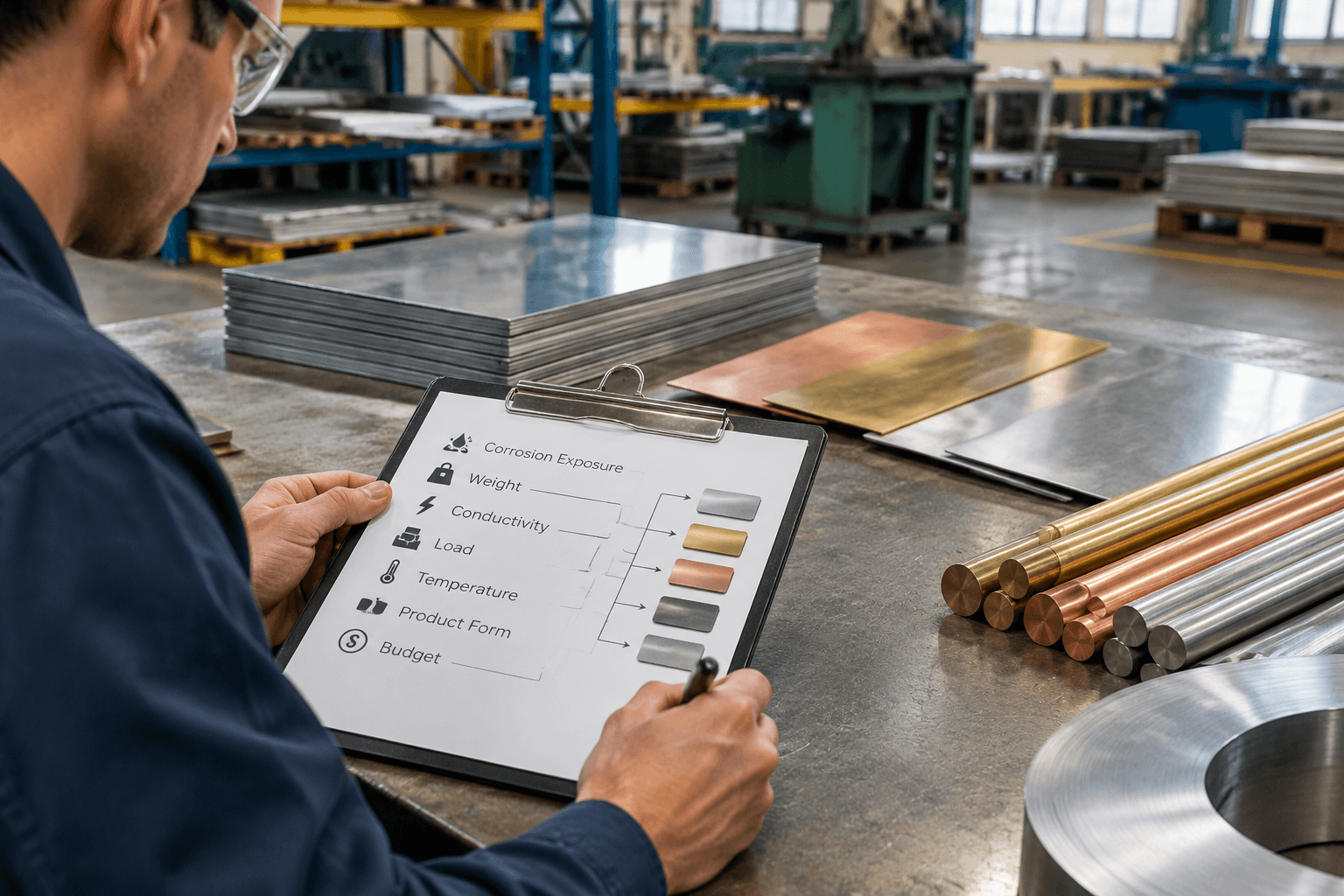
Start with the service requirement, then narrow the material family and finally specify the exact grade, temper, condition, and product form.
- Define the environment. Identify humidity, salt exposure, chemicals, temperature cycling, outdoor exposure, abrasion, and contact with dissimilar metals. A material that performs well in dry indoor service may require isolation or finishing in a marine or chemical environment.
- Set the mechanical target. Record load type, stiffness, impact, fatigue, wear, deflection, and fastening requirements. Strength alone is not enough; modulus, geometry, joint design, and temperature may control the component.
- Decide whether weight is a primary constraint. Aluminum may be a sensible screening candidate for a lightweight enclosure, while copper may be justified when conductivity is more important than mass. Titanium may enter the discussion when both weight and demanding service conditions matter, subject to cost and processing feasibility.
- Separate electrical and thermal needs. Specify conductivity, contact resistance, heat flow, insulation, and temperature conditions. Copper and aluminum should not be treated as interchangeable without checking connections, expansion, surface treatment, and cross-section.
- Match the manufacturing route. Confirm whether the part will be cut and bent from sheet, machined, extruded, forged, or cast. For sheet-form components, material, thickness, bend geometry, joining, and finish must be reviewed together. A custom sheet metal enclosure may need a different material decision from a cast housing with the same external dimensions.
- Check joining and finishing. Welding, brazing, soldering, mechanical fastening, plating, anodizing, painting, passivation, and other treatments are alloy- and process-dependent. Also assess galvanic compatibility between the component and its fasteners or mating parts.
- Confirm availability and total cost. Review local and export availability, standard stock forms, minimum order quantities, scrap value, machining time, tooling, finishing, inspection, packaging, and expected supply stability. Recyclability can support recovery value, but contamination and mixed-alloy separation affect the result.
For example, a lightweight electrical enclosure may begin with aluminum or a suitable coated ferrous option, but the final choice depends on conductivity, shielding, stiffness, corrosion exposure, forming, and assembly. A wear bushing may prompt a bronze comparison, yet load, lubrication, shaft material, speed, and manufacturing method decide whether that family is appropriate. These are screening examples, not final engineering approvals.
Yishang has more than 26 years of experience manufacturing custom sheet metal parts and metal products for B2B OEM and ODM projects, with exports to more than 50 countries. For a preliminary material review, provide a component drawing or concept, service environment, load and weight priorities, conductivity or finish requirements, intended manufacturing route, and any current material specification or alternatives under consideration. This information allows the material family and product form to be discussed together.
Frequently Asked Questions
Is cobalt a ferrous metal?
No. Cobalt is classified as non-ferrous because it is not an iron-based principal constituent. However, cobalt can be ferromagnetic, which shows why chemical classification and magnetic behavior are different questions.
What is the strongest non-ferrous metal?
There is no single answer without defining the strength metric and conditions. Tensile strength, yield strength, fatigue strength, creep resistance, fracture toughness, temperature, alloy, heat treatment, and product form can change the ranking. High-strength titanium, nickel, cobalt, and aluminum alloy systems may each be suitable for different requirements.
Are all non-ferrous metals non-magnetic and corrosion resistant?
No. Nickel and cobalt can be magnetic, and some non-ferrous alloys may show magnetic response. Corrosion resistance is also environment-specific. Alloy chemistry, galvanic contact, temperature, chemicals, surface condition, and protective finishing all affect performance.
What are five common ferrous metals or alloy families?
Common ferrous examples include carbon steel, alloy steel, stainless steel, tool steel, and cast iron. They contrast with aluminum, copper, zinc, titanium, nickel, brass, and bronze, which are non-ferrous systems. The comparison still depends on the exact grade, condition, and product form.