
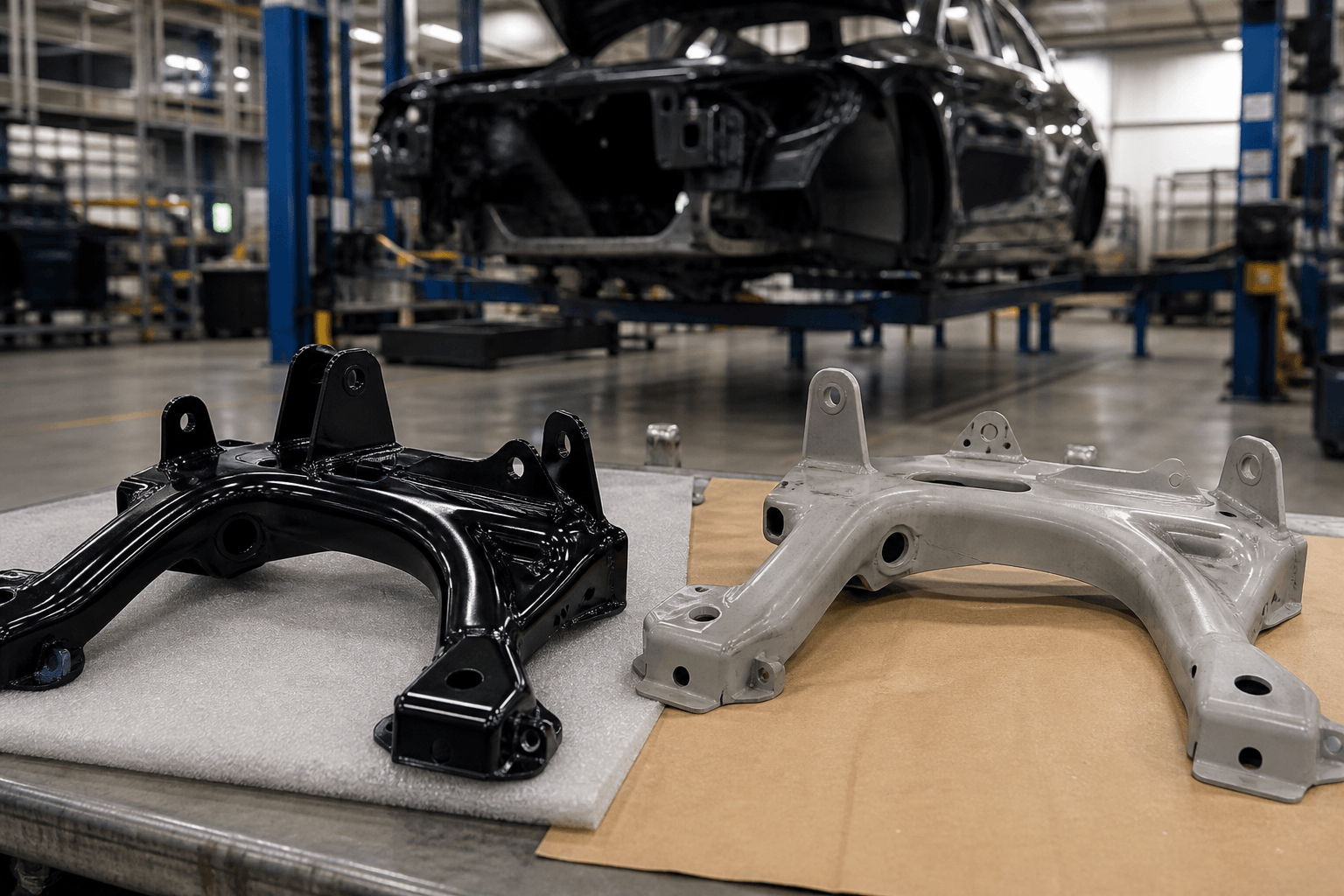
In an OEM context, “powder coat car” usually means coating selected removable, electrically conductive metal parts—not sending a fully assembled vehicle through a powder-coating line. Wheels, brackets, mounts, frames, and selected underbody components may be candidates, but each part must be reviewed for disassembly, substrate preparation, oven-cure tolerance, masking, fit, grounding, appearance, and service environment. A complete vehicle includes seals, plastics, glass, electronics, lubricated joints, and heat-sensitive assemblies, so whole-vehicle coating is impractical without substantial disassembly and engineering validation.
For an OEM buyer, this question often appears when a drawing calls for a durable finish on a bracket, wheel, mount, or other metal component. The correct scope is the part, not the vehicle name. Even a removable body panel needs separate review because its size, visible-surface requirements, color matching, repair expectations, and possible distortion may make liquid automotive paint more appropriate.
Can This Car Part Be Powder Coated? An OEM Suitability Matrix
When an automotive part reaches a coating supplier, the first screen is practical: Is the substrate conductive, can the part tolerate the complete cure cycle, and can sensitive surfaces be masked? The decision also depends on corrosion exposure, UV, humidity, chemicals, abrasion, geometry, dimensional fits, and safety function. A conductive metal part is not automatically suitable for standard powder coating, especially when it arrives as an assembly.
| Part category | Possible fit | Principal risk | Required confirmation |
|---|---|---|---|
| Wheels and removable visible metal parts | Often feasible after part-specific review | Surface preparation, visible finish, mounting faces, stud holes, balance, outdoor exposure, and structural requirements | Substrate, existing coating, wheel-specific mounting review, masking map, color, appearance criteria, and approved coating system |
| Brackets, mounts, frames, and selected underbody parts | Common candidates when supplied as bare, removable metal parts | Salt, moisture, stone impact, weld seams, cavities, threads, and mating surfaces | Pretreatment, corrosion requirements, edge coverage, keep-out areas, rack points, and inspection plan |
| Aluminum or galvanized removable components | Potentially suitable with substrate-specific preparation | Pretreatment compatibility, existing surface condition, cut edges, dissimilar-metal interfaces, and cure profile | Alloy or galvanized condition, approved pretreatment, powder system, masking, and corrosion requirements |
| Body panels and prominent exterior surfaces | Possible, but subject to additional engineering and appearance review | Panel size, distortion, finish smoothness, color matching, batch consistency, and field repair | Cure tolerance, approved sample, color and gloss limits, surface class, rack method, and repair process |
| Brake, steering, suspension, or other safety-related parts | Not suitable for blanket approval | Effects on fatigue-sensitive areas, fastener interfaces, heat transfer, inspection, or assembly | Vehicle or component engineering approval and documented performance validation |
| Engine-adjacent and exhaust components | Requires temperature-specific review; standard powder may be unsuitable | Service temperature, thermal cycling, fluids, and coating degradation | Actual temperature profile and a coating system qualified for that environment |
| Assemblies containing rubber, plastics, seals, glass, electronics, or lubricated parts | Generally unsuitable for a standard powder-coating line while assembled | Heat damage, contamination, trapped powder, and inaccessible interfaces | Disassembly plan or a lower-temperature alternative process |
This matrix is a screening tool, not an approval. It does not establish corrosion resistance, functional safety, or compliance with a vehicle manufacturer’s requirements. Share the drawing, material, assembly condition, and service environment before finalizing the coating scope. Buyers can also explore custom automotive metal parts and assemblies for OEM applications.
From Prepared Metal to an Inspected Finish
For a buyer comparing coating suppliers, the key question is not simply whether a facility has an oven. The supplier must control the complete route for a removable automotive metal part, because pretreatment, masking, grounding, cure, and handling can each affect adhesion, appearance, corrosion performance, and final fit.
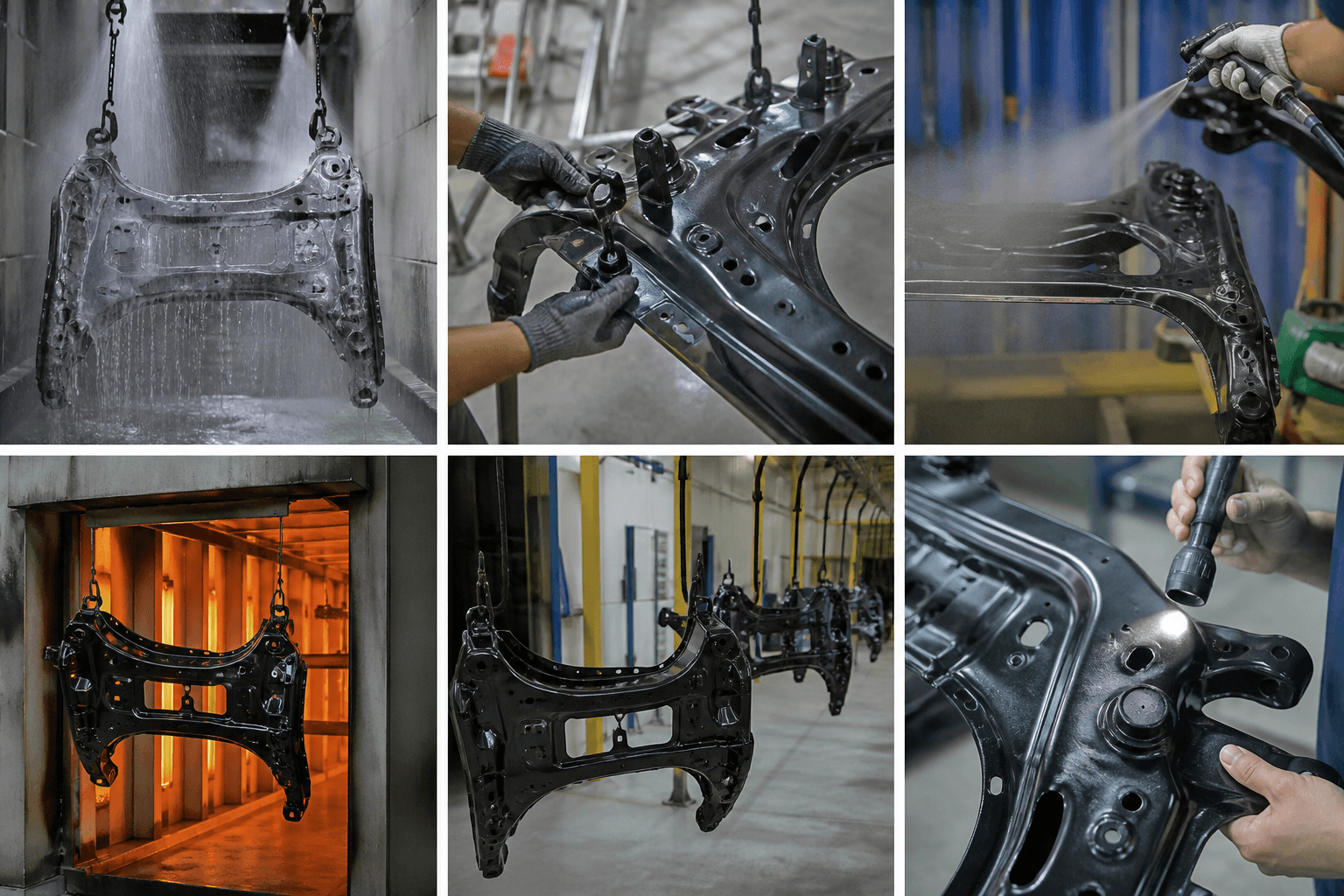
- Cleaning and substrate-specific pretreatment: Oil, fabrication residue, oxidation, scale, existing contamination, and dust must be removed. Depending on whether the part is steel, galvanized steel, aluminum, or another conductive metal, the approved route may include degreasing, acid treatment, blasting, phosphating, rinsing, drying, and dust removal. The substrate and required protection determine the sequence; one treatment should not be assumed suitable for every metal or existing surface condition.
- Masking and racking: Threads, bearing seats, electrical contacts, gasket faces, press fits, and other defined keep-out zones are protected. The rack must support the part without deformation, provide reliable electrical continuity, and place contact marks in agreed locations. Masking materials and methods must also tolerate the selected cure cycle.
- Grounding and electrostatic application: The conductive part is grounded while electrostatically charged powder is sprayed. Exposed faces generally receive powder more readily than deep recesses, narrow cavities, or shielded corners. Rack hooks, contact points, part cleanliness, and grounding continuity all influence transfer efficiency.
- Flow and cure: Heating melts, levels, and chemically cures the powder. Acceptance should be based on the powder manufacturer’s technical data and the actual workpiece metal temperature, not only the oven-air setpoint. Heavy and light sections may heat at different rates, so the thermal profile must represent the actual part and rack arrangement.
- Cooling and inspection: The coated part is cooled and handled to avoid damage before visual, dimensional, and functional checks. Depending on the project, inspection may cover film thickness, appearance, masked zones, rack marks, color, gloss, adhesion, edge coverage, and performance tests.
Pretreatment is not a cosmetic extra. Poor cleaning, contamination retained in weld seams, or an unsuitable conversion layer can undermine adhesion and corrosion performance even when the visible powder finish initially looks acceptable.
Design Details That Determine Fit and Coverage
Many coating-related assembly problems begin in the drawing rather than at the spray booth. Powder adds material to the part, so a finish that looks acceptable can still cause failure when it enters a controlled interface or blocks a functional opening. A drawing callout or masking map is more reliable than an instruction such as “mask important holes.”
Functional surfaces and defined keep-out zones
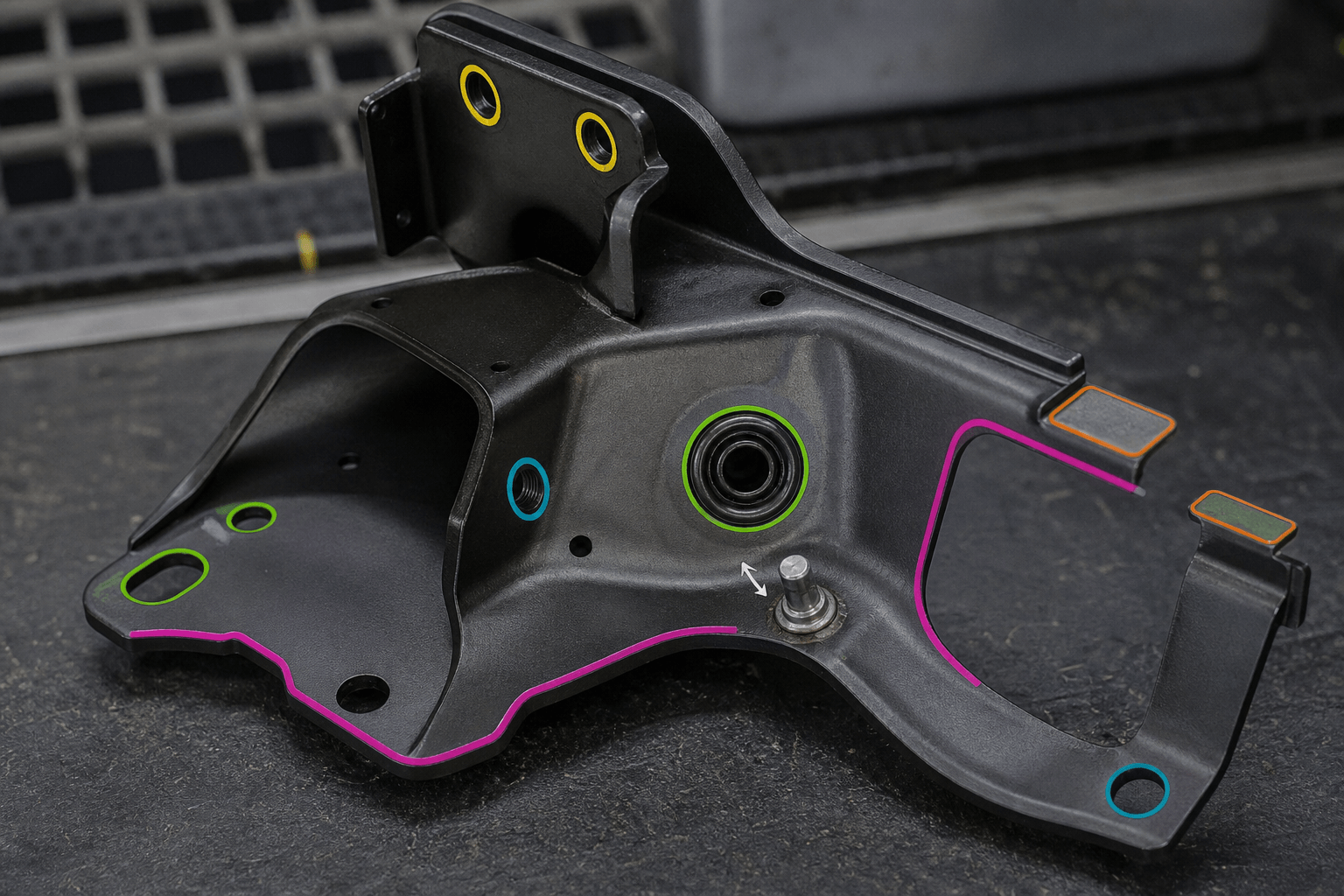
- Identify internal and external threads, tapped holes, bearing seats, press fits, sliding interfaces, dowel holes, and precision mounting faces.
- Define uncoated zones for electrical grounding or bonding points, sensor and connector interfaces, contact faces, gasket seats, and sealing surfaces.
- Check whether coating on bolt seats or clamped joints could change seating, torque behavior, or electrical continuity.
- Account for coating build-up in the final tolerance stack instead of relying on uncontrolled scraping after curing.
- Mark surfaces that must remain inspectable or free of coating for later assembly, adjustment, or service.
Geometry, drainage, and spray access
- Sharp edges and inside corners can produce uneven coverage. Electrically shielded areas may be thin, while confined corners can collect excess powder.
- Weld seams, overlap joints, and porous areas can retain contamination or release gas during curing, contributing to pinholes, craters, or other surface defects.
- Drain and vent holes must remain open. Closed cavities can trap pretreatment liquids, powder, or heated air and may not receive consistent spray access.
- Hinge areas, moving joints, and sliding features need clearance review to prevent binding or damage during assembly.
- Specify hanging points and accept that small uncoated rack-contact marks may remain where electrical contact was made.
These checks are especially important for custom fabricated sheet metal components with a defined powder-coating scope. Bends, welded corners, enclosed sections, and secondary hardware can alter spray access and cure behavior, so coating requirements should be released with the part drawing rather than added informally after fabrication.
Powder Coating Versus Automotive Wet Paint
When the same removable metal component could use either finish, the choice should follow the part and its production context. Powder coating may suit repeat batches of conductive parts that can be racked and cured, while liquid automotive paint may be more practical for assembled surfaces, localized repair, exact color blending, or parts that cannot tolerate the powder cure cycle.
| Decision factor | Powder coating | Liquid automotive paint |
|---|---|---|
| Production context | Well suited to repeat batches of removable conductive parts that can be racked and cured | Often practical for assembled surfaces, repair work, localized application, and some low-volume programs |
| Cure limitation | The entire part and any remaining components must tolerate the specified heat cycle | Some systems offer lower-temperature curing, although the selected paint still requires technical review |
| Outdoor exposure | Outdoor-grade polyester systems are commonly evaluated for UV exposure, subject to the complete coating specification | Automotive exterior paint systems can support color and weathering requirements when properly specified |
| Corrosion, chemicals, and abrasion | Performance depends on resin, pretreatment, substrate, film control, cure, exposure, and mechanical damage | Performance also depends on the paint stack, substrate preparation, application, cure, and environment |
| Appearance and color | Can provide controlled color, gloss, or texture when batches and process controls are managed | Often better suited to fine color blending, layered finishes, and matching adjacent vehicle panels |
| Complex geometry and size | Deep recesses, cavities, electrically shielded areas, very large parts, and oven capacity require review | May suit some complex or assembled surfaces and very large visible areas more readily |
| Damage and repair | Localized repair and invisible color blending may be difficult | Commonly preferred for on-vehicle repair and blendable cosmetic refinishing |
| Batch efficiency | Can be efficient for compatible repeat production with suitable rack loading and controlled color changes | May be more practical where colors change frequently or the work is repair-oriented |
Resin selection also needs context. Polyester powders are commonly evaluated for exterior UV exposure. Epoxy powders may provide useful mechanical, adhesion, chemical, or corrosion-related properties in a validated system, but they can chalk under outdoor UV exposure. Epoxy-polyester hybrids are more commonly associated with general indoor applications. Engine-adjacent or exhaust parts may require a high-temperature coating system rather than a standard powder category.
The resin family alone does not predict service performance. Pretreatment, substrate protection, cure, film control, edge condition, humidity, salt, chemicals, abrasion, temperature, and maintenance all influence the result. A coastal underbody application, an interior mounting bracket, and a visible exterior panel should not share one coating specification simply because each is made from metal.
Build a Comparable OEM Coating Specification
A comparable quote begins with a clear part package. The supplier needs enough information to separate base-part requirements from coating requirements and identify conflicts before sampling, especially when tolerances, appearance, or prototype timing matter.
Information to include with the drawing or RFQ
- Part drawing or CAD file, photograph, revision level, substrate, material thickness, dimensions, weight, and current surface condition.
- Whether the item arrives as a bare removable part or an assembly, including inserts, seals, lubricants, electronics, or other heat-sensitive components.
- Vehicle location and expected exposure to UV, humidity, salt, chemicals, abrasion, impact, and operating temperature.
- Prototype quantity, sample needs, batch or annual demand, packaging method, handling protection, and shipping destination.
- Color reference, gloss or texture, appearance-critical surfaces, approved sample or color-panel requirements, and acceptable variation.
Coating, inspection, and responsibility
- State the approved pretreatment and powder system, or define the performance requirements a supplier must meet when proposing an equivalent.
- Specify the target film-thickness range, masked and uncoated areas, threads, grounding points, bearing or press-fit surfaces, gasket seats, rack points, drain holes, and other keep-out zones.
- Require cure evidence appropriate to the project, including how the supplier will verify the actual metal-temperature profile and retain relevant production records.
- Define inspection requirements for visual defects, edge coverage, coating-thickness uniformity, adhesion, color difference, gloss, impact resistance, and corrosion testing when those checks are needed.
- Agree on sample approval, retained samples or color panels where useful, batch traceability, nonconformance handling, approved repair methods, and responsibility for rework.
Inspection depth should follow project risk. Adhesion, impact, or corrosion testing should not be treated as universal requirements for every automotive part; the method, sampling plan, and acceptance limits need to be agreed before production release. Buyers can also review inspection and quality-control planning for coated metal parts.
Cost factors that affect the quotation
| Cost driver | Why it changes the quote |
|---|---|
| Part dimensions, weight, and rack utilization | Large or heavy parts require different handling, while inefficient rack loading can reduce batch productivity and oven utilization. |
| Surface condition and pretreatment | Existing coating, corrosion, scale, oil, weld residue, or substrate sensitivity can change preparation work and process controls. |
| Masking and keep-out zones | Threads, precision fits, grounding points, gasket seats, and numerous small protected areas add labor, materials, and inspection points. |
| Powder type and finish | Resin family, color, gloss, texture, appearance class, and environmental requirements affect material and process scope. |
| Batch volume and color changes | Prototype work, small batches, frequent color changes, and sample approval can require more setup and handling than repeat production. |
| Inspection and rework | Detailed records, testing, retained samples, repair requirements, and nonconformance handling add scope and may affect rework exposure. |
| Packaging and logistics | Finished surfaces need protection from rubbing, impact, moisture, and contamination during storage and shipping. |
There is no reliable universal price for powder coating car parts. A comparable quotation should state what preparation, masking, coating, inspection, rework, packaging, and logistics are included instead of presenting an unexplained price per part.
Request a technical OEM project review: Yishang supports B2B OEM and ODM custom metal manufacturing and has more than 26 years of experience manufacturing custom sheet metal parts and metal products, with exports to more than 50 countries. Overseas buyers can submit drawings, CAD files or photographs, revision level, material and dimensions, current surface condition, use environment, quantities, prototype or sample needs, color and appearance requirements, masking maps, target coating thickness, inspection criteria, and packaging needs. A project review can assess part suitability and clarify pretreatment, masking, inspection, and quotation requirements. Yishang serves wholesale and custom manufacturing projects rather than consumer one-off vehicle refinishing.
Frequently Asked Questions
For procurement and engineering teams, these answers frame the early decision. Final acceptance still belongs in the part-specific drawing, coating specification, and validation plan.
What are the disadvantages of powder coating a car part?
The part must tolerate oven curing and usually must be removed from heat-sensitive assemblies. Masking can be labor-intensive, deep geometry may be difficult to cover uniformly, and coating build-up can affect fits. Local repair and color blending are also generally harder than with liquid automotive paint, while correct pretreatment remains essential.
How much does it cost to powder coat car parts?
There is no reliable universal price. The quote depends on part size and weight, existing coating or corrosion, preparation, masking, rack loading, powder system, color and finish, batch quantity, inspection, rework risk, packaging, and shipping. Drawings and a coating specification are needed for a comparable quotation.
How long does powder coating last on automotive parts?
Service life cannot be stated from the process name alone. It depends on substrate preparation, resin system, film and cure control, UV, moisture, salt, chemicals, temperature, abrasion, impact damage, and maintenance. Any durability requirement should be connected to documented test methods and the actual service environment.
Is powder coating better than paint for car parts?
It can be a strong choice for repeat batches of removable conductive metal parts that tolerate curing and need a controlled finish. Liquid paint may be preferable for assembled vehicles, heat-sensitive components, exact body-color blending, very large visible surfaces, or localized repair. The correct choice follows the part and performance specification.