
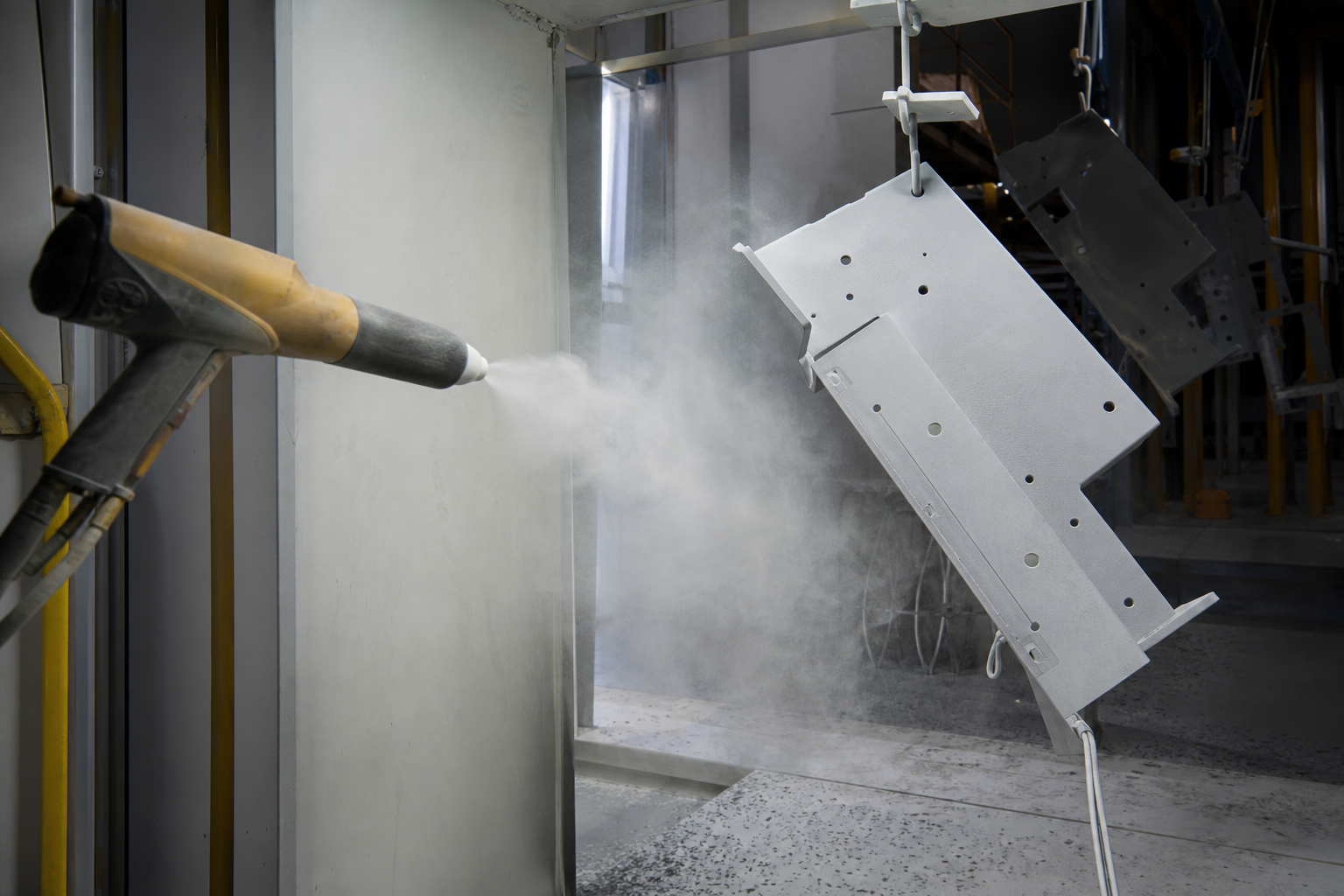
Yes. Industrial powder coating is sprayed as actual dry particulate material carried in moving air, not as liquid paint droplets. Heat later melts and flows the deposited particles into a continuous film; thermoset powders also chemically crosslink during cure.
The visible cloud near the spray gun is finely ground coating material suspended in air. Electrostatic forces help the particles collect on a grounded workpiece. For OEM buyers, this distinction matters because part geometry, grounding points, masking details, and the specified heating cycle can all affect the finished component. Once properly heated and cooled, the coating is a coherent solid film rather than a powdery layer.
Coating powder contains more than pigment
When a buyer specifies a powder-coated part, the color identifies only one aspect of the required finish. Powder coating material typically combines a polymer resin, pigments, flow or appearance modifiers, and other formulation additives. A curing agent is also included where the coating chemistry requires one. Together, these ingredients influence application behavior, gloss, texture, hardness, weathering response, and resistance to the intended service environment.
Epoxy, polyester, and epoxy-polyester hybrid powders are common general categories, but a family name or color does not establish how a particular product will perform. Selection depends on the substrate, indoor or outdoor exposure, appearance requirements, and applicable product specification. Product-specific application and cure requirements should come from the powder supplier’s technical documentation.
Powder coatings belong to two distinct material families:
- Thermoset powder melts and flows during heating, then undergoes a chemical crosslinking reaction. Once properly cured, it cannot simply be reheated and returned to its original powder or melt state.
- Thermoplastic powder melts during heating and forms its solid film primarily as it cools. It does not rely on the same crosslinking mechanism as a thermoset coating.
This distinction matters because not every powder coating forms its finished film through the same cure mechanism.
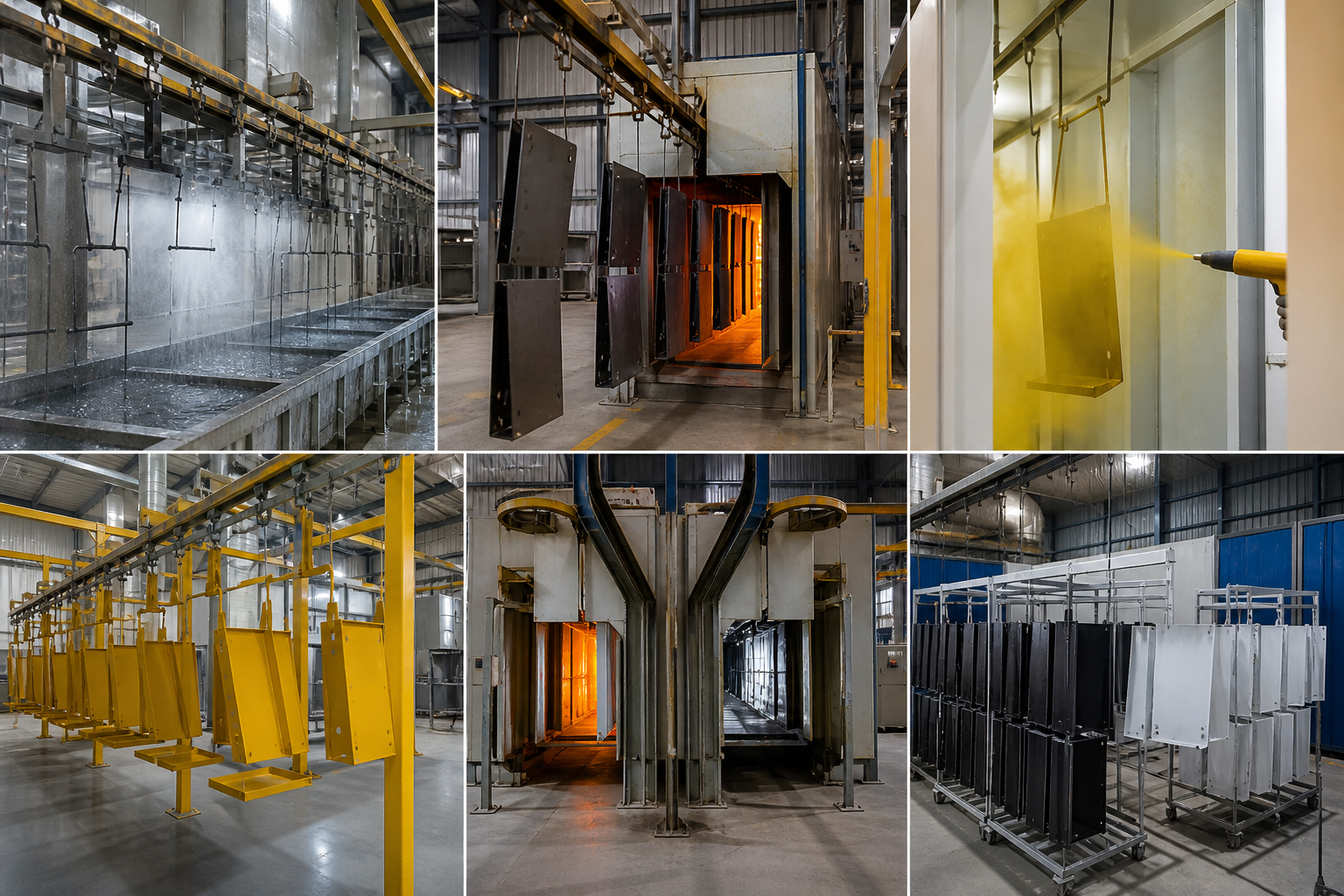
How airborne powder becomes a solid finish
The final appearance depends on more than the spray operation itself. Surface preparation, fixturing, electrical continuity, part geometry, application settings, and the verified heating cycle work together. A problem at any stage can affect coverage, adhesion, assembly interfaces, or cosmetic consistency.
- Prepare the surface. Oil, oxidation, dust, welding residue, and other contamination can interfere with adhesion or appearance. Cleaning and conversion pretreatment must suit the substrate and selected coating system. Steel, galvanized material, aluminum, and previously coated parts should not be assumed to need identical preparation.
- Dry and fixture the workpiece. Residual moisture can contribute to finish defects. The part is hung or supported in an orientation that allows pretreatment drainage, spray access, heating, and handling while controlling fixture marks. Enclosed volumes may need suitable vent or drain provisions.
- Establish grounding and electrical continuity. The spray gun charges the powder or otherwise supports electrostatic deposition, while the grounded workpiece attracts the airborne particles. Contaminated hooks, insulated contact points, or poor continuity can weaken this attraction and lead to inconsistent deposition.
- Apply the powder. Moving air transports the particles through the gun and toward the part. Powder output, electrostatic settings, spray path, part orientation, geometry, and grounding all affect deposition. Deep recesses, closely spaced corners, and shielded areas can be difficult to cover because spray access and the electric field are not uniform around every feature.
- Heat and flow the deposited layer. Before heating, the coating remains particulate and can be disturbed by contact or airflow. As the workpiece heats, the powder melts and flows, allowing the separate particles to form a continuous layer.
- Crosslink or solidify the film. Thermoset powder crosslinks according to its applicable cure requirements. Thermoplastic powder forms its final film through melting and subsequent solidification. The schedule should follow the powder supplier’s technical data and account for the workpiece reaching the required metal temperature. The oven-air setting alone does not confirm that a heavy or geometrically complex part has completed the required cycle.
- Cool and inspect. After cooling, the coating can be evaluated against the project’s documented appearance and functional requirements. Inspection methods and acceptance limits should be selected for the component rather than treated as a universal test package.
Powder coating is a surface-finishing operation performed after the relevant part-making processes. Sheet metal cutting and forming, welding, CNC machining, and assembly remain separate manufacturing operations, even when they contribute to the same product. Powder coating is also not a metal-deposition process such as electroplating. Related options are outlined under custom metal surface-finishing services.
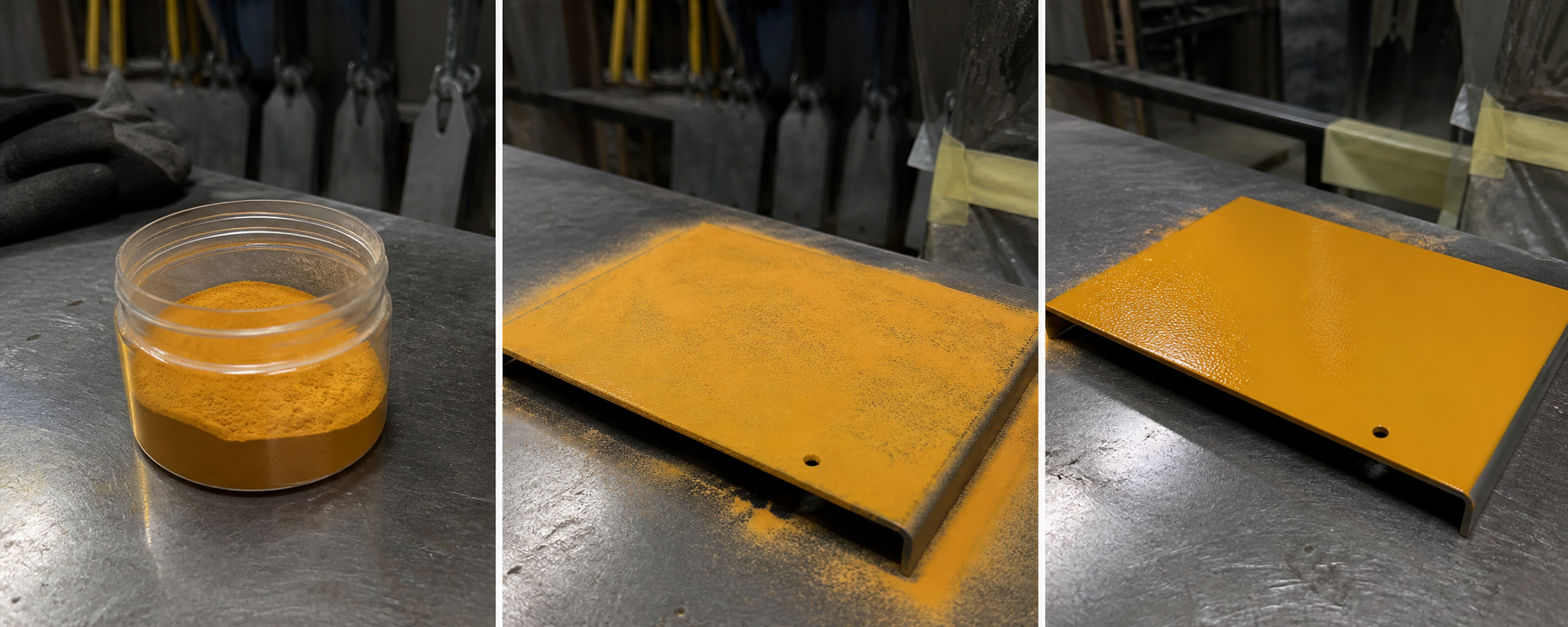
Powder coating and liquid paint compared
Choosing between powder and liquid paint requires more than comparing color charts. Both processes can create protective or decorative films, and both depend on suitable surface preparation. The main difference is the physical state of the sprayed material and how that material becomes a film. Electrostatic application alone does not identify a process as powder coating because compatible liquid coatings can also be sprayed electrostatically.
| Decision factor | Powder coating | Liquid spray paint |
|---|---|---|
| Material at the gun | Finely ground dry particles transported in air | Liquid coating atomized into droplets |
| Deposition method | Commonly relies on electrostatic attraction to a grounded workpiece | May use conventional, air-assisted, airless, or electrostatic application, depending on the system |
| Film formation | Particles melt and flow during heating; thermosets crosslink, while thermoplastics solidify on cooling | Depends on the coating chemistry and may involve evaporation, chemical reaction, baking, or a combination of mechanisms |
| Geometry considerations | Grounding, spray access, and electric-field behavior are important around corners, recesses, and shielded features | May suit some recesses, heat-sensitive substrates, assembled products, or on-site work, subject to the selected coating |
| Overspray handling | Recovery may be possible on a suitably designed line, but not every overspray stream can or should be reused | Handling depends on the paint, booth, application method, and environmental controls |
| Localized repair | A repair can be difficult to blend with the original cured color, gloss, and texture | Some liquid systems are more practical for localized or field-applied repair |
| Information buyers should specify | Approved powder system or family, color reference, gloss or texture, exposure, masking, and acceptance criteria | Paint system, color, sheen, exposure, application constraints, and acceptance criteria |
Neither route is automatically best for every component. Heat sensitivity, part size, enclosed geometry, color-change patterns, repair expectations, appearance requirements, and available process controls can influence the choice. Corrosion performance cannot be inferred from “powder coated” or “painted” alone; pretreatment, coating chemistry, film integrity, edge condition, service environment, and the agreed test basis all matter.
Design details that affect powder-coated metal parts
A useful finish specification starts with the base metal and service environment, then defines appearance and protected interfaces. This information allows the coating requirements to be reviewed alongside the drawing, tolerances, assembly sequence, and fabrication details. A color name alone is usually insufficient because perceived color can vary with the reference system, gloss, texture, film formation, lighting, and viewing conditions.
For an enclosure, bracket, frame, or panel, identify the material grade if known, indoor or outdoor exposure, approved color reference, gloss or texture target, and cosmetic faces. If appearance is critical, define any approved comparison sample, viewing conditions, and acceptable variation before production. Hidden and cosmetic surfaces do not necessarily need the same visual acceptance criteria.
Geometry should also be reviewed before coating. Deep channels, closely spaced flanges, overlapping seams, sharp edges, and shielded recesses may not receive the same deposit as open faces. Hanging orientation influences spray access, pretreatment drainage, fixture marks, and the available grounding contact. Enclosed volumes may require venting for heating and processing.
Coating buildup can affect later assembly. Drawings should identify threads, electrical bonding points, grounding contacts, bearing seats, gasket lands, mating surfaces, press-fit areas, and close-clearance interfaces that need masking or another form of control. A hole that fits before finishing may not provide the same clearance afterward, while coating over an intended electrical contact can interrupt continuity.
Process boundaries are especially important in mixed assemblies. A machined insert or welded subassembly may be incorporated into a sheet metal product, but machining, welding, fabrication, finishing, and final assembly are separate steps. Their interfaces must be planned: weld residue can affect surface preparation, machined fits may require masking, and some fasteners or electrical components may need to be installed after coating rather than exposed to the finish cycle.
These considerations are particularly relevant to custom sheet metal enclosures, where cosmetic panels, hardware interfaces, grounding paths, and assembly features can occur on the same product. Color, gloss, adhesion, film thickness, impact, bending, or corrosion checks may be appropriate for particular projects, but they are not universally required without an agreed specification. A project-specific quality control plan should identify the inspection method, sampling basis, documentation, and acceptance criteria that apply.
Questions about powder spray and film formation
These questions address common points that arise when drawings, finish notes, and prototype requirements are being prepared for a powder-coated component.
Does coating powder become liquid in the oven?
Yes. The deposited particles melt and flow as the workpiece heats, temporarily creating a molten layer before the finished film develops. Thermoset powder then crosslinks during cure. Thermoplastic powder instead forms its final solid film primarily by cooling after melting.
Is electrostatic spraying exclusive to powder coating?
No. Electrostatic application is closely associated with powder coating, but compatible liquid coatings can also be sprayed electrostatically. The material state is the clearer distinction: powder coating applies dry particles, while liquid painting applies atomized liquid droplets.
Will powder evenly cover recessed corners and enclosed areas?
Not necessarily. Deep recesses, tight corners, overlapping features, and areas shielded from the gun can be harder to coat because of restricted spray access and electric-field behavior. Geometry, orientation, grounding, application settings, and spray path must be considered together. Critical coverage areas should be identified on the drawing or finish specification.
Can all powder overspray be collected and reused?
No. Recovery depends on the booth and handling system. Reclaimed material may be unsuitable when colors change frequently or when contamination and appearance control are concerns. Any use of reclaimed powder should follow the coating supplier’s guidance and the project’s finish requirements.