
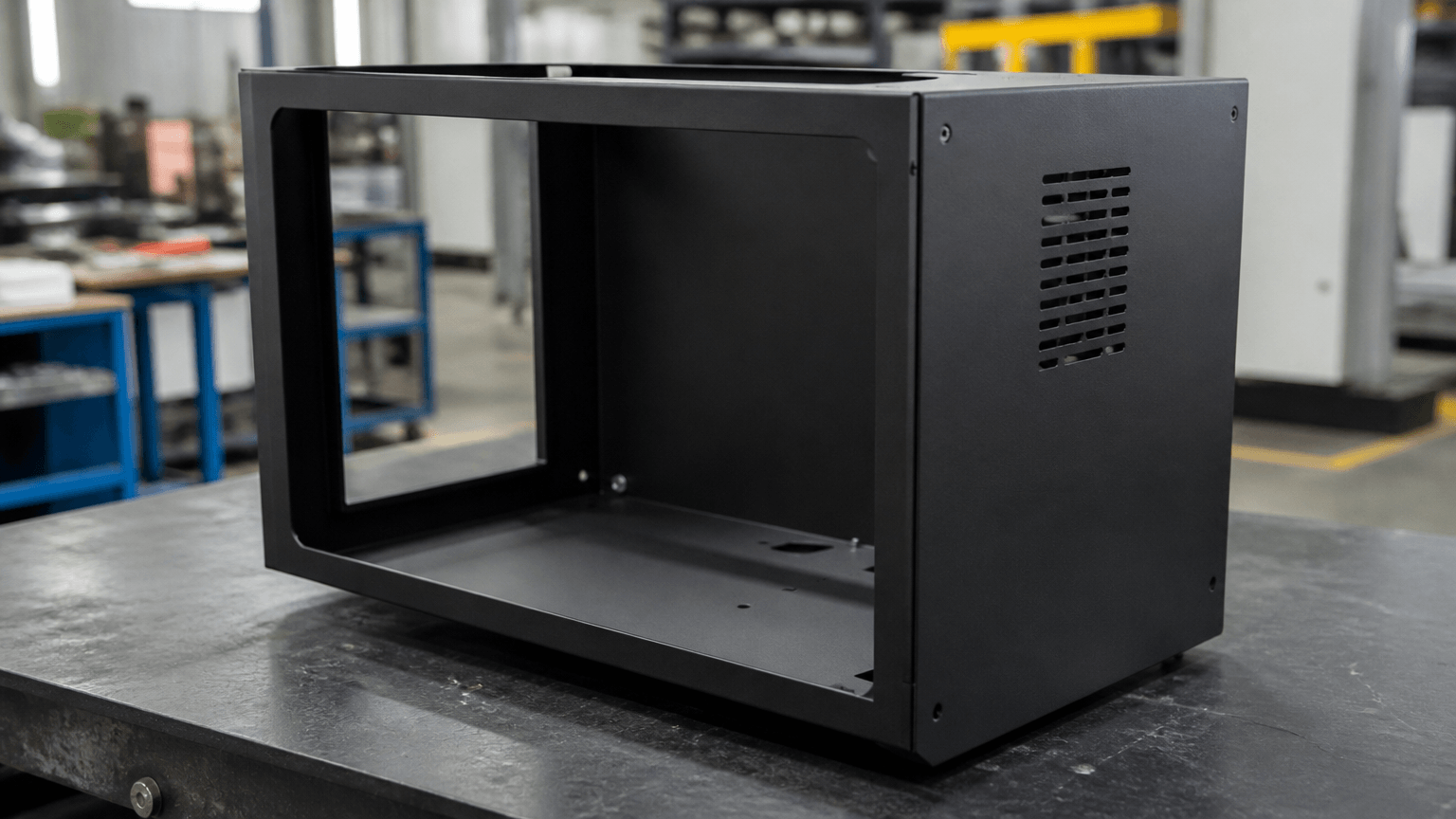
Powder coating matte finish describes a low-reflectivity powder-coated surface, but “matte” alone is not enough to release an OEM enclosure, cabinet, frame, rack, or fabricated assembly for production. Buyers also need to define the color, gloss measurement angle, target or approved gloss range, smooth or textured condition, substrate, coating requirement, and acceptable appearance limits.
The final appearance depends on the powder formulation, prepared metal surface, deposited film, part geometry, and cure conditions. For production approval, use a representative coated part or panel supported by documented visual and measurement criteria. The phrase “matte black” cannot, by itself, control color, sheen, texture, or batch-to-batch consistency.
This distinction becomes important when moving from a color chip to an actual fabricated product. A small flat sample may not show how the finish will look across bends, edges, recesses, weld zones, or adjoining panels. The specification must therefore connect the intended appearance to the production part and the conditions under which it will be inspected.
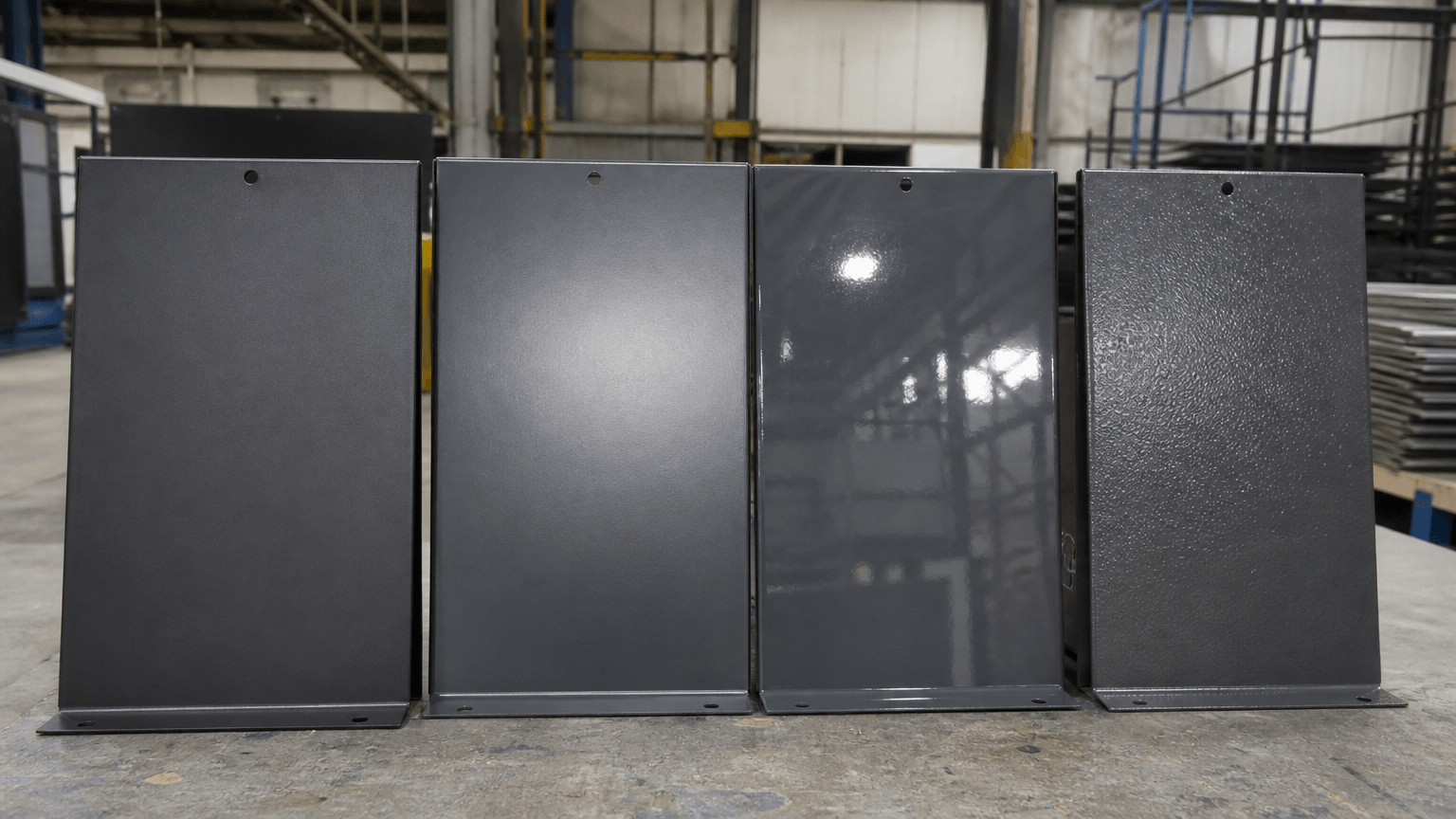
Matte, Satin, Gloss, and Texture Are Different Requirements
When several coated panels must match in an enclosure or cabinet assembly, a general finish name leaves too much room for interpretation. Gloss is the reflected-light response measured under a defined arrangement. Although “matte” indicates relatively low reflectivity, it does not establish a universal numerical range; measurement angle, color, surface relief, film thickness, and cure condition can all affect instrument readings and visual assessment.
| Finish description | Visual character | Specification implications |
|---|---|---|
| Smooth matte | Muted reflection on a surface without intentional relief. | Define the color, gloss angle and approved range, smoothness, and cosmetic limits. Substrate marks or local preparation differences may remain visible. |
| Satin or semi-gloss | More reflected light than matte, but less pronounced reflection than high gloss. | Do not treat “satin” as a fixed gloss value. State the required measurement conditions and whether adjoining components must match. |
| High gloss | Strong reflection and a brighter visual appearance. | Surface waviness, grinding marks, scratches, weld transitions, and leveling differences may be more apparent. |
| Textured or wrinkle | Deliberate surface relief combined with a particular reflective appearance. | Specify the texture type and level. Texture can affect cleaning, touch, masking transitions, dimensional buildup, and visual matching. |
Textured powder coating is not a substitute for smooth matte powder coating. Texture changes the physical surface profile as well as the way light scatters. An equipment cabinet intended to have a flat, smooth appearance can therefore fail its design requirement even if a textured coating produces similarly low reflectivity.
Matte black also requires more definition than a color name. Different black powders can vary in undertone, gloss, surface flow, and texture. Because catalog images and screen displays are affected by lighting and display settings, use an agreed color reference or physical master when color matching matters.
What Controls the Final Coated Surface?
When a prototype looks different from the approved panel, the cause may lie in the coating process, the fabricated substrate, or the interaction between them. These technical boundaries should remain clear: cutting and bending create the sheet metal geometry, welding joins fabricated components and changes local surface conditions, and pretreatment and powder coating prepare and finish the surface. Assembly then brings coated and uncoated components together, while inspection verifies the agreed appearance and functional requirements.
CNC-milled or turned parts may be installed in a sheet metal assembly, but they are produced through separate machining processes. Their interfaces may require masking, controlled coating buildup, electrical contact, or a different finish. These requirements should be identified without treating machining as part of the powder-coating operation.
Powder Formulation and Service Conditions
The resin system, matting approach, additive balance, component compatibility, and cure response can influence gloss, leveling, mechanical behavior, and weathering suitability. A low-gloss formulation may also respond differently to changes in film build or heating than a higher-gloss powder.
Low reflectivity does not automatically provide better scratch resistance, corrosion resistance, adhesion, hardness, abrasion resistance, UV stability, or cleanability. Suitability depends on the selected powder system, substrate, pretreatment, cure, exposure, and project requirements. Performance tests should be specified only when relevant to the product’s service environment.
Fabricated Substrate Condition
Base-metal roughness, grinding marks, burrs, handling damage, weld preparation, and formed geometry can affect the coated appearance. Oil, residue, weld spatter, trapped contamination, moisture, or porosity may contribute to local defects. Broad flat faces can also reflect light differently from bends, corners, or weld zones, even when they receive the same nominal color.
Sharp edges, inside corners, narrow returns, and deep recesses can be difficult to cover uniformly. If exposed edges or thin-looking areas are unacceptable, review the part design, edge preparation, spray access, and inspection criteria together. Cosmetic zones should be identified on the drawing or supporting images so that exterior faces are not assessed in the same way as concealed or purely functional surfaces unless the project requires it.
Application and Film Build
Grounding, spray settings, part orientation, access to recesses, and deposited film thickness affect coverage and surface flow. Uneven or excessive film build can alter gloss, texture, leveling, edge appearance, and fit at assembly interfaces. The coating requirement should be selected for the powder system and actual part rather than copied from an unrelated project.
Threaded holes, grounding points, electrical contacts, bearing seats, close-fit features, and other assembly interfaces may need masking. Because a masking boundary can leave a visible coating transition, its position should be defined relative to cosmetic surfaces and mating components.
Cure Response and Defect Investigation
Oven conditions, actual part temperature, time at temperature, loading pattern, and the thermal mass of the part or assembly can influence cure. Uneven, insufficient, or excessive cure may affect gloss, color, adhesion, hardness, and other properties. Required cure conditions must follow the selected powder system and applicable supplier documentation.
- Gloss variation: can be associated with differences in film build, powder, substrate condition, spray coverage, or cure response.
- Color variation: may appear between powder lots, production batches, adjoining panels, or areas with different thermal histories.
- Orange peel: describes uneven surface flow influenced by formulation, film build, substrate condition, or cure response.
- Pinholes: may be associated with contamination, outgassing, porosity, trapped moisture, or process conditions.
- Craters: can result from contamination or incompatible material at the coating interface.
- Exposed or thin-looking edges: can reflect edge geometry, deposition behavior, spray access, or inadequate coverage.
- Weld or corner inconsistency: may relate to local preparation, geometry, access, contamination, or thermal response.
These relationships identify areas to investigate; they do not establish the root cause of a particular defect. Diagnosis requires the actual part, coating materials, and relevant process records.
Define a Matte Finish That Can Be Approved
Before drawings or purchase documents are released, the finish requirement must connect appearance, functional interfaces, and inspection. The information may be distributed across the drawing, finish specification, sample request, and purchase order, but it should remain consistent. Conflicting notes can result in a visually acceptable part that does not assemble correctly—or a functional part that fails cosmetic inspection.
- Color reference: identify the applicable color system or supply a physical master. State whether separate panels or adjoining components must match.
- Gloss requirement: define the measurement angle, instrument or agreed method where applicable, and the target or acceptable range. Include color and texture conditions so that the result is interpreted correctly.
- Surface character: distinguish smooth matte from fine texture, coarse texture, wrinkle, satin, and other appearances.
- Coating requirement: state the project-specific film-thickness or coating requirement and identify features where buildup could affect fit or function.
- Substrate and preparation: identify the base metal, pretreatment expectations, visible weld preparation, and restrictions on grinding or surface marks.
- Masking: mark threads, grounding locations, electrical contacts, close-fit interfaces, and all areas that must remain uncoated.
- Cosmetic zones: classify viewing faces, exterior edges, bends, weld zones, concealed surfaces, and functional areas as needed.
- Appearance limits: identify unacceptable defects and define inspection lighting, viewing distance, part orientation, and whether adjoining parts are evaluated together.
- Performance requirements: specify relevant adhesion, hardness, abrasion, corrosion, weathering, or cleaning evaluations only when required by the intended service conditions.
Choose the Finish Description Before Sampling
| Design objective | Finish description to evaluate | Information still needed |
|---|---|---|
| Low reflection without deliberate surface relief | Smooth matte powder coating | Color, gloss angle and range, smoothness, coating requirement, and cosmetic limits. |
| Moderate sheen | Satin or semi-gloss powder coating | Measured gloss requirement, color reference, and matching expectations. |
| Strong reflection | High-gloss powder coating | Leveling expectations, substrate condition, visible-surface criteria, and inspection lighting. |
| Deliberate relief or pattern | Textured or wrinkle powder coating | Texture type and level, cleaning needs, buildup at interfaces, and an approved sample. |
Yishang’s Surface Finishing information provides context for coordinating finishing options on custom metal parts. For a project-specific specification and sample review, provide 2D drawings or 3D CAD files, material details, part or assembly photographs identifying cosmetic zones, the color reference, gloss criteria if already defined, the smooth or textured requirement, coating and masking instructions, inspection criteria, and estimated prototype and production quantities.
Control the Finish from Sample to Repeat Production
A visually acceptable first sample does not automatically provide a repeatable production standard. Sample approval should create a controlled reference that procurement, quality personnel, product development teams, and the manufacturer can all use—not merely a record that one observer accepted the finish under unspecified lighting.
- Align the requirements. Product development, procurement, quality personnel, and the manufacturer should confirm the color, gloss method, surface character, substrate, masking, cosmetic zones, assembly interfaces, and service environment.
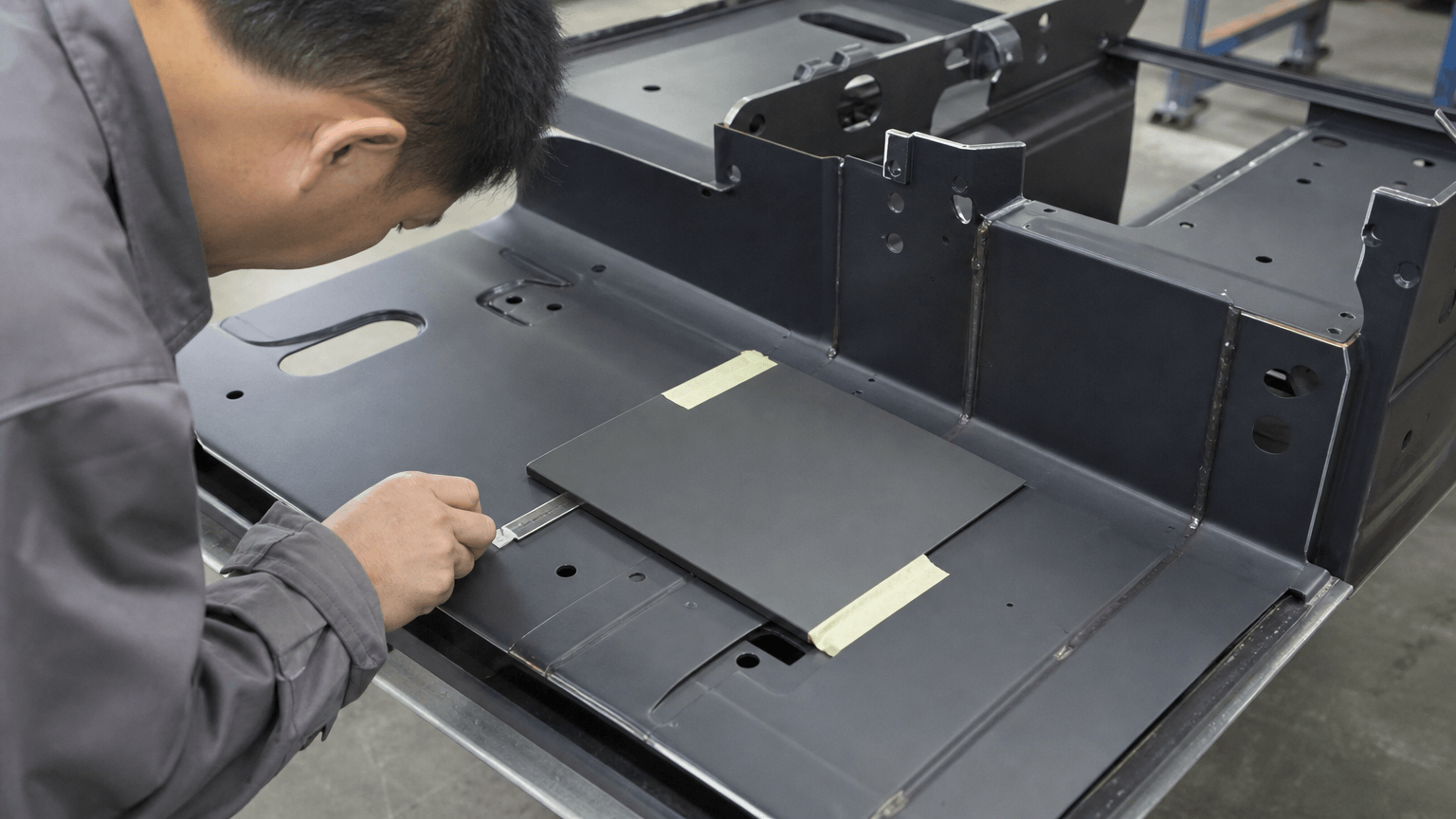
- Produce a representative sample. Use a part or panel that reflects the production substrate and relevant features. When bends, welds, edges, or recesses are visually important, a flat color chip alone is insufficient.
- Inspect under agreed conditions. Assess color and appearance using defined lighting, distance, orientation, and comparison conditions. Record gloss measurements when they form part of acceptance.
- Retain the approved standard. Identify and preserve the approved panel, sample part, or other agreed physical reference together with its color, gloss, texture, and inspection information.
- Maintain relevant records. Document the powder identification or lot information, masking instructions, applicable pretreatment and cure records, coating measurements, and inspection results required by the project.
- Compare repeat orders consistently. Evaluate later batches and replacement components against the retained standard under the same agreed conditions.
Matching risk can increase when parts are produced from different powder lots, on different dates, or under changed line conditions. Differences are especially visible when replacement panels are installed beside earlier components. Inspection records and batch traceability help identify what changed, while the retained approval standard provides a common visual reference. Related planning information is available through Yishang’s Prototyping and Quality Control pages.
For custom sheet metal enclosures, coating approval must also account for assembly. A panel can meet its visual criteria yet remain nonconforming if coating buildup obstructs threads, grounding points, hinges, fasteners, or close-fit interfaces. Finish inspection and assembly verification are separate checks, and both may be required before release.
Questions About Matte Powder-Coated Parts
These questions address common issues that arise when buyers prepare drawings, prototype requests, inspection requirements, and production orders for matte powder-coated components.
Can powder coating have a gloss finish, and how is gloss measured?
Yes. Powder coatings can produce matte, satin, semi-gloss, high-gloss, and textured appearances. Gloss is measured using an agreed instrument method and angle, such as 20°, 60°, or 85°. Record the selected angle and inspection conditions because readings taken under different methods are not interchangeable.
Is matte powder coating the same as textured or wrinkle coating?
No. Smooth matte describes low reflectivity without intentional surface relief. Textured and wrinkle powders create a physical surface pattern that affects appearance, cleaning, touch, buildup, and inspection. They require separate descriptions and sample approval.
Why can parts in the same matte color look different?
Possible influences include powder-lot variation, substrate roughness, weld preparation, film build, spray access, grounding, part geometry, cure response, lighting, and viewing angle. Matching the color reference alone does not control gloss or texture.
What must be approved before batch production?
Approve the color reference, gloss angle and range, smooth or textured condition, substrate and preparation, coating requirement, masking locations, cosmetic zones, defect limits, and inspection conditions. Confirm that coating buildup will not interfere with drawing tolerances, threads, grounding points, fasteners, or mating features. Retain the approved sample or panel with its inspection record before releasing the production quantity.
Can a matte powder coating be used outdoors?
Some matte powder systems may be suitable for outdoor use, but low gloss does not establish weathering or corrosion performance. Before requesting a prototype or production quotation, confirm the powder system, substrate, pretreatment, cure, UV and moisture exposure, cleaning chemicals, corrosion requirements, and any project-specific qualification tests.
Release the Requirement, Not Just the Finish Name
A powder coating matte finish becomes controllable only when the visual request is translated into color, gloss, texture, substrate, coating, masking, cosmetic, and inspection requirements. A representative approved sample, combined with consistent records, then provides a practical basis for evaluating the prototype, production batch, and repeat orders.
Yishang can review matte-finish requirements for custom sheet metal parts, enclosures, cabinets, frames, racks, and welded assemblies before prototype approval. Send the relevant 2D drawings or 3D CAD files, material and tolerance details, photographs marking cosmetic zones, color reference or physical master, gloss angle and acceptable range if defined, smooth or textured requirement, film-thickness and masking instructions, performance and inspection criteria, prototype quantity, and expected production volume.