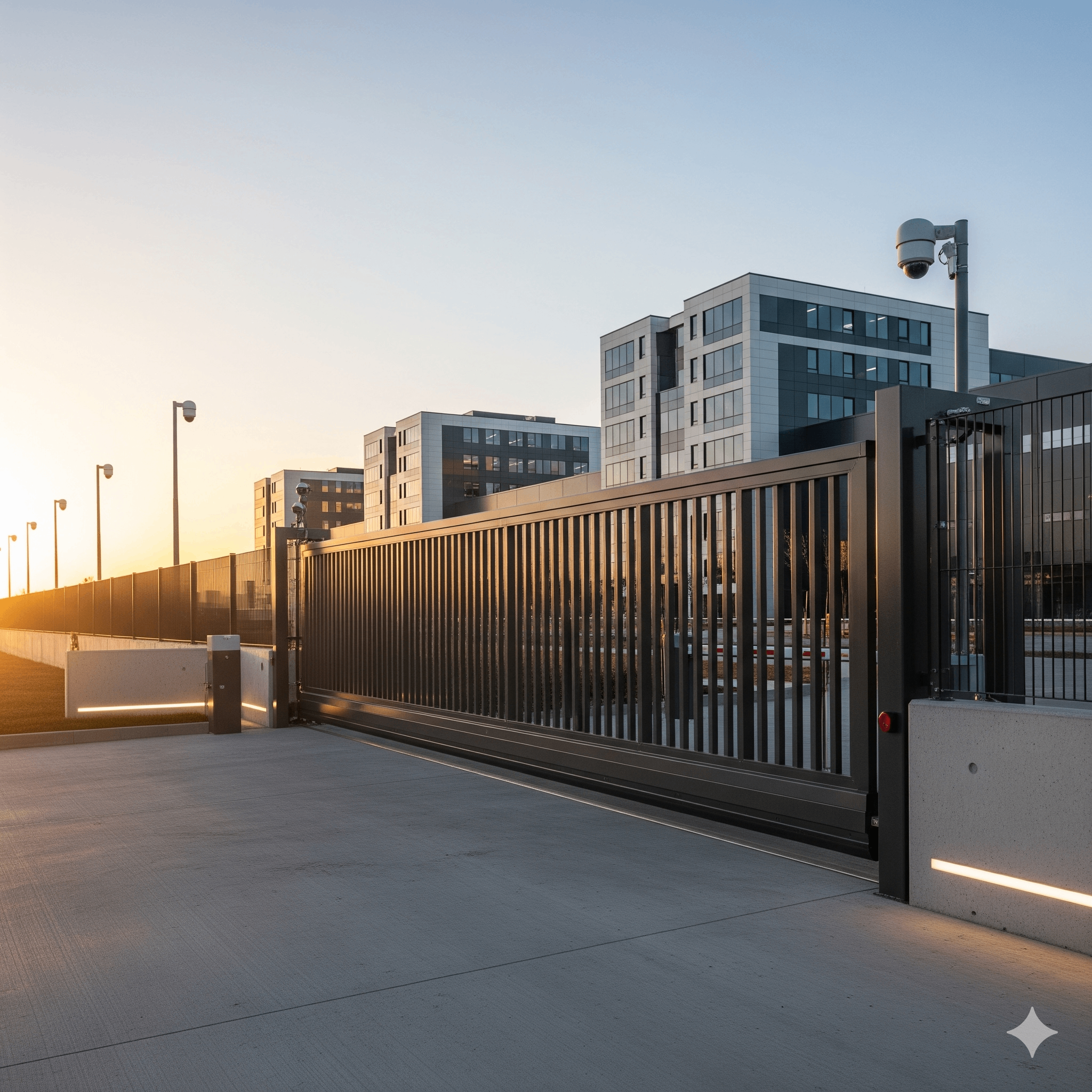
The Strategy Behind the Steel: Why Perimeter Intelligence Matters
Protecting a sprawling commercial site is no longer just about fence height or gate thickness. As we head into 2026, the reality for industrial facilities and data centers has shifted significantly. Specifically, sites now require a proactive defense ecosystem. This system must think as fast as the threats it faces. For wholesale distributors, the challenge isn’t just finding hardware. Instead, it is about providing a system that holds up when the stakes are highest.
At YISHANG, we often see what we call the “Perimeter Fallacy.” This is the dangerous assumption that any steel barrier creates security. The truth is, a fence is just a boundary marker without a solid Security Risk Assessment Framework (SRAF). A professional framework acts as the strategic brain. Consequently, it ensures that every
cantilever slide gate or crash-rated bollard serves a specific purpose. That purpose is to buy the most precious asset: Response Time.
Bridging the Gap: Aligning Steel with Global Standards
For a wholesale purchaser, picking the right standards is about more than just checking boxes. Moreover, it is about building a reputation for reliability. When a manufacturer understands these nuances, it removes technical guesswork from the bidding process. As a result, the final installation meets the rigid demands of high-value sites like military bases and airports. This ensures a smoother process without unnecessary friction.
Strategy at the Governance Level: ISO 31000
Think of ISO 31000 as the foundation for business continuity. It forces a move away from looking at security as a simple expense. Instead, it treats security as a core part of risk appetite. By integrating high-precision metal fabrication into this framework, procurement teams can justify the investment. Therefore, a well-engineered perimeter prevents disruptions that could freeze a global supply chain or compromise a sensitive data hall.
Tactics in the Field: ASIS International (POA)
If ISO 31000 is the “why,” the ASIS “Protection of Assets” manual is the “how.” It relies on the concept of Concentric Circles of Protection. This defense-in-depth model is vital for border stations and correctional facilities. For a wholesaler, providing products that fit this layered approach is key. Whether it’s a bi-fold gate or a specialized securfold system, the engineering must reflect formal risk findings. This ensures the site can adapt as mission requirements change over the years.
The New Digital Reality: NIST SP 800-30
Today’s boundaries are smarter than ever. For instance, automated systems and IoT sensors are now part of the physical barrier. Consequently, the NIST SP 800-30 framework has become highly relevant for public utilities and schools. A partner like YISHANG focuses on securing the metal housing for these digital nodes. This shielding protects against tampering and environmental wear. Furthermore, following RoHS standards and maintaining ISO 9001 compliance is more than just paperwork. It ensures that every global shipment performs exactly as promised.
The Calculus of Defense: Quantifying the “Delay-to-Response”
At its heart, security is a math problem involving time and physics. The best frameworks eventually come down to the Delay-to-Response (D-R) Ratio. No barrier is truly an “impenetrable wall” forever. In fact, its real engineering goal is to provide a predictable delay. This allows response forces to intercept an intruder before they reach a critical asset.
Measuring the Probability of Interruption (Pi)
In professional risk assessments, the math is clear. Probability of Interruption (Pi) equals the Probability of Detection times the Probability of Assessment times the Probability of Interception.
The part of this equation where material quality matters most is the Probability of Interception. A basic carbon steel fence might offer only a few seconds of delay. In contrast, YISHANG’s high-tensile stainless steel mesh can extend that window to several minutes. Thus, CNC machining and precision engineering change the conversation. We’re no longer talking about price per meter. Instead, we focus on seconds of delay per dollar invested.
Engineering Integrity: Where the Weld Meets the Work
That delay time is a direct result of how a product is built. For example,
robotic welding provides a level of consistency that manual work cannot match. This ensures that crash-rated beams and fences have no “weak links” in their structural joints. This process is followed by in-house sandblasting and industrial coating. Such treatments protect against the slow creep of corrosion. For coastal projects, this resilience ensures the barrier maintains its rated delay time for twenty years or more.
Finding the Cracks: Transition Zones and Access Engineering
Every perimeter has its weak spots. Usually, these occur at the transition zones where the barrier must open for people and cargo. For a busy logistics hub, these entrance points are the most significant vulnerability. Therefore, the choice between a vertical pivot gate and a cantilever slide gate is a strategic decision. It must be based on traffic flow and uncompromised security findings.
The Logic of Anti-Tailgating
Tailgating is the oldest trick for unauthorized entry at warehouses. In response, a modern risk framework calls for anti-tailgating devices. These are integrated directly into reinforced box frame gates. YISHANG designs these systems with high-speed operators and redundant sensors. The goal is simple: prevent bottlenecks while maintaining structural strength for thousands of duty cycles.
Geotechnical Realities and Structural Sag
Vulnerability analysis also looks at what’s under the ground. For instance, a heavy-duty vertical lift gate weighing several tons needs a foundation designed for local soil. Our engineering team provides the design drawings and specs needed to prevent “mechanical sag.” This is a common failure in budget-grade gates that can compromise a site’s security. In addition, specialized coating and sandblasting keep gates compliant and protect a wholesaler’s reputation.
Mitigation in Action: HVM and the Drone Factor
Hostile Vehicle Mitigation (HVM) has moved from a niche requirement to a standard expectation. Wholesalers now need to offer solutions like crash-rated bollards. These must meet precise kinetic energy absorption standards.
ASTM F2656: Understanding M30 vs. M50
The risk assessment determines whether a site needs an
ASTM F2656 rating. At YISHANG, we focus on custom fabrication. This ensures the metal structure transfers energy during an impact without shearing. This is critical for military bases and financial institutions where the margin for error is zero. Furthermore, these high-performance systems are built using RoHS-compliant processes to meet modern environmental goals.
Defending the Third Dimension
The third dimension of perimeter defense is now the air. Modern fencing has to serve as a rigid sensor platform for UAV detection. Consequently, this requires a level of structural rigidity to prevent false alarms from wind vibration. In data centers and border stations, precision is paramount. This engineering detail keeps the system reliable and aerial threats at bay.
The Real Cost of Security: TCO vs. Cheap Imports
For a wholesale procurement officer, the biggest risk is the long-term cost of a poor decision. Focusing only on the initial purchase price is a flawed strategy. Eventually, a framework that ignores Total Cost of Ownership (TCO) will uncover “Ghost Costs.” These include the hidden expenses of mechanical failure and surface rust.
Consider the operational efficiency. For example, a gate system needing a service call every month will become more expensive than a premium YISHANG solution within three years. Superior materials and maintenance-free finishes provide a much better ROI. Consequently, the installation stays compliant for decades. Beyond the physical, a framework backed by ISO 9001 quality provides a “Due Diligence” defense. This shields an organization from legal liabilities and lowers insurance premiums.
A Future-Proof Partnership
Designing a secure perimeter is a complex exercise in engineering. It’s the perfect marriage of a strategic framework and precision fabrication. For wholesale distributors, success comes from partnering with manufacturers who understand this balance. Moreover, they must focus on the economics of longevity.
At YISHANG, we provide more than just metal. Specifically, we provide the machining services, welding expertise, and planning support needed to lead your market. From custom design consultation to high-durability hardware, we help you secure the most demanding projects. Let’s talk about how we can help you hold the line on your next project.
FAQ: Professional Procurement Insights
Q: How does ISO 9001 change the risk assessment? It provides predictability. In a high-stress event, you need to know a barrier will perform exactly as specified. Specifically, ISO 9001 ensures manufacturing consistency, so there are no “weak links” in the physical defense.
Q: Why should wholesalers worry about RoHS compliance? It is becoming a standard requirement for international projects. Therefore, RoHS-compliant products ensure your inventory is future-proof and ready for the environmental regulations of any jurisdiction.
Q: When is 316 Stainless Steel actually necessary? It depends on the environment. A professional assessment looks at salinity and pollution levels. If a site is near the coast, 316-grade is a must to keep structural integrity and delay time intact for the long haul.
Q: How do I justify a higher quote to my client? Focus on the D-R Ratio and TCO. Show them that a higher-quality system isn’t just an expense. Instead, it is a way to increase the probability of stopping a breach while saving on maintenance every year.