
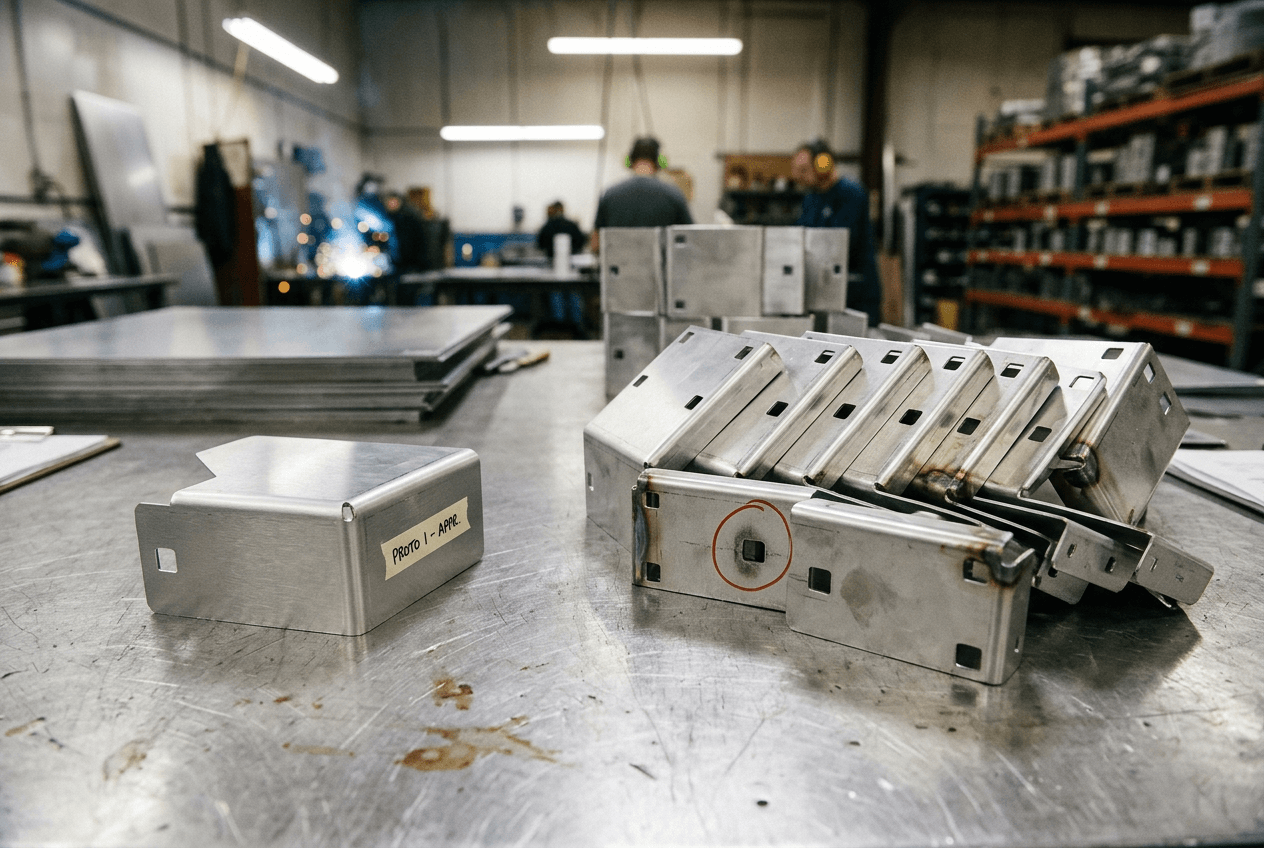
A sourcing manager approves a prototype metal enclosure for a control system. The cover closes, the mounting holes line up, and the powder coating looks acceptable on video. The buyer then asks the same sheet metal fabrication shop to quote 500 units for a launch date that cannot move.
The danger does not start with the batch. It starts when the buyer treats one approved sample as a complete production standard. A prototype may pass because a technician bent slowly, adjusted a hinge by hand, opened coated holes, polished one visible edge, or corrected weld distortion after assembly. Those actions can help development, but they do not automatically become repeatable production controls.
For overseas OEM buyers, this creates a procurement risk with several consequences. Quotes may exclude hidden labor. Lead times may assume standard production speed. Inspection may follow the drawing while the buyer expects the sample. The batch can then arrive with mixed appearance, slow assembly, door rub, hole misalignment, or finish disputes. The issue is not only quality. It is an approval gap that affects cost, timing, and accountability.
A Passing Prototype Can Hide Unpriced Production Work
A prototype proves that one part can be made. It does not prove that 500 parts can repeat the same result at the quoted cost. Sheet metal fabrication includes laser cutting, CNC punching, bending, welding, grinding, powder coating, hardware installation, and assembly. Each step can include small corrections that disappear from the final sample.
Those corrections matter during purchasing. If the shop spends two extra hours fitting a prototype enclosure, the buyer may never see that labor. If the production quote assumes normal bending and assembly, the batch price no longer reflects the approved sample. A low quote can then become a delayed delivery, a change request, or an argument about what the sample really approved.
Hand corrections do not scale cleanly
Consider a wall-mounted control cabinet. The prototype door sits flat because the hinge side was adjusted after welding. The latch catches because one hole was enlarged before coating. The front face looks smooth because a welder ground longer than planned. None of these actions means the supplier performed poorly. They mean the team solved prototype problems manually.
In batch production, manual fixes create unstable output. One worker may adjust the hinge more than another. A second shift may grind less to protect time. Coating thickness may reduce clearance on holes that worked during the sample build. The buyer sees variation. The supplier sees an undefined standard.
The quote may exclude the work that made the sample acceptable
Procurement teams often compare unit prices after prototype approval. That comparison can mislead them if each supplier quotes a different version of repeatability. One shop may include welding fixtures, extra inspection, cosmetic grinding, masking, and assembly checks. Another may quote only the drawing and standard process.
The cheaper offer may not be cheaper after rework, sorting, air freight, or line stoppage. Buyers should ask what prototype adjustments the supplier made and which ones the production quote includes. If Yishang reviews an RFQ at this stage, the most useful discussion is not a sales promise. It is a check on whether the sample result can repeat through normal production methods.
RFQ Ambiguity Makes Suppliers Quote Different Versions of the Same Part
The RFQ should convert a successful prototype into clear batch requirements. Many RFQs do the opposite. They attach a 3D file, a PDF drawing, a few photos, and the phrase “same as sample.” That may feel practical, but it leaves the supplier to decide what matters. Different suppliers will make different assumptions, so their quotes will not represent the same production risk.
A drawing may show material thickness, outer size, and hole diameters. It may not identify critical mounting holes, cosmetic faces, grounding points, insert locations, weld classes, or post-coating fit. During prototyping, the supplier can ask questions and adjust. During batch production, open details become cost drivers and inspection disputes.
Drawing and sample conflicts create the first dispute
One common problem appears when the prototype differs from the drawing. The sample may include a larger bend relief, a shifted hinge, or a wider clearance hole. The buyer approves the sample because it fits. Later, production follows the drawing because the purchase order did not record the sample deviation.
The result can look like a quality failure, but the root cause sits in the RFQ package. The shop made the part to one reference while the buyer inspected against another. This risk grows when several parts form one assembly, such as a cabinet body, removable cover, internal tray, brackets, and latch hardware.
Quote assumptions should become part of procurement control
Buyers can reduce this risk by asking suppliers to state assumptions before the purchase order. The RFQ should define material grade and thickness, annual or batch quantity, critical tolerances, finish expectations, hardware requirements, assembly tests, and packaging needs. It should also mark which dimensions control fit and which surfaces control appearance.
These details affect price and lead time. A simple laser cut and bent bracket may need only standard inspection. The same bracket may need a fixture if it bolts into an existing welded frame with little adjustment. A powder coated enclosure may need masking for threaded holes, grounding studs, or sliding contact surfaces. If the RFQ does not mention those details, the quote may omit them.
Clear RFQ language does not require tight control everywhere. It tells the sheet metal fabrication shop where control matters. That helps the supplier choose a practical route instead of adding cost blindly or underestimating the batch.
Assembly Fit Breaks When Batch Controls Are Not Defined
Prototype approval often hides tolerance stack-up. One enclosure body, cover, hinge, latch, and internal bracket may fit together once. In a batch, small variations in bend angle, hole position, weld pull, coating thickness, and hardware placement can combine. The individual parts may pass basic inspection, but the final assembly may rub, rock, scrape, or fail to mount.
The procurement risk grows when drawings carry precise CAD geometry but no practical production tolerance. Sheet metal does not behave like a perfect model. Bend radii vary with tooling and material. Welded frames move with heat. Powder coating adds thickness. Hardware insertion can shift slightly. Buyers do not need to control every dimension tightly, but they must name the dimensions that protect assembly function.
Project example: electronics enclosure with a sliding tray
An OEM orders a stainless steel electronics housing with a removable internal tray. The prototype tray slides smoothly because the side flanges were corrected by hand. The buyer approves the sample and releases a larger order. During batch assembly, some trays scrape the coated side wall and block cable routing.
The starting issue was not the material or the operator alone. The RFQ did not define tray clearance after coating, flange angle tolerance, or the inspection method. The supplier priced a standard formed assembly, not repeated sliding fit. Earlier clarification could have led to a larger clearance, a controlled bend datum, a trial assembly check, or a small pilot batch before full release.
Project example: brackets inside a welded machine frame
A buyer sources 2,000 laser cut and bent brackets for a welded machine frame. The prototype bracket fits the frame because one hole was slightly opened during trial assembly. The drawing lists hole diameter but does not control hole position relative to the bent flange. Production bends from a different datum, and some brackets need filing before bolts pass through.
This creates a chain of costs. Assembly workers lose time. The buyer asks for sorting. The supplier points to the drawing. A field schedule slips because a small bracket became a line-side correction. The better control would have been simple: identify the mating holes, define the datum, set a positional tolerance, and decide whether a go/no-go fixture or assembly sample should guide inspection.
Before the PO, Turn the Sample Into a Repeatable Production Standard
Buyers do not need a long textbook checklist before every order. They need a transfer review that captures what made the prototype pass. That review should happen before the production purchase order fixes price, lead time, packaging, and inspection expectations.
Start by comparing the approved prototype with the latest drawing. If the sample includes deviations, record them. If a hole was enlarged, a bend relief changed, or a weld ground smoother than the drawing shows, decide whether production should repeat it. Do not leave the decision inside photos or memory.
Define the few controls that protect the batch
The most useful controls usually relate to fit, appearance, and handling. Identify holes that mate with customer assemblies. Define door gaps, latch engagement, hinge movement, gasket surface flatness, and welded frame squareness where they affect function. For cosmetic parts, mark A-surfaces, visible welds, acceptable grinding level, coating color, gloss or texture, and masking zones.
Finish expectations deserve special attention because they often look subjective. “Black powder coating” does not explain whether hanging marks are acceptable, whether internal surfaces matter, or how much color variation can appear between coating runs. A prototype coated in one small batch may look more uniform than 500 parts processed across several hanging cycles.
Packaging also belongs in the same risk discussion. A perfect finish can fail after stacking, vibration, overseas shipping, or repeated handling. If the buyer expects retail-facing panels or visible cabinet doors, packaging must protect those surfaces from the start. Otherwise, the dispute shifts from coating quality to shipment damage.
Use a pilot batch when the sample required judgment
A pilot batch helps when the prototype relied on manual fitting, cosmetic finishing, welded alignment, or moving assemblies. It does not need to be large. A short run can reveal whether cycle time, weld distortion, coating coverage, hardware installation, and assembly fit stay stable when the part leaves prototype treatment.
The buyer should also ask the supplier to explain inspection points. A flat panel may need dimensional checks only. A welded frame may need diagonal measurement or a checking fixture. A hinged metal enclosure may need an opening and closing test. A powder coated housing may need thread masking checks and surface inspection under agreed lighting.
When sending an RFQ to Yishang, include drawings, material requirements, quantities, tolerances, finish expectations, hardware details, assembly notes, and packaging needs. Add photos or inspection notes from any approved prototype. That information helps separate one-off prototype effort from repeatable batch fabrication before the order locks in risky assumptions.
Frequently Asked Questions
What should OEM buyers prepare before requesting a sheet metal fabrication quote?
Buyers should prepare drawings, material grade, sheet thickness, quantities, tolerance notes, finish expectations, and any assembly or inspection requirements. The clearer the RFQ, the fewer assumptions the supplier needs to make during quoting.
Why do sheet metal fabrication quotes vary between suppliers?
Quotes often vary because suppliers make different assumptions about tolerances, material yield, finishing steps, welding complexity, inspection needs, packaging, and lead time. A detailed RFQ helps buyers compare quotations on the same technical basis.
How can tolerance requirements affect fabrication cost?
Tight tolerances may require more controlled cutting, forming, fixturing, inspection, or secondary work. Buyers can control cost by separating fit-critical dimensions from non-critical dimensions instead of applying tight tolerances everywhere.
When is a prototype recommended before batch production?
A prototype is useful when the part has tight fit-up, visible surfaces, welded assemblies, complex bends, or mating components. It helps confirm manufacturability, assembly behavior, and finish expectations before larger quantities are produced.
What surface finish details should be included in an RFQ?
Buyers should specify finish type, color, coating thickness if required, cosmetic surfaces, corrosion expectations, masking areas, and any visual acceptance standard. This avoids finish-related rework or quote changes later.
How can Yishang support custom sheet metal fabrication projects?
Yishang can review drawings, clarify fabrication requirements, discuss materials and finishes, support prototypes, and prepare for batch production based on the buyer’s RFQ details.