
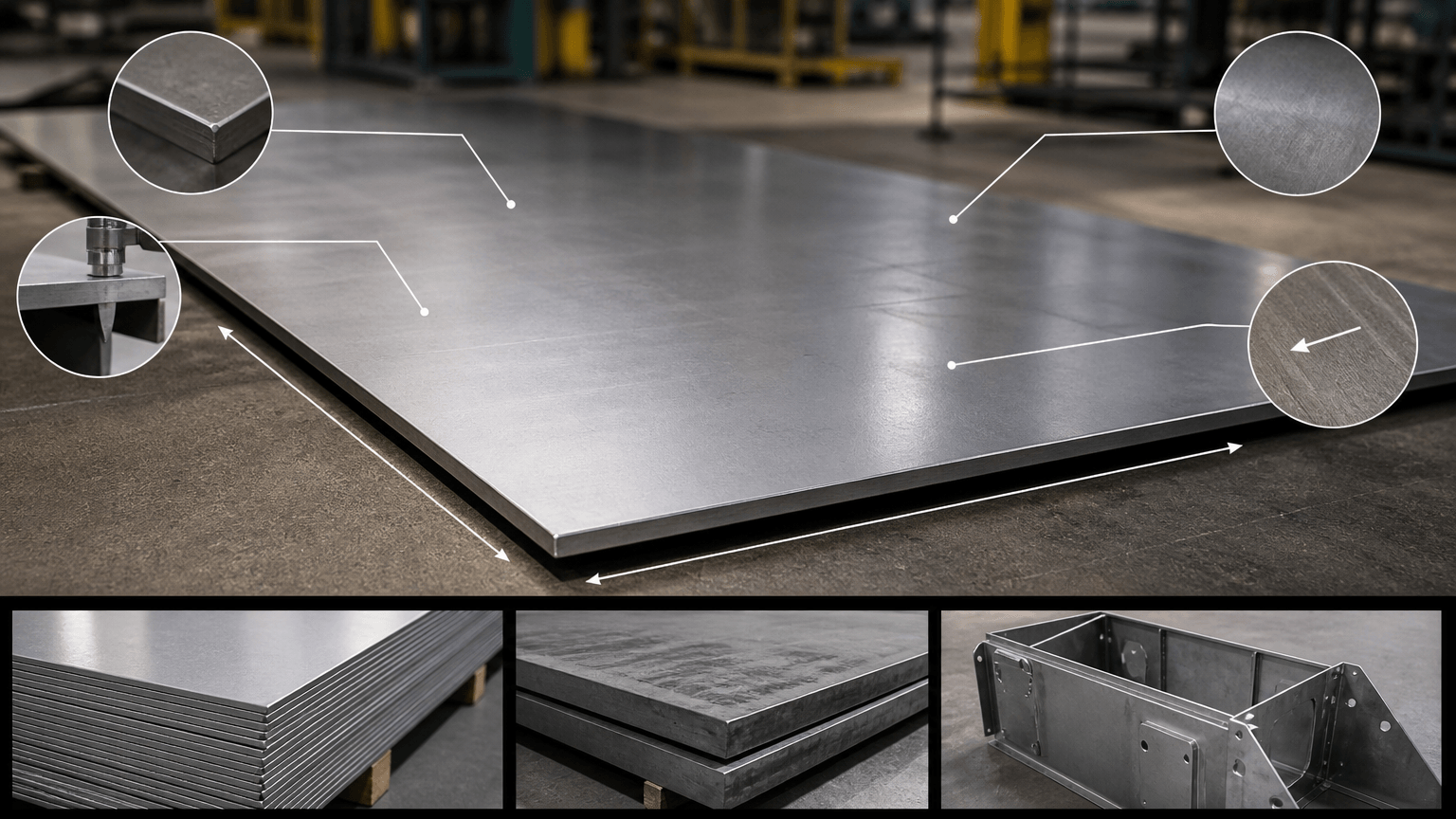
“Sheet of sheet metal” normally means a flat sheet of metal or a cut sheet-metal blank, but it is not a complete purchasing specification. If an OEM buyer wants material for its own process, the request may be for full stock; if the buyer wants a rectangle, holes, bends, or a ready-to-install enclosure, the supplier must quote a different deliverable. Add material, grade, thickness, dimensions, quantity, surface, and required form before requesting a firm review.
Direct answer: use sheet metal, a sheet of metal, metal sheet, or sheet-metal blank as appropriate. State whether delivery is raw sheet, rectangular cut-to-size sheet metal, a profile-cut blank, or a custom sheet-metal part. Holes, bends, welds, finishing, and assembly move the request beyond raw stock.
What the phrase can mean at delivery
A purchasing team may use the phrase for several manufacturing stages. That matters because the quotation scope, process route, and inspection criteria change when flat stock becomes a cut, formed, joined, or finished product.
| Term | Practical meaning |
|---|---|
| Sheet metal | General term for flat rolled metal stock. The material specification, product standard, or industry convention determines its classification. |
| A sheet of metal / metal sheet | Plain-language descriptions of a flat product; they do not define grade, thickness, size, or quality. |
| Sheet-metal blank | A flat piece prepared for a later operation. It may be rectangular or have a cut profile. |
| Rectangular cut-to-size sheet | A rectangle cut from larger stock with specified width, length, tolerance, and edge condition. |
| Profile-cut blank | A flat blank with a shaped perimeter, holes, slots, or other openings made by an agreed cutting process. |
| Plate | A thicker flat product. Many references use about 3/16 inch, approximately 4.8 mm, as an orientation point between sheet and plate. |
| Foil | A very thin flat metal product. Its boundary with sheet varies by material and application. |
| Fabricated component | A part that has moved beyond flat stock through bending, welding, finishing, assembly, or another defined operation. |
The 3/16-inch figure is not a universal cutoff. The applicable material standard and industry practice control, especially near the boundary.
What to put on a quote-ready purchase request
A request for only “stainless sheet” or “aluminum blank” leaves important decisions open. Separate raw-material requirements from finished-part requirements so the supplier can review material, processing, inspection, packaging, and price against the same definition.
| Field | Information to provide |
|---|---|
| Deliverable | Full sheet, rectangular blank, profile-cut blank, bent part, welded assembly, or finished product. |
| Material family | Mild steel, stainless steel, aluminum, galvanized steel, copper, brass, or a defined alloy family. |
| Grade and standard | Exact grade plus the applicable ASTM, SAE, EN, or customer standard. Confirm the reference after grade and condition are selected. |
| Temper or condition | Required temper, heat-treated condition, or other delivery state where applicable. |
| Thickness | Nominal thickness in millimeters or inches and the required thickness tolerance. |
| Size and quantity | Width, length, full-sheet dimensions or blank dimensions, piece count, forecast, and prototype needs. |
| Surface and grain | Mill surface, brushed or polished appearance, coating, protective film, and grain direction where relevant. |
| Part requirements | Profiles, holes, bend angles and radii, welds, coating, assembly interfaces, datums, and finished-part tolerances. |
| Edges and quality | Flatness, squareness, burr limit, edge condition, surface defects, inspection method, and required records. |
Decision matrix: from “sheet of sheet metal” to the correct deliverable
| Actual need | Request | Minimum definition |
|---|---|---|
| Material for your own downstream work | Full sheet | Family, grade, condition, thickness, dimensions, surface, quantity, and documents. |
| A flat rectangle | Rectangular blank | Material details plus width, length, tolerance, squareness, flatness, edges, and burr limit. |
| A shape with holes or slots | Profile-cut blank | Material details plus drawing or CAD file, profile and hole tolerances, datums, burrs, and edge quality. |
| A three-dimensional or ready-to-install item | Custom sheet-metal part | Finished dimensions, bends, welds, finish, critical interfaces, inspection, quantity, and packaging. |
An illustrative request line is: Material: [family, grade, temper/condition]; thickness: [mm or in]; size: [width × length]; quantity: [pieces]; surface: [condition]; deliverable: [full sheet, rectangle, or profile blank]. Bend, hole, weld, and coating details may be absent for raw stock but become essential for a custom component.
Review the sheet-metal material options with the intended forming, joining, and finishing route. If the deliverable is unclear, a specification review can classify the request before pricing.
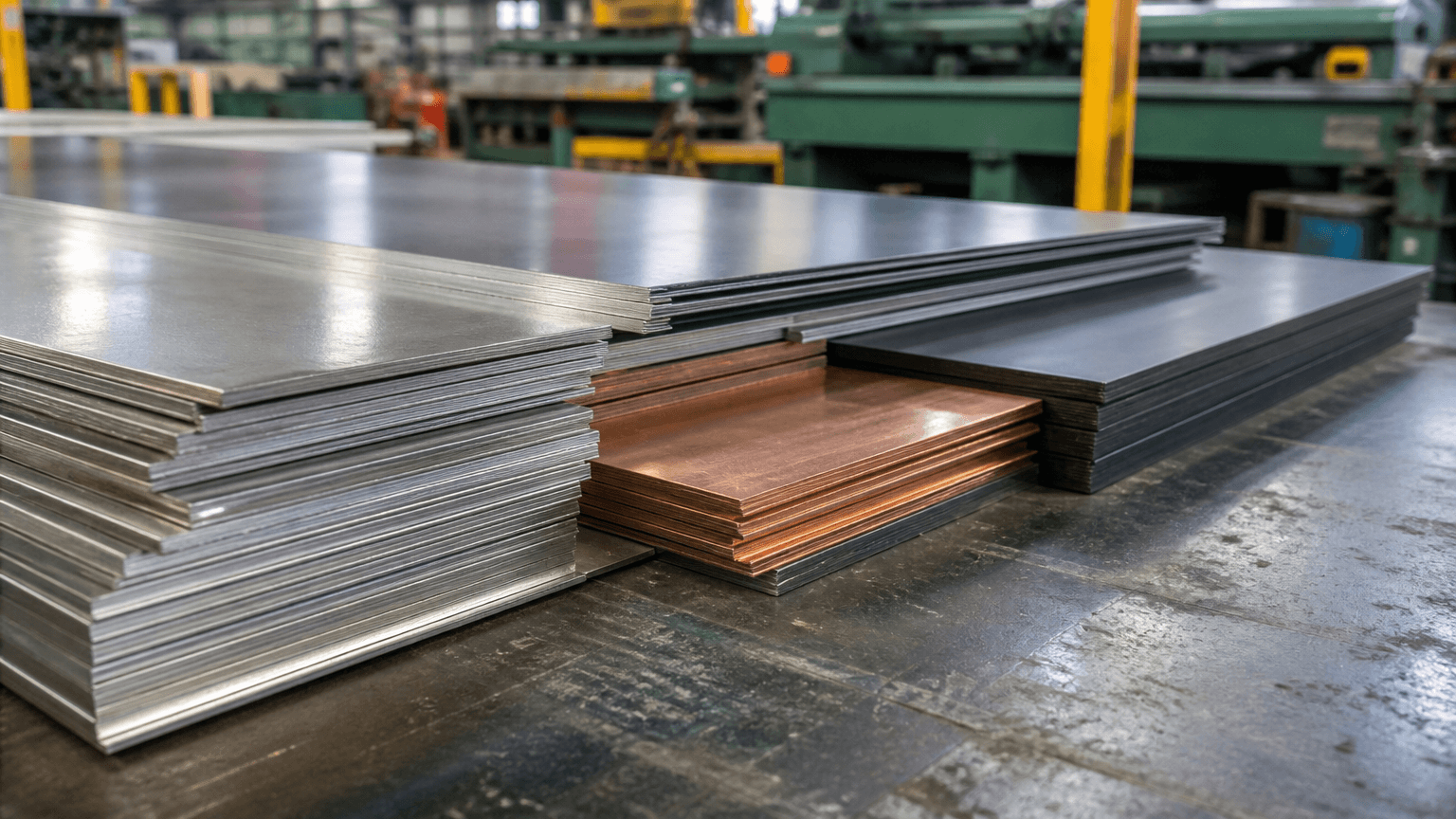
Material, gauge, and standard sheet formats
Material selection trade-offs
Material choice is a trade-off among strength, weight, corrosion resistance, formability, weldability, conductivity, appearance, and finishing. Grade, temper, thickness, geometry, and joining method can change the result, so the matrix is a screening aid rather than a substitution guide.
| Material | Key trade-offs | Process and finish considerations |
|---|---|---|
| Mild steel | Often balances strength, formability, and weldability; denser than aluminum and limited in bare-metal corrosion resistance. | May require paint, powder coating, plating, or another protective finish. Grade and thickness affect bending and welding. |
| Stainless steel | Provides corrosion-resistant and appearance-focused options, with higher density than aluminum. Strength and forming vary by grade and condition. | 304 is often evaluated for general corrosion-resistant service; 316, with molybdenum-bearing chemistry, is often considered when chloride exposure matters. Welding and surface treatment remain grade-specific. |
| Aluminum | Low density can reduce weight, while alloy and temper control strength, stiffness, and corrosion behavior. | Conductivity may be useful. 5052 and 6061 offer different forming and strength balances; do not assume 6061 is a substitute for 5052 at a bend. Joining and finish require review. |
| Galvanized steel | A zinc-coated steel product that provides different corrosion protection from uncoated mild steel. | Cut edges, bends, weld areas, fumes, coating repair, and subsequent painting need a defined process. |
| Copper | High electrical and thermal conductivity, but relatively soft and heavier than aluminum at the same volume. | Alloy and temper affect forming, joining, oxidation, polishing, and appearance. State conductivity and surface requirements. |
| Brass | Useful conductivity and a recognizable appearance; density, strength, and formability vary by alloy. | Specify the alloy, forming or joining method, finish, and appearance consistency after processing. |
For grade checks, references may include ASTM A240 for stainless steel sheet, plate, and strip; ASTM B209 for aluminum and aluminum-alloy sheet and plate; and ASTM A653 for zinc-coated steel sheet. Use the applicable standard and producer datasheet to confirm grade, temper or condition, mechanical behavior, forming limits, and documentation. These references are not blanket compliance or equivalence claims.
Gauge, nominal 4×8 sizing, and cut formats
Gauge is material-specific. A higher gauge number generally indicates thinner material within one gauge table, but steel, stainless steel, aluminum, galvanized steel, copper, and brass do not share one universal conversion. State millimeters or inches as the controlling thickness, then add gauge only after checking the correct material table.
A nominal 4×8-foot sheet is 4 × 12 = 48 inches by 8 × 12 = 96 inches, or approximately 1219.2 × 2438.4 mm. This is a nominal example, not a guaranteed delivered size. Confirm supplied dimensions, tolerances, flatness, usable area, and availability.
| Format | Quote and acceptance variables |
|---|---|
| Full sheet | Stock dimensions, material, thickness, surface, quantity, packaging, and freight. |
| Rectangular blank | Width, length, tolerance, squareness, flatness, edge condition, burr limit, and cutting method. |
| Profile-cut blank | CAD or drawing, perimeter and hole tolerances, datums, burrs, and required edge quality. |
| Fabricated part | Bend radii and angles, welds, finish, interfaces, assembly, and finished-part inspection. |
The price of a 4×8 sheet or cut blank varies with grade, thickness, material area or weight, cutting method, setup, nesting, scrap, quantity, finish, protective film, documents, packaging, and freight. A rectangle and a profile-cut blank are different work scopes even when they start from the same sheet.
When the request becomes custom sheet-metal fabrication
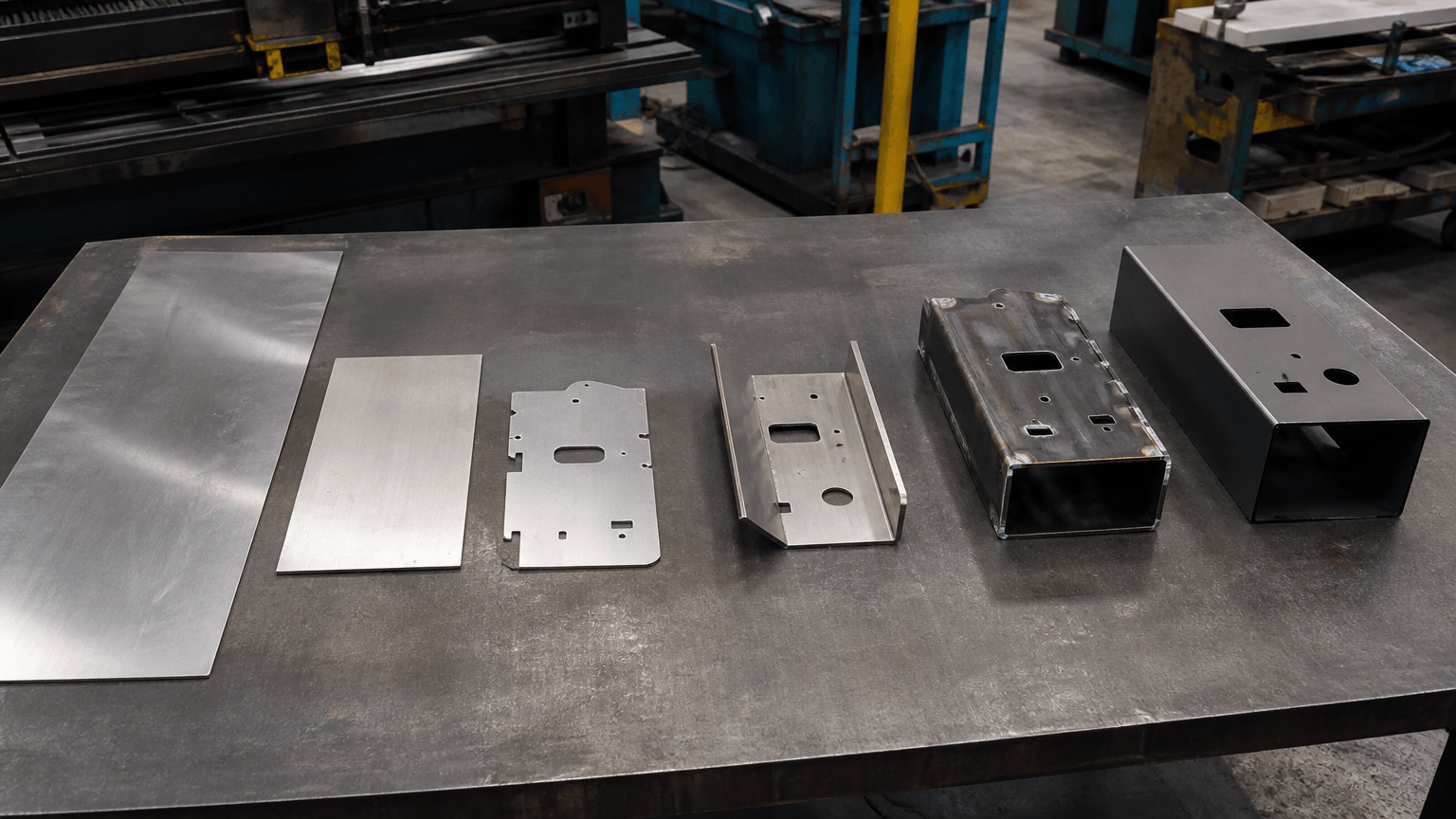
The requirement crosses from raw-material buying into custom manufacturing when the buyer needs holes, slots, flanges, bends, welded joints, a coating, or an assembled interface. The supplier is then reviewing a process route and finished deliverable, not only a sheet of metal.
Raw sheet → rectangular or profile-cut blank → bent component → welded assembly → finished and assembled product
Steps may be omitted or reordered according to the drawing, material, finish, and assembly method.
- Cutting: Shearing or another agreed method can create a rectangle. Laser cutting or CNC punching can create profiles and openings; neither is automatically the cheapest or best choice for every requirement.
- Bending: Forming changes flat geometry into flanges, channels, panels, or enclosure sections. Angle, radius, grain direction, and springback may affect review.
- Welding: Welding joins separate pieces and introduces location, appearance, distortion, and inspection requirements.
- Finishing and assembly: Surface treatment, protective film, hardware, subassembly, and packaging are downstream requirements, not synonyms for sheet cutting.
CNC turning and milling are separate machining processes. They remove material from a workpiece to make a machined component; they do not describe cutting a flat sheet profile. For example, an OEM enclosure may use a machined insert while its enclosure drawing controls the sheet-metal bends and welds. The interface should define datums, mounting features, fit or clearance, and joining method.
Deep drawing and stamping are separate sheet-forming routes. Machining, extrusion, and die casting are also separate process decisions. They should not be used as interchangeable names for laser cutting, CNC punching, bending, or welding.
Yishang supports B2B OEM and ODM custom manufacturing, prototype review, and batch production. A route using laser cutting, CNC punching, bending, welding, finishing, and assembly can be reviewed through custom sheet-metal fabrication, subject to the material, geometry, quantity, and drawing.
OEM acceptance and RFQ preparation
Acceptance requirements should distinguish incoming raw material from a cut blank and from a finished part. Put the requirements on the drawing, purchase order, inspection plan, or quality agreement.
- Raw sheet: Verify material family, grade, condition, thickness tolerance, dimensions, flatness, surface defects, coating, grain direction, edge damage, and protective film.
- Cut blanks: Inspect dimensions, datums, hole and slot locations, squareness, flatness, burrs, edge condition, distortion, and surface protection.
- Fabricated parts: Evaluate bend angles and radii, weld locations and appearance, finished dimensions, coating or other finish, assembly fit, and critical interfaces.
- Records: Request material certificates, heat or lot traceability, inspection reports, and sample or first-article records when required.
Define measurement methods, datum references, sampling, and acceptance limits. Packaging should also address separation, edge protection, moisture protection, blocking, and shipping protection for large sheets or finished assemblies. Review the Quality Control approach with the product-specific requirements.
Prepare an OEM RFQ: Send the material family, grade, temper or condition, thickness, blank or finished-part dimensions, quantity, forecast, prototype needs, timing, drawing or 3D file, tolerances, datums, finish, protective film, inspection documents, packaging, and shipping requirements. Yishang can help determine whether the requirement is raw sheet, a cut blank, or a custom OEM component and review a suitable process route.
Yishang has more than 26 years of experience, exports custom metal products to more than 50 countries, supports prototype and batch-production projects, and holds ISO and RoHS certifications. Product-specific material, inspection, and acceptance requirements should still be stated in the purchase documents.
Frequently Asked Questions
What sheet of sheet metal details should buyers define before requesting a quote?
Buyers should define the functional requirement, drawing notes, critical dimensions, material or process expectations, and any inspection points related to sheet of sheet metal. This helps suppliers quote the same manufacturing scope instead of making different assumptions.
How can RFQ details affect cost, fit, or lead time?
RFQ details can change tooling, forming, welding, finishing, inspection, or rework requirements. If buyers do not clarify it early, two supplier quotes may look comparable while covering different production risks.
Why should drawing requirements be reviewed before prototype approval?
drawing requirements may look acceptable on a single sample but become harder to control during batch production. Buyers should confirm whether the prototype reflects the same process, finish, and inspection conditions expected for production.
What inspection points matter most for sheet of sheet metal projects?
Important inspection points usually include fit-critical dimensions, holes or mating areas, cosmetic surfaces, finish build-up, welded or formed features, and any dimensions that affect downstream assembly. These points should appear in the RFQ or drawing notes.
How can buyers reduce prototype approval risk before batch production?
Buyers can reduce risk by clarifying drawings, locking key material and finish assumptions, defining inspection timing, approving a representative sample, and confirming which dimensions or surfaces require tighter process control.
How can Yishang help review sheet of sheet metal requirements?
Yishang can review drawings, RFQ notes, material requirements, tolerance expectations, finish details, samples, and assembly needs to identify unclear assumptions before quoting or batch production.