
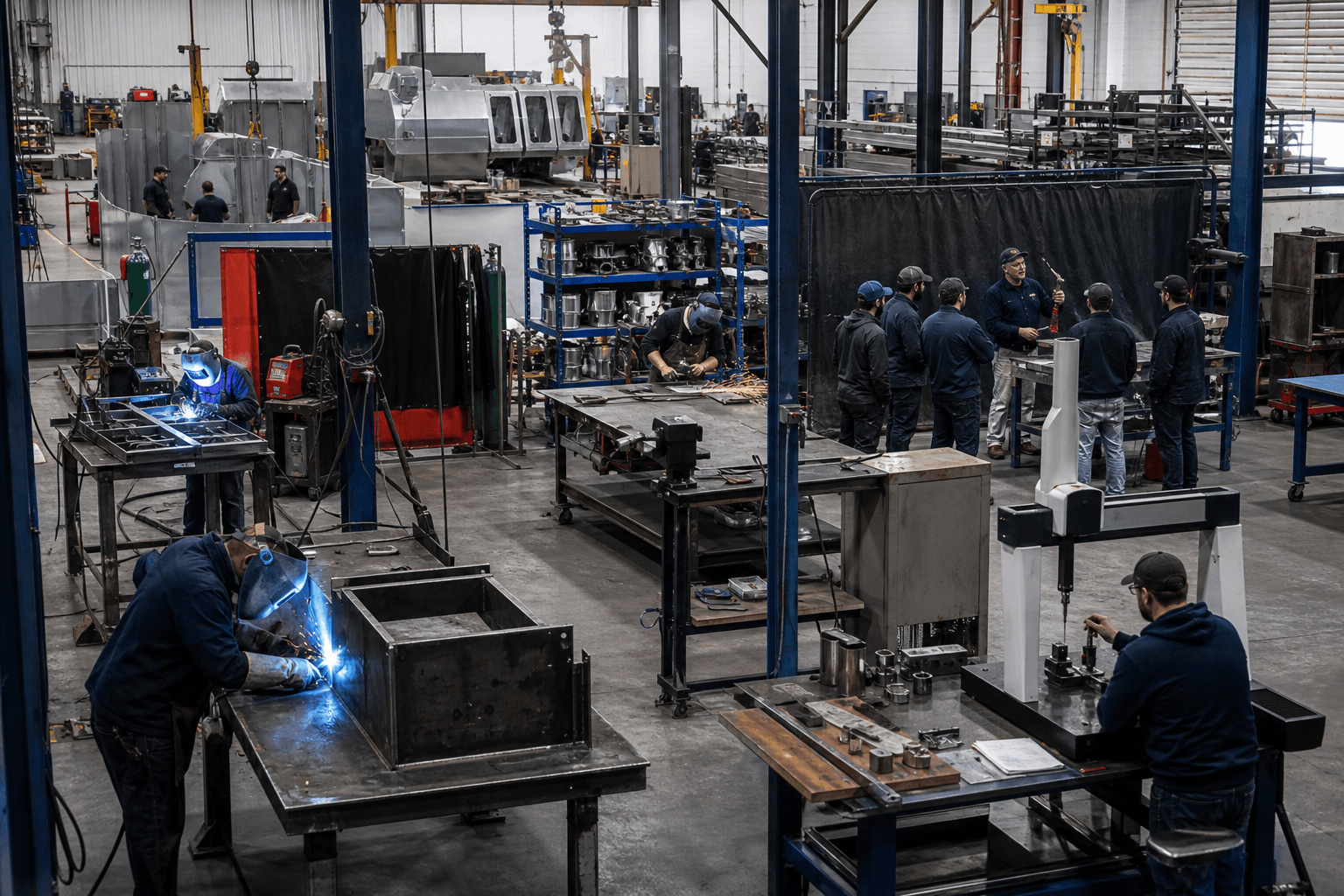
The welding industry is a broad manufacturing and labor-market ecosystem built around joining metal by welding. It includes welding operations, fabrication services, equipment and consumables, training and qualification pathways, inspection, skilled workers, and end-use manufacturers. It is wider than a welding station or one occupation.
For an OEM buyer sourcing a frame, enclosure, bracket, or other welded assembly, that distinction matters. The part may pass through cutting, forming, fixturing, joining, finishing, inspection, and assembly. Workforce conditions can influence setup time, queue time, overtime, rework, and delivery, but a public forecast does not prove a particular supplier’s capacity. This article focuses on interpreting workforce signals and requesting project-specific evidence, not on market-size forecasting or welding instruction.
Welding industry scope: more than a welding operation
When an OEM receives a quotation for a welded enclosure or support, the quoted work may involve much more than arc-on time. Material preparation, forming, joint access, fixtures, inspection, finishing, and final assembly can all affect whether the part is repeatable and delivered as scheduled.
The ecosystem includes welding fabricators, OEM manufacturers, equipment and consumable suppliers, fixture and maintenance providers, training organizations, inspectors, and skilled workers. It serves industrial machinery, electronics, energy equipment, construction products, automotive systems, appliances, and other manufactured goods. Sheet metal fabrication is one segment of this wider industry, not a synonym for it.
Where welding fits in a custom fabrication route
A drawing that calls for a welded cabinet or frame does not, by itself, define the supplier’s production scope. Buyers should separate the joining operation from the surrounding fabrication steps and from the finished delivery scope.
| Term | What it means | Possible scope | Buyer implication |
|---|---|---|---|
| Welding | A joining operation using heat, pressure, or both. | Joint preparation, fit-up, joining, cleaning, and specified checks. | Access, material, thickness, process, weld length, and requirements affect labor and quality. |
| Welding fabrication | A broader production service with welding as one route step. | Cutting, forming, fixturing, fit-up, welding, finishing, inspection, and assembly. | Evaluate the integrated production route, not only weld execution. |
| Sheet metal fabrication | Making sheet or plate parts through cutting and forming, with joining added when needed. | Laser cutting or CNC punching, bending, hardware insertion, welding, polishing, coating, and assembly. | Some parts need no welding. Cutting and bending are not universal welding substitutes. |
| Machining | Removing material to create features or interfaces. | CNC-machined inserts, brackets, or mating surfaces used with a fabricated assembly. | Review interfaces, tolerances, material, and exposure to welding heat separately. |
| Finishing | A surface-treatment operation. | Polishing, coating, or other specified surface work. | It addresses appearance or surface performance, not metal joining. |
| Inspection | Verification against drawing or acceptance requirements. | Dimensional, visual, or other checks required by the project. | Inspection creates evidence of conformity but is not a fabrication process. |
| Welded assembly | A finished multi-part unit containing welded joints. | Parts, fit-up, welds, dimensional checks, surface treatment, and mechanical or electrical assembly when specified. | Schedule and price the complete delivery scope, not only welding time. |
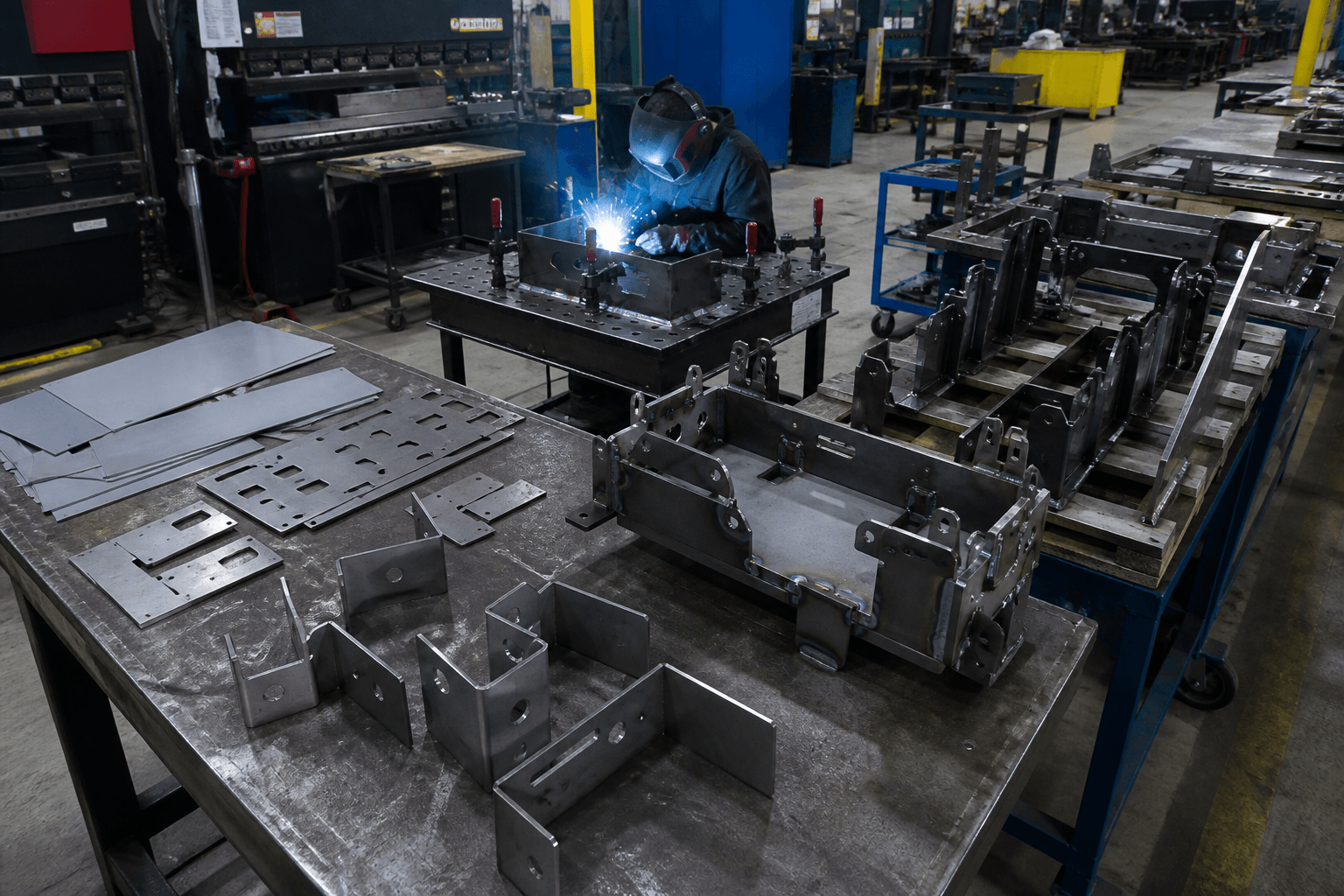
A possible route is laser cutting or CNC punching, bending, fit-up, welding, finishing, and assembly, but the actual sequence depends on geometry and function. A flat or bent sheet part may be delivered without welding, while a frame, cabinet, or structural assembly may require several welded joints. For a broader view of combined operations, see custom sheet metal structures and assemblies.
How to read welding workforce data
A public workforce forecast becomes useful only when it matches the labor and process involved in the part being sourced. A national figure about welding may not describe the availability of an experienced fabricator, TIG operator, pipe welder, programmer, or inspection resource in the supplier’s location.
The AWS Foundation and U.S. Bureau of Labor Statistics (BLS) workforce analysis used for this topic groups six occupational categories in which welding is a primary function. That is a statistical lens, not a complete count of everyone who welds or every person in a fabrication plant. Check the exact occupational titles and definitions in the published release before using the grouping.
Source discipline: Record the publication date, forecast period, geography, occupational definition, statistical basis, and denominator for any figure. No undated shortage, wage, growth, hiring, or market-size number should be used to make a supplier-specific claim.
- Geography: State, region, commuting area, and industrial concentration can produce different labor conditions from a national average.
- Growth versus replacement: New positions created by industry growth are different from hiring needed because of retirement, turnover, or movement out of the occupation. Total hiring need may include both.
- Occupation and experience: A general welding category may not represent experienced fit-up skill or the process knowledge needed for the project.
- Process and qualification: MIG, TIG, robotic, pipe, stainless steel, and aluminum work involve different skill combinations. Confirm any customer, code, or AWS qualification that actually applies.
- Wage data: Compare location, experience, occupation, and qualification. A wage figure is not a universal price index for a finished welded part.
Technical schools, apprenticeships, industry certifications, and four-year education also measure different pathways. They vary in duration, cost, practical exposure, and intended job-readiness output, so none should be treated as an interchangeable measure of production capacity.
How workforce conditions reach OEM cost, quality, and delivery
For the buyer, a labor signal becomes a project risk only through a specific production mechanism. The relevant question is not whether a shortage exists in the abstract, but whether the required skill, workstation, and inspection capacity are available for this part and schedule.
- Skill coverage affects setup and fit-up. Limited experience with a joint, material, position, or surface requirement can increase fixture adjustment, supervision, engineering review, or first-article effort.
- Turnover affects continuity. Replacing experienced workers can increase training time and variation in fit-up, distortion control, or work-instruction use. Cross-training and process controls can change the outcome.
- Production load affects queue time and labor cost. A full schedule may create overtime, subcontracting, changeover delays, or a longer queue. The effect depends on batch size and suitable workstation availability.
- Inspection and rework consume capacity. Difficult access, complex joints, demanding visual requirements, or extensive inspection can add time after welding. Rework may compete for the same skilled resources as new production.
The project-specific effect also depends on weld complexity, access, material, thickness, batch size, finishing, and inspection requirements. Wage changes may influence a quotation, but they do not alone predict final pricing; material, engineering, overhead, utilization, quality requirements, and commercial terms also matter.
Robotic or semi-automated welding can reduce repetitive manual work when geometry, volume, joint consistency, fixtures, and loading support it. It still requires programming, fixture planning, changeover, maintenance, process control, and inspection skills. Manual welding may remain more practical for variable assemblies or low quantities.
Evidence to verify before supplier selection
When two suppliers both describe themselves as capable welders, project-specific evidence helps distinguish a general service description from a controlled production route. The evidence should match the part, quantity, and stage rather than rely on an unverified headcount claim.
- Skill coverage: Ask which manual and automated process experience matches the drawing, material, thickness, joint position, and finish. Confirm applicable customer, code, or AWS qualification requirements.
- Process control: Clarify work instructions, weld procedure control, fixture planning, material identification, traceability, and revision control. Request WPS or PQR documentation only when the specification or governing requirement calls for it.
- Capacity planning: Review suitable workstations, current production load, batch-size fit, planned maintenance, changeover assumptions, and the response to demand surges, absence, or equipment interruption.
- Quality evidence: Request scoped inspection records, nonconformance handling, corrective-action examples, and first-pass or rework information when available. State the relevant period and part scope.
- Staffing continuity: Look for cross-training, backup coverage, supervision, onboarding controls, and subcontractor oversight instead of relying only on an employee count.
A prototype may require a sample and fit review; a pilot batch may require repeatability checks and documented lessons; repeat production may require revision control, batch records, inspection planning, and corrective-action discipline. Review the supplier’s quality-control approach against the actual acceptance criteria.
Welding industry workforce risk: an evidence-to-action matrix for OEM buyers
| Signal | What it may affect | Evidence to request | Possible mitigation |
|---|---|---|---|
| Regional forecast or wage movement | Hiring pressure or quotation sensitivity | Date, geography, occupation, method, and project-specific supplier response | Compare qualified sources; do not treat a national trend as factory proof. |
| Limited coverage of the required process or material | Setup time, supervision, and variation | Representative samples, qualification scope, work instructions, and inspection plan | Review joint design, fixturing, and prototype results before volume release. |
| High production load or absence exposure | Queue time, overtime, subcontracting, and delivery stability | Capacity plan, load assumptions, backup coverage, maintenance, and surge process | Use a staged release, realistic schedule, or approved second source where appropriate. |
| High inspection or rework burden | Effective capacity and batch consistency | Nonconformance process, corrective actions, and scoped first-pass or rework data | Simplify access and fixturing where function allows, then validate the design. |
Design the joint for repeatable production
If a bracket or enclosure uses hidden joints, difficult fixture locations, or unnecessary weld interruptions, the design can expose the project to avoidable fit-up and inspection effort. The goal is not to remove welding automatically; it is to make each required joint accessible, repeatable, inspectable, and appropriate for the product.
- Provide clear weld access and joint visibility where the function permits.
- Allow practical fixture locations and stable datums for loading and distortion control.
- Use realistic weld lengths and avoid unnecessary starts, stops, and interruptions.
- Where engineering permits, evaluate bends, tabs, slots, interlocking features, standardized joint details, and standardized materials to reduce part count or fit-up effort.
Route selection remains application-specific. Bending may reduce joints in some enclosures, but it cannot replace a weld where structural continuity, sealing, access, material behavior, or compliance requires one. Automation suits stable geometry and repeat volume more readily than highly variable work. Stainless steel and aluminum fabrication may also require closer attention to heat management, distortion, surface condition, and finishing.
Validate fit and assembly during prototype review before committing to batch production. The practical conclusion is to use workforce data to frame questions, then judge the route through the actual drawing, materials, inspection burden, capacity evidence, and schedule assumptions. For machinery applications, buyers can also review custom metal fabrication for industrial equipment and the custom welding process scope.
Request a welding capability and design review
For an RFQ or pre-quotation review, send a representative drawing, 3D model, or product sketch, plus material grade and thickness, weld symbols, joint requirements, drawing tolerances, applicable inspection criteria, prototype, pilot, or batch-production stage, estimated annual or batch volume, and finishing, assembly, packaging, and delivery expectations.
Yishang can review whether a custom sheet metal or welded-assembly route fits and which inputs are missing before quotation. Yishang is a B2B custom manufacturer with more than 26 years of experience, exports to more than 50 countries, and supports prototype review and batch production. The supplied company information lists ISO and RoHS certifications. The review does not assume a specific welding capacity or turnaround time.
Frequently Asked Questions
For an OEM comparing a welded part, a formed part, or a complete assembly, these answers clarify terminology and the evidence needed before prototype or production decisions.
Is the welding industry the same as welding fabrication or sheet metal fabrication?
No. Welding is the joining operation. Welding fabrication is a wider service, sheet metal fabrication is a cutting and forming route that may include welding, and a welded assembly is the finished multi-part scope.
How should buyers interpret the six welding-related occupations used in AWS Foundation and BLS workforce analysis?
Treat them as defined categories where welding is a primary function, not as a complete workforce count. Check the published titles, period, geography, denominator, and the balance between growth and replacement demand.
Can a welding labor shortage change the price or lead time of an OEM metal part?
It can through setup time, queue length, overtime, subcontracting, inspection, or rework, but the effect is project-specific. Compare the supplier’s part-specific assumptions and evidence rather than relying on public labor data alone.
Does robotic welding eliminate workforce risk for custom welded assemblies?
No. Suitable automation can reduce repetitive manual work, but programming, fixtures, loading, maintenance, changeovers, inspection, and process control still require skilled support.
Should every welded sheet metal product be redesigned to reduce welding?
No. Consider structural function, sealing, access, material, finish, compliance, assembly, and quantity first. Bends, tabs, slots, or standardized joints may reduce effort in some designs but cannot replace every required weld.