

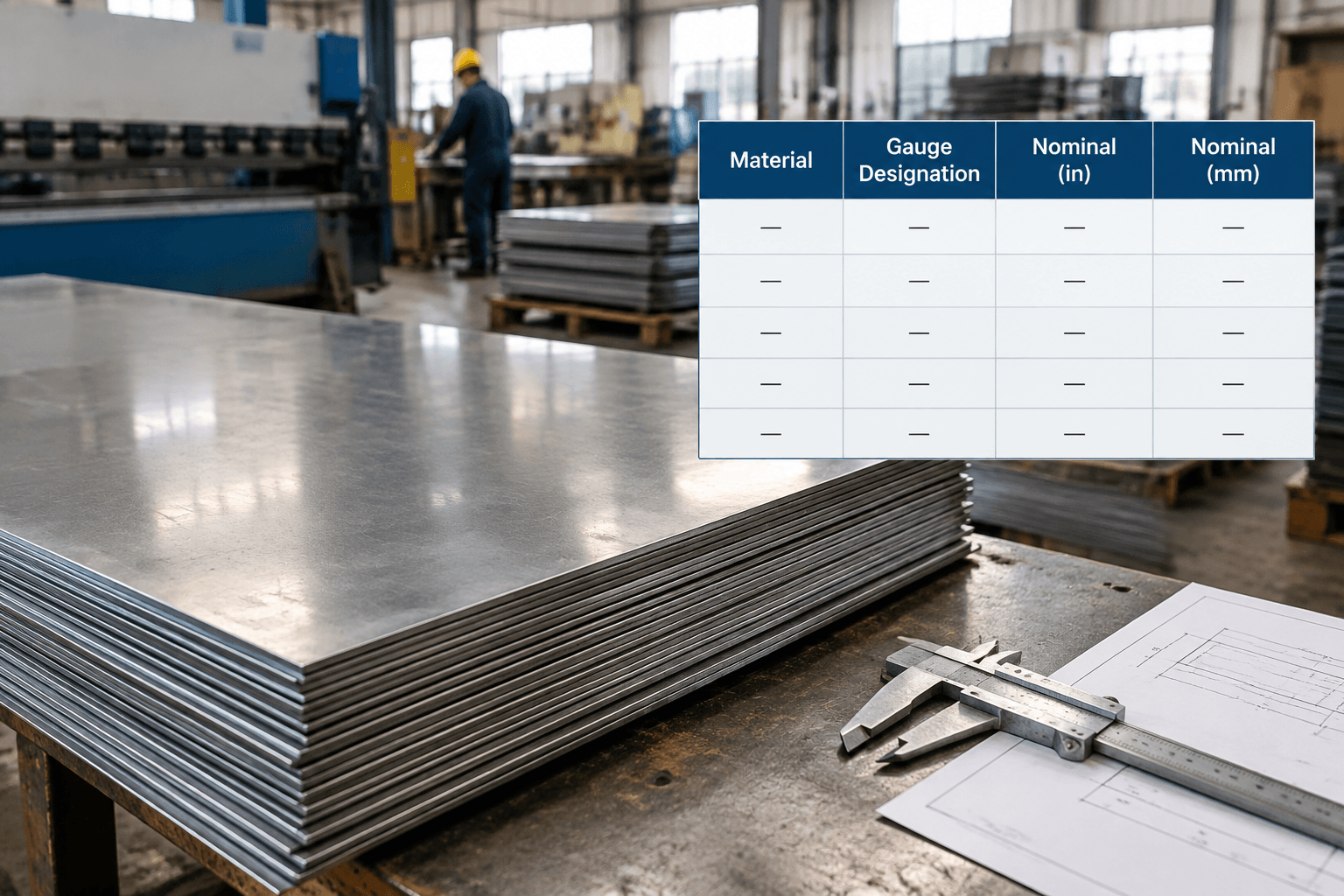
The supplied reference associates 16 gauge sheet thickness with 0.0598 in (1.519 mm). That is not a universal conversion: the reference does not identify the material, and gauge-to-thickness values vary by material or gauge system.
Use those numbers only when the applicable material-specific gauge reference confirms them. For purchasing, fabrication, and inspection, define the material, nominal thickness, units, and permitted thickness variation directly on the drawing.
Why the Material Changes the Gauge Conversion
Gauge is a designation, not a material-independent unit such as an inch or millimeter. A 16 gauge entry in one material system may represent a different nominal thickness from 16 gauge in another. Consequently, a drawing note that says only 16 GA
leaves an important requirement open to interpretation.
This matters when comparing steel, stainless steel, aluminum, and other sheet products. The gauge number must be read through the table or product specification applicable to that material. It should not be converted by assuming that a value found for one material also applies to another.
| Information available | Can thickness be confirmed? | Required action |
|---|---|---|
| Material and applicable gauge reference are identified | Yes, subject to verification | Use the nominal value stated in that authoritative material-specific reference. |
| Material is identified, but the gauge reference is not | Not reliably | Confirm the relevant product specification or state decimal thickness directly. |
Only 16 gaugeis stated |
No | Request the material, nominal thickness, units, and tolerance before production. |
The supplied search snippet also displays the values 2.440 and 11.911 without headers or context. They cannot be treated as weight, mass, thickness, or any other property unless the source labels and definitions are available.
Nominal Thickness Is Not an Acceptance Range
A gauge conversion normally gives a nominal thickness: the designated or target value used to describe the sheet. It does not, by itself, state the complete range that an actual sheet may measure.
Three terms should remain distinct:
- Nominal thickness is the stated dimensional designation associated with the selected material and product.
- Ordered thickness is the requirement communicated on the purchase order, drawing, or material specification.
- Measured thickness is the result obtained from the received sheet or finished component using an appropriate inspection method.
The acceptable difference between nominal and measured thickness depends on factors such as material, product form, applicable specification, and purchasing requirement. There is no universal thickness tolerance that can be inferred from 16 gauge
alone.
Inspection therefore needs a defined acceptance basis. A measured result can be compared with a drawing tolerance or referenced material specification, but it cannot be judged simply by deciding whether it appears close to a gauge-chart value. Measurement location and surface condition may also need to be controlled when they could affect the result.
Is 16 Gauge Thicker Than 18 Gauge?
Within the same material-specific gauge system, 16 gauge sheet is thicker than 18 gauge sheet. Gauge numbering generally works in the inverse direction in this comparison: the lower gauge number indicates the thicker sheet.
For example, if a project offers 16 gauge and 18 gauge versions of the same specified sheet material under the same gauge reference, the 16 gauge option is the thicker one. The comparison becomes unreliable if the two numbers refer to different materials or different gauge systems. Compare verified decimal dimensions when material definitions do not match.
From ’16 Gauge’ to a Complete Thickness Callout
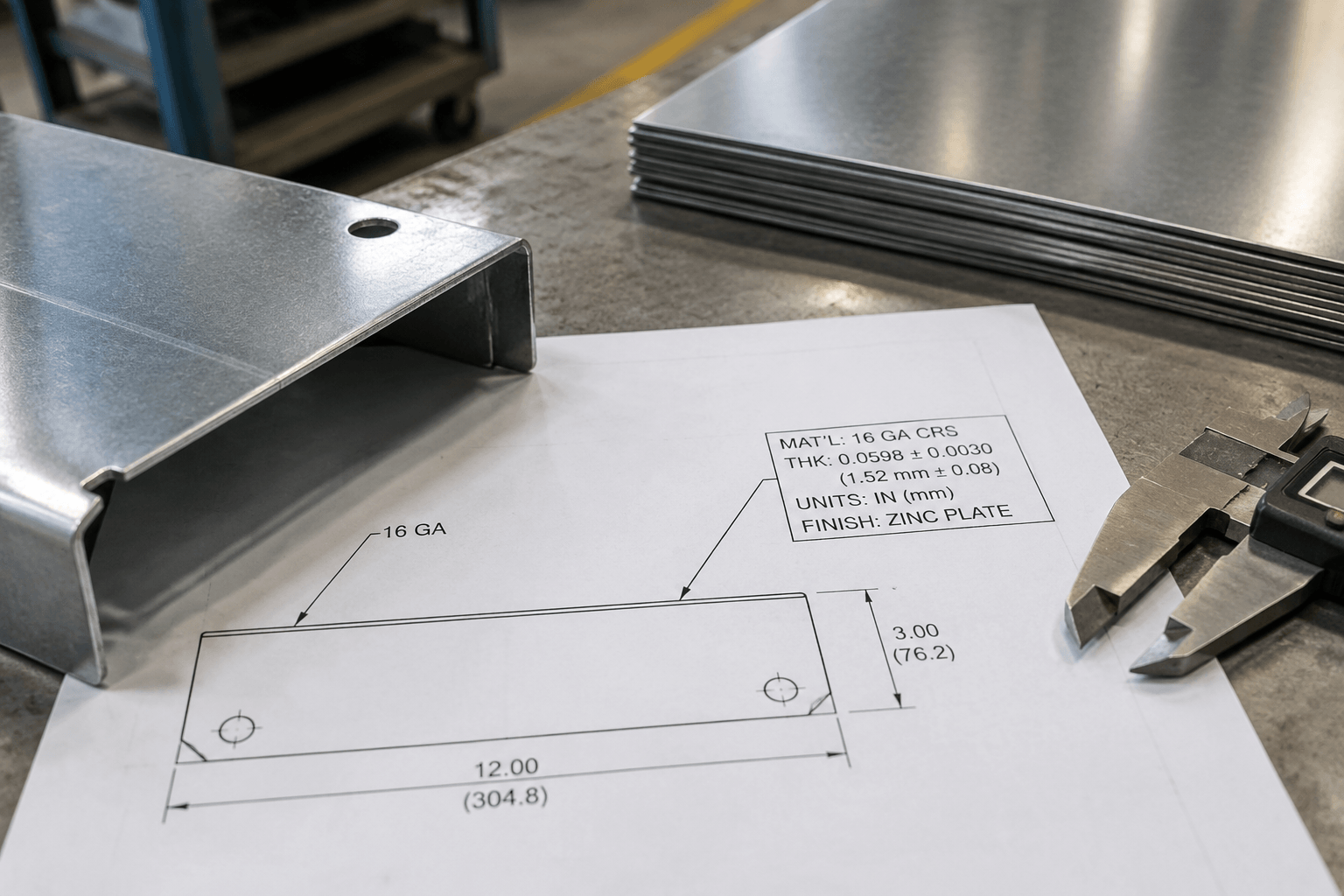
A complete drawing callout removes the need for the fabricator, material supplier, and inspector to guess which conversion was intended. It also gives procurement teams a consistent basis for comparing quotations.
Incomplete callout
Material: 16 GA sheet
This note does not identify the material family or grade, dimensional thickness, units, acceptable variation, or relationship between base metal and finish.
Complete callout structure
Material: [material family and grade]; base sheet thickness: [nominal dimension] [in or mm]; thickness tolerance: [specified limits or applicable referenced requirement]; finish: [type and requirement], applied after fabrication.
The actual entries must come from the product design and its governing requirements. A useful callout may show both gauge and decimal thickness for reference, but the drawing should identify which requirement controls if they conflict. For international projects, dual units can help communication, provided rounding does not create two different acceptance limits.
Keep coating information separate from base-sheet thickness. Paint, plating, and powder coating can change finished surface dimensions, but they do not redefine the gauge of the underlying sheet. If a coated dimension affects a mating part, electrical contact area, fastener engagement, door gap, or enclosure seal, define the relevant finished requirement separately.
This level of detail is especially important for custom metal brackets built to drawing requirements, where thickness can influence hole position after forming, stiffness, and assembly alignment. It is equally relevant to custom sheet metal enclosures, where panels, bends, hardware, finish, and mating dimensions must work together.
Send Yishang the material grade or family, required nominal thickness and units, applicable thickness tolerance, finish or coating requirement, and a drawing showing critical fit and assembly dimensions. Yishang can review the thickness definition for ambiguity before custom parts are prepared for manufacturing. This review confirms the written requirement rather than substituting an assumed gauge conversion for missing design information.
How Defined Thickness Supports Fabrication and Inspection
Sheet thickness affects more than raw-material purchasing. Bending behavior, formed geometry, edge conditions, fastener selection, and assembly clearances may all depend on the defined base-metal thickness. These effects also vary with alloy, temper or condition, bend geometry, and process, so thickness alone does not determine a universal bend allowance or finished result.
Once the requirement is explicit, incoming material and completed parts can be checked against the same acceptance basis. The drawing can distinguish raw sheet thickness from coated finished dimensions and identify which interfaces require dimensional inspection. This helps keep prototype and production requirements aligned without treating gauge as a complete specification.
Frequently Asked Questions
Is 16 gauge always 0.0598 inch or 1.519 mm?
No. The supplied snippet associates 16 gauge with 0.0598 in and 1.519 mm, but it does not identify the material. Because gauge conversions depend on the material or gauge system, confirm the value against an authoritative reference for the specified sheet product before using it.
Is 16 gauge thicker than 18 gauge?
Yes, when both designations belong to the same material-specific gauge system. Do not use that directional comparison to infer exact dimensions or compare sheets from different material systems. Verified inch or millimeter dimensions provide the clearer comparison.
Should a fabrication drawing use gauge, decimal thickness, or both?
Use a nominal dimensional thickness with units and an applicable tolerance. Gauge may be included as a secondary reference when useful, but the drawing should identify the controlling requirement and specify the material. This avoids conflicting interpretations during sourcing, production, and inspection.
Does paint, plating, or powder coating count toward the stated sheet thickness?
Not when the stated value defines the base sheet. A coating may add to finished dimensions, but it does not change the gauge designation of the underlying metal. State the finish separately and define any critical finished dimensions where coating buildup could affect fit or assembly.