
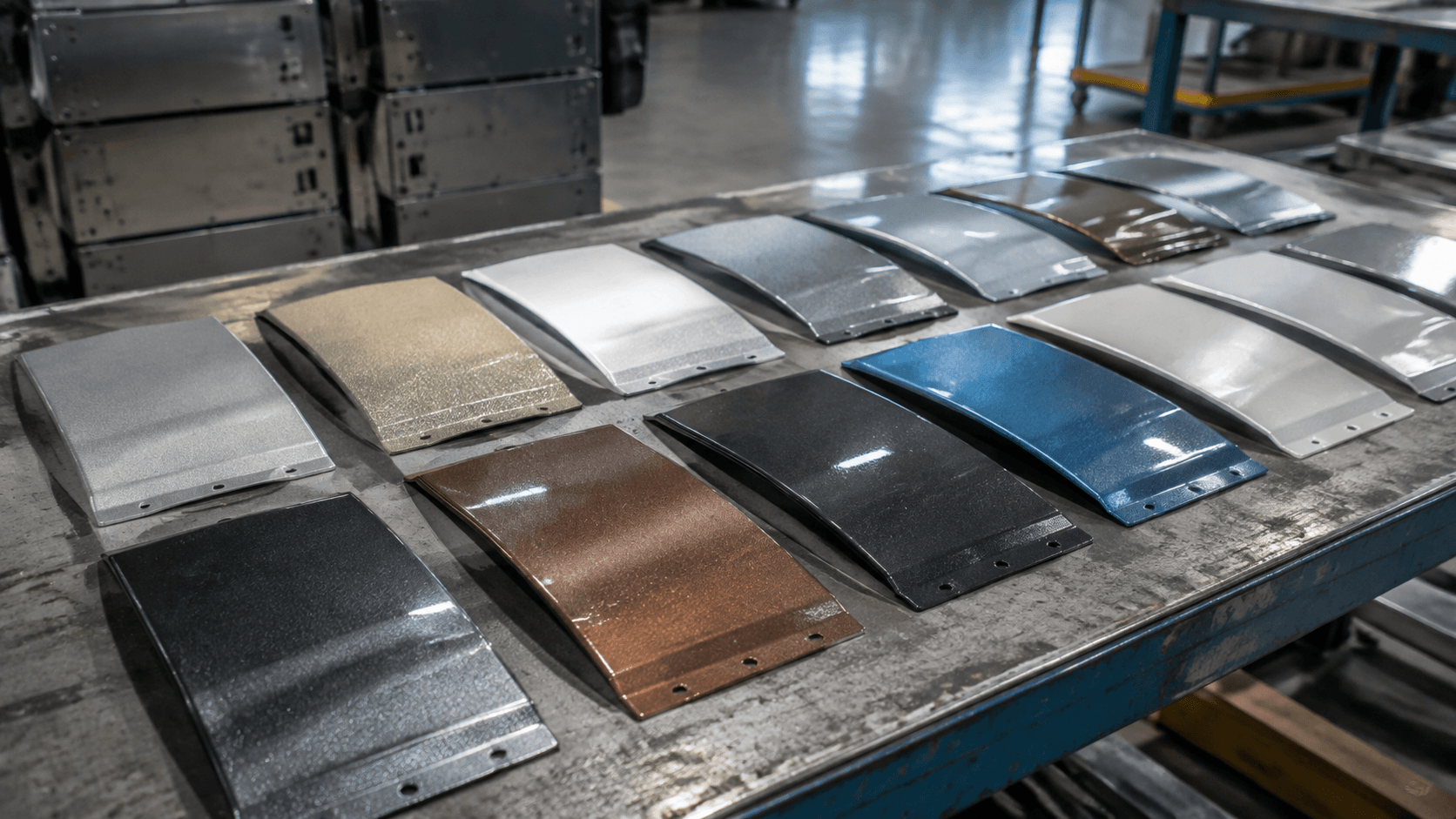
When an OEM enclosure, frame, or formed panel needs a metallic look, metallic powder coat colors are powder-coating finishes formulated with metallic or effect pigments to create that effect. Copper, steel, nickel, silver, gold, and iron are descriptive appearance families, not universal, supplier-independent color standards. For an RFQ or prototype, the name is only a starting point: define a physical reference, substrate, geometry, environment, and batch-approval method.
Metallic powder coat is a visual effect, not solid metal
A drawing that calls out metallic silver for an enclosure door or frame still lacks a complete finish target. The final effect depends on the pigment system, surface condition, part geometry, and application and curing process. That matters when a buyer approves a formed assembly rather than a flat sample.
Metallic appearance comes from reflective or effect pigments distributed through a cured powder film. Depending on the formulation and application, the finish may look bright and sparkled, subdued and satin, textured, or directional as the viewing angle changes. It remains a coating over the selected substrate; it does not make steel or aluminum the same material as polished metal or deposited plating.
In procurement terms, powder coat colors metallic describes a family of effect finishes rather than a supplier-independent color chart. Request technical information for the selected coating system and review an actual panel before approval. You can also compare related surface-finishing options for OEM metal parts.
| Finish route | Source of appearance | Important distinction |
|---|---|---|
| Metallic powder coat | Effect pigments in a cured powder film | Visual metallic effect, not solid metal or a universal color standard |
| Polished metal | Reflection from the exposed substrate | Appearance follows the alloy and polishing route rather than a powder film |
| Brushed metal | Directional mechanical abrasion | Grain direction is a defining visual feature |
| Anodized aluminum | A controlled oxide layer on aluminum | Different substrate and process requirements; not functionally identical to powder coating |
| Plated or chrome surface | A deposited metallic layer | Different interface, process controls, and performance requirements |
Define the metallic appearance beyond the color name
At RFQ stage, buyers may know whether the part should look premium, industrial, warm, or subdued, but that description is too broad for consistent approval. Translate the intended impression into a physical reference and observable requirements so procurement, engineering, and finishing teams are reviewing the same target.
Silver, steel, and nickel usually require a decision about cool or warm hue, brightness, gloss, texture, and flake visibility. Gold and copper need attention to yellow, red, or brown tones. Iron or dark metallic finishes require a decision about the charcoal or near-black base, gloss, texture, and acceptable sparkle. These remain descriptive categories, not guaranteed stock colors.
| Appearance variable | Requirement to record |
|---|---|
| Hue | Color direction and whether the target is warmer, cooler, lighter, or darker |
| Gloss | Bright, satin, or low-gloss appearance, compared with the approved reference |
| Texture | Smooth, fine, textured, or another specified surface character |
| Sparkle or flake | Flake size impression, density, brightness, and whether the effect should be muted or pronounced |
| Viewing conditions | Lighting, viewing distance, viewing angle, and finish-critical surfaces |
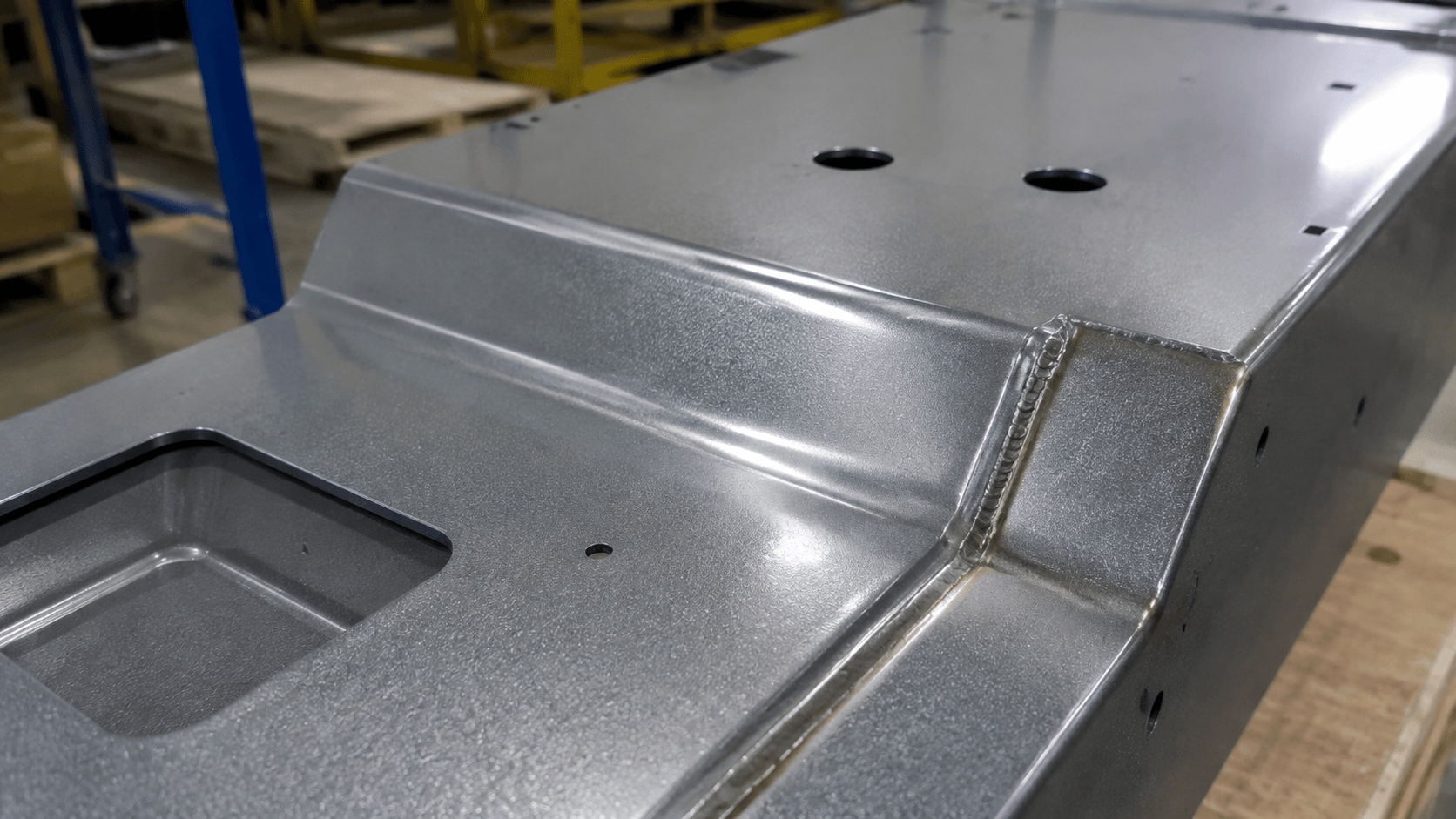
| Surface area and geometry | Expected appearance on large flat faces, formed faces, weld zones, edges, and recessed areas |
Review physical sample panels under agreed lighting and from more than one angle. Screen images and photography can show a general direction, but they should not be the sole approval method because lighting, camera settings, display calibration, and scale affect perceived color and flake.
A large flat panel can reveal shade or flake distribution that is not obvious on a small card. Bends reflect light differently from flat faces, while weld zones, recesses, holes, and masked boundaries can interrupt visual continuity. Approve a representative panel or first article that includes the finish-critical surfaces and, where practical, the same formed or welded features as the production part.
Check substrate and geometry before final approval
Before treating a sample as final, confirm that the proposed coating system and pretreatment are compatible with the production substrate. Metallic powder coating may be feasible on mild steel, aluminum, stainless steel, and galvanized steel, but one pretreatment route should not be assumed to fit all four. Surface condition, weld preparation, cleaning, and the selected coating system need to be reviewed together.
| Substrate | Engineering review points | Evidence before production |
|---|---|---|
| Mild steel | Edges, weld cleanup, contamination, and the corrosion-protection system | Pretreatment confirmation and a representative sample |
| Aluminum | Alloy or formed condition, surface preparation, and pretreatment compatibility | Coating-system confirmation on comparable aluminum |
| Stainless steel | Mill or brushed surface, weld discoloration, cleaning, and adhesion-related preparation | Sample review using the specified surface condition |
| Galvanized steel | Zinc surface condition, weld areas, potential outgassing during curing, and coating compatibility | System confirmation and a sample representing the galvanized part |
Cutting and forming establish sheet-metal geometry; welding joins components and can alter the local surface condition. Powder coating is a separate finishing operation and should not be used to approve fabrication or weld quality. If an assembly includes a CNC-machined bracket or insert, identify its fits, mating faces, grounding or contact points, and masking separately.
The drawing should identify material, thickness, bends, sharp edges, welds, recesses, holes, critical dimensions and tolerances, contact points, and masked or uncoated zones. For custom sheet metal enclosures, review exterior panels, doors, returns, and interior faces together. For welded custom metal frames, include welds, corners, and assembly interfaces in the approval sample rather than approving only a flat coupon.
Match durability to the service environment
Once the visual target is defined, select durability separately. A metallic label describes appearance, not service life: an indoor cabinet and an outdoor, salt-exposed assembly may both be called metallic gold but still require different system reviews.
Create an environment profile covering UV exposure, moisture, salt, temperature, handling, abrasion, cleaning agents, and chemical contact. Compare it with the selected supplier’s technical data, durability classification, and any customer or project acceptance requirements.
Metallic powder coat color decision matrix: next approval action
| Environment | Visual priority | Substrate or geometry risk | Evidence and approval action |
|---|---|---|---|
| Protected indoor use | Hue, gloss, texture, and consistent sparkle | Large panels, doors, formed faces, and visible assembly interfaces | Physical panel under agreed lighting, followed by representative first-article review |
| Outdoor or UV-exposed use | Appearance plus retention of the intended effect | Exposed faces, edges, welds, and moisture entry points | Selected system technical data and project durability review before approval |
| Humid or salt-exposed use | Uniform finish and protection of the substrate | Substrate, pretreatment, cut edges, and weld zones | Pretreatment and coating-system review with any required project evidence |
| Abrasive or high-contact use | Texture and acceptable visible wear during handling | Edges, corners, contact faces, and assembly damage | Supplier data and defined acceptance requirements, then prototype or first-article review |
| Chemical cleaning or exposure | Color and gloss under the expected cleaning regime | Seams, recesses, fastener areas, and contamination retention | Compatibility review for the actual agents and use pattern |
Do not infer outdoor, salt, chemical, abrasion, or high-contact suitability from a color name. Performance belongs to the complete substrate, pretreatment, coating, and curing system, which must be checked against the selected supplier’s data and the project’s acceptance requirements.
Control the finish from sample panel to production batch
After the visual target is approved, metallic consistency becomes a process-control issue. Powder lot, pigment orientation, application settings, spray direction, part orientation, curing conditions, substrate, and geometry can all affect the result, so the controls should be documented rather than assumed.
- Approve a physical master panel. Record the reference, lighting, viewing angle, viewing distance, and surfaces it represents. Keep it available for first-article and batch comparisons.
- Control the powder lot. Record the supplier description and lot for approved samples and production. If recovered or reclaimed powder is considered, follow a documented policy and assess its possible effect on hue, sparkle, texture, and repeatability. Do not assume it is always suitable for reuse.
- Record application and curing controls. Document relevant application settings, part orientation, and curing conditions according to the selected system’s instructions. Do not transfer settings from another metallic finish automatically.
- Review a representative first article. Compare flat faces, bends, edges, weld zones, recesses, masked boundaries, and other finish-critical areas before releasing the batch.
- Inspect against written criteria. Check hue, gloss, texture, coverage, and visible metallic uniformity under the agreed viewing conditions. Keep batch records and document any approved variation or nonconformance disposition.
Inspection verifies the defined appearance; it is not a substitute for coating-process control. A digital photograph may support traceability, but it should not replace the physical reference when metallic effect and viewing angle are important. Align the finish brief with related quality-control considerations for finished metal products.
Turn the finish brief into an OEM specification
A useful finish brief connects the visual target to the part and its operating conditions. It should expose unresolved decisions before sampling, quoting, or batch release.
- Part definition: Attach the current 2D drawing or 3D model and mark finish-critical faces, bends, welds, holes, recesses, assembly interfaces, and critical tolerances.
- Substrate: State the metal type, grade or alloy when known, thickness, existing surface condition, and differences between part numbers.
- Appearance reference: Provide a physical panel or target reference and describe hue, gloss, texture, sparkle or flake character, and viewing conditions. Do not specify only silver, gold, or copper.
- Environment: State indoor or outdoor use, UV, moisture, salt, temperature, abrasion, contact, cleaning, and chemical exposure requirements.
- Masked areas: Identify threads, grounding or contact points, mating faces, labels, holes, and surfaces that must remain uncoated or receive special handling.
- Quantity and approval: Provide prototype needs, production quantity or forecast, required first-article stage, sample approver, and release method.
- Acceptance criteria: Define allowable visual variation, inspection lighting and angle, critical surfaces, coverage expectations, and the treatment of nonconforming appearance.
- Records and protection: Agree which powder-lot, application, curing, inspection, packaging, and repeat-order reference records are required.
Project feasibility and sample review: Send the current 2D drawing or 3D model, material and thickness, critical dimensions and tolerances, bends and welds, masking requirements, finish-critical surfaces, metallic color reference or physical sample, gloss and texture expectations, service environment, production quantity or forecast, and prototype or first-article needs. Yishang can review the finish brief with the sheet metal design and support OEM or ODM custom manufacturing from prototype review through powder-coated batch production. Yishang has more than 26 years of custom metal manufacturing experience and exports to more than 50 countries.
Frequently Asked Questions
For an RFQ, pair the finish question with the current drawing or model, critical tolerances, substrate, quantity, and prototype requirements. That information helps separate a visual preference from a finish that can be reviewed on the actual part.
Are metallic powder coat colors suitable for outdoor use?
They may be suitable when the selected coating system, substrate, pretreatment, and curing process meet the project’s outdoor requirements. The color itself does not establish UV, moisture, salt, or corrosion performance. Review the relevant supplier data and define the environment before approving a prototype or production batch.
Can metallic powder coating be applied to aluminum, stainless steel, mild steel, and galvanized steel?
All four may be candidates, but compatibility must be confirmed for the specific coating system and pretreatment. Their surface conditions and preparation risks differ, so a representative sample is important when formed faces, welds, or existing textures are visible.
Why can metallic powder-coated parts differ in shade, sparkle, texture, or flake orientation?
Powder lot, application settings, spray and part orientation, curing conditions, substrate, and geometry can all affect appearance. Large faces, bends, recesses, welds, and masked boundaries may therefore look different. A master panel, process records, and a representative first article establish the comparison basis.
Can a metallic powder coat color replace anodizing or chrome plating when the appearance needs to match?
It may be a visual alternative in some applications, but it is not functionally identical to anodizing, chrome plating, polished metal, or another deposited surface. Compare substrate, wear, chemical, electrical, and layer-structure requirements rather than appearance alone.
A metallic powder coat color becomes reproducible when its name is converted into a controlled finish specification. If the part is still at drawing or prototype stage, send the drawing, physical reference, environment, quantity, and approval requirements to Yishang for a project-feasibility and sample review.