
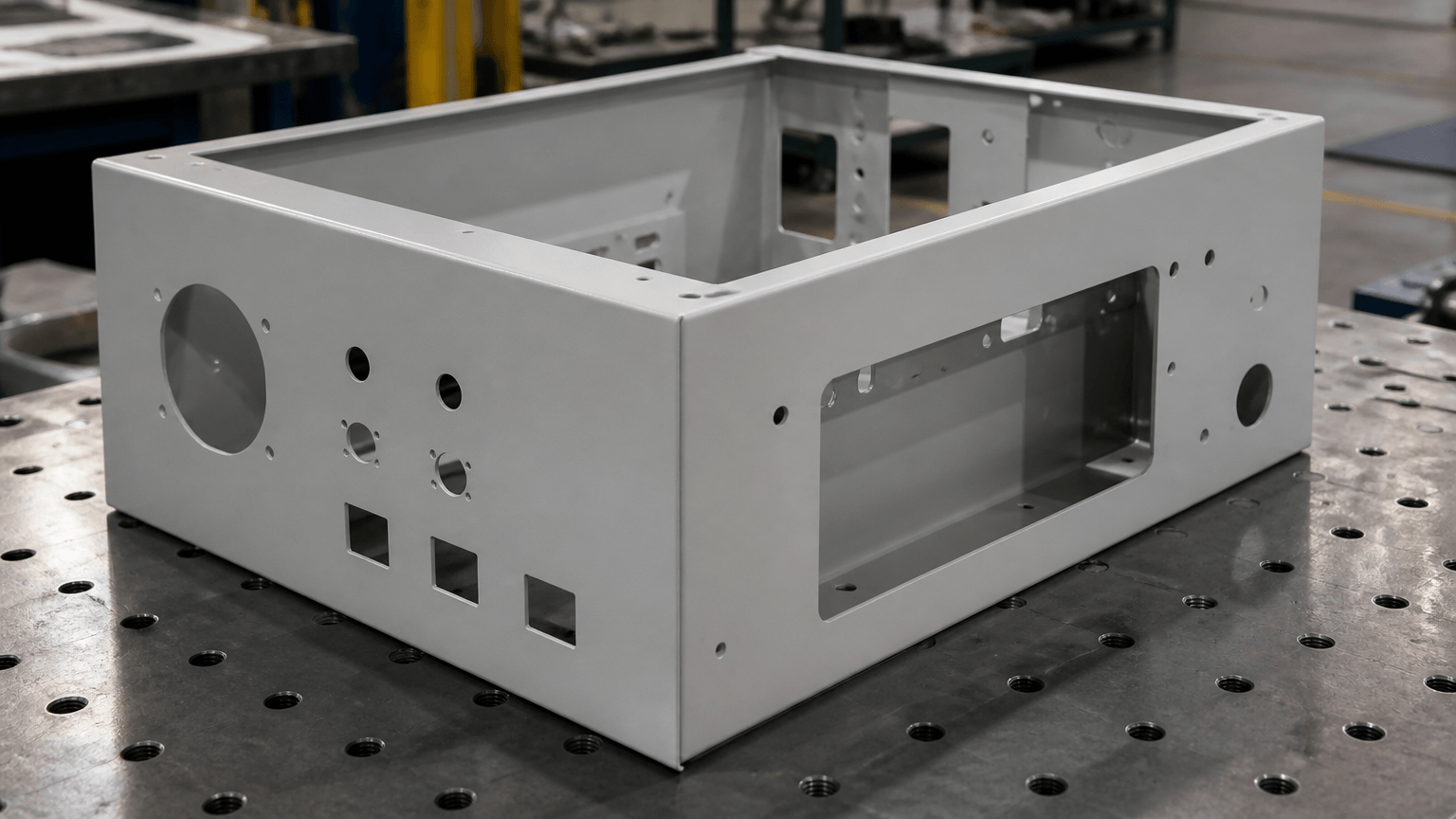
“Figur sheet metal” is not, by itself, a material grade or finishing process. If “Figur” is a brand, product, or project term, identify that entity separately in the drawing or RFQ. For the powder-coated OEM use case addressed here, the relevant description is a fabricated sheet-metal part finished with a cured powder coating.
“Metal powder coated” usually means a fabricated metal part or assembly that has received a dry powder finish; it is not a loose powder product. The finish cannot be specified adequately without defining the substrate and thickness, preparation, service environment, appearance, curing basis, coated and masked areas, and acceptance checks. Powder coating is a later finishing step after sheet-metal fabrication; it does not replace cutting, punching, bending, welding, machining, or assembly.
What does powder-coated sheet metal mean, and how is the part made?
For an OEM evaluating a cabinet, bracket, display rack, enclosure, or welded frame, the process boundary matters. Laser cutting, CNC punching, bending, and forming create sheet-metal geometry; welding joins formed parts; machining creates separate components; powder coating finishes prepared metal; and final assembly brings parts and hardware together.
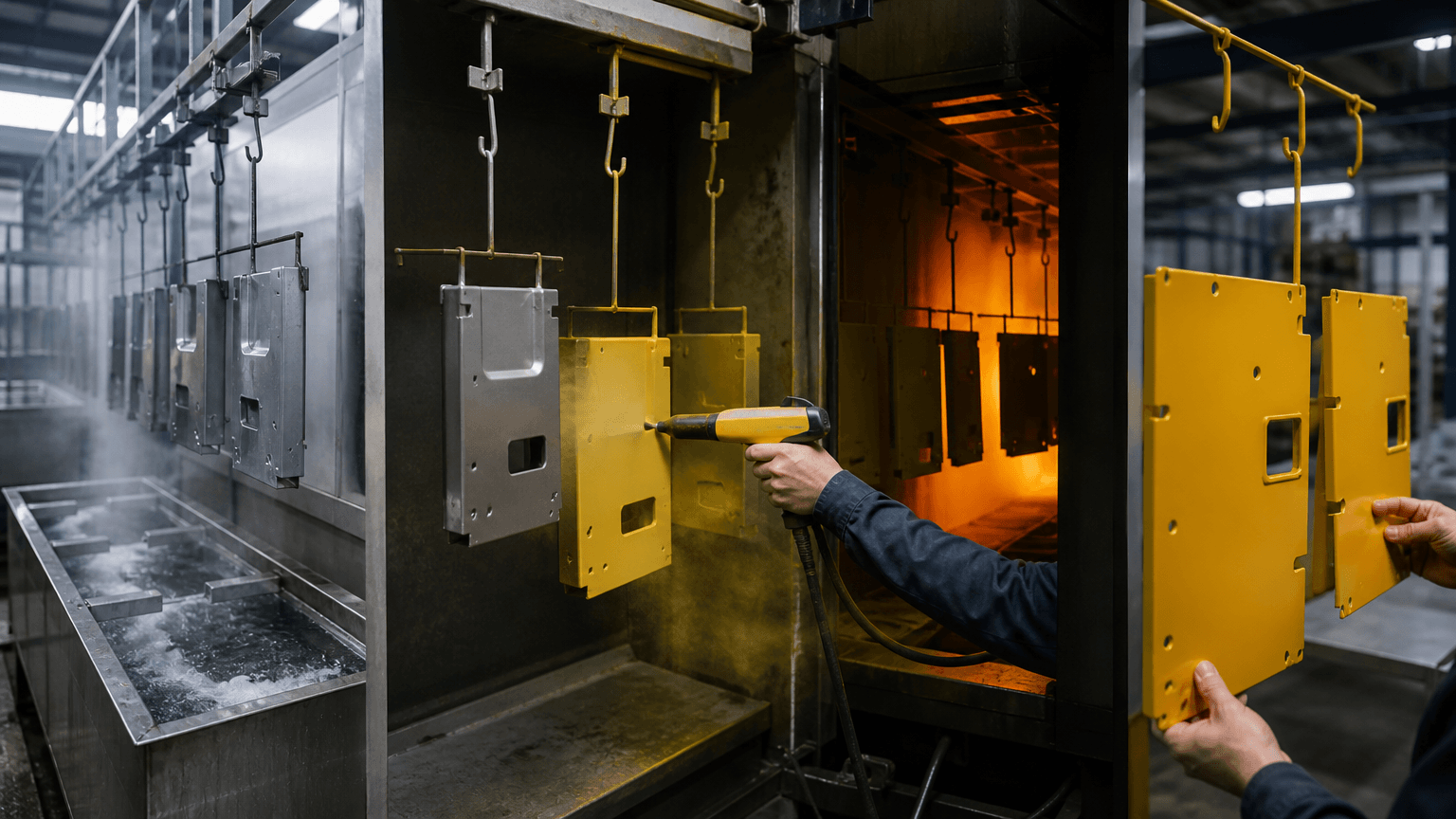
The following is a typical production route, not a fixed sequence for every product. Powder coating may be applied to individual fabricated parts, welded subassemblies, or an assembly at a selected stage. Geometry, internal access, heat sensitivity, masking, racking, and the final assembly method determine which stage is practical.
- Fabricate and join: Complete cutting, punching, bending, forming, and welding. Remove or correct unsuitable spatter, sharp contamination, and grinding marks before finishing.
- Choose the coating stage: Decide whether to coat separate parts, welded subassemblies, or an accessible assembly. Do not assume that a complete assembly can be coated without access or heat-related limitations.
- Review the surface: Identify oil, rust, oxides, weld residue, grinding dust, and other contamination that could affect adhesion or appearance.
- Clean and pretreat: Select degreasing, derusting, blasting, phosphating, or another applicable route according to the substrate, contamination, weld condition, and required performance.
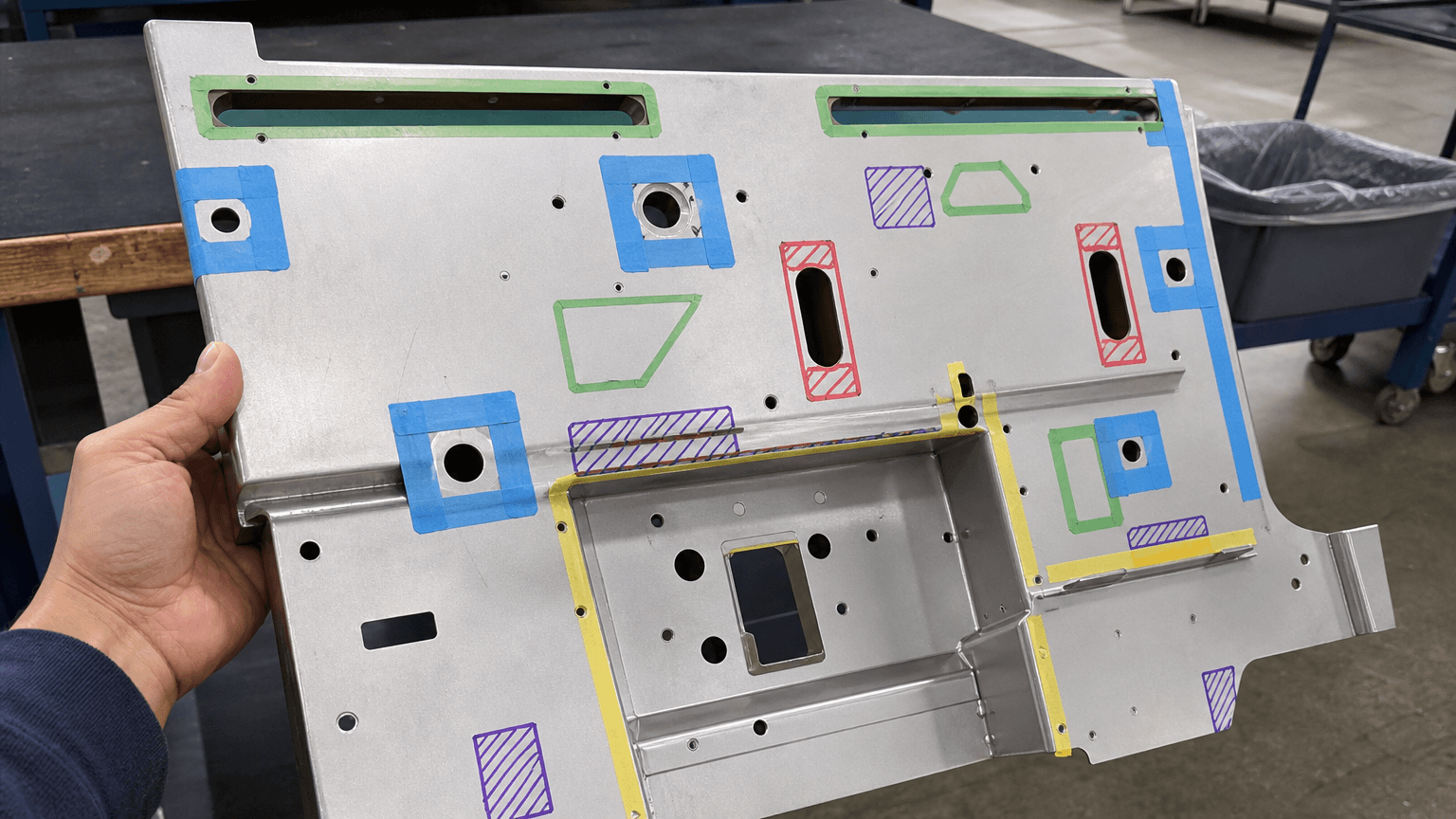
- Dry, rack, and mask: Dry the part, choose an orientation that supports spray access, and mask threads, grounding faces, mating surfaces, labels, or other defined keep-outs.
- Apply the powder: Electrostatic spraying deposits the selected powder on prepared surfaces. Recesses, internal areas, edges, and rack-contact regions require specific review.
- Heat and cure: The powder melts and cures within the powder manufacturer’s specified window. Coordinate that requirement with the part’s actual metal temperature rather than relying only on an oven setting.
- Inspect: Check appearance, coverage, film thickness where required, interfaces, and critical dimensions against the agreed acceptance criteria.
Process boundary: Preparation is not identical for every metal or welded geometry. Confirm a substrate-specific surface-finishing route before production, especially for mixed materials, recessed areas, or heavily worked weld zones.
Build a part-level finish specification
An RFQ that says only powder-coated metal leaves important decisions open. Use a part-level matrix so the drawing, purchase order, prototype, and production batch carry the same requirement.
| Field | Define | Why it matters |
|---|---|---|
| Part scope | Part number, revision, production stage, and coated surfaces | Sets the processing scope and assembly state. |
| Substrate | Metal type and nominal thickness | Guides preparation, cure review, and dimensional planning. |
| Environment | Indoor or outdoor use, humidity, chemicals, UV, abrasion, washdown, or another relevant exposure | Frames the required performance without assuming a universal coating rating. |
| Preparation | Cleaning, rust or oxide removal, blasting, phosphating, or another agreed route | Addresses adhesion and incoming surface condition. |
| Powder and cure | Named powder system or performance requirement, cure window, and verification basis | Avoids the ambiguity of standard powder or guessed settings. |
| Color and appearance | Color code or approved physical master sample, gloss, texture, visual standard, appearance level, and acceptable batch variation | A color reference alone may not define the finished appearance. |
| Film thickness | Agreed target or range and measurement locations, when needed | Controls fit and performance without assuming a universal value. |
| Interface control | Drawing references for holes, threads, grounding or electrical contacts, labels, mating faces, bearing areas, and keep-outs | Protects functional surfaces from unintended buildup. |
| Acceptance | Visual conditions, defect limits, coverage, dimensions, and any agreed adhesion, cure, or corrosion checks | Makes sample and batch approval measurable. |
Do not rely on the words standard powder. If the system is not predetermined, describe the service environment and required performance, then have the finisher propose a compatible system for approval. Specify film thickness only when the range and measurement approach suit the design and are agreed with the finisher. Any adhesion, cure, or corrosion check also needs an agreed method, sampling plan, and acceptance requirement.
Design-review checkpoint: Use the matrix with the 2D drawing and available 3D CAD model. A pre-prototype review can reveal whether the coating scope, weld condition, part subdivision, or assembly sequence needs adjustment.
Pre-RFQ finish review: Send the 2D drawing, available 3D CAD, substrate, finish reference, quantity, and critical-interface notes for a coordinated review before prototype release.
Control interfaces that coating can affect
A visually good finish can still prevent assembly on a cabinet door flange, enclosure panel, welded frame, or display-rack foot. The added film may affect thread engagement, opening size, insertion clearance, electrical contact, or movement. Mark critical areas directly on the drawing and use the table below as the shared interface list for design, finishing, and inspection.
| Feature | Potential consequence | Define on the drawing or process plan |
|---|---|---|
| Threads and small holes | Film buildup can impede engagement or reduce the opening. | Masking, a keep-out, or controlled post-coat treatment. |
| Grounding and electrical faces | The coating may isolate the contact. | A bare, masked, or approved post-treatment contact zone. |
| Mating, sliding, press-fit, or bearing surfaces | Film can change clearance, insertion force, or movement. | Controlled coated area and final dimensional check. |
| Edges, corners, and welds | Transitions, residue, and access can affect coverage and appearance. | Preparation requirements and visual acceptance. |
| Recesses and internal surfaces | Spray access and film continuity may vary with geometry. | Coverage expectations and an access review. |
| Racking points and labels | Contact marks or coating on labels can affect handling or identification. | Permitted rack marks and label keep-outs. |
An enclosure or cabinet may need coating control at door flanges, hinges, panel joints, latches, and grounding studs. A welded frame or display rack may need review at feet, insertion points, corners, and weld seams. Custom sheet metal enclosures and custom metal frames show why finish, weld geometry, dimensional fit, and assembly must be considered together.
Where a machined insert, spacer, or mounting component meets a coated sheet-metal part, define whether it is coated and how its contact area is controlled. For a welded assembly coated as one piece, review internal access; for separately coated parts, define joint and fastener-contact requirements.
How should powder coating be compared with other finishes?
Powder coating is one possible finish, not a universal substitute. Compare the mechanism with the substrate, exposure, appearance, part size, heat sensitivity, tolerances, batch volume, and functional surfaces.
| Process | Typical substrate | Mechanism | Appearance or functional objective | Geometry and heat constraints | Consider it when |
|---|---|---|---|---|---|
| Powder coating | Compatible fabricated metal substrates, subject to preparation review | Electrostatic powder followed by heat curing | Defined color, gloss, texture, and a cured film | Review film buildup, masking, spray access, racking, internal areas, and heat exposure | The substrate and part can follow a suitable preparation and curing route, and functional faces can be controlled. |
| Liquid paint | Metal substrates compatible with the selected wet coating system | Wet coating that dries or cures | May support different appearance, repair, size, or application objectives | Review drying, handling, coverage, repair, and heat constraints | A wet route better fits the part size, repair requirement, appearance, or heat limitation. |
| Anodizing | Suitable aluminum alloys | Electrochemical surface treatment | Surface treatment associated primarily with aluminum rather than a paint film | Review alloy, color, contact areas, geometry, and dimensional surface change | An aluminum component requires an anodized surface treatment and its alloy and interfaces are compatible. |
| Electroplating | Compatible conductive metal parts | Deposition of another metal layer | Metallic appearance or a functional deposited layer, depending on the system | Review bath access, rack contact, masking, and layer buildup | The design calls for a deposited metal layer or metallic surface objective rather than a cured powder film. |
| Galvanizing | Steel | Zinc-coating route | Zinc-coated steel with process-specific appearance and exposure considerations | Review geometry, dimensions, drainage or venting where applicable, and appearance | A zinc-coating route suits the steel part, its exposure, and its geometry. |
Powder coating is not automatically rustproof, weatherproof, or corrosion-proof. The result depends on the substrate, preparation, coating system, film control, geometry, defects, and service conditions. Process selection should follow the part’s required function rather than a generic claim that one finish is best.
Approve the finished part in sequence
For a first article or production batch, do not approve a powder-coated cabinet by looking only at one flat visible panel. Review the appearance, the critical locations identified in the interface table, and any performance checks identified in the purchase specification.
- Visual comparison: Compare color, gloss, texture, coverage, contamination, runs, visible defects, and overall appearance with an approved sample under agreed viewing conditions.
- Coverage: Inspect edges, welds, corners, recesses, internal areas, and other marked critical locations.
- Film measurement: Measure thickness at defined locations using an agreed method when it affects performance or fit.
- Interfaces and dimensions: Verify masking, threads, holes, grounding faces, mating surfaces, and critical dimensions after coating.
- Special checks: Use adhesion, cure, or corrosion checks only when the method, sampling plan, and acceptance criteria are specified.
- First-article release: Approve a representative sample before batch production when color, texture, masking, or assembly interfaces are high risk.
Keep powder-coating criteria specific to the part while aligning them with the broader product inspection plan. The related quality-control guidance can help organize that review.
What changes powder-coated metal cost and lead time?
Pricing and schedule change with the part, finishing route, and approval plan. The main drivers are project-specific rather than universal percentages or fixed schedules.
| Driver | Possible effect | Information to provide |
|---|---|---|
| Size and shape | Oven fit, curing constraints, racking, hanging orientation, and spray access | Dimensions, weight, geometry, and assembly state |
| Volume and finish changes | Batch grouping, setup, color changes, and texture changes | Prototype quantity and expected production volume |
| Incoming condition | Extra cleaning, derusting, spatter removal, or grinding correction | Material condition and weld-preparation requirements |
| Masking complexity | Manual preparation and post-coat cleaning or removal | Marked interfaces, holes, labels, contacts, and mating faces |
| Approval and rework | Sample review, mismatch, defects, dimensional correction, inspection, or repackaging | Approval owner, sample plan, criteria, and packaging needs |
Grouping compatible parts may reduce unnecessary finish changes only when their substrate, color, texture, and process requirements are compatible. The review should also distinguish individual sheet-metal parts, welded assemblies, and separate machined components because preparation, masking, racking, and final assembly needs may differ.
Project-specific finish review: For an OEM or ODM powder-coated part, provide:
- 2D drawings and available 3D CAD files
- Base metal, thickness, quantity, and production stage
- Color code or approved sample, gloss, texture, and appearance requirements
- Service environment and agreed corrosion, adhesion, cure, or thickness requirements
- Masking, grounding, threaded-hole, mating-surface, and other interface notes
- Prototype, first-article, batch-production, and assembly requirements
Yishang can review the fabrication route, powder-coating scope, interface risks, prototype requirements, and batch handoff for OEM or ODM projects. The company has more than 26 years of custom metal manufacturing experience, exports to more than 50 countries, and supports prototype review and batch production.
Frequently Asked Questions
These questions often arise when a powder-coated sheet-metal part moves from design review to a drawing, sample, or production approval.
Is powder-coated metal the same as painted metal?
No. Powder coating uses dry particles that are electrostatically applied and heat-cured. Liquid paint is a wet coating route with different drying conditions, handling requirements, repair options, and heat constraints.
Can aluminum, stainless steel, galvanized steel, and mild steel all be powder coated?
They may be suitable, but they do not automatically use the same preparation route. Cleaning, oxide or rust removal, pretreatment, weld condition, cure, and access should be reviewed for the specific substrate and assembly.
Can threaded holes, grounding points, and mating surfaces be powder coated?
Only when the resulting film does not compromise their function. These areas commonly need a defined keep-out, masking operation, or controlled post-coat treatment shown on the drawing.
How should an OEM approve color, gloss, texture, and batch consistency?
Use a physical master sample or clearly identified color reference, then state gloss, texture, viewing conditions, appearance level, and acceptable variation. Approve a representative first article before a high-risk batch.
Does powder coating change dimensions or fit on custom sheet-metal parts?
Yes. The coating adds material to coated surfaces. Tight fits, holes, threads, and sliding areas should therefore be reviewed with the agreed film control and checked after coating.