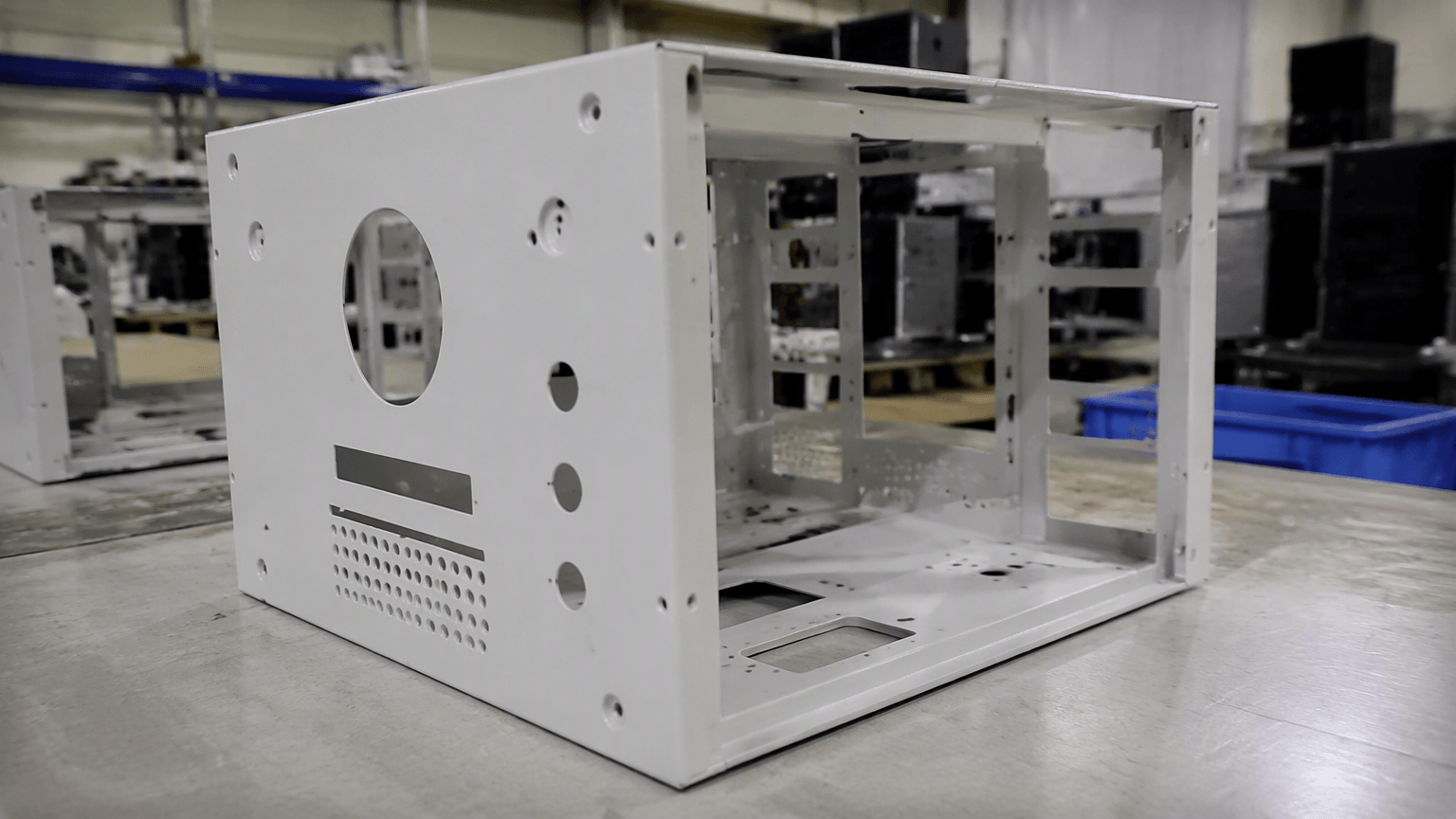
Metal powder coated means a fabricated metal substrate receives a dry powder finish. A finisher electrostatically applies the powder to the prepared part, then heats it so the powder melts, flows, and cures into a continuous coating. For an OEM sourcing an enclosure, cabinet, bracket, frame, or welded assembly, powder coating fits only when the substrate, geometry, functional interfaces, and service environment support the process.
Powder coating describes the finish, not the method used to make the part. Laser cutting, CNC punching, bending, machining, and welding create or modify the component; powder coating follows those operations. Assembly remains a separate step involving fasteners, electrical hardware, seals, machined components, and other interfaces. This distinction matters when choosing an electromechanical assembly manufacturer: the finish must work with the completed product, not only with its exterior panels.
Substrate and Finish Are Different Decisions
The metal substrate determines the part’s structure, openings, mounting features, and dimensional interfaces. The coating adds a surface layer to selected areas after fabrication. It cannot replace decisions about material grade, thickness, bend details, weld condition, tolerances, or assembly design.
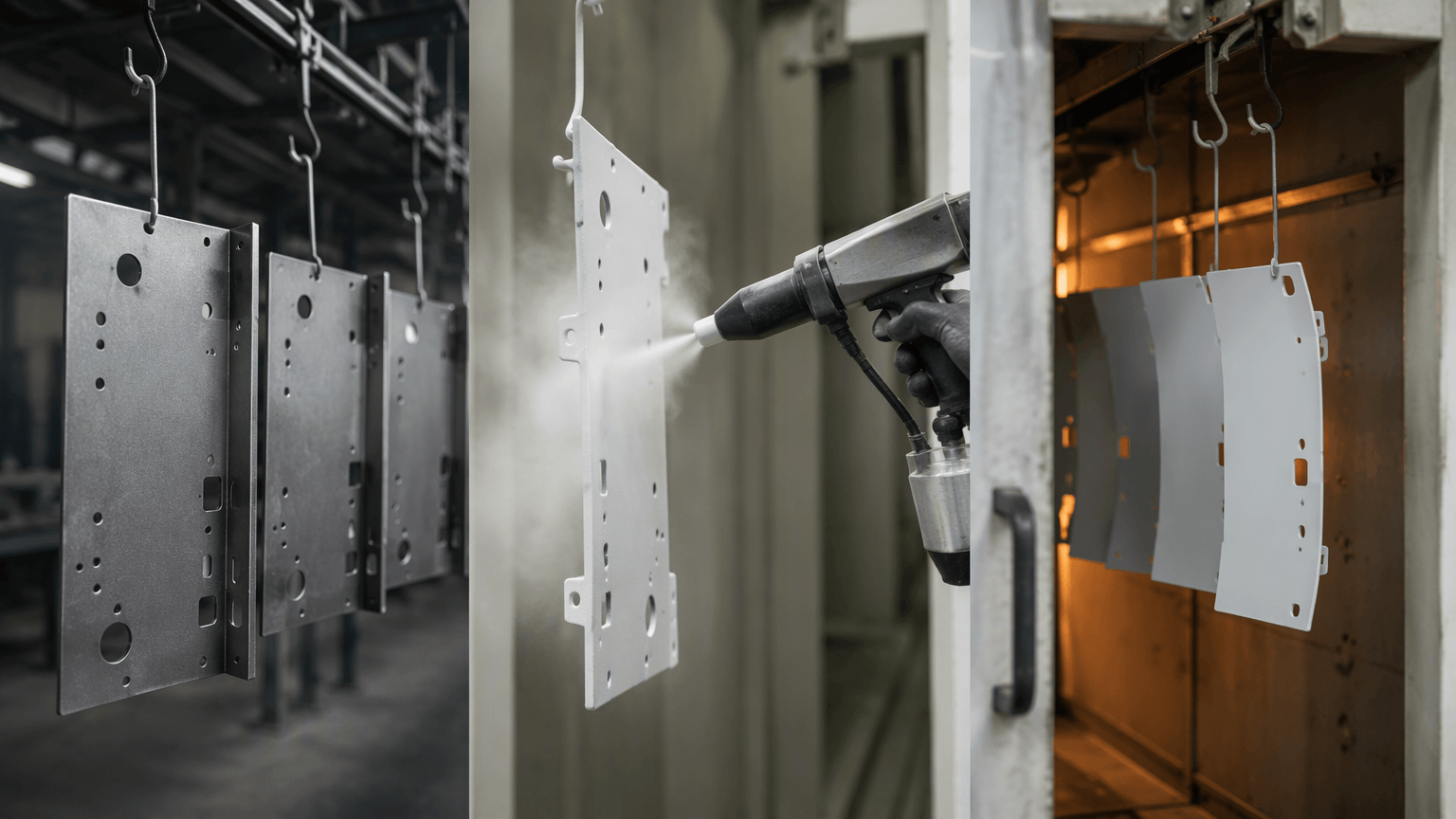
Charged powder particles move toward the suitably grounded metal part. Controlled heating then melts and cures the powder. The finisher must select preparation, powder system, coverage, and heating conditions for the substrate and application; one coating recipe will not suit every product.
Process Sequence from Fabrication to Inspection
For a custom sheet metal part, coating readiness starts before powder reaches the surface. The sequence below connects fabrication to finishing while keeping each process boundary clear.
- Review fabrication. Complete cutting, punching, bending, machining, and welding before coating. Review burrs, sharp edges, weld spatter, distortion, trapped debris, recesses, and mounting features because they can affect coverage, appearance, or fit.
- Clean and prepare. Oil, rust, scale, fingerprints, weld residue, dust, and other contamination can interfere with adhesion or create visible defects. Choose cleaning, mechanical treatment, residue removal, and pretreatment for the substrate. Steel, galvanized steel, aluminum, and stainless steel can require different preparation decisions.
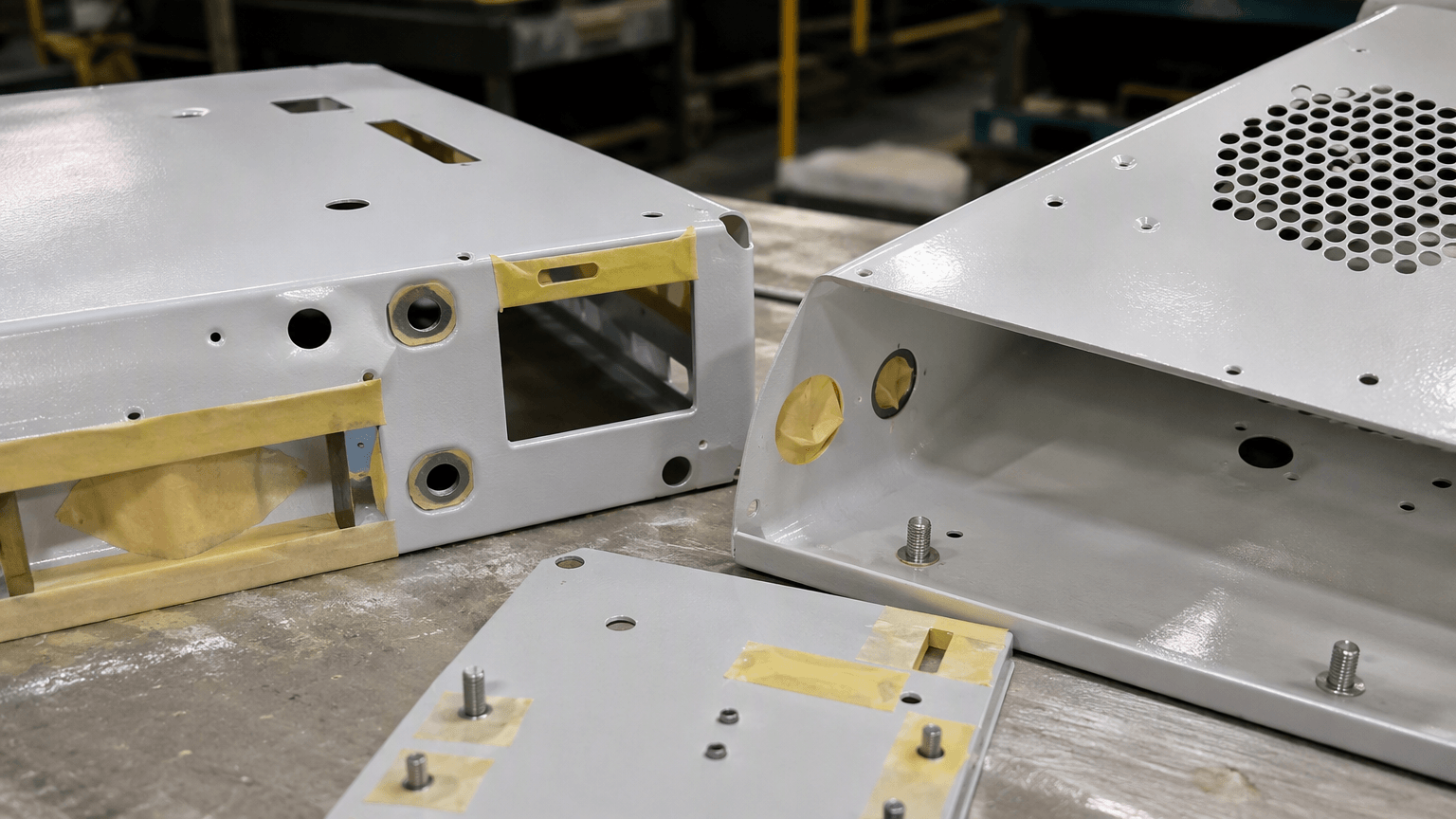
- Mask and protect. Protect threads, precision holes, grounding points, connector openings, mating faces, bearing seats, labels, and assembly datums when coating must not cover them. Account for spray access, edge build-up, removal, and the dimensional function of each feature.
- Apply powder. Apply dry powder to the prepared, suitably grounded part. Identify required exterior, interior, edge, corner, and recess surfaces in advance. Deep pockets, narrow channels, overlapping bends, and welded structures can make uniform coverage more difficult.
- Cure in a controlled heating process. Heating melts and cures the powder. The heating condition depends on the powder system and the part’s material, mass, and geometry. Review heat-sensitive inserts, seals, labels, electronics, and preassembled components before coating.
- Inspect and handle. Check the finished part against agreed appearance, masking, dimensional, and functional requirements. Review color and texture variation, coverage, exposed metal, contamination, damaged areas, holes, threads, contact points, and mating surfaces. Continue careful handling and packaging after inspection because handling can damage the finish.
Rework requires a project decision. Local repair, stripping, recoating, or touch-up can change appearance, film build, edges, and the surrounding surface. Agree on the response to a defect before production.
Powder-Coated Metal Fit by Substrate and Geometry
OEM buyers often consider powder coating for fabricated enclosures, cabinets, frames, brackets, racks, guards, and welded assemblies. The part needs suitable preparation, coating access, heating, inspection, and assembly clearance without compromising functional surfaces or the required appearance.
| Part or condition | Initial assessment | Points to review |
|---|---|---|
| Steel sheet enclosures, cabinets, brackets, and frames | Often a practical candidate | Oil and rust removal, weld condition, edges, grounding areas, internal surfaces, and mating features |
| Galvanized steel | May suit powder coating with substrate-specific preparation | Zinc condition, pretreatment compatibility, outgassing risk, and the role of the zinc layer |
| Aluminum panels and fabricated parts | Often considered for coating | Oxide and contamination control, thin-section distortion, masking, and visible-face appearance |
| Stainless steel parts | Can suit a coated appearance or added treatment when the project requires it | Cleaning, preparation, the reason for coating, and preservation of functional interfaces |
| Welded assemblies with recesses or overlapping members | Require geometry and process review | Powder access, trapped contamination, weld spatter, shadowed surfaces, drainage, hanging orientation, and heating behavior |
| Tight threads, precision bores, or sliding interfaces | Require masking or post-process control | Exclusion zones, fit after coating, masking removal, and whether post-coating machining is acceptable |
| Assemblies with heat-sensitive components | Require sequence review or another finish route | Whether components can be installed after curing and how to prevent damage |
Part size and geometry affect surface access and whether the complete part can pass through the available heating process. Weld quality also affects readiness: residue, porosity, sharp transitions, and distortion may remain visible or interfere with coverage. Discuss batch consistency when prototypes will lead to production, since preparation, powder batch, hanging position, part heating, handling, and rework can produce visible variation.
Finish Requirements for the Drawing or Purchase Specification
A request for “black powder coating” leaves important production decisions open. A reviewable specification should define the finish, identify coated surfaces, and show which features must remain available for assembly, grounding, inspection, or service.
- Substrate: State the metal grade or designated material, thickness, and any existing galvanized or treated surface.
- Preparation: Identify the required preparation level, or agree on a substrate-appropriate process.
- Color, gloss, and texture: Provide a recognized color reference or approved physical sample. Define smooth, textured, matte, metallic, or other appearance requirements and identify appearance-critical zones.
- Coating area: Mark coated, partially coated, and uncoated surfaces, including internal faces that matter functionally or visually.
- Masking: Identify threads, holes, grounding points, connector openings, mating faces, precision datums, labels, and other areas that must remain free of coating.
- Fit and assembly: Flag fastener locations, cable entries, press-fit features, sliding surfaces, and interfaces with machined or electrical components. Consider coating in the tolerance stack where it affects fit.
- Inspection: Provide buyer-supplied acceptance criteria or inspection methods when required. Otherwise, agree how to record visual, dimensional, masking, and functional checks.
These details matter when a coated enclosure must arrive ready for later assembly. See custom sheet metal enclosures for a relevant product context and custom sheet metal fabrication built to your drawings for the upstream route.
Powder Coating Compared with Other Finish Routes
The correct route depends on the substrate, geometry, appearance, heat exposure, repair needs, and functional surface requirements. Powder coating does not replace liquid painting, plating, anodizing, or galvanizing.
| Finish route | May be considered when | Boundary to keep clear |
|---|---|---|
| Powder coating | A cured colored or textured finish suits a part that can be prepared, masked, and heated appropriately | Control preparation, coverage, curing, handling, and uncoated interfaces |
| Liquid paint | Geometry, appearance, repair method, or temperature sensitivity favors a liquid spray system | It uses a different material and application sequence with separate acceptance requirements |
| Anodizing | An aluminum surface treatment and its associated appearance or surface behavior are required | It is an electrochemical treatment of aluminum, not a powder layer applied to any metal |
| Plating | A specified metallic surface, electrical interface, wear behavior, or dimensional requirement calls for plating | Evaluate substrate compatibility and functional coverage separately |
| Galvanizing | A zinc-based corrosion-protection route suits the steel product and service conditions | It changes the surface-protection strategy and does not simply substitute for colored powder coating |
Coordinate upstream fabrication and finishing while keeping them as separate process decisions. Cutting method, bend layout, weld sequence, machining of mating components, and assembly order can influence the final coating result. The surface finishing reference provides broader context for preparation and finish selection.
Project Review Before an RFQ
For an early supplier review, provide the 2D drawing or 3D model, material and thickness, part or assembly dimensions, batch quantity or expected production volume, intended application, color reference, gloss and texture preference, coated-area definition, and masking details. Include fit, grounding, corrosion exposure, assembly, appearance, and inspection requirements so the supplier can assess the finish in its actual use context.
Yishang can review the fabrication route and powder-coating requirements for an OEM or ODM project, including prototype considerations and batch-production planning. Send the drawing or model with the material, thickness, dimensions, quantity, finish reference, masking plan, and operating environment. The quality control reference provides general supplier context; project documents should still define coating-specific acceptance requirements.
Frequently Asked Questions
What coating thickness details should buyers define before requesting a quote?
Buyers should define the functional requirement, drawing notes, critical dimensions, material or process expectations, and any inspection points related to coating thickness. This helps suppliers quote the same manufacturing scope instead of making different assumptions.
How can masking areas affect cost, fit, or lead time?
masking areas can change tooling, forming, welding, finishing, inspection, or rework requirements. If buyers do not clarify it early, two supplier quotes may look comparable while covering different production risks.
Why should powder coating be reviewed before prototype approval?
powder coating may look acceptable on a single sample but become harder to control during batch production. Buyers should confirm whether the prototype reflects the same process, finish, and inspection conditions expected for production.
What inspection points matter most for electromechanical assembly manufacturer projects?
Important inspection points usually include fit-critical dimensions, holes or mating areas, cosmetic surfaces, finish build-up, welded or formed features, and any dimensions that affect downstream assembly. These points should appear in the RFQ or drawing notes.
How can buyers reduce assembly clearance risk before batch production?
Buyers can reduce risk by clarifying drawings, locking key material and finish assumptions, defining inspection timing, approving a representative sample, and confirming which dimensions or surfaces require tighter process control.
How can Yishang help review electromechanical assembly manufacturer requirements?
Yishang can review drawings, RFQ notes, material requirements, tolerance expectations, finish details, samples, and assembly needs to identify unclear assumptions before quoting or batch production.