
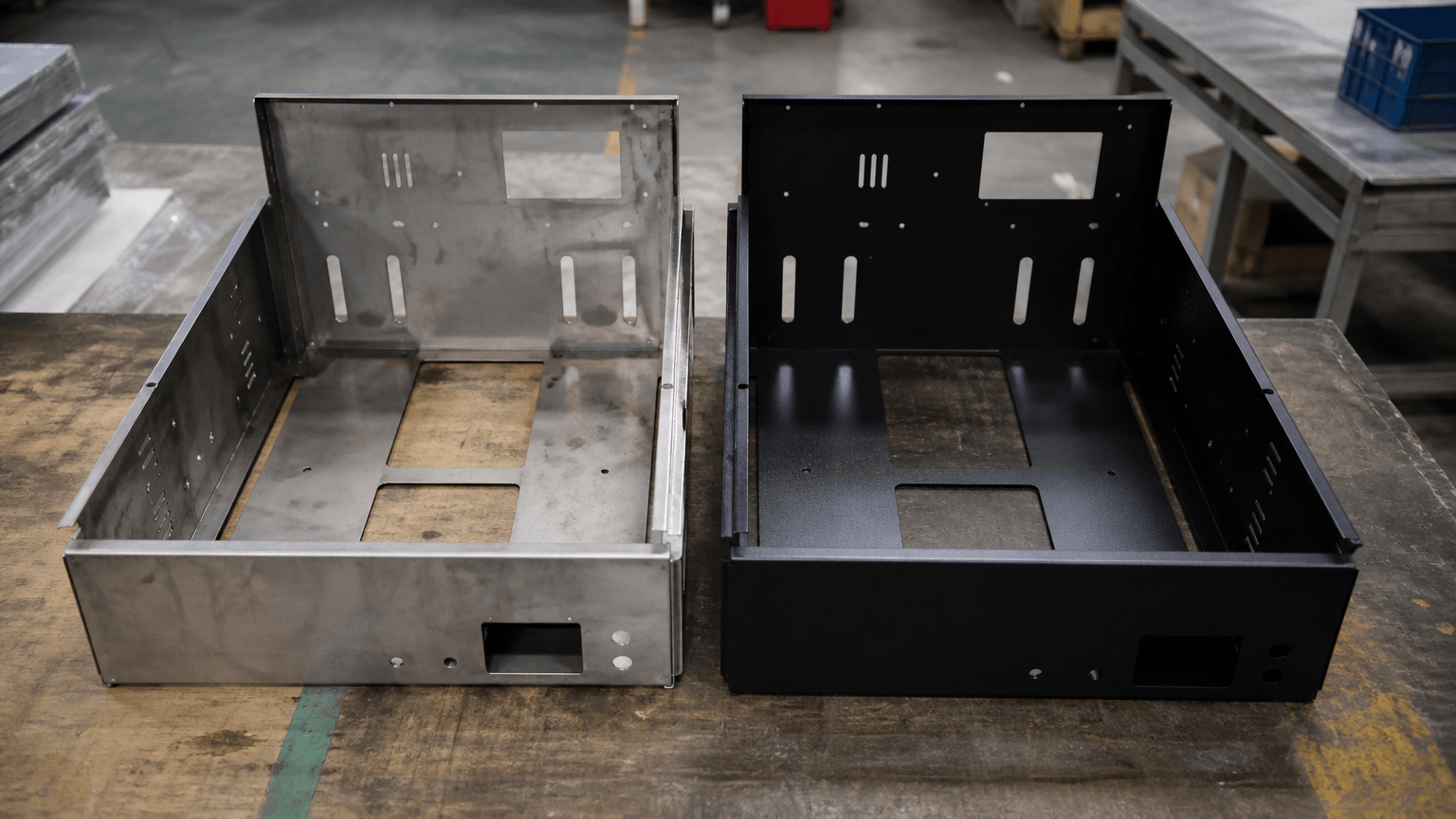
Short answer: Spray paint over powder coated metal can be feasible when the existing powder film is firmly bonded, clean, free from active corrosion or blistering, and compatible with the proposed wet-coating system. It is a separate finishing operation, not an automatic extension of the original finish; surface preparation, added film at interfaces, appearance, and acceptance checks should be agreed before production.
For an OEM buyer, when an RFQ says metal powder coated, it usually means powder-coated metal: a fabricated metal part finished with electrostatically applied and heat-cured powder. The practical question is whether the existing film or the new substrate, preparation, masking, cure, and assembly interfaces suit the required part.
Can you spray paint over powder-coated metal?
Sometimes, but the decision depends on the condition and chemistry of the existing powder film as well as the proposed wet paint. The old coating should be firmly bonded and free from active corrosion, blistering, peeling, or significant chalking. It also needs to be clean and compatible with the spray-paint system. The paint supplier’s preparation and compatibility requirements should govern the final route.
A practical, non-numeric validation sequence is:
- Inspect the existing film: Check for loose or failed areas, corrosion, contamination, damage, and unknown coating conditions. Pay particular attention to edges, corners, recesses, and critical dimensional interfaces.
- Clean the surface: Remove oil, dirt, fingerprints, moisture, and other contamination using a method compatible with the existing film and proposed paint.
- Prepare the surface: Degloss or mechanically prepare the powder surface as required by the wet-coating system. Avoid treating abrasion as a universal recipe; the preparation should preserve the substrate and produce the surface condition required by the paint system.
- Review primer compatibility: Confirm whether a primer is needed and whether it is compatible with both the existing powder film and the spray paint.
- Test a representative area: Apply the proposed preparation, primer, and paint to an area that represents the actual substrate, geometry, and appearance requirements.
- Verify the result: Check adhesion, appearance, dry or cure condition, film build where relevant, and fit at affected interfaces before applying the route to a batch.
Peeling, bubbling, chalking, corrosion, unknown coating chemistry, or critical dimensional interfaces may justify removing the old powder coat and refinishing the part instead of simply spraying over it. Removal and refinishing should be assessed against the substrate, geometry, existing film, and proposed finish. A wet overcoat should not be assumed to correct a failing powder film.
This overcoat decision is separate from applying powder to newly fabricated metal. The process guide below describes a new powder-coated finish unless it specifically refers to an existing coating being overpainted.
What a powder-coated metal part actually is
If a drawing calls for a powder-coated cabinet, bracket, frame, or welded enclosure, the finish identifies the surface condition of the fabricated part. It does not identify the alloy, replace the cutting and forming route, or include assembly automatically. That distinction helps an OEM separate the coating requirement from the rest of the manufacturing scope.
During a new powder-coating operation, dry powder particles are electrostatically charged and attracted to a grounded, prepared metal surface. Heat melts the deposit and cures it into a continuous film. This differs from liquid painting, where a wet coating is applied and then dried or cured. Spray paint over an existing powder film is therefore a separately qualified wet-coating operation. Powder coating plastic is a different application and should not be treated as coating metal.
Powder coating normally follows custom sheet metal fabrication. Laser cutting and CNC punching create blanks and openings, metal bending forms the sheet, and welding fabrication joins components. CNC machining may supply a separate component or interface. Final assembly is another operation, so the drawing should state whether machined parts are coated separately, masked, or installed after coating.
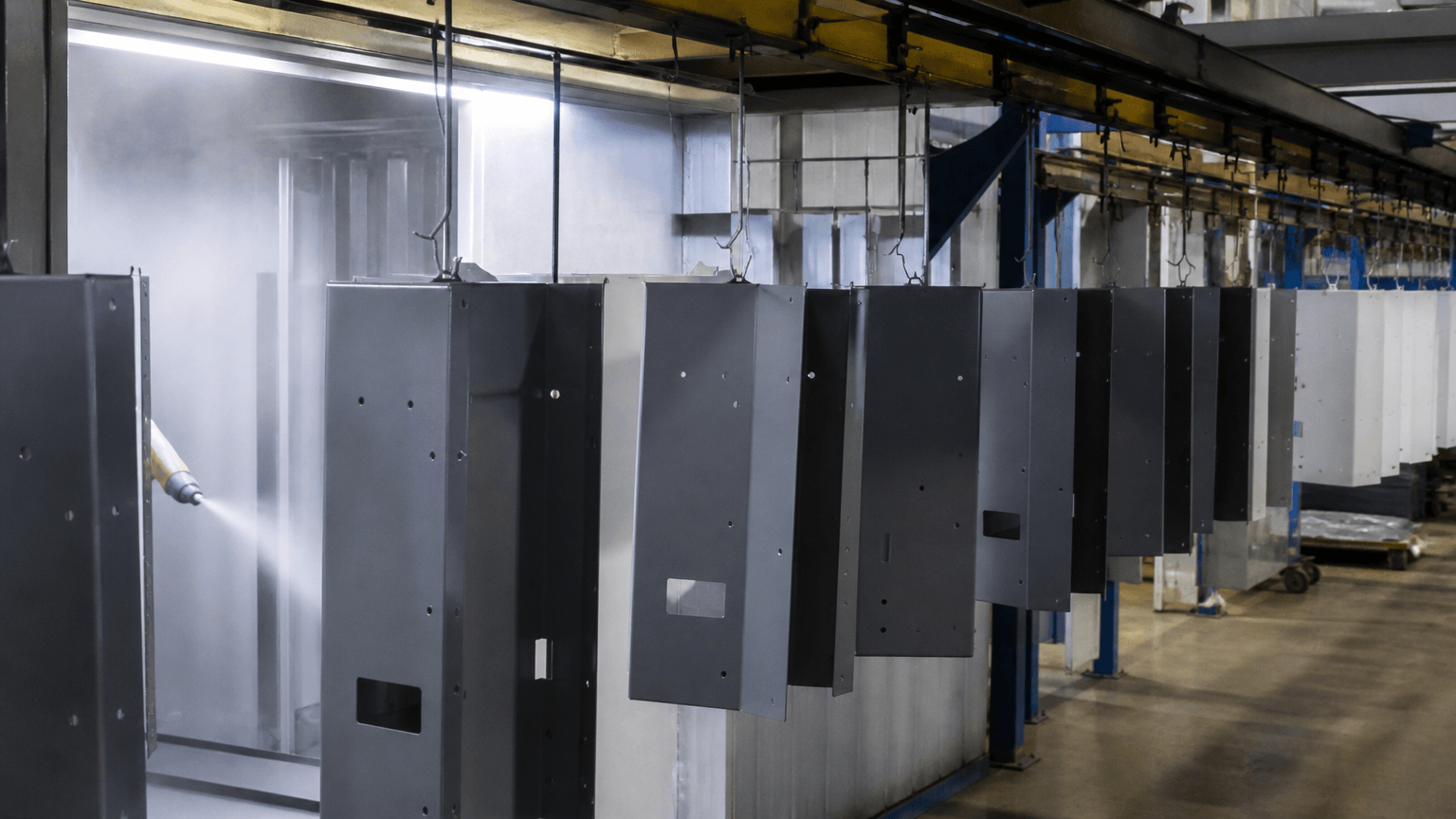
For a new powder finish: review substrate and geometry first
Before releasing an enclosure or welded frame for a new powder finish, an OEM buyer should review the metal grade, construction, and critical interfaces together. A part may be a candidate for powder coating while still needing a different preparation route, powder-system check, hanging method, or masking plan.
Mild steel, aluminum, galvanized steel, and stainless steel can all be candidates, but their preparation routes are not interchangeable. Aluminum fabrication may involve oxidation or handling marks. Stainless steel fabrication presents a passive surface that needs suitable treatment. Galvanized steel has a zinc surface requiring compatible preparation, while mild steel may need attention to oil, rust, mill residue, and weld contamination. The substrate, pretreatment, and selected powder system should be reviewed as one system.
Oil, fingerprints, moisture, rust, oxidation, loose particles, and welding residue can interfere with adhesion and may undermine the intended corrosion protection of the coating system. Welds should be checked for relevant spatter and residue. Sharp edges, porous areas, and poorly cleaned joints can also affect appearance and coverage before the part reaches the finishing stage.
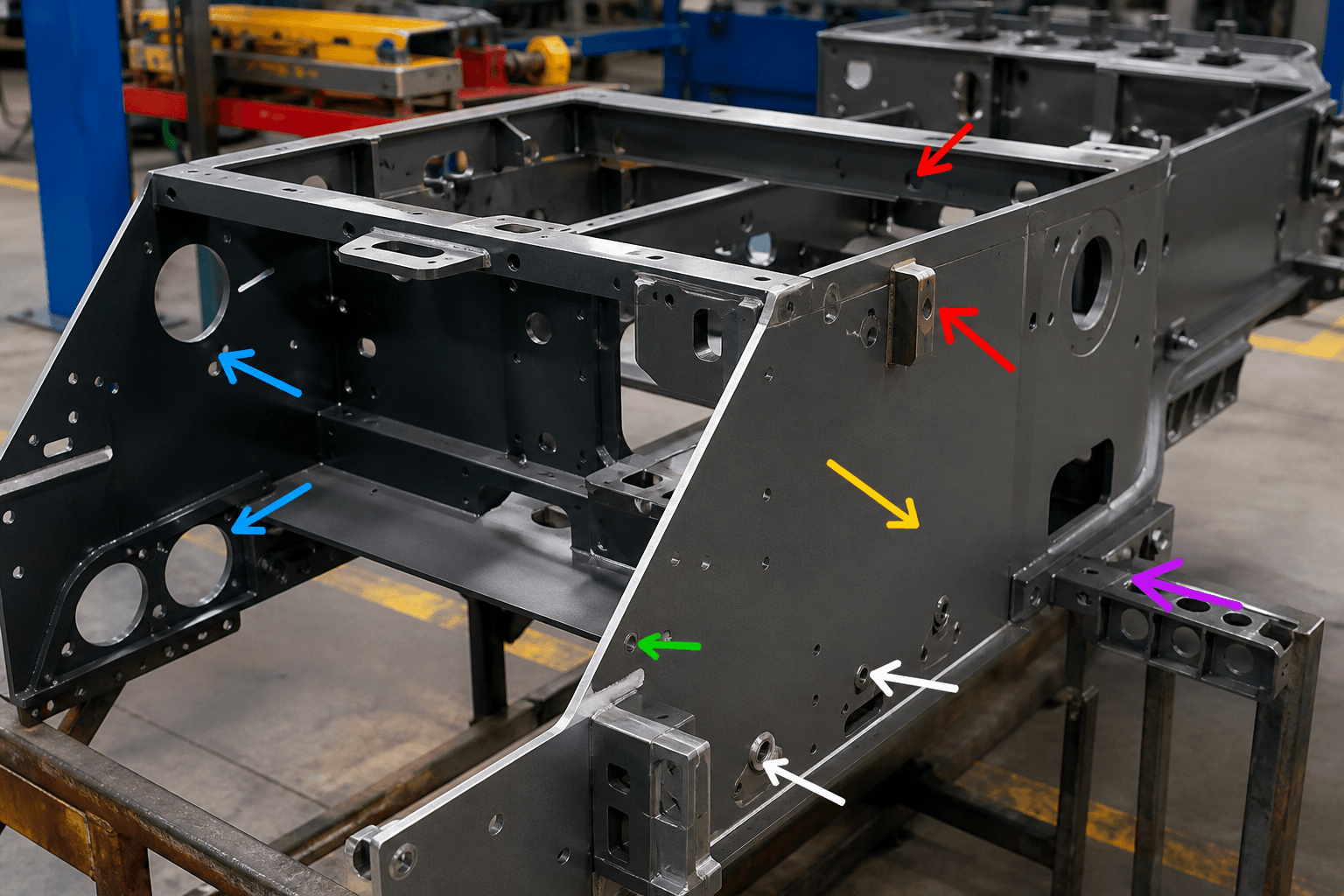
Folded edges, sharp corners, deep recesses, enclosed sections, narrow channels, drain paths, and internal cavities can limit powder access or make cleaning and drying difficult. Hanging points affect grounding, gun access, visible contact marks, and inspectability. Do not assume uniform coating on every edge or internal surface.
For clarity, use the term critical no-coat and keep-clear interfaces for threads, holes, grounding or electrical contact surfaces, connector interfaces, labels, sliding fits, and mating faces. These interfaces need drawing callouts or an approved finish brief, especially on a custom sheet metal enclosure.
Typical route from fabricated part to a cured powder finish
A laser-cut bracket, bent sheet metal part, or welded frame passes through several controlled stages before it is ready for assembly. This sequence applies to a new powder finish, not automatically to spray paint over an existing powder film. Preparation and pretreatment depend on the substrate, powder system, surface condition, geometry, and assembly strategy.
- Condition review: After laser cutting, CNC punching, bending, or welding, check burrs, sharp edges, spatter, oil, rust, oxidation, and other residue. Decide whether to coat components or the welded assembly before final assembly.
- Cleaning and preparation: Remove grease, dirt, loose particles, and corrosion products. Degreasing, rust removal, blasting, mechanical preparation, or another suitable method may be selected for the actual surface condition.
- Pretreatment: Choose a substrate-compatible treatment, which may include phosphating or another specified process. Galvanized surfaces, aluminum, stainless steel, and weld zones may require different preparation decisions.
- Drying: Remove moisture and preparation residues before application. Recesses and enclosed sections need attention because retained liquid can contribute to later defects.
- Masking and hanging: Protect the critical no-coat and keep-clear interfaces. Position the part so required faces remain accessible and electrical contact points are controlled.
- Powder application: Apply the selected powder electrostatically to the prepared metal. Orientation, grounding, edge geometry, recesses, and gun access influence coverage.
- Heat curing: Melt and cure the powder within the window specified for the powder system. The relevant condition is the temperature reached by the metal part, not simply the oven-air setting.
- Cooling and inspection: Cool the part before checking appearance, coverage, film requirements, masked interfaces, and other agreed acceptance points.
Preparation supports adhesion, controlled coverage reduces exposed areas, and cure affects final film properties such as hardness and appearance. Coating components before final assembly can improve access to mating areas. Coating a welded assembly may reduce later assembly work, but cavities, drain paths, hanging points, and inaccessible faces must be reviewed first.
New powder-coated metal RFQ matrix
An RFQ that says only metal powder coated may leave the supplier to guess the finish, interfaces, and inspection assumptions. The matrix below is for specifying a new powder finish on fabricated metal. It converts a broad finish request into reviewable inputs before quotation, sampling, and batch approval.
| RFQ field | State this information | If undefined |
|---|---|---|
| Base material and construction | Alloy or steel type, thickness, welded or separate parts, and machined interfaces. | Preparation and compatibility may be misjudged. |
| Environment and performance | Moisture, chemicals, UV, abrasion, temperature exposure, and intended finish performance. | The powder system or validation plan may not suit service. |
| Powder and appearance | Powder system, color reference, gloss, texture, visible zones, non-visible faces, and approved sample. | Appearance and batch variation become difficult to compare. |
| Film requirement | Nominal or permitted film thickness, measurement method, and measurement locations. | Fit, coverage, and appearance assumptions may conflict. |
| Cure | Powder-system cure requirements and the agreed cure or performance verification method. | Oven-air settings alone may not demonstrate the required condition. |
| Masking and interfaces | The critical no-coat and keep-clear interfaces, required masking method, and any permitted contact or coating areas. | Interference, grounding rework, or coating removal may follow. |
| Edges and cavities | Edge coverage, internal surfaces, drain or vent needs, hanging marks, weld cleanup, and cosmetic zones. | Access and coverage may vary across the part. |
| Quantity and handling | Prototype and batch quantities, dimensions, rack or hanging needs, color grouping, and packaging. | Setup, changeover, segregation, and handling assumptions may differ. |
| Inspection and acceptance | Appearance defects, film locations, adhesion or cure checks, assembly fit, records, and agreed criteria. | Release decisions may become subjective. |
For a pre-RFQ review, send 2D drawings and 3D files, base metal and thickness, the fabricated-part description, critical dimensions or tolerances, service environment, required finish performance, color, gloss, texture, appearance zones, sample expectations, critical no-coat and keep-clear interfaces, prototype and batch quantities, and inspection, packaging, and delivery needs. Cure, adhesion, corrosion, and other performance checks should use agreed methods and acceptance criteria rather than unsupported defaults.
Soft evaluation prompt: A project-specific review can separate the fabrication, new powder-coating, spray-overcoat, assembly, and inspection assumptions before a supplier quotes or approves a sample.
Next action: Use Yishang’s inquiry channel to send the drawings, files, substrate details, existing or proposed finish information, quantities, and inspection requirements. Request a route review that identifies whether the part should receive a new powder finish, a validated wet overcoat, or removal and refinishing, and that records the preparation, masking, interface, and acceptance assumptions for quotation or sampling.
Compare finishes by product requirement
When an OEM evaluates a finish for a metal enclosure, frame, or bracket, the choice should follow the substrate, environment, interfaces, part geometry, and production route. Powder coating is not automatically interchangeable with liquid painting, electroplating, anodizing, or galvanizing. If the finish route is still open, review Yishang’s Surface Finishing scope alongside the project requirements.
| Route | Process and substrate relationship | Objective and constraint |
|---|---|---|
| Powder coating | Dry powder is electrostatically applied and heat-cured on prepared metal. | Creates a specified cured film; requires compatible preparation, grounding, access, masking, and heat curing. |
| Liquid painting | A wet coating is applied to a prepared surface by spray or another method. | May suit application, localized repair, appearance, or thermal constraints that differ from powder curing; chemistry and compatibility need review. |
| Electroplating | A metallic layer is deposited electrochemically on suitable conductive parts. | May support functional or appearance objectives; recess coverage, dimensional build, contacts, and masking require definition. |
| Anodizing | An electrochemical surface treatment primarily associated with aluminum. | Alloy, color response, electrical interfaces, appearance, and geometry influence the result. |
| Galvanizing | A zinc layer is applied to steel through a galvanizing process. | Supports a defined zinc-based corrosion objective; drainage, venting, dimensions, welds, handling, and appearance require review. |
The appropriate route depends on the base metal, service environment, required interfaces, part size and geometry, production route, and validation plan. Spray paint over powder coated metal should not be treated as automatically equivalent to specifying a new powder finish on prepared metal.
Cost and scheduling variables for powder-coated metal
The variables in this section apply primarily to a new powder-coating route. A wet spray overcoat has its own preparation, compatibility testing, primer, drying or curing, and possible removal considerations.
Two visually similar powder-coated metal parts can have different costs when their dimensions, hanging density, order quantities, or curing-equipment constraints differ. A large frame, deep cabinet, or irregular welded assembly may need more deliberate handling than a flat bracket.
Masking the critical interfaces adds preparation and handling. Weld-spatter removal, rust, oil, oxidation, difficult recesses, and special pretreatment can change the route. Color or texture changes affect changeover, while sample approval, batch segregation, inspection, rework, and protective packaging can affect schedule and consistency. The quote should distinguish coating cost from upstream laser cutting, CNC punching, bending, welding, machining, and assembly.
Release and troubleshooting before batch production
Use a defined release sequence for either a new powder finish or a wet overcoat, but identify the route in the finish brief. For an existing powder film, the representative overcoat test is the decision gate. For a new powder-coated part, the approved finish sample and fabrication condition establish the starting reference.
- Freeze the reference: Approve a finish brief or representative sample covering color, gloss, texture, visible zones, cosmetic limits, critical dimensions, and part revision. For an overcoat, also record the existing film and proposed wet-coating system.
- Review preparation: Confirm material, weld condition, contamination removal, pretreatment or surface preparation, drying, masking, and hanging before batch release.
- Inspect appearance: Check color, gloss, texture, bare areas, edge coverage, contamination, pinholes, craters, runs, and other agreed defects.
- Verify film and cure: Measure film at the specified locations using the agreed method. For a new powder finish, apply the agreed cure and performance checks; for an overcoat, verify the wet coating’s agreed dry or cure condition and compatibility or adhesion result.
- Check interfaces: Verify clearance at the critical no-coat and keep-clear interfaces, grounding continuity where relevant, and assembly fit.
- Record and troubleshoot: Link the result to the revision, finish specification, sample or test area, batch, and inspection report. Separate preparation, application, cure, and mechanical-interface causes before corrective action. If the existing powder film is failing or its chemistry remains unsuitable, reassess removal and refinishing rather than treating another coat as the default correction.
This release package makes repeat production more objective. Buyers can also review the supplier’s quality control approach alongside the finish specification.
Planning a custom project? Overseas OEM and ODM buyers can share 2D drawings and 3D files, base metal and thickness, critical dimensions or tolerances, service environment, finish requirements, prototype and batch quantities, critical no-coat and keep-clear instructions, and inspection expectations. Yishang can review the route for custom sheet metal parts, metal enclosures, metal frames, and welded assemblies through fabrication, powder coating, prototype review, assembly, and batch production. Yishang has more than 26 years of custom metal manufacturing experience and exports to more than 50 countries.
Frequently Asked Questions
These questions commonly arise when an OEM is deciding whether an existing finish can be overcoated or when a new powder-coated metal part is being prepared for RFQ.
Is metal powder coated the same as powder-coated metal?
They usually describe the same finished condition. Powder-coated metal is the more conventional English phrase. Neither term names a raw alloy; both refer to fabricated metal that received an electrostatically applied, heat-cured powder finish.
Can aluminum, galvanized steel, stainless steel, and mild steel all be powder coated?
They can all be candidates, but preparation and compatibility checks differ. Oxidation, zinc surfaces, passive stainless surfaces, rust, weld residue, contamination, and the selected powder system must be reviewed for the specific part and environment.
Will powder coating cover threads, holes, grounding points, and mating surfaces?
It may reach the critical no-coat and keep-clear interfaces unless they are deliberately masked or otherwise controlled. Identify the required clearances and contact conditions on the drawing or finish brief, then confirm the keep-out method and the required fit or continuity check after coating.
Why can a powder-coated metal part peel, bubble, or show poor edge coverage?
For a new powder finish, possible contributors include oil or moisture, inadequate preparation, corrosion, weld contamination, unsuitable pretreatment, poor powder access, edge geometry, or an unsuitable cure condition. For spray paint over an existing powder coat, poor cleaning or deglossing, incompatible primer or paint, or a failing old film can also contribute. The investigation should separate preparation, application, cure, and interface causes.
What drawings and finish information should an OEM buyer send for a powder-coated metal RFQ?
Send 2D drawings and 3D files with material and thickness, critical dimensions or tolerances, service environment, powder system, color, gloss, texture, appearance zones, film and cure requirements, critical no-coat and keep-clear interfaces, quantities, inspection, packaging, and delivery requirements. The RFQ matrix above shows why each field matters.