
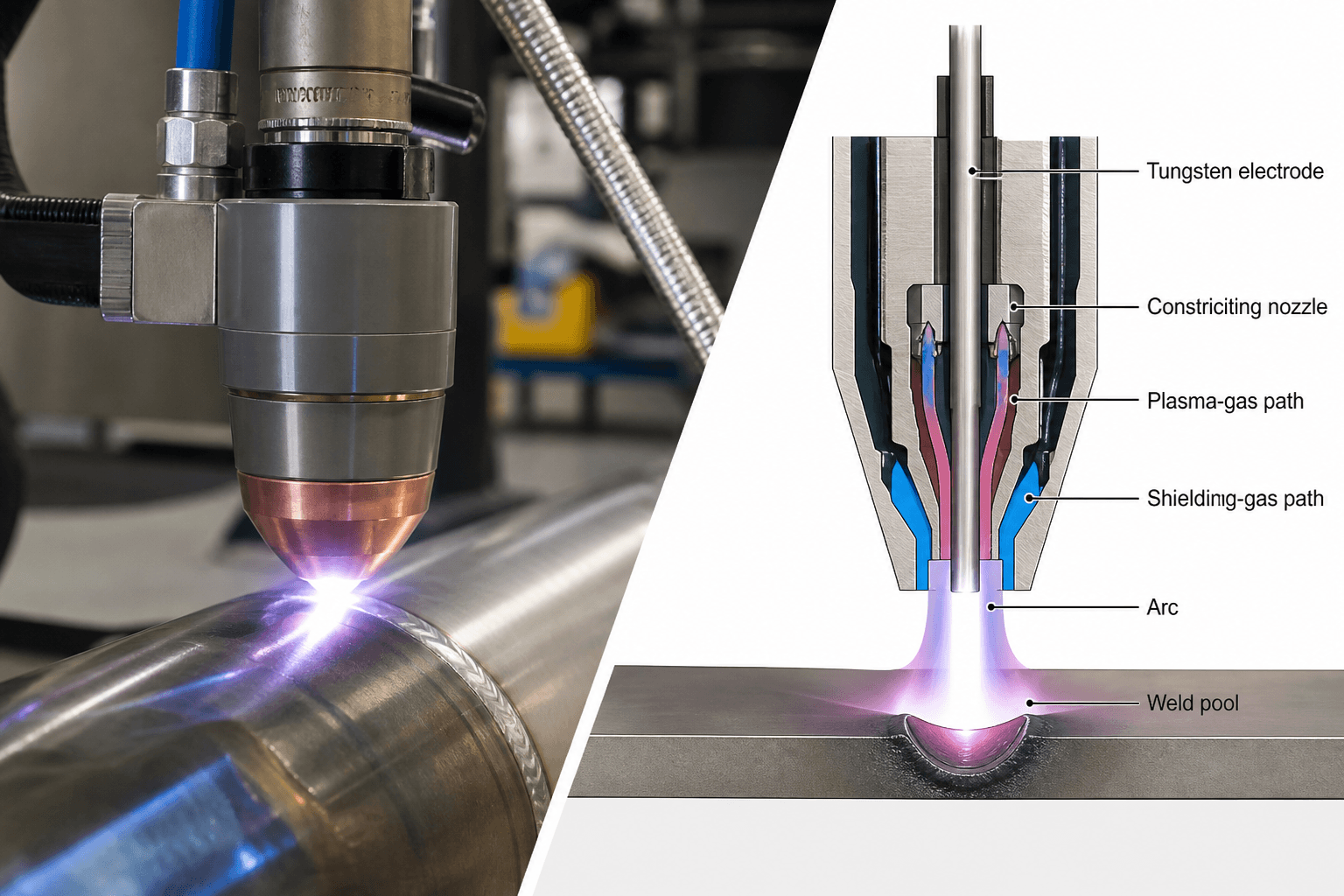
Plasma welding, usually called plasma arc welding (PAW), is a non-consumable tungsten arc welding process. Inside the torch, plasma gas passes through a small nozzle orifice around the tungsten, constricting the arc into a narrow, directional jet. External shielding gas protects the arc and weld pool, and filler metal may be added. PAW fuses a prepared joint; plasma cutting instead melts and ejects material. PAW shares TIG’s tungsten electrode, but its constricted arc is a distinct arrangement. Suitability depends on alloy, thickness, joint design, access, operating mode, equipment, and validated parameters.
For an OEM buyer, the process question is whether PAW can produce a repeatable seam, frame joint, enclosure corner, or tube-to-plate connection within the required dimensional and inspection limits.
What plasma arc welding does—and how it differs from TIG and plasma cutting
When a drawing specifies a welded sheet-metal part, the torch affects gas coverage, stand-off, fit-up sensitivity, fixture design, and production controls as well as penetration.
Plasma gas forms and sustains the constricted arc. External shielding gas protects the molten metal and heated surfaces from atmospheric contamination. Depending on the joint, the reverse side may also need a root purge or backing arrangement. Gas type, purity, flow, delivery, and torch geometry therefore belong in one procedure.
PAW is not plasma arc cutting. Cutting uses a high-temperature jet to melt and eject material through a kerf; welding controls a pool so the prepared edges or surfaces fuse and solidify into a joint. PAW and TIG both use a non-consumable tungsten electrode, but TIG does not use the same constricting plasma-gas and nozzle arrangement. TIG may remain preferable where manual flexibility, difficult access, or lower equipment complexity matters most. For drawing-based parts, see Custom Sheet Metal Fabrication Built to Your Drawings.
How PAW modes and parameters interact
A PAW torch must coordinate arc initiation, plasma formation, shielding, travel, cooling, and solidification. A setting that works on a flat coupon may not transfer to a restrained enclosure or frame.
- Prepare: clean, align, support, and fixture the joint.
- Start: establish the arc without tungsten contact; some equipment uses a pilot arc.
- Constrict: plasma gas passes through the orifice and concentrates the arc.
- Shield: external gas protects the arc and pool; root protection may be required.
- Travel: current, voltage, speed, stand-off, mode, and filler control fusion.
- Solidify: maintain shielding through cooling, then inspect the joint.
Microplasma, melt-in, and keyhole modes
| Mode | Behavior and use | Validation focus |
|---|---|---|
| Microplasma | Small, stable arc for very thin sections or delicate components. | Burn-through, distortion, fit-up, and arc stability. Approximately 0.1 mm-class work is only a conditional example. |
| Melt-in | Surface weld pool without a through-thickness keyhole; may suit seams, edges, and fillets. | Fusion, bead profile, heat input, and filler placement. |
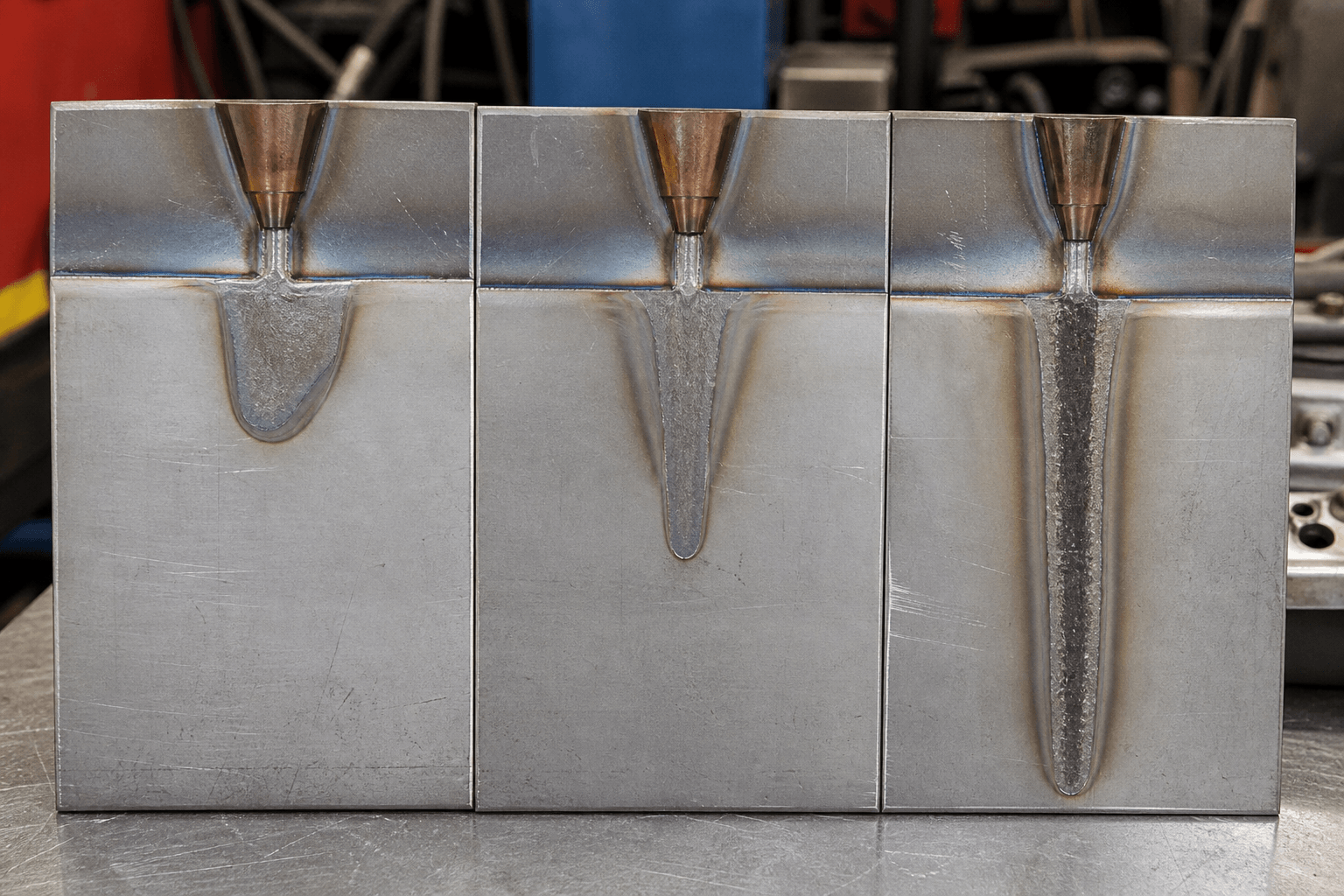
| Keyhole | Concentrated jet penetrates a suitable joint while trailing metal closes the opening. | Gap, edge preparation, root formation, position, and keyhole stability. Approximately 10 mm-class single-pass depth is conditional, not a universal limit. |
These are operating regimes, not automatic quality levels. Plasma-gas type and flow shape the jet; shielding-gas type and flow protect the weld. Current and voltage affect arc energy and length, while travel speed controls heating time. Tungsten condition, nozzle orifice, filler delivery, torch stand-off, and water cooling must be reviewed with those settings. Water cooling is commonly used to manage torch and nozzle heat during sustained or higher-energy work. The usable window must be developed for the exact alloy, thickness, joint, position, torch, nozzle, and power source.
| Variable | Role and interaction |
|---|---|
| Plasma gas | Forms the jet; type and flow affect constriction, stability, and penetration. |
| Shielding gas | Protects the pool; check coverage, turbulence, leaks, and root-side protection. |
| Current | Controls energy and mode; review with speed, gap, thickness, and filler. |
| Voltage and stand-off | Influence arc length and energy distribution; keep alignment consistent. |
| Travel speed | Changes heat input and fusion; balance against current, mode, and filler. |
| Tungsten | Electrode geometry and condition affect stability; inspect for contamination and erosion. |
| Nozzle orifice | Shapes the jet; wear, damage, and contamination can change the arc. |
| Filler metal | May bridge a gap or change composition and profile; confirm compatibility. |
| Water cooling | Removes torch heat; verify coolant level, flow, temperature, and alarms. |
Material, thickness, and joint design determine suitability
PAW suitability starts with the exact material grade and thickness, then extends to thermal behavior, surface preparation, fit-up, position, access, appearance, tolerance, and inspection. A product label such as frame or enclosure is not enough to select the process.
| Factor | What the review should address |
|---|---|
| Material grade and condition | Confirm alloy, temper or condition, thickness, heat behavior, and filler compatibility. |
| Stainless steel | Control cleaning, residues, shielding, heat, and back-side protection where required. |
| Aluminum | Control oxide removal, cleanliness, shielding, heat sinking, distortion, and filler selection. |
| Dissimilar metals | Require metallurgical and procedure review for dilution, cracking, phases, and corrosion concerns. |
| Thickness | Thin work may need microplasma; thicker joints may need keyhole or another strategy. Validate representative restraint and heat sinking. |
| Joint and fit-up | Check root gap, mismatch, edge condition, joint type, start and stop locations, and fixture control. |
| Position and access | Confirm torch angle, stand-off, shielding, filler access, and actual welding orientation. |
| Surface condition | Remove oil, moisture, oxide, scale, paint, and embedded contamination through a defined preparation method. |
PAW may be investigated for a stainless-steel enclosure seam or aluminum frame when access and fit-up can be repeated. Sheet-metal fabrication defines the parts and edges; PAW is the welding operation. Machining, finishing, assembly, and inspection remain separate drawing or project requirements. For frame context, see Custom Metal Frames Built Square, Stable and Ready to Assemble.
When should an OEM compare PAW with TIG, laser, MIG, or electron beam welding?
No process is universally superior. Compare equipment, operating cost, speed, heat input, fit-up, access, automation, maintenance, and production volume using representative parts.
| Process | Equipment and cost factors | Speed, heat, fit-up, and volume considerations |
|---|---|---|
| PAW | Tungsten, constricting nozzle, plasma and shielding gas, and often water cooling; setup and consumable control add complexity. | May support controlled mechanized travel and concentrated heating, but keyhole work is fit-up sensitive. Investigate for repeat joints and sufficient volume. |
| TIG | Tungsten and shielding gas with generally less torch complexity; manual skill and labor may affect cost. | Flexible for varied joints, short runs, manual access, and lower equipment complexity, though cycle time and heat input are joint-specific. |
| Laser | Beam source, delivery, guarding, fixtures, gas, integration, and maintenance can create substantial equipment requirements. | May provide narrow heat input and high automation potential, but needs beam access, strong fit-up control, and suitable surface condition. |
| MIG | Consumable wire, shielding gas, torch, and wire system; often practical for general fabrication. | May suit long welds and deposition-rate priorities. Automation is practical, but access, spatter, heat, and fit-up still require control. |
| Electron beam | Focused beam under vacuum or controlled vacuum; chamber, handling, and maintenance affect cost. | Specialized joints may justify it, but part size, chamber access, cleanliness, and vacuum cycles constrain production. |
How to troubleshoot plasma welding defects
Investigate defects as process symptoms. Material preparation, gas delivery, torch condition, cooling, fit-up, motion, and parameters can interact.
| Problem | Possible causes and controls |
|---|---|
| Tungsten inclusion | Contact, contamination, overload, or poor electrode condition. Inspect tungsten, nozzle, alignment, stand-off, gas, and arc start before resuming. |
| Undercut | May relate to speed, current, voltage, gas turbulence, nozzle wear, keyhole behavior, fit-up, or filler technique. Change one controlled variable at a time. |
| Porosity or contamination | Check cleaning, moisture, gas source and lines, leaks, shielding coverage, turbulence, and root protection. |
| Arc instability or poor fusion | Inspect tungsten, orifice, cooling, gas flow, alignment, stand-off, joint gap, position, and recorded parameters. |
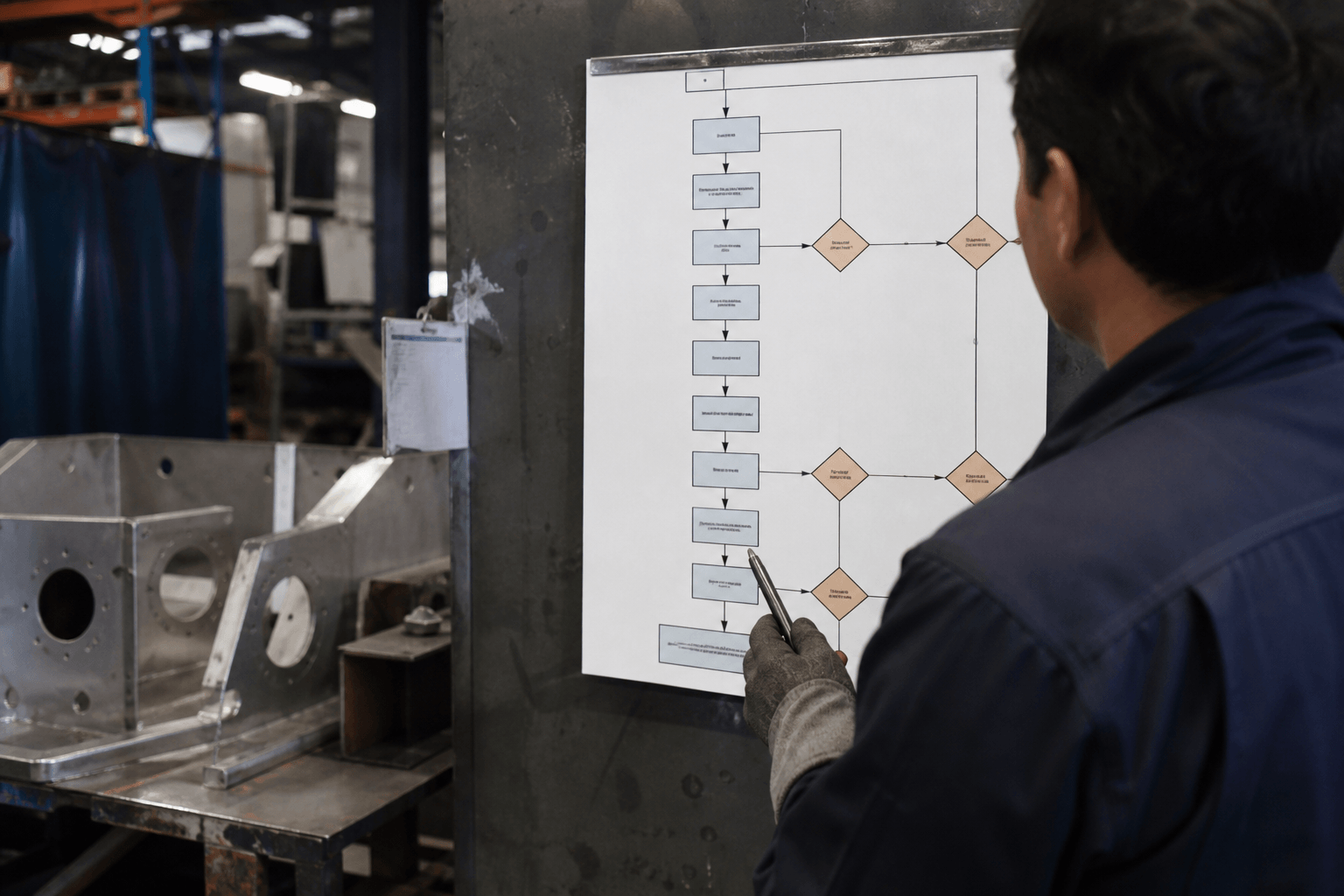
- Isolate material, surface preparation, joint design, and fit-up.
- Verify plasma gas, shielding gas, lines, connections, leaks, and root protection.
- Inspect tungsten, nozzle, torch alignment, stand-off, water cooling, hoses, and alarms.
- Review current, voltage, mode, speed, filler practice, and start-stop records.
- Check fixture restraint, motion, position, and access.
- Run a representative controlled sample, then inspect it against the drawing, customer specification, contract, or project requirement.
Acceptance criteria and inspection methods must come from the governing project documents. See Quality Control for broader inspection context.
What determines PAW readiness for repeat OEM production?
Total ownership cost includes the power source, torch, water-cooling system, gas controls, fixtures, automation, tungsten, nozzles, filler, maintenance, training, setup, inspection, rework, and traceability. Return on investment depends on repeat weld length, annual volume, cycle time, tolerance, joint consistency, and the cost of the alternative qualified process.
- Review the drawing: confirm grade, thickness, joint, length, position, access, tolerance, appearance, and inspection.
- Assess the route: select a candidate PAW mode and identify TIG, laser, MIG, or electron beam as relevant alternatives.
- Weld representative samples: use production material, fit-up range, restraint, position, and access, including credible worst-case conditions.
- Record the window: control current, voltage, gas, speed, stand-off, tungsten, nozzle, filler, cooling, and start-stop behavior.
- Approve the product: inspect samples and, where required, complete first-article or pilot review on the actual assembly.
- Monitor batches: define setup checks, consumable replacement, gas and cooling checks, inspection frequency, defect response, and traceability.
Ask a manufacturing partner for confirmed equipment availability, relevant material and joint experience, sample-weld capability, procedure and consumable control, inspection planning, defect response, and production records. General welding capability should not be treated as proof of dedicated PAW capability.
Plasma welding questions OEM teams ask
Is plasma welding the same as plasma cutting?
No. Cutting melts and ejects material; PAW fuses and controls a weld pool. Cutting equipment should not be assumed to provide a welding procedure.
Is PAW better than TIG welding?
Not universally. PAW may suit a concentrated, repeatable mechanized joint, while TIG may suit manual flexibility, difficult access, varied work, or lower equipment complexity. Compare representative results and total process requirements.
Can PAW be used for thin stainless steel or aluminum?
It can be considered, but exact alloy, thickness, cleaning, oxide control, shielding, heat management, fit-up, and filler compatibility require validation. Approximately 0.1 mm-class microplasma work is only a conditional example.
What is keyhole plasma welding?
Keyhole PAW uses a concentrated jet to penetrate a suitable joint while trailing metal closes the opening. Gap, edge preparation, speed, stand-off, gas, position, and equipment must be validated. Approximately 10 mm-class single-pass depth is not a universal limit.
What causes tungsten inclusions or undercut?
Inclusions may follow electrode contact, contamination, overload, or unsuitable tungsten condition. Undercut may involve speed, current, voltage, gas turbulence, nozzle wear, keyhole behavior, fit-up, or filler technique. Use the troubleshooting sequence and confirm the cause with inspection.
Conclusion: validate the joint, not just the process
PAW is a distinct constricted tungsten-arc process whose value depends on the material, joint, fit-up, access, mode, equipment, and repeatability required. Compare it with TIG, laser, MIG, and electron beam welding through representative samples, documented parameters, inspection evidence, and production economics—not through a universal claim of superiority.
Frequently Asked Questions
What hole alignment details should buyers define before requesting a quote?
Buyers should define the functional requirement, drawing notes, critical dimensions, material or process expectations, and any inspection points related to hole alignment. This helps suppliers quote the same manufacturing scope instead of making different assumptions.
How can tolerance stack affect cost, fit, or lead time?
tolerance stack can change tooling, forming, welding, finishing, inspection, or rework requirements. If buyers do not clarify it early, two supplier quotes may look comparable while covering different production risks.
Why should mating parts be reviewed before prototype approval?
mating parts may look acceptable on a single sample but become harder to control during batch production. Buyers should confirm whether the prototype reflects the same process, finish, and inspection conditions expected for production.
What inspection points matter most for plasma welding projects?
Important inspection points usually include fit-critical dimensions, holes or mating areas, cosmetic surfaces, finish build-up, welded or formed features, and any dimensions that affect downstream assembly. These points should appear in the RFQ or drawing notes.
How can buyers reduce fit-up inspection risk before batch production?
Buyers can reduce risk by clarifying drawings, locking key material and finish assumptions, defining inspection timing, approving a representative sample, and confirming which dimensions or surfaces require tighter process control.
How can Yishang help review plasma welding requirements?
Yishang can review drawings, RFQ notes, material requirements, tolerance expectations, finish details, samples, and assembly needs to identify unclear assumptions before quoting or batch production.