
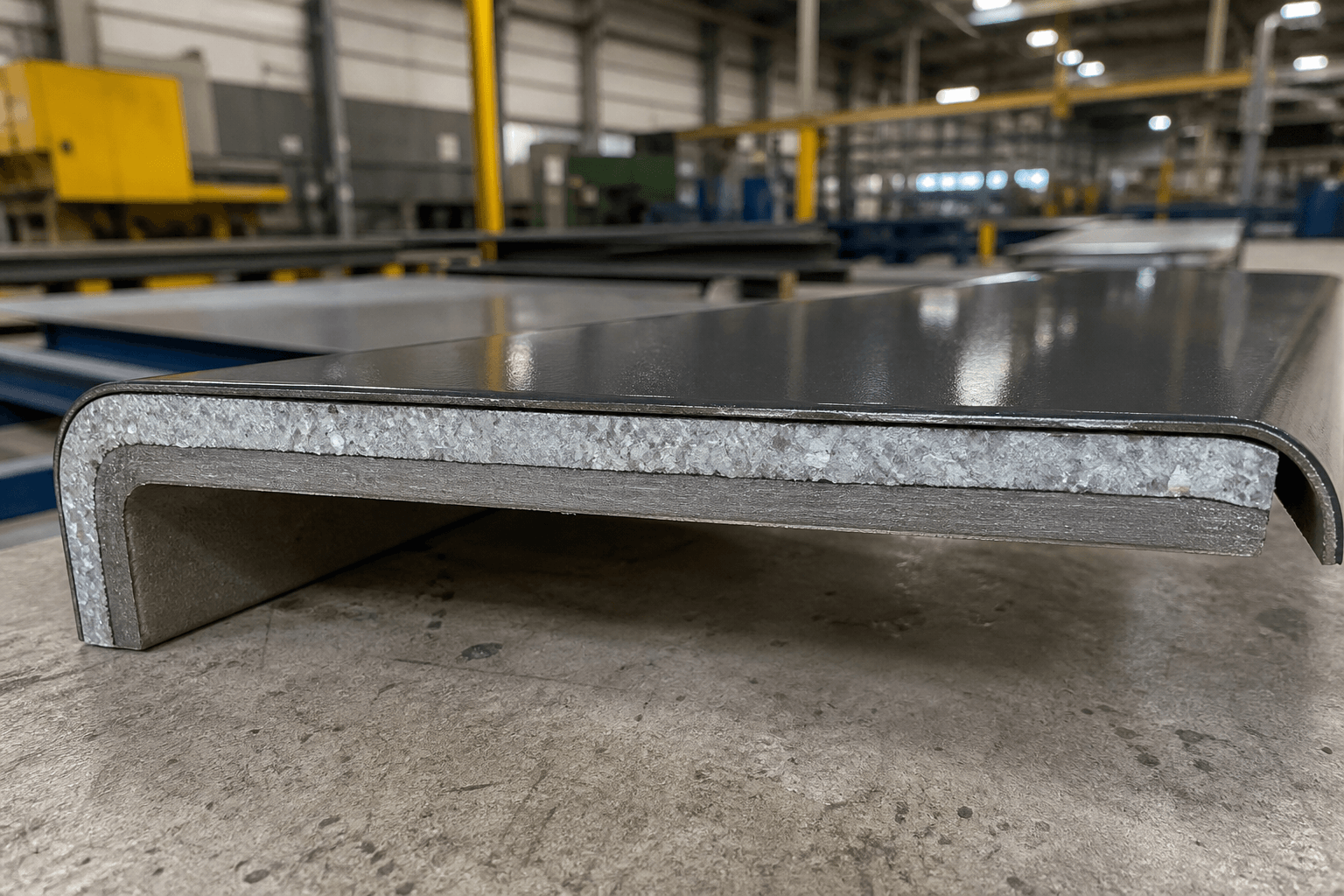
Yes—powder coating galvanised steel is generally feasible, but reliable adhesion and appearance depend on the galvanising type and zinc condition, preparation, outgassing risk, compatible powder system, curing verification, and service environment. A compatible part can still blister, flake, or interfere with assembly if residues, moisture, geometry, or heat history are not controlled.
For an OEM buyer approving a frame, enclosure, or other fabricated part, the useful question is not simply whether it can be coated. It is whether the zinc surface arriving from the galvaniser is suitable for the selected pretreatment and powder process, and whether the finished part will meet exposure and assembly requirements.
Galvanising and powder coating perform different jobs. Zinc provides a barrier and sacrificial layer for the steel. The cured powder film adds an outer protective and decorative layer with colour and gloss. Powder coating does not permanently eliminate corrosion or make an unsuitable zinc surface acceptable automatically.
First identify the galvanising type and the condition presented to the coater. Fresh zinc may carry process residues or passivation materials; weathered zinc may have oxidation, salts, or white corrosion; and contaminated zinc may need cleaning followed by a new surface assessment. Check powder-manufacturer data and pretreatment guidance against the actual substrate, then validate the route on representative parts or a first article.
Defect diagnosis starts with the surface, not the symptom
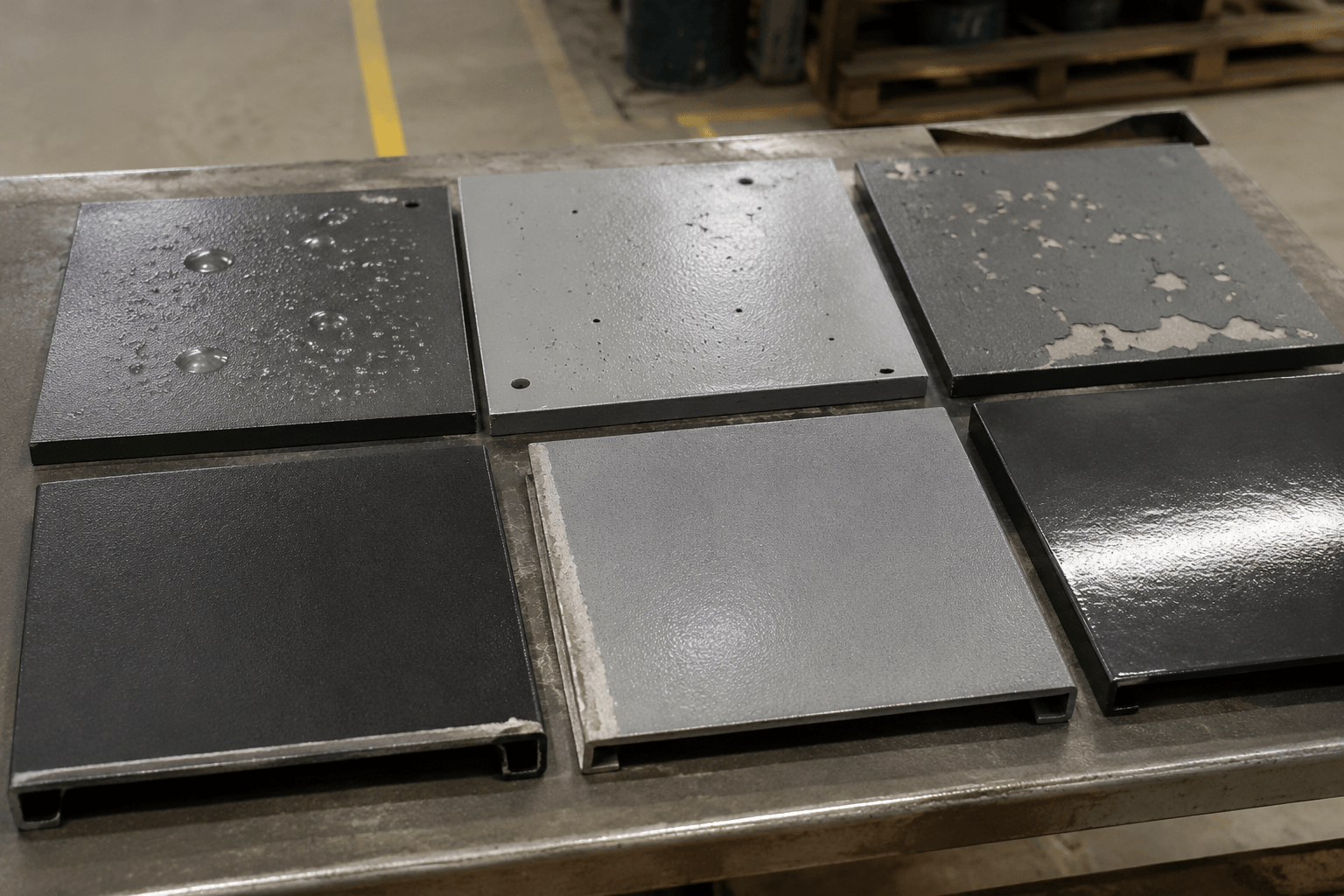
If a buyer is approving a first article or investigating a rejected batch, bubbles and flaking create more than an appearance issue: they can trigger stripping, rework, dimensional checks, and disputes over which supplier owns the failure. Start with the zinc condition and process records before choosing a corrective action.
Heating can release moisture or volatile material trapped in rough zinc areas, pores, weld residues, or contamination. This outgassing may produce bubbles or pinholes. Zinc oxidation, salts, oil, unsuitable passivation residues, poor drying, insufficient pretreatment, contaminated handling, and incorrect cure can also reduce adhesion or change gloss. A visible symptom does not prove one root cause.
- Bubble raised area linked to gas, moisture, or contamination risk
- Pinhole opening through the powder film
- Flaking loss of adhesion at the zinc-to-powder interface
- Thin edge reduced coverage at a sharp or exposed edge
- Uneven gloss variation linked to film build, cure, or contamination
| Symptom | Possible contributors | Verification and corrective direction |
|---|---|---|
| Bubbles or pinholes | Outgassing, moisture, oil, salts, or rough zinc. | Review surface, drying, and preheat records. Re-clean and qualify a suitable degassing route on representative parts. |
| Flaking or poor adhesion | Loose oxidation, contamination, incompatible chemistry, or incomplete cure. | Review pretreatment, handling, adhesion results, and part-metal cure evidence before rework. |
| Thin edge coverage | Sharp edges, electrostatic effects, or poor spray access. | Inspect critical edges and review edge preparation, orientation, and the agreed coverage requirement. |
| Uneven film build | Variable zinc texture, recesses, orientation, or application. | Map critical surfaces and review hanging, spray access, and dimensional allowances. |
| Colour or gloss variation | Uneven cure, mixed batches, contamination, or film variation. | Check powder-batch traceability, cure records, colour, gloss, and film readings. |
| White corrosion or corrosion beneath the film | Moisture, damaged zinc, exposed cut areas, or water-retaining gaps. | Review storage and handoff condition; repair damaged galvanising by an agreed method before recoating. |
| Thread or assembly interference | Zinc or powder build-up on threads, holes, or mating faces. | Check with the specified gauge or mating component and revise masking or allowances as needed. |
Do not make a second powder coat the default response. If contamination, trapped moisture, or the original geometry remains, recoating may conceal rather than remove the cause.
Geometry sets the limits before coating
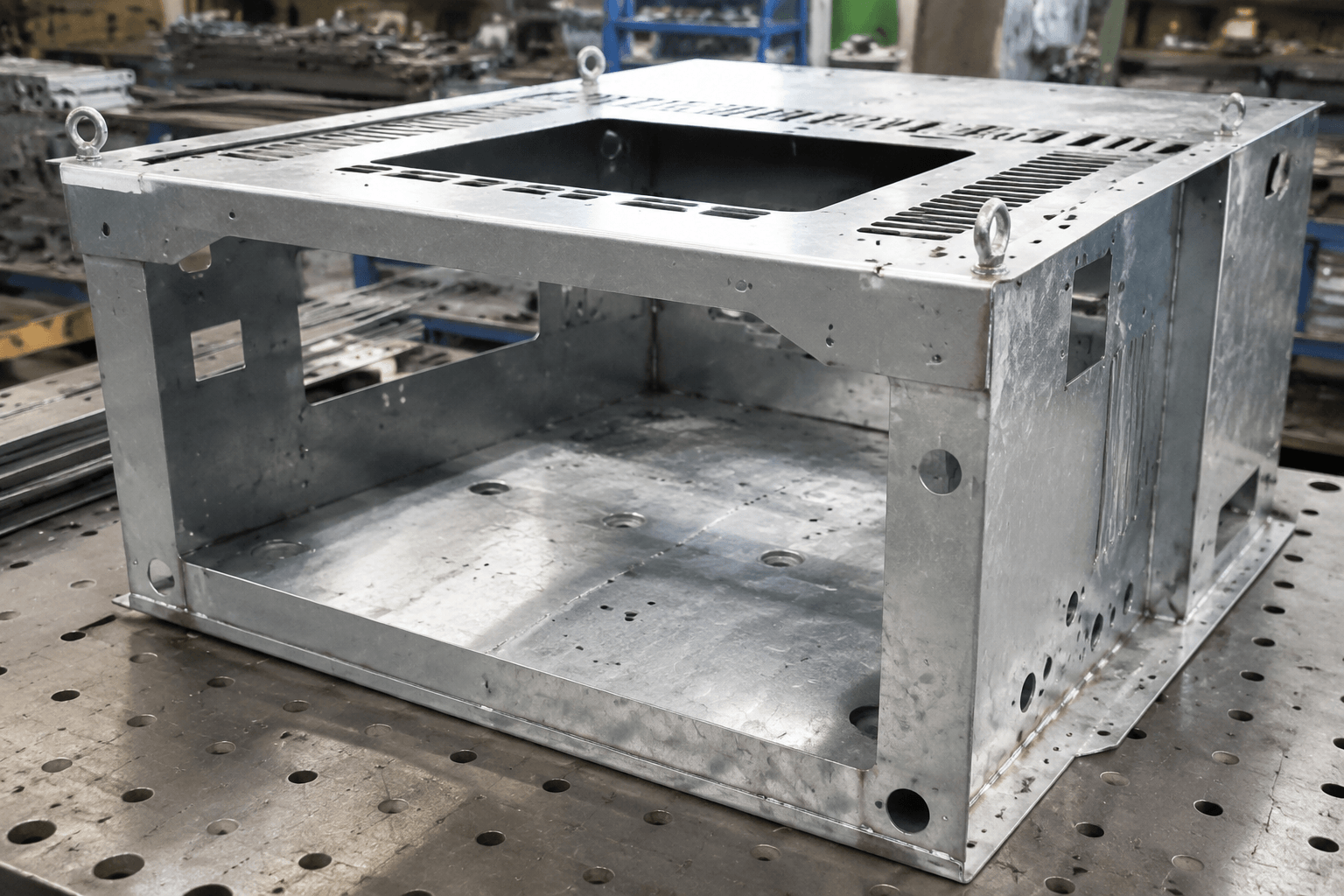
A vent omitted from a fabrication drawing may not be fixable at the coating stage without redesign. Before sheet-metal fabrication and galvanising, obtain the galvaniser’s guidance for venting, drainage, immersion, lifting, and enclosed sections. Hollow frames and enclosures need suitable vent and drain holes so treatment liquids and moisture do not remain trapped; the design depends on the section and process, not a universal hole rule.
Welding should leave seams free from excessive spatter, flux, anti-spatter residue, burrs, and sharp projections. Sharp edges are difficult to cover consistently. Drilling or machining after galvanising can expose steel and damage zinc, so any post-galvanising operation needs an agreed repair route.
- Vent and drain holes at enclosed sections
- Welds and sharp edges for surface review
- Threads and bearing faces for masking
- Hanging points away from critical faces
- Drainage, cavities, and assembly clearances
- Identify threads, electrical contact points, gasket lands, bearing faces, and mating surfaces that must remain within dimensional limits.
- Define whether holes will be plugged, masked, cleaned after coating, or accepted with a specified finish condition.
- Provide hanging points in non-critical areas and identify unavoidable rack marks or touch-up zones.
- Check drainage around folded returns, pockets, channels, and enclosure bases in both processing and installed orientations.
- Allow for zinc and powder build-up where parts assemble, slide, seal, or accept fasteners.
For drawing-led work, custom sheet-metal fabrication built to your drawings should include these finishing interfaces. Enclosure designs also need review of cavities, threads, masking zones, and assembly faces; see custom sheet-metal enclosures.
Build preparation and curing around the actual zinc surface
Classify the incoming surface. Record whether it is hot-dip galvanised or electrogalvanised, and inspect for oil, dirt, packaging residue, moisture, loose oxidation, white corrosion, bare areas, and transport damage. Fresh, weathered, and contaminated zinc are different inputs.
Control storage. Protect parts from rain, condensation, salts, dirty supports, and rubbing. If the surface changes before coating, reassess it instead of relying only on the original galvanising record.
Clean and dry without unnecessarily attacking the zinc. The cleaner, rinsing, drying, and handling sequence must address grease, release agents, oils, salts, and storage residues while remaining compatible with the zinc surface.
Create a stable adhesion surface. A qualified route may use suitable abrasion, chemical conversion, zinc-phosphate, zirconium-based treatment, or another supplier-approved method. The objective is a clean, stable surface, not maximum roughness or automatic removal of zinc.
Manage outgassing. Consider preheating or pre-baking when sample work identifies gas release, trapped moisture, or a geometry-related risk. Temperature, duration, loading, and sequence must come from the substrate, geometry, powder system, and validation results.
Apply and cure using part-metal evidence. Follow the powder technical data and verify the temperature reached by the part, not only the oven-air setpoint. Samples or first articles should confirm appearance, adhesion, cure state, and film build.
Control rework and handling. Cool parts before handling, remove masking carefully, inspect threads and mating faces, and protect the finish during transport. Rework documentation should state whether the powder, zinc, or both layers were damaged and which repair route is permitted.
The finish specification starts with exposure, not colour
Select the powder system around humidity, UV exposure, coastal salts, chemicals, temperature, intermittent wetting, cleaning, maintenance, and the expected service period. Polyester or another chemistry may be appropriate according to the supplier’s data, but no resin is universal. Hot-dip and electrogalvanised steel should be treated as different surface inputs when the substrate choice is still open.
| Environment | Finish priorities | Validation focus |
|---|---|---|
| Indoor and dry | Appearance, adhesion, cure, and fit. | Visual approval, film thickness, adhesion, and cure verification. |
| Urban or general outdoor | Weatherability, UV resistance, drainage, and edge coverage. | Powder data, samples, colour and gloss approval, and relevant corrosion checks. |
| Coastal or salt exposure | Seams, edges, moisture control, and exposure-specific system selection. | Agree test method, duration, specimen preparation, and acceptance criteria in advance. |
| Industrial or chemical contact | Resistance to named chemicals, concentrations, temperatures, and cleaners. | Obtain evidence for the actual exposure rather than a general outdoor designation. |
| High UV exposure | Colour and gloss retention as well as corrosion protection. | Review UV data and define any accelerated test and acceptance requirement. |
A purchase specification should define:
- Steel grade and thickness, galvanising type, zinc-surface condition, and any zinc-layer requirement.
- Powder chemistry or approved system, colour reference, gloss level, and acceptable visual variation.
- An agreed film-thickness range suited to geometry, cure, threads, and mating dimensions.
- Appearance, adhesion, cure, edge coverage, colour, gloss, and critical assembly-surface inspections.
- Powder batch, galvanised-part lot, cure record, inspection record, and rework traceability.
- Any corrosion or cyclic test, with method, duration, specimen preparation, and acceptance criteria agreed beforehand.
Put these requirements in the drawing, quality plan, or purchase order. Yishang’s quality-control information can support that discussion, while project-specific acceptance criteria still require agreement.
Make each process handoff explicit
When fabrication, galvanising, storage, transport, powder finishing, and inspection involve different suppliers, an undefined handoff can become a quality dispute. Assign responsibility for the work, surface condition, evidence, and rework approval before production.
| Stage | Define | Evidence |
|---|---|---|
| Fabrication, welding, and machining | Material, drawing revision, vents, drains, weld finish, threads, and post-galvanising operations. | Drawing review and fabrication inspection. |
| Galvanising | Hot-dip or electrogalvanised condition, lot identity, damage, residues, moisture, and white-corrosion concerns. | Lot record, outgoing inspection, photographs, and repair disposition. |
| Storage and transport | Protection from rain, condensation, salts, dirty contact, and abrasion. | Packaging instructions and receipt condition check. |
| Powder finishing | Cleaning, pretreatment, drying, outgassing controls, powder batch, cure, film build, appearance, and dimensional protection. | Process records, part-metal cure evidence, readings, and rework records. |
| Inspection and assembly | Sample approval, visual and dimensional limits, thread and mating-face condition, and release authority. | Inspection report, gauge or mating checks, traceability, and release. |
Use an approved sample or photographs to define each handoff. Connect galvanised-part lots, powder batches, cure records, inspection results, and shipment identifiers.
Request a pre-RFQ technical review
Start a drawing-led review with Yishang for custom sheet-metal geometry, coating interfaces, prototype requirements, and batch-production needs. Confirm galvanising ownership before quotation: the galvanised material may be customer supplied or managed by a separate galvanising supplier; it should not be assumed to be processed in-house by Yishang.
- Drawings or 3D files showing material, thickness, cavities, welds, threads, masking areas, tolerances, and assembly interfaces.
- Whether the material is hot-dip galvanised, electrogalvanised, fresh, weathered, contaminated, or damaged.
- Photos or samples if bubbles, pinholes, flaking, white corrosion, or interference already exist.
- Service environment, UV and chemical exposure, colour, gloss, film-thickness target, and inspection or corrosion-testing requirements.
- Quantity, prototype or batch stage, delivery location, and supplier ownership of fabrication, galvanising, powder coating, inspection, and rework.
Powder coating galvanised steel is feasible when zinc condition, design, preparation, powder, cure, storage, and handoffs are controlled as one connected process.
Frequently Asked Questions
For an RFQ, use these answers to check the drawing, supplied zinc condition, finish requirement, and inspection ownership before release.
Can hot-dip galvanised steel be powder coated after galvanising?
Yes, generally. Inspect texture, residues, oxidation, moisture, damage, and passivation or storage contamination. Select compatible pretreatment and powder, then confirm adhesion, appearance, film build, and cure on representative parts.
Does galvanised steel always need blasting or chemical pretreatment before powder coating?
No single method applies to every zinc surface, but preparation and validation are necessary. Abrasion, chemical conversion, zinc-phosphate, zirconium-based, or another approved route may be selected for the actual condition and powder system.
Why does powder coating on galvanised steel develop bubbles, pinholes, or poor adhesion?
Possible causes include outgassing, moisture, oil, salts, zinc oxidation, unsuitable pretreatment, contaminated handling, insufficient cure, or excessive film build. Review surface records, cure evidence, film thickness, defect locations, and photographs before rework.
Does galvanised steel need to be powder coated within a fixed number of hours after galvanising?
No universal time window applies. Protect the zinc from contamination and condensation, reassess its condition before coating, and use a validated process rather than a fixed number of hours.
Is powder coating over galvanised steel suitable for coastal or high-UV applications?
It may be suitable if the complete system is selected and qualified for the defined exposure. Specify chemistry, edges, film build, colour, gloss, inspection, and any corrosion or UV test method and acceptance criteria.