
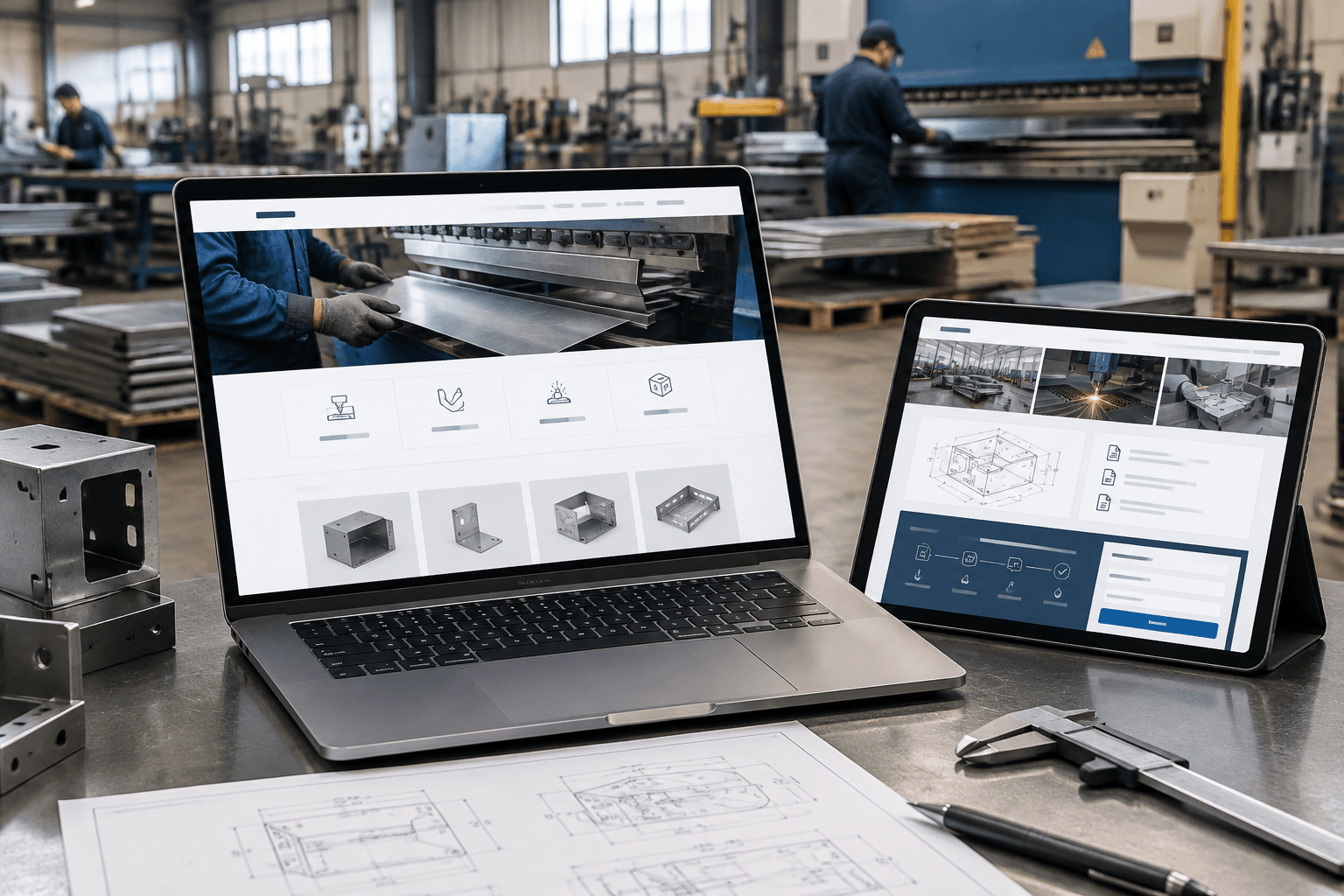
A useful fabrication company website helps an OEM or ODM buyer check process fit, product relevance, quality evidence, production transparency, and the next inquiry step. It should make supplier screening more efficient, but the website alone cannot prove capability, compliance, or readiness for a specific order.
Use the site to identify what the manufacturer appears to support, what evidence is published, and which technical points still require confirmation. A polished gallery and a long capability list are useful only when they connect to materials, part geometry, production requirements, quality controls, or actual deliverables.
What Should Be Clear During the First Website Review?
The first review should establish whether the company serves the right type of buyer and project. For custom industrial work, look for an explicit B2B focus, support for drawing-led manufacturing, OEM or ODM options, navigable product and process pages, quality information, and a practical contact route.
Company context can help establish relevance when it is specific and verifiable. Yishang, for example, serves B2B wholesale and custom manufacturing projects, supports OEM and ODM work, has more than 26 years of experience manufacturing custom sheet metal parts and metal products, and exports custom metal products to more than 50 countries. Yishang also holds ISO and RoHS certifications. These facts provide screening context, but they do not replace confirmation of certificate scope, project requirements, process ownership, or order-specific controls.
A strong initial review should answer four questions:
- Commercial fit: Does the company work with businesses requiring custom or repeat manufacturing?
- Technical fit: Are the relevant forming, machining, joining, finishing, assembly, and verification routes explained separately?
- Product fit: Do examples resemble the part family or manufacturing route, even if they are not identical to your project?
- Contact readiness: Does the site tell you what drawings, specifications, quantities, and acceptance requirements to provide?
Treat missing information as a question for the supplier, not automatic evidence of either capability or incapability.
Match the Part to the Correct Manufacturing Route
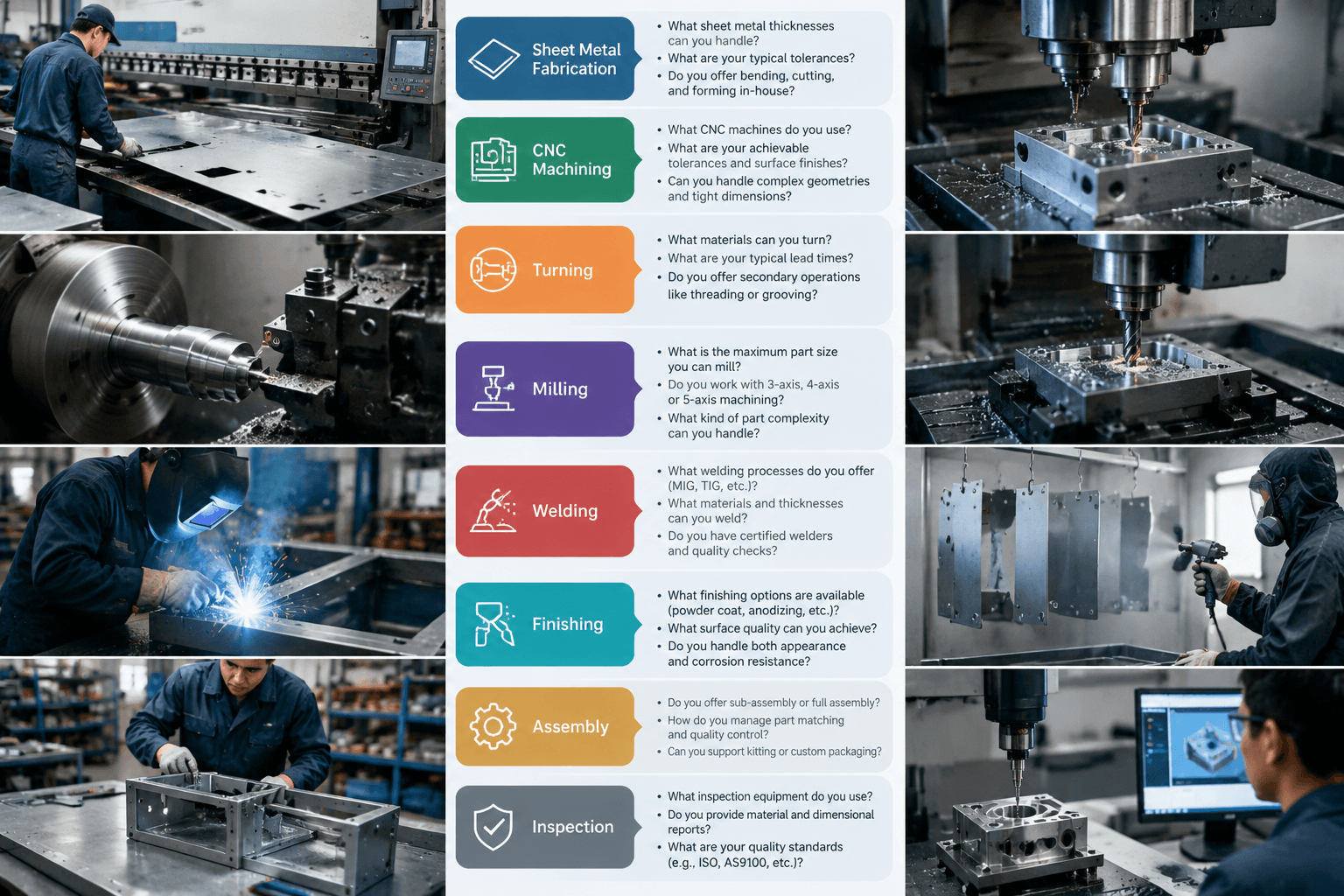
Process names should not be treated as interchangeable. Sheet metal fabrication creates parts and assemblies primarily from sheet or plate through operations such as cutting, bending, forming, and joining. CNC machining removes material to produce controlled features or solid parts. Turning and milling are distinct machining routes, while welding, finishing, assembly, and inspection perform different supporting roles.
| Process or activity | Role in production | Useful website evidence |
|---|---|---|
| Sheet metal fabrication | Produces formed panels, brackets, covers, cabinets, and related parts from sheet or plate. | Published materials, thickness ranges, part dimensions, forming constraints, quantities, and examples of comparable geometry. |
| CNC machining | Removes material to create solid components, precision interfaces, holes, pockets, threads, or features that forming cannot produce. | Material and geometry information, tolerance conditions, machined feature examples, quantity guidance, and drawing requirements. |
| CNC turning | Produces rotational parts such as shafts, pins, bushes, or threaded components. | Diameter and length limits when published, material options, feature examples, and whether turned parts can be integrated into assemblies. |
| CNC milling | Creates prismatic faces, slots, pockets, hole patterns, and controlled interfaces. | Part examples, supported geometry, tolerance context, and any stated production constraints. |
| Welding | Permanently joins fabricated or machined components. | Joint types, materials, appearance requirements, distortion considerations, inspection options, and disclosure of process ownership. |
| Finishing | Provides surface appearance, corrosion protection, cleanliness, or preparation for later use. | Available finish categories, color or texture controls, masking needs, cosmetic criteria, and whether finishing is internal or externally coordinated. |
| Assembly | Combines fabricated parts, machined items, hardware, inserts, or purchased components. | Assembly state, hardware responsibility, fit checks, packaging expectations, and supplied-component handling. |
| Inspection | Verifies requirements rather than creating the part. | Inspection stages, measurable characteristics, report formats, traceability options, acceptance documents, and any stated limitations. |
Published numbers require context. A tolerance may depend on material, thickness, feature type, geometry, process sequence, and measurement method. Dimensions and weights may be restricted by equipment or handling. Quantity can affect tooling and production route. If a website gives no limits, ask rather than assuming unlimited capacity.
The site should also identify, where possible, which work is performed in-house and which is managed through external providers. Coordinated work is not inherently unsuitable, but process ownership affects communication, change control, scheduling, traceability, and responsibility for nonconforming results. For a closer look at machining as a separate route, see the custom CNC machining overview.
Read Product Pages as Manufacturing Evidence
A product page is useful when it explains more than what the finished item looks like. Look for the design input, probable manufacturing route, material or finish options when verified, assembly condition, intended production context, and information needed to evaluate a similar part.
Consider a hypothetical formed bracket. Relevant evidence might include a drawing-led workflow, bend and hole relationships, mounting interfaces, finish requirements, and whether hardware insertion or assembly is involved. A custom metal bracket page can therefore be more informative than a gallery containing unrelated finished products.
For an enclosure, buyers may need evidence covering panels, doors, cutouts, hinges, fasteners, cosmetic surfaces, internal component interfaces, and delivery in a ready-to-assemble or assembled state. The custom sheet metal enclosure page is relevant to that product route. It still does not prove that a supplier can manufacture every enclosure size, tolerance, material, finish, or volume.
Keep four types of content distinct. Product examples demonstrate relevance; industry pages provide application context; testimonials report opinions; and technical records provide verifiable evidence. None should be presented as an identical customer case unless the project details are genuinely documented and permitted for publication.
Fabrication Company Website Evaluation Matrix
This matrix turns general claims into evidence checks and focused buyer questions. Use it to compare suppliers consistently before sending detailed RFQ data.
| Website claim or topic | Evidence to look for | Question to carry forward |
|---|---|---|
| Custom fabrication capability | Defined part families, process routes, drawing inputs, materials, dimensions, thicknesses, weights, quantities, and constraints where published. | Which route and constraints apply to our drawing? |
| OEM and ODM support | Explanation of whether the supplier builds to buyer drawings, helps develop a manufacturing definition, or supports both. | What technical input is required, and who controls design approval and revisions? |
| Quality system | Certification references and, when available, certificate details, scope, issuer, and validity. | Can the relevant current documents be reviewed for this sourcing decision? |
| Inspection capability | Inspection stages, characteristics checked, sampling or acceptance approach, report examples, and traceability options. | Which records can be supplied with this order, and must they be agreed before pricing? |
| Production capacity | Specific limits connected to material, geometry, size, weight, thickness, volume, or schedule. | What constraint is most likely to affect our part or forecast? |
| Integrated supply | Clear responsibility for fabrication, machining, welding, finishing, assembly, inspection, and externally coordinated steps. | Which operations are controlled directly, and how are outside processes approved and documented? |
| Delivery readiness | Packaging, labeling, assembly state, documentation, and shipping responsibilities when stated. | What constitutes a complete, acceptable shipment for this project? |
Company-level certification and project-level acceptance evidence solve different problems. An ISO or RoHS certification is not the same as an inspection report for a particular production lot. Likewise, a dimensional record, material document, finish record, or traceability file does not automatically establish company-wide certification.
Facility photographs, machine images, promotional quality statements, and testimonials can support a broader assessment, but they do not define capacity. Credible qualification connects claims to applicable documents, measurable constraints, process responsibility, and agreed deliverables.
Turn Website Research Into a Capability-Fit Inquiry
After screening the website, begin with a capability-fit discussion instead of requesting generic pricing with incomplete data.
- Send the available part drawing, model, specification, or controlled reference document.
- State the required material, overall dimensions or sheet thickness, quantity, intended application, and expected production pattern.
- Identify finish, welding, hardware, assembly, packaging, inspection, reporting, and traceability requirements that may affect the route.
- Provide target timing and any non-negotiable acceptance criteria without assuming a lead time.
- Ask which operations are performed in-house, which are externally coordinated, and what production constraints require review.
- Clarify how missing dimensions, drawing conflicts, revisions, substitutions, and scope changes will be handled before detailed pricing.
This sequence gives the supplier enough context to identify process fit and information gaps. It also helps procurement compare responses on the same basis rather than comparing prices built from different assumptions.
For a focused discussion with Yishang, provide the drawing or available specification together with material, dimensions or thickness, quantity, application, finish, assembly state, inspection documentation, target timing, and acceptance criteria. The first objective should be to confirm capability fit and required clarifications before detailed pricing.
Frequently Asked Questions
What should a metal fabrication company website include?
It should define the company’s B2B scope, custom manufacturing model, relevant part families, distinct production processes, quality information, and inquiry requirements. Useful pages also publish applicable materials, dimensions, thicknesses, weights, tolerances, quantities, or constraints when those facts have been verified. The site should make clear what remains subject to drawing review.
How can I tell whether a fabricator supports OEM and ODM custom work?
Look for a clear statement of OEM and ODM support and an explanation of the expected design input. OEM work commonly starts from buyer-controlled drawings or specifications, while ODM involvement may include development from functional requirements. Confirm design responsibility, approval stages, revision control, intellectual-property handling, and the information needed to define production.
What is the difference between sheet metal fabrication and CNC machining on a supplier website?
Sheet metal fabrication forms, cuts, and joins sheet or plate into components and assemblies. CNC machining removes material to create solid parts or controlled features; turning and milling are separate machining methods. Machined parts may interface with a sheet metal assembly, but machining should not be described as sheet metal fabrication.
Can a fabrication company website prove certification, inspection capability, or production capacity?
No. It can present useful evidence, such as certification information, sample report formats, process descriptions, and published constraints, but these must be checked against current documents and project requirements. Confirm certificate scope and validity where relevant, order-specific inspection deliverables, process ownership, and the capacity conditions applicable to the actual drawing.