
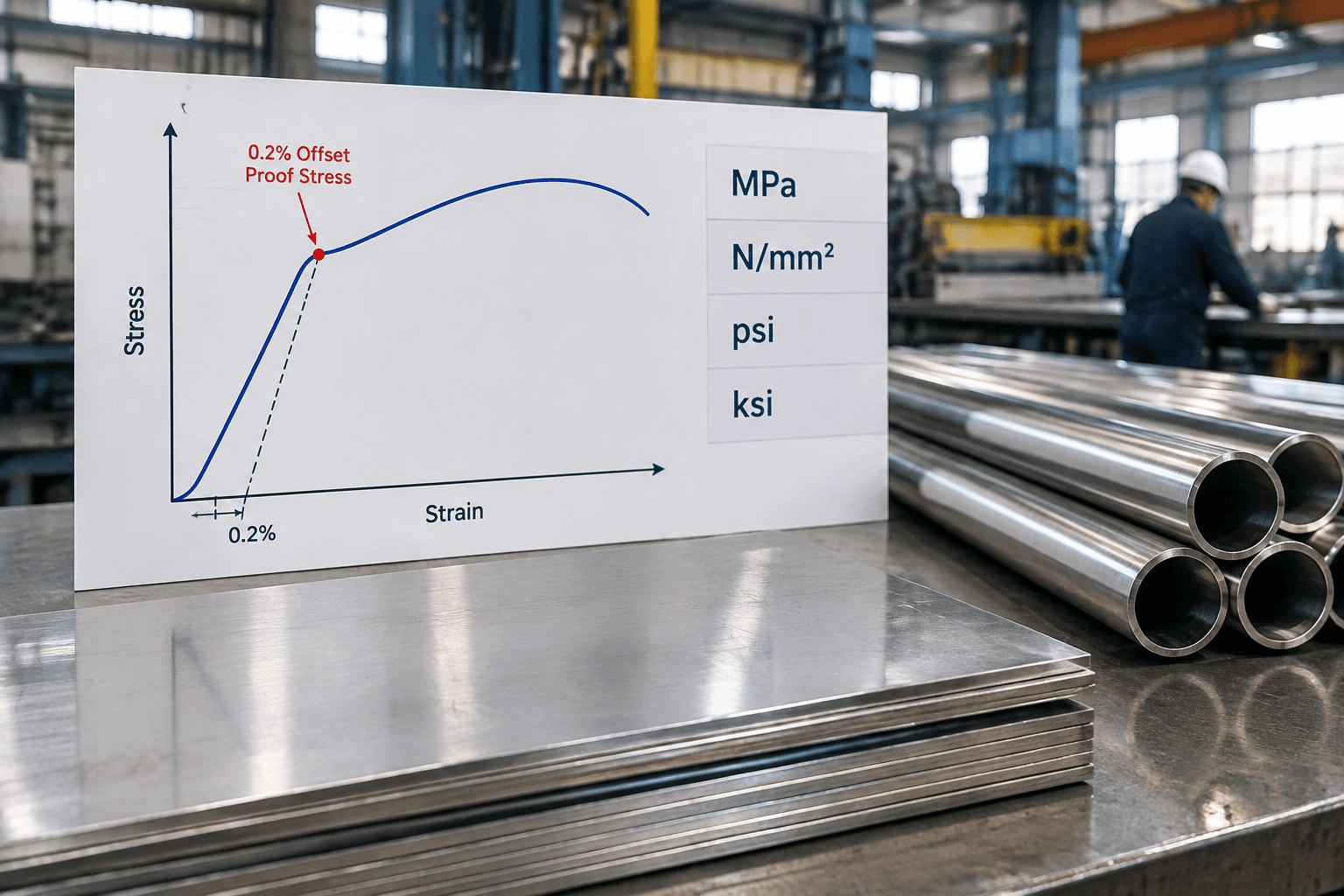
The specified minimum room-temperature yield strength of ASTM A240/A240M Type 316 stainless steel plate, sheet, and strip is 205 MPa, equal to 205 N/mm² and approximately 29,733 psi or 29.7 ksi. ASTM presents the corresponding inch-pound requirement as 30 ksi; the applicable value still depends on product form, dimensions, supplied condition, temperature, specification edition, and whether the figure is a minimum or a typical result.
| Grade | Published requirement | Converted value | Value status | Applicable basis |
|---|---|---|---|---|
| 316 | 205 MPa / 30 ksi | 205 N/mm² / 29,733 psi / 29.7 ksi | Specified minimum | Room-temperature yield strength for plate, sheet, and strip covered by ASTM A240/A240M; material must meet the specification’s applicable heat-treatment, dimensional, and testing requirements |
MPa and N/mm² are numerically identical because 1 MPa equals 1 N/mm². The small difference between the exact conversion of 205 MPa, which is 29.7 ksi, and the published 30 ksi value results from ASTM’s independently stated SI and inch-pound requirements. Do not use that rounding difference to reject material; apply the unit system designated by the purchase specification.
316 Yield Strength Lookup: Match the Number to Its Basis
A yield-strength number is useful only when its scope travels with it. For the direct answer above, the authoritative basis is the mechanical-property table in ASTM A240/A240M, the specification for chromium and chromium-nickel stainless steel plate, sheet, and strip for pressure vessels and general applications. The current edition and any project-specific amendments should be checked before ordering.
| Entry | Product form | Thickness or size | Condition | Temperature | Strength definition | Status and source |
|---|---|---|---|---|---|---|
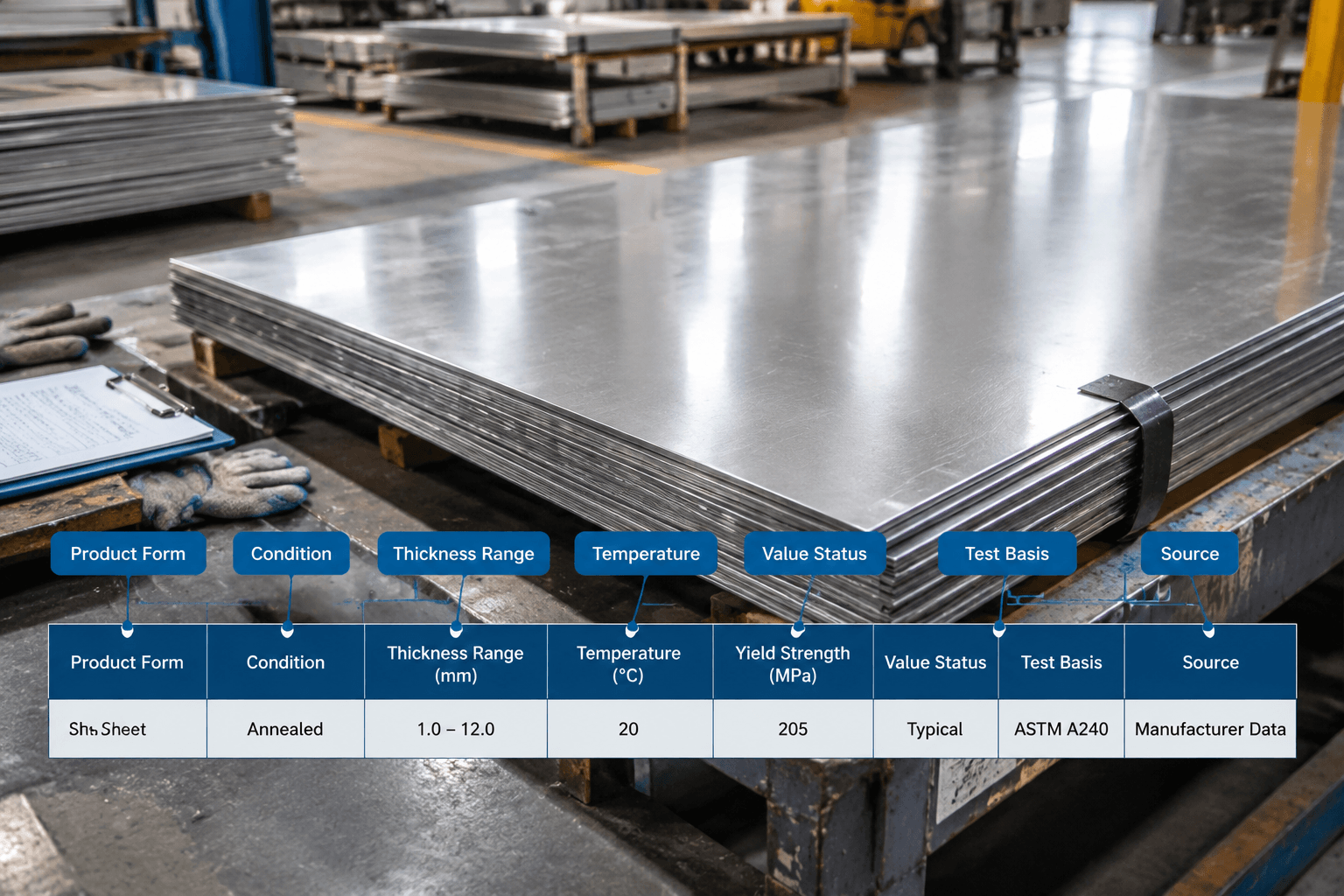
| 205 MPa; 205 N/mm²; approximately 29,733 psi; 29.7 ksi | Plate, sheet, or strip | Only dimensions within the scope and applicable tables of the specified ASTM A240/A240M edition | Heat-treated condition required by the specification | Room-temperature test basis | Yield strength reported under the specification’s referenced mechanical-test requirements | Specified minimum; ASTM A240/A240M Type 316 |
| 30 ksi; 30,000 psi | Plate, sheet, or strip | Same scope qualification as above | Same as above | Room-temperature test basis | Yield strength | Specified minimum stated in the inch-pound column; ASTM A240/A240M Type 316 |
| Any value described only as typical | Must be identified | Must be identified | Must be identified | Must be identified | 0.2% proof stress, yield strength, or another definition must be stated | Informational until its original producer datasheet or test report is identified; not a guaranteed ASTM minimum |
| Any elevated-temperature value | Must match the ordered product | Must match the source range | Must match the source condition | Exact test temperature required | Measured yield, proof stress, or design allowable must be distinguished | Do not substitute for the room-temperature ASTM minimum without a governing source |
The table intentionally does not assign one value to bar, tube, pipe, wire, forgings, castings, or cold-worked products. Those forms are governed by different specifications and may have different minimums, conditions, sampling rules, and dimensions. A bar datasheet therefore cannot automatically qualify sheet used in a fabricated enclosure, even when both products are marked 316.
Why Published 316 Values Do Not Always Agree
Search results commonly place 205 MPa beside higher figures without explaining that they represent different kinds of data. Several variables can account for the apparent conflict.
| Variable | How it changes interpretation | What to verify |
|---|---|---|
| Product form | Sheet, plate, bar, tube, pipe, wire, forgings, and castings have separate manufacturing routes and specification requirements. | The exact product specification named on the purchase order and material certificate. |
| Thickness or diameter | Some standards divide minimum properties by dimensional range. Test-specimen orientation and location may also differ. | The range containing the ordered thickness, wall thickness, or diameter. |
| Supplied condition | Annealed material and intentionally cold-worked material are not mechanically interchangeable. Cold work can raise yield strength while reducing ductility and changing forming behavior. | Condition designation, heat-treatment requirement, and whether increased strength is guaranteed. |
| Value status | A specified minimum is an acceptance threshold. A typical value is descriptive data and may be an average, representative result, or historical value. | Words such as minimum, typical, nominal, average, or actual tested. |
| Yield definition | Austenitic stainless steel does not always show a sharp yield point, so proof or offset methods are commonly used. | Whether the source reports yield strength, 0.2% proof stress, Rp0.2, or another offset. |
| Temperature and test basis | Room-temperature results cannot be assumed at elevated temperature. Test method, specimen geometry, orientation, and strain rate can also affect reported results. | Temperature, referenced test requirements, and source revision. |
Fabrication adds another layer. Bending produces localized cold work, while welding creates a heat-affected region and residual stress. These effects do not justify replacing the certified base-material minimum with an assumed stronger value. They may influence springback, distortion, assembly fit, and engineering analysis, but finished-part capacity requires geometry, load direction, joints, stress concentration, fatigue, temperature, and an appropriate safety basis—not yield strength alone.
Interpreting 316 Yield Strength at Elevated Temperature
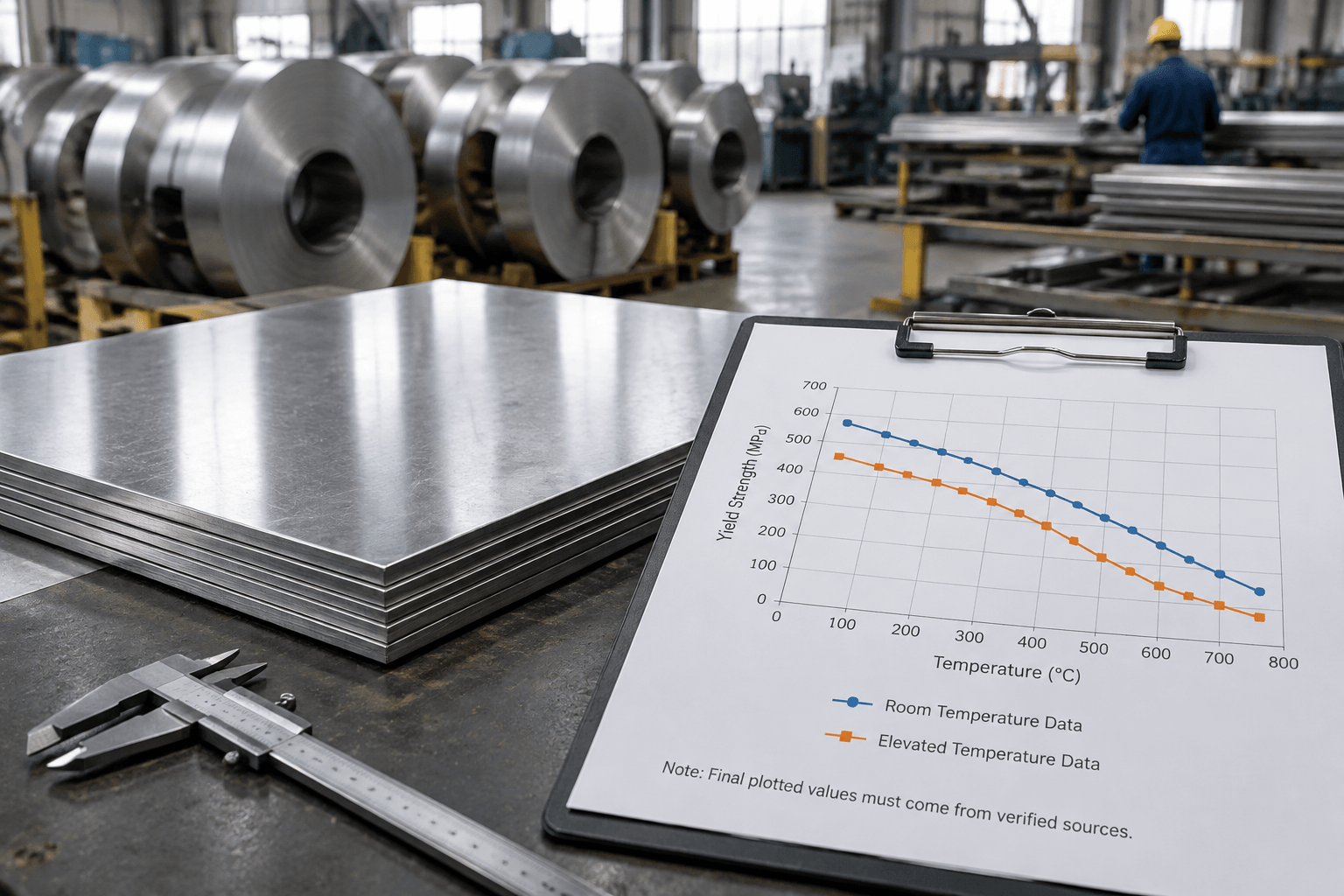
As temperature rises, the proof strength of annealed 316 generally decreases, but there is no responsible single temperature curve for every 316 product. Elevated-temperature tables may represent minimum proof stress, short-time tensile-test data, time-dependent design values, or code allowables. These categories answer different questions and must not be mixed.
| Temperature-data category | Meaning | Correct use |
|---|---|---|
| Room-temperature ASTM A240/A240M minimum: 205 MPa / 30 ksi | Procurement acceptance requirement for the covered 316 flat products | Room-temperature material ordering and certificate review within the specification’s scope |
| Elevated-temperature 0.2% proof stress | Stress producing a defined permanent strain at a stated test temperature | Use only with the stated grade, form, condition, dimensions, test basis, and temperature |
| Typical short-time test result | Representative measured behavior rather than a guaranteed minimum | Preliminary comparison or engineering research, not automatic purchasing acceptance |
| Design allowable stress | A value established by a design code using its own rules and reductions | Code design under that code; it is not the same as measured yield strength |
| Creep or stress-rupture data | Time-dependent behavior under prolonged temperature and load | Long-duration high-temperature evaluation, not a substitute for room-temperature yield |
A project needing numerical values above room temperature should identify the governing design code or source first, then select the table for the exact 316 product and condition. The source’s temperature increments, interpolation rules, revision, and time basis must remain attached to the numbers. Quoting an elevated-temperature figure without these details can make a technically correct number incorrect for the application.
Is 316 Stronger Than 304 or 316L?
Not necessarily. Under like-for-like ASTM A240/A240M room-temperature requirements for plate, sheet, and strip, Type 304 and Type 316 have the same specified minimum yield strength. Type 316L has a lower listed minimum in this particular comparison.
| Grade | Minimum yield strength | Equivalent units | Controlled comparison basis |
|---|---|---|---|
| 304 | 205 MPa / 30 ksi | 205 N/mm²; approximately 29,733 psi | ASTM A240/A240M flat product, room-temperature requirement |
| 316 | 205 MPa / 30 ksi | 205 N/mm²; approximately 29,733 psi | ASTM A240/A240M flat product, room-temperature requirement |
| 316L | 170 MPa / 25 ksi | 170 N/mm²; approximately 24,656 psi or 24.7 ksi | ASTM A240/A240M flat product, room-temperature requirement |
This does not mean every tested 316 sheet is stronger than every tested 316L sheet. Actual results can exceed the minimum, and overlapping results are possible. Nor does the comparison make 316 and 304 interchangeable: chemistry, corrosion environment, fabrication route, welding requirements, and applicable material standard still matter.
The L in 316L identifies a low-carbon version; it does not stand for low strength. If a project requires 316L for welding or corrosion-related reasons but also requires a higher guaranteed yield strength, that requirement must be supported by an appropriate product specification and condition. It should not be inferred from an unrelated typical-properties PDF.
Writing a Verifiable 316 Material Requirement
An unambiguous requirement combines material identity with the basis on which strength will be accepted. A useful drawing note or purchase clause can be structured as follows:
Material: Type 316 stainless steel sheet, [thickness], supplied in the condition required by [governing material specification and edition]. Minimum room-temperature yield strength: [value and designated unit system], verified by the material documentation required on the purchase order. Any elevated-temperature property is for engineering review only unless its governing source, temperature, value type, and acceptance requirement are stated separately.
Each bracketed field performs a different job. The grade controls material identity; sheet identifies the product form; thickness connects the order to the correct dimensional range; condition prevents annealed and cold-worked products from being treated as equivalent; and the specification establishes testing and acceptance rules. The documentation clause should state whether a certificate of compliance, material test report, heat or lot traceability, or independent testing is required.
For load-bearing custom metal brackets, strength data should be reviewed together with thickness, bend direction, bend radius, hole position, weld details, load path, and inspection requirements. For custom stainless sheet metal enclosures, the same material definition also supports consistent bending, springback control, tolerances, and assembly fit.
Frequently Asked Questions
Are MPa and N/mm² equivalent when reporting 316 yield strength?
Yes. One megapascal equals one newton per square millimetre, so 205 MPa is exactly 205 N/mm². It converts to approximately 29,733 psi or 29.7 ksi. A standard may publish 30 ksi as the paired inch-pound requirement because independently stated unit systems use rounded values.
What is the difference between 304 and 316 yield strength under like-for-like conditions?
For ASTM A240/A240M plate, sheet, and strip at room temperature, both Type 304 and Type 316 have a specified minimum yield strength of 205 MPa or 30 ksi. Different products, conditions, specifications, or typical test data may produce a different comparison.
Which has higher yield strength, 316 or 316L?
In the ASTM A240/A240M flat-product comparison, 316 has a 205 MPa minimum while 316L has a 170 MPa minimum. That is a comparison of specification thresholds, not proof that every individual 316 product will test higher than every 316L product.
Can a generic 316 properties PDF be used as a guaranteed design or purchasing value?
No, not unless the document identifies the applicable product form, size range, condition, temperature, strength definition, governing specification, and minimum status. Typical datasheet values are useful references but are not automatically guaranteed procurement minimums or design allowables.