
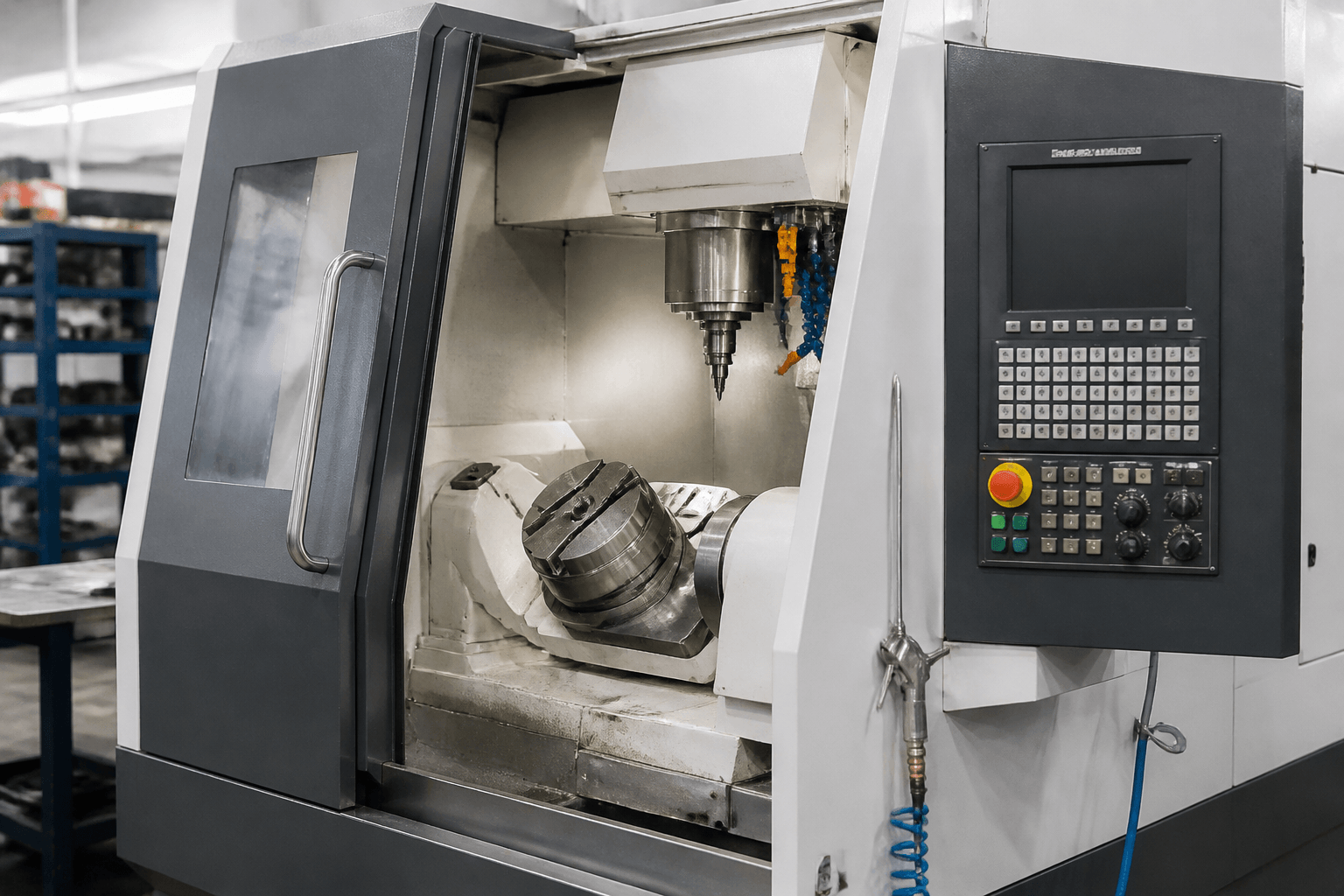
Short answer: A 5 axis small CNC machine is a compact machining system that combines limited physical space with integrated linear and rotary motion. However, the number of axes alone does not establish what the machine can actually produce. The required part geometry, usable work envelope, rotary-axis arrangement, spindle and structure, controller, CAM workflow, workholding, and complete ownership cost determine whether a compact 5-axis machine is worthwhile.
For some parts, 5-axis motion can reduce setups and improve access to angled or complex surfaces. For others, a 3-axis machine with suitable workholding, an indexed rotary setup, or an outsourced machining route may be more practical. The correct decision starts with the part and its process requirements rather than with the smallest advertised footprint or lowest machine price.
What Counts as a Small 5-Axis CNC Machine?
“Small” usually describes the machine’s physical footprint, work envelope, and intended work volume, not a universal size category. A compact machine may fit in a limited workshop area and accept relatively small workpieces, but the available space for the part is always less than the outside dimensions of the enclosure. Rotary hardware, the spindle, fixtures, tool clearance, chip evacuation, and operator access all affect usable capacity.
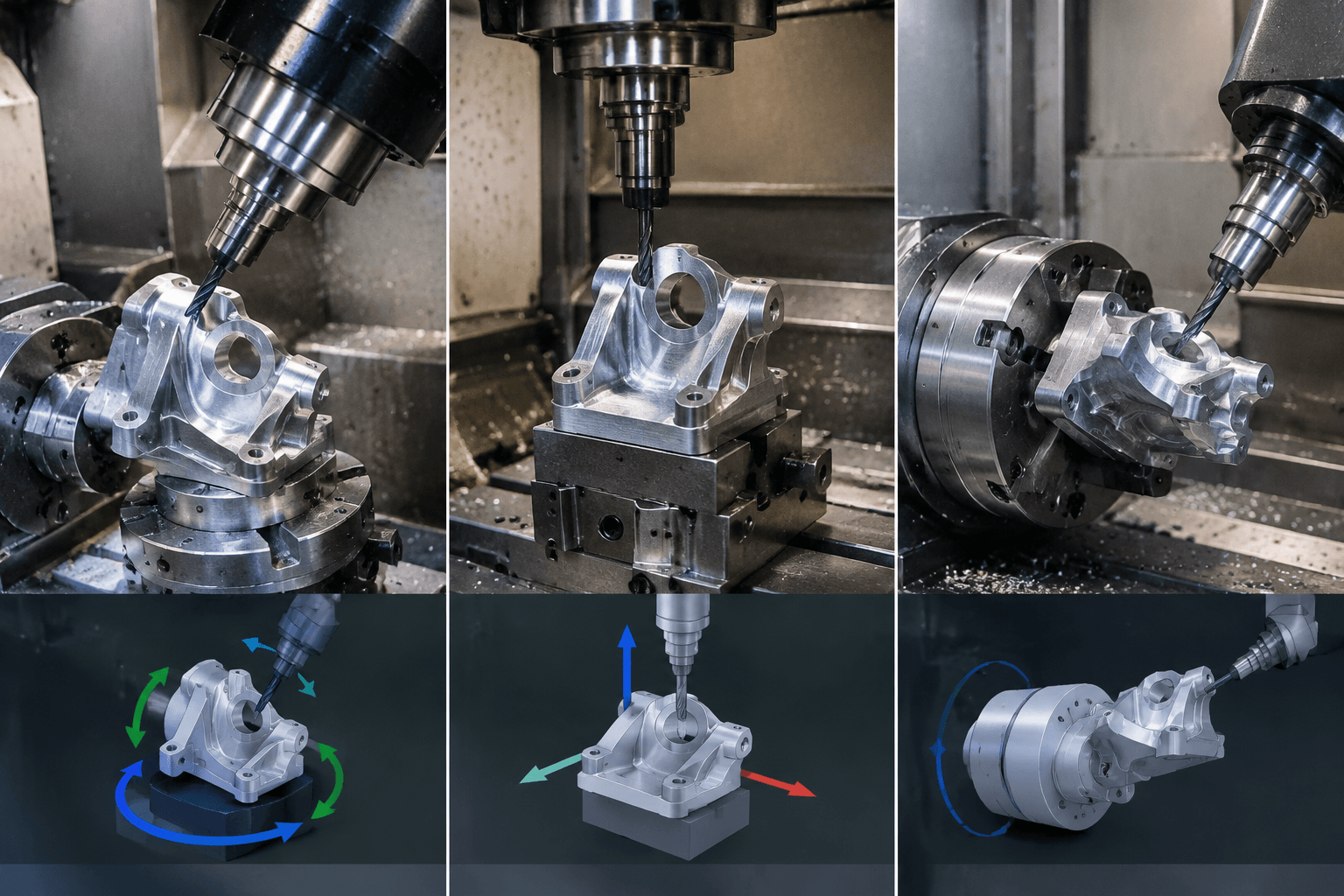
A 5-axis machine normally combines three linear axes with two rotary axes. The linear axes move the cutting tool or workpiece along three directions. The rotary axes tilt or turn the workpiece, spindle, or both, depending on the machine architecture. These axes can be used in different ways:
| Workflow | How motion is used | Typical reason to consider it |
|---|---|---|
| Simultaneous 5-axis machining | Linear and rotary axes coordinate during cutting, allowing the tool orientation and position to change continuously. | Contoured surfaces, difficult tool access, or geometry that requires changing tool orientation along the cut. |
| Indexed 3+2 machining | Rotary axes position the workpiece or tool, then stop while the three linear axes perform the cutting operation. | Multiple angled faces, holes on different orientations, or fewer setups without continuous rotary motion. |
| 4-axis or rotary-axis machining | A rotary axis may index between operations or rotate during cutting, depending on the machine configuration and programmed strategy. | Cylindrical features, repeated radial details, or features arranged around an axis. |
| 3-axis machining | Three linear axes perform the cutting while the workpiece remains in a fixed orientation for each setup. | Parts whose surfaces and features can be reached with conventional setups. |
This distinction matters because a machine may be described as 5-axis while the intended workflow uses only indexed positioning. That can still be valuable, but it is different from continuous simultaneous machining. The controller, rotary-axis drives, CAM software, post-processor, machine kinematics, and operator workflow must all support the motion being requested.
Axis Count Is Not the Same as Usable Capability
Theoretical axis count is only one part of the system. A machine can have five programmed axes but still be a poor fit for a particular part if the rotary table occupies too much of the work area, the spindle cannot reach a required surface, or the enclosure does not provide enough clearance at a tilted angle.
Evaluate the usable work envelope in the configurations that matter for the part. Check the space remaining after installing the rotary hardware and workholding. Consider the maximum part height, the distance between the spindle and fixture, tool length, collision risk, and access for loading and unloading. A compact envelope may be useful for small components, but compactness can involve tradeoffs in rigidity, clearance, access, and flexibility.
Also separate positioning a part from cutting it effectively. A rotary axis may reach an orientation in simulation, yet the spindle, tool holder, fixture, or enclosure may prevent the intended cut. CAM verification and machine-specific post-processing are therefore part of capability assessment, not optional details added after the machine is selected.
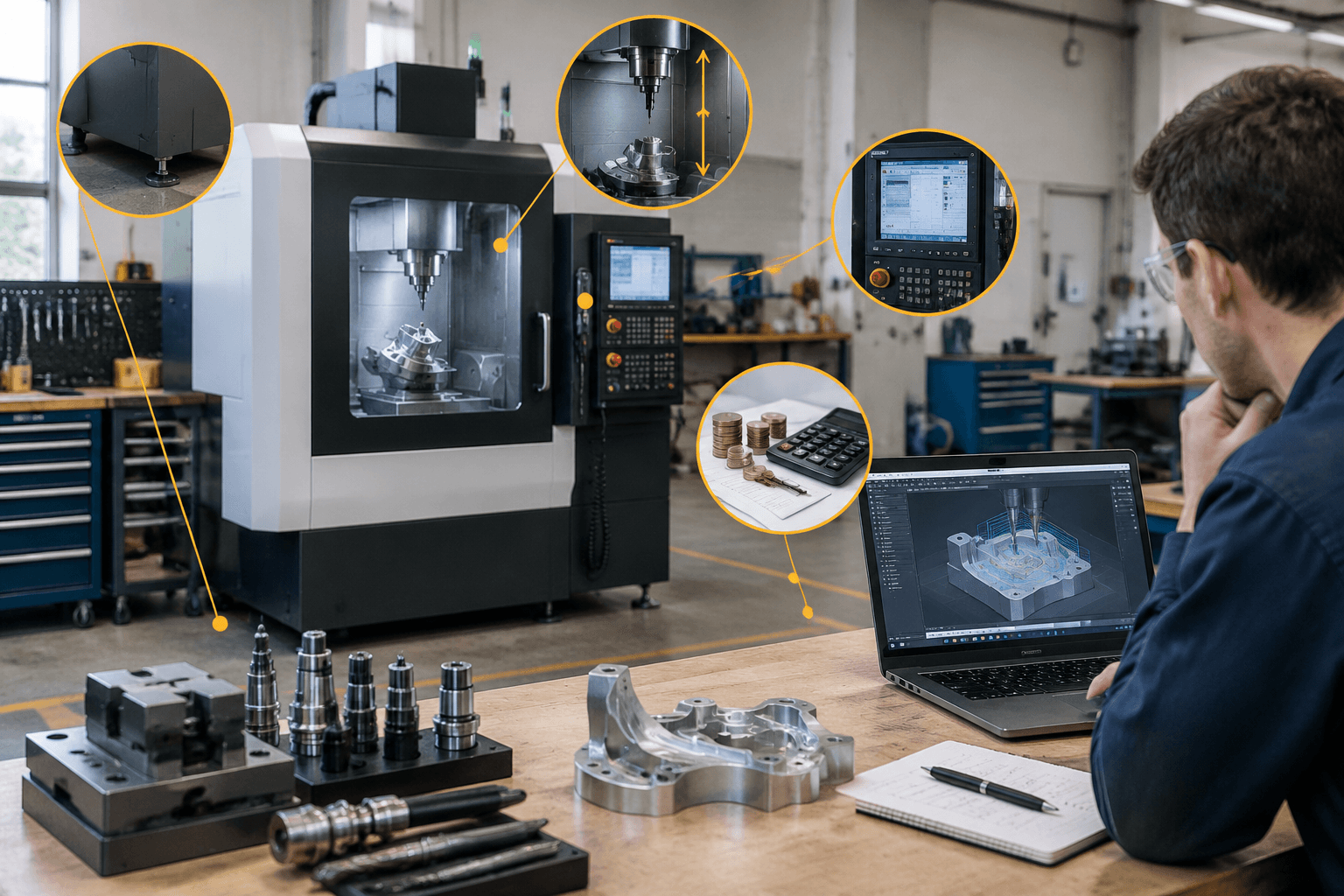
How to Evaluate a Small 5-Axis CNC Machine
Usable travel, clearance, and rotary integration
Start with the part envelope, not the machine’s advertised outside dimensions. Identify the largest finished part, the stock size, the fixture envelope, and the tool access needed at each orientation. Ask how the rotary axis is integrated: is it a table, a trunnion-style arrangement, a head configuration, or another design? Each arrangement affects loading, clearance, workholding, and how much space remains for the part.
Rotary integration also affects setup repeatability and programming. Determine how the work coordinate system is established, how the part is located, and whether the intended workflow requires repositioning or multiple fixtures. These questions are more useful than simply confirming that a fifth axis exists.
Spindle and structural behavior
The spindle must suit the tools, material, cutting strategy, and surface access required by the work. Review the available spindle characteristics, tool interface, speed range, cooling arrangement, and tool-changing approach as applicable to the intended machine. Do not treat a nominal spindle specification as proof that the system will handle every material or cutting condition.
Rigidity is equally important. A small frame, extended tool, tall fixture, or tilted rotary position can change the cutting behavior substantially. For demanding work, assess the complete load path from the tool through the spindle, structure, rotary axis, fixture, and workpiece. A smaller machine can be appropriate for light-duty work or prototypes while being a poor match for heavy cuts, difficult materials, or sustained production without verified evidence that it meets those requirements.
Controller, CAM, and post-processor workflow
Five-axis machining depends on more than CAD geometry. The CAM system must create the required toolpaths, the post-processor must translate them for the specific machine kinematics, and the controller must execute the programmed motion correctly. Confirm these interfaces before purchase or upgrade.
For indexed 3+2 work, the workflow may be relatively straightforward compared with continuous simultaneous motion, but it still requires correct rotary-axis definitions, work offsets, tool orientation, and collision checking. Simultaneous machining adds further requirements for tool-axis control, singularity management, simulation, and verification. The exact features available depend on the selected software and configuration, so they should be verified rather than assumed from the phrase “5-axis.”
Workholding, chip management, and serviceability
Workholding must keep the part secure while leaving the required faces accessible. A fixture that works for one orientation may block another, interfere with the tool, or reduce the available travel. Consider locating strategy, clamping access, repeat loading, fixture changes, and how the part will be removed without damage.
Chip management and coolant access become especially important when the workpiece is tilted or enclosed by rotary hardware. Chips can collect around fixtures and moving components, while restricted access can make cleaning and inspection more time-consuming. Review routine maintenance, lubrication, access to service parts, troubleshooting support, documentation, and the practical skill required to keep the system operating.
Does the Part Need Five Axes?
Classify the part before comparing machines. The key questions are whether the geometry requires changing tool orientation during a cut, whether several faces must be reached without re-fixturing, whether a rotary axis is needed for cylindrical features, and whether the expected quantity justifies the additional setup and programming complexity.
| Part situation | Likely process question | Initial direction |
|---|---|---|
| Flat faces, pockets, holes, and accessible edges | Can all required features be reached with a fixed setup or a small number of conventional setups? | Compare a 3-axis process before assuming 5-axis capability is needed. |
| Several angled faces or holes on different sides | Can the rotary axes position the part and then stop for cutting? | Indexed 3+2 or a suitable rotary workflow may be sufficient. |
| Deep access around a shaped surface | Must the tool orientation change continuously to maintain access or avoid interference? | Investigate simultaneous 5-axis machining and verify the CAM and post-processor path. |
| Cylindrical or radial features | Does the part need continuous rotation, indexed positions, or only conventional setups? | Compare a rotary-axis workflow with other suitable machining arrangements. |
| Large, heavy, or structurally demanding workpiece | Can the compact machine provide enough clearance, support, rigidity, and loading access? | Do not infer suitability from axis count; compare the complete machine envelope and process load. |
| Prototype or low-volume component | Will fewer setups offset programming, fixturing, and learning time? | Consider 5-axis access when it removes meaningful process complexity, but include the operator workload. |
| Repeated small-batch production | Can the fixture, program, inspection approach, and chip-management routine be repeated consistently? | Evaluate repeatable workflow and serviceability, not only initial purchase cost. |
A drawing-driven component such as a custom metal bracket should be evaluated by its actual faces, holes, material, quantity, tolerance requirements, and access directions before deciding that in-house 5-axis machining is necessary. Adding axes does not automatically improve every machining task. It can reduce setups or open access to difficult surfaces, but it can also add programming, fixture, maintenance, and verification requirements.
Compare Complete Ownership Cost, Not Just Machine Price
A meaningful comparison includes the full system required to produce acceptable parts. The machine is only one cost category. Include rotary hardware if it is not integrated, tooling, holders, workholding, CAM software, post-processing, installation, electrical or facility preparation, training, maintenance, consumables, inspection equipment, and the time needed to develop a reliable process.
| Cost category | Questions to include |
|---|---|
| Machine and rotary hardware | What motion, envelope, fixtures, and accessories are included, and what must be added? |
| Tooling and workholding | Which tools, holders, fixtures, locating components, and replacement items are needed for the intended parts? |
| Software and programming | Does the CAM and post-processing workflow support the required indexed or simultaneous motion? |
| Installation and learning | What setup, commissioning, training, programming, and verification time will be required? |
| Maintenance and support | How will routine service, troubleshooting, spare parts, and technical support be handled? |
| Production time | How much time is spent loading, probing, fixturing, programming, verifying, cleaning, and removing chips? |
For some users, upgrading an existing 3-axis machine or adding a suitable rotary workflow may solve the actual access problem. For others, buying a compact 5-axis system may make sense when repeated setups, complex access, or simultaneous tool orientation are central to the work. Outsourcing can also be rational when demand is uncertain, the required capability is occasional, or the complete ownership burden is greater than the expected internal benefit.
Sheet metal enclosure production is a separate fabrication category and should not automatically be treated as a 5-axis milling application. A custom sheet metal enclosure should be assessed according to its own drawing, material, geometry, quantity, and fabrication requirements rather than assigned to a machining route because its shape appears complex.
Selection Guidance
Before comparing a 5 axis small CNC machine with another machine or an outsourced route, document the part’s approximate dimensions, stock condition, material, required faces, access directions, tolerances, surface expectations, batch size, and expected repeat frequency. Mark which features require continuous tool-axis movement and which can be handled through indexed positioning or separate setups.
Then verify the machine-specific work envelope with the actual rotary hardware and fixture installed. Confirm the CAM, post-processor, controller, collision-checking, tooling, service, and maintenance requirements. A compact system is a good fit only when its complete workflow can produce the required part consistently within the available space, time, skill, and budget.
For a manufacturing-fit discussion, provide part drawings or CAD files, material and approximate dimensions, required features, tolerances, surface expectations, and prototype or production quantity. That information helps determine whether the part is better suited to a compact in-house machine, an upgraded setup, or an outsourced custom manufacturing route.
Where RFQ Assumptions Create Cost and Production Risk
Many sheet metal fabrication problems begin before production starts. If drawings, tolerances, finish expectations, material grades, or assembly requirements are unclear, suppliers may quote based on different assumptions. That can make prices difficult to compare and may lead to rework, cosmetic rejection, assembly misalignment, or production delays later.
For OEM buyers, the goal is not simply to request the lowest price. The goal is to make sure each supplier is quoting the same manufacturing reality. Before confirming an order, clarify which dimensions are fit-critical, which surfaces are cosmetic, whether prototypes must match batch-production conditions, and how finished parts will be inspected.
Frequently Asked Questions
What hole alignment details should buyers define before requesting a quote?
Buyers should define the functional requirement, drawing notes, critical dimensions, material or process expectations, and any inspection points related to hole alignment. This helps suppliers quote the same manufacturing scope instead of making different assumptions.
How can tolerance stack affect cost, fit, or lead time?
tolerance stack can change tooling, forming, welding, finishing, inspection, or rework requirements. If buyers do not clarify it early, two supplier quotes may look comparable while covering different production risks.
Why should mating parts be reviewed before prototype approval?
mating parts may look acceptable on a single sample but become harder to control during batch production. Buyers should confirm whether the prototype reflects the same process, finish, and inspection conditions expected for production.
What inspection points matter most for 5 axis small cnc machine projects?
Important inspection points usually include fit-critical dimensions, holes or mating areas, cosmetic surfaces, finish build-up, welded or formed features, and any dimensions that affect downstream assembly. These points should appear in the RFQ or drawing notes.
How can buyers reduce fit-up inspection risk before batch production?
Buyers can reduce risk by clarifying drawings, locking key material and finish assumptions, defining inspection timing, approving a representative sample, and confirming which dimensions or surfaces require tighter process control.
How can Yishang help review 5 axis small cnc machine requirements?
Yishang can review drawings, RFQ notes, material requirements, tolerance expectations, finish details, samples, and assembly needs to identify unclear assumptions before quoting or batch production.