
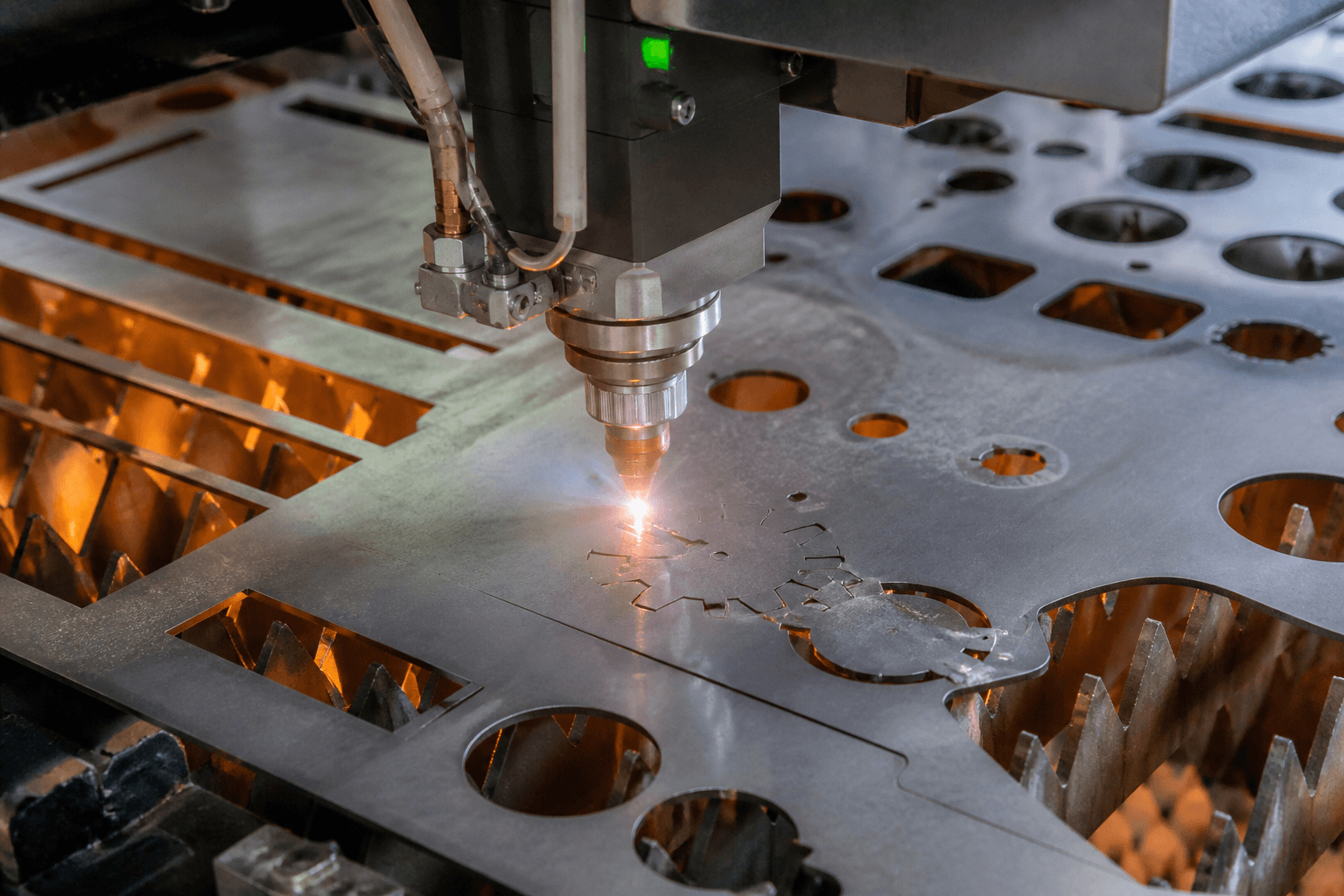
The main advantages of laser cutting are detailed geometry, narrow kerf potential, repeatable digital toolpaths, limited physical tooling, efficient sheet nesting, and rapid changeovers between designs. These benefits are strongest when the material, thickness, part geometry, laser source, assist gas, focus, speed, and downstream edge requirements are matched to the application.
Laser cutting can simplify the production of custom metal components, but it is not automatically the fastest, cheapest, or most accurate choice for every part. Buyers should evaluate its advantages against finished-part requirements rather than judging the process only by machine capability or cutting speed.
How the Laser-Cutting Process Creates Its Advantages
Laser cutting is a non-contact thermal cutting process. A focused beam delivers concentrated energy along a programmed path, while machine motion controls the position of the cutting head or workpiece. Assist gas may help remove molten material, manage the cutting reaction, and influence the resulting edge condition.
The path normally begins with a CAD drawing and is prepared through CAM or nesting software before being translated into G-code or another machine-readable format. Because the profile is controlled digitally, manufacturers can move from an outside contour to holes, slots, lettering, ventilation patterns, or other internal features without producing a separate punch, die, or cutting template for every shape.
Non-contact cutting also means that no conventional blade or tool edge is pressing directly against the sheet. This reduces cutting-tool contact and removes some tool-access restrictions, although heat input, beam access, feature spacing, and material behavior still limit what can be produced reliably.
Laser cutting should not be confused with laser engraving or marking. Cutting separates material through its thickness. Engraving removes material to create a shallow recess, while marking changes or treats the surface to produce identification or contrast without necessarily creating meaningful depth.
Which Advantages Matter for Custom Metal Parts?
The practical value of laser cutting depends on the part. A decorative panel, mounting bracket, enclosure blank, and welded frame component may use the same basic process, but each places different demands on geometry, dimensions, appearance, and downstream fabrication.
| Laser-cutting advantage | Where it helps | What must still be checked |
|---|---|---|
| Detailed digital profiles | Internal cutouts, lettering, curved contours, ventilation patterns, and irregular outlines can be produced directly from drawing data. This is useful for products such as laser-cut metal signage, where visual geometry is part of the design. | Small features, sharp corners, narrow bridges, and closely spaced cuts must suit the material and thickness. |
| Narrow kerf potential | A controlled cut width can preserve material between adjacent profiles and support efficient nesting. | Kerf is not a universal fixed value. It changes with the complete cutting setup and must be compensated for in the toolpath. |
| Repeatable toolpaths | Once the program and process are stable, repeated parts follow the same programmed geometry. | Finished-part consistency also depends on sheet condition, focus, gas delivery, heat accumulation, machine condition, and inspection control. |
| Limited physical tooling | Custom profiles may be introduced without dedicated dies, molds, or profile-specific blades. | Programming, setup, material handling, nozzles, gases, maintenance, and equipment costs remain part of production. |
| Rapid design changeovers | Revised CAD data can support prototypes, mixed products, and changing order configurations without rebuilding hard tooling. | Each revision still needs manufacturability review, program validation, and drawing control. |
These characteristics are especially relevant when a project contains several part numbers or frequent design revisions. They do not mean that design freedom is unlimited. Every geometry must still leave enough material to cut, handle, form, weld, finish, and assemble the part without unacceptable damage or variation.
Kerf, Heat, and Finished-Part Dimensions
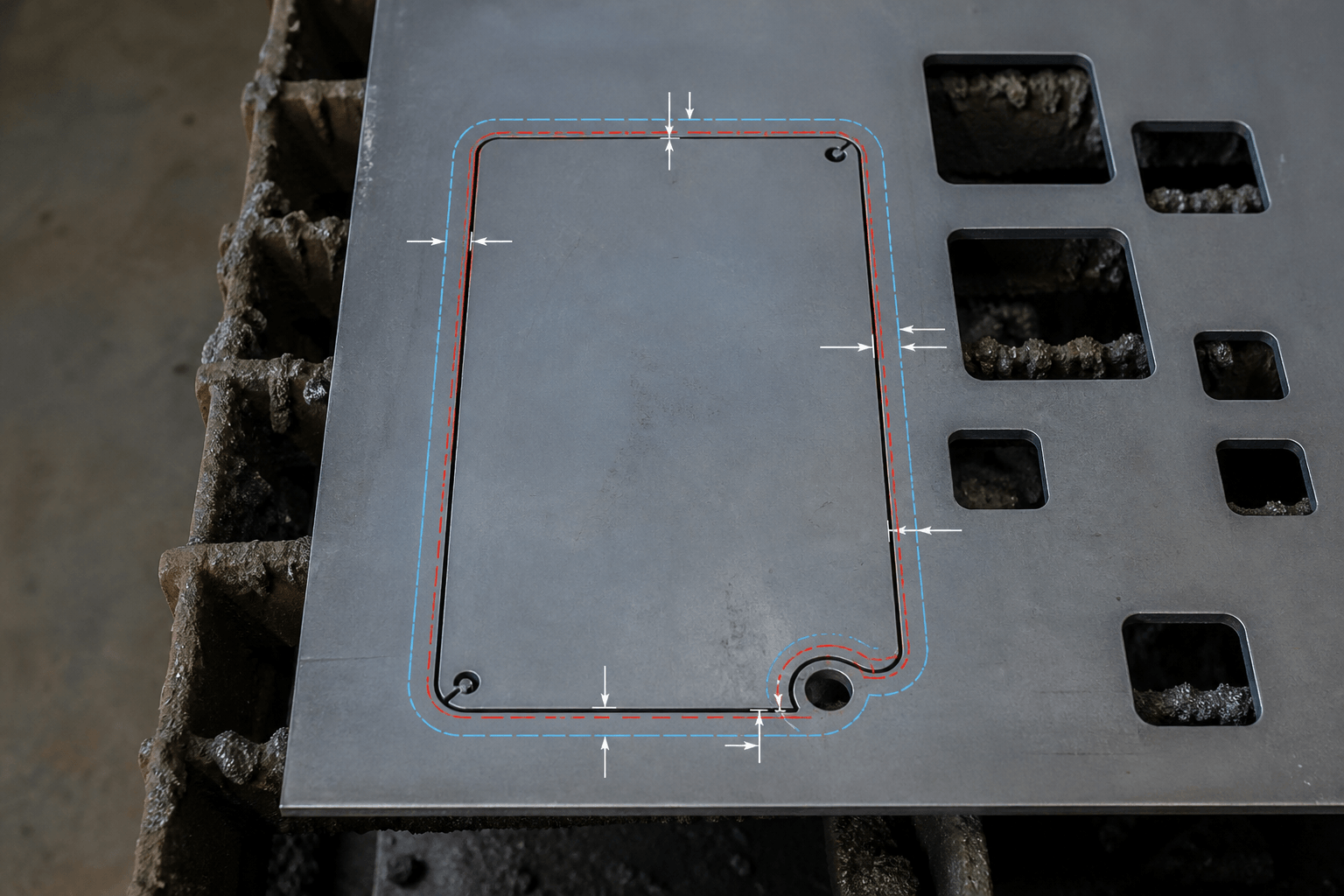
Kerf is the width of material removed by the cutting process. Imagine a programmed line running through the center of a cut. If the laser followed that line without compensation, the finished edge would be offset by part of the kerf width. CAM software therefore offsets the toolpath to place the final edge where the drawing requires it.
This compensation affects outside profiles, hole dimensions, slot widths, spacing between nearby features, and the amount of material required between nested parts. Kerf that is wider, narrower, tapered, or inconsistent can change the finished geometry even when the machine follows its commanded path correctly.
Dimensional results depend on more than the positioning capability stated for a machine. Material type and thickness influence energy absorption and heat flow. Focus position, beam condition, cutting speed, power, assist-gas type and pressure, nozzle alignment, sheet flatness, pierce strategy, and feature sequence can also affect the cut. Small holes and narrow slots may behave differently from large outside contours, while repeated cuts in one area can concentrate heat.
This distinction matters for components such as custom metal brackets. A visually acceptable blank may still fail to assemble if mounting holes, slots, bend references, or mating edges do not meet the drawing. Critical dimensions and their tolerances should therefore be identified explicitly instead of relying on a general shop tolerance or an assumed laser capability.
How Drawing Features Influence Laser-Cutting Results
A drawing review should connect each feature with its functional purpose and the likely behavior of the cutting process.
- Holes: Hole size relative to material thickness can affect roundness, taper, and edge condition. Assembly-critical holes may need inspection or a later machining operation, depending on their tolerance and function.
- Narrow slots: Very narrow openings can concentrate heat and may not clear material consistently. Slot width should be reviewed together with thickness, orientation, and required fit.
- Closely spaced features: Limited material between cuts may overheat, distort, or become fragile during handling. Spacing also affects nesting and scrap removal.
- Sharp internal corners: The beam has a finite cutting width, so a perfectly sharp internal corner is not always realistic. Corner relief or a permitted radius may be necessary for mating parts.
- Long, thin profiles: Slender parts can move after cutting because of residual stress, heat input, or reduced support in the sheet skeleton.
- Critical dimensions: Dimensions controlling bends, inserts, welding fixtures, hardware, or final assembly should be marked with appropriate tolerances and inspection expectations.
Cut geometry must also account for later operations. On custom sheet metal enclosures, for example, cutouts near bend lines, tabs, corner joints, and hardware locations interact with forming and assembly. A suitable flat pattern considers the complete fabrication sequence rather than treating the laser-cut blank as an isolated product.
Edge Quality and Secondary Work
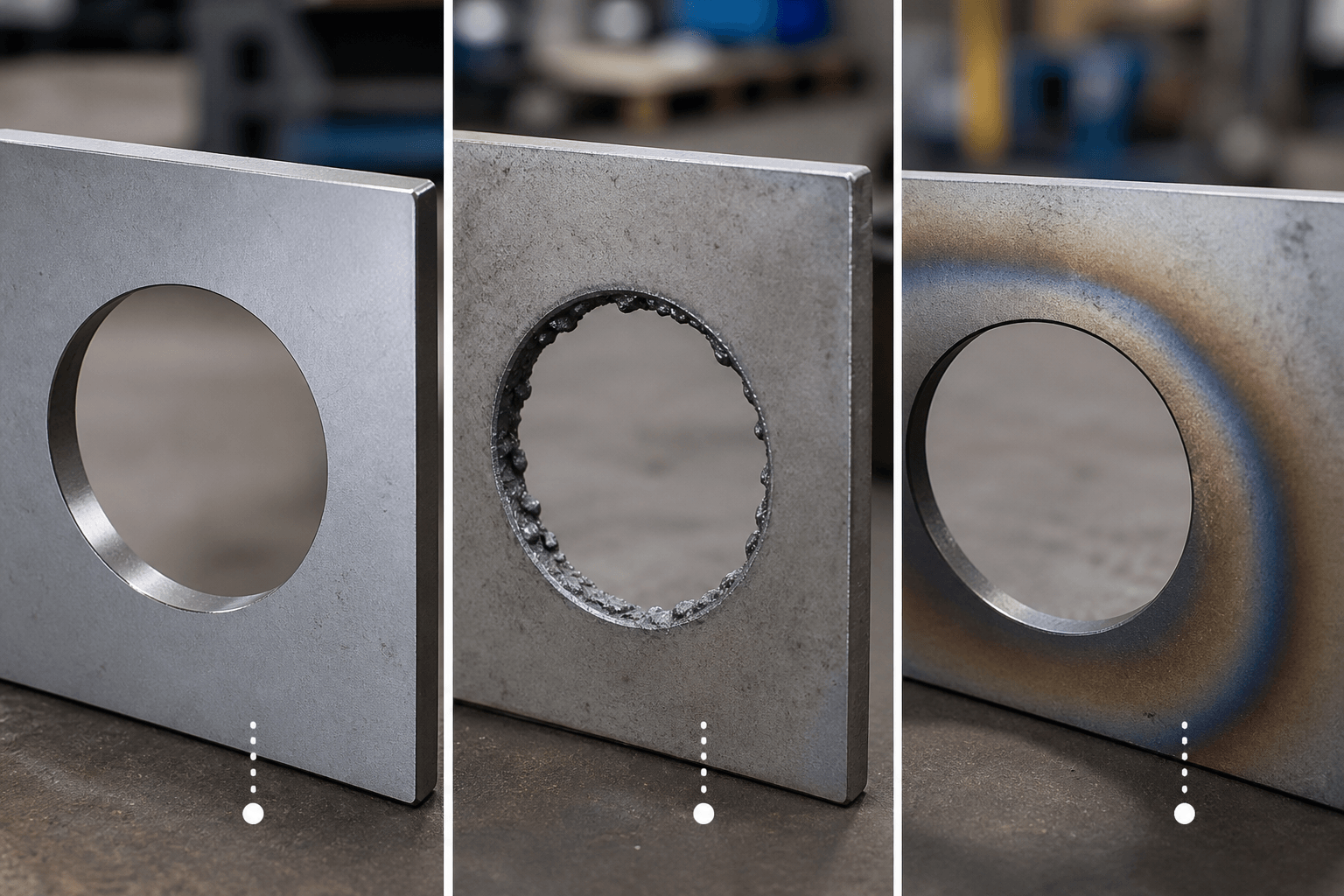
A laser-cut edge can be suitable for immediate use in some applications, but “laser cut” does not automatically mean “finished.” Edge quality describes several conditions, including cut smoothness, taper, attached material, burrs, oxidation, heat-related discoloration, and consistency through the material thickness.
- Dross or attached burr: Molten material may remain on the lower edge if it is not fully expelled. Mechanical removal may be required before coating, welding, handling, or assembly.
- Oxidized or discolored edges: The assist gas and material reaction can affect color and surface chemistry. This may matter for visible stainless steel, coating adhesion, or weld preparation.
- Heat-affected conditions: Thermal cutting can alter a narrow region near the edge. Whether this is acceptable depends on the alloy, specification, and part function.
- Handling edges: Even a generally clean cut may contain sharp corners or local burrs that require deburring for safe handling or product use.
Visible products may need grinding, polishing, brushing, or coating preparation. Welded parts may require edge cleaning, while assembly-critical features may need calibration, drilling, reaming, or machining. These are separate downstream operations, not inherent steps within laser cutting itself.
Where Laser Cutting Adds Value—and Where It Does Not
Laser cutting is often a strong candidate for detailed two-dimensional profiles, multiple internal features, custom batches, mixed part numbers, prototypes, and designs expected to change. Reduced dependence on dedicated tooling can lower setup barriers, particularly when hard tooling would be difficult to justify.
However, tooling savings should not be mistaken for zero setup cost. The economic comparison should include programming, nesting, material utilization, piercing time, cutting time, assist gas, electricity, consumables, maintenance, inspection, secondary finishing, and equipment investment. Production volume also changes the decision: a dedicated high-speed process may become attractive for a stable, very high-volume geometry, while laser cutting may retain an advantage for variable production.
Plasma cutting may deserve evaluation when the project prioritizes economical separation of suitable material and does not require the same level of fine detail. Waterjet may be considered when avoiding a thermal cutting zone is important or when the material responds poorly to the available laser configuration. Mechanical cutting, punching, sawing, or machining may be more appropriate for particular profiles, edge conditions, thicknesses, or precision features.
The advantages of laser cutting become less significant when the material is incompatible with the available laser source, the section is outside a practical cutting range, heat sensitivity dominates the requirement, secondary machining is unavoidable, or edge-finishing work outweighs the setup benefits.
Frequently Asked Questions
Is laser cutting more expensive than other cutting methods?
It depends on the part and production plan. Compare programming, setup, material use, cutting time, gas, electricity, maintenance, inspection, finishing, and any required tooling. Laser cutting may reduce hard-tooling costs and changeover time, but its equipment and operating costs can make another method more economical for some materials, thicknesses, geometries, or volumes.
What materials cannot be cut with a particular laser setup?
Material compatibility depends on the laser source, wavelength, power, machine configuration, thickness, surface condition, reflectivity, thermal behavior, and safety controls. A material list should never be treated as proof that every grade, coating, composite, or thickness can be processed with the same settings. The supplier should review the exact material specification.
How is laser cutting different from engraving or marking?
Laser cutting passes through the workpiece to separate a profile. Engraving removes a controlled amount of surface material to create depth, while marking creates identification or contrast primarily at the surface. The processes can use related equipment, but their objectives, settings, cycle times, and quality criteria are different.
Can laser-cut edges be used without deburring?
Sometimes, but not universally. Suitability depends on dross, burrs, sharpness, oxidation, discoloration, taper, appearance, coating, welding, and assembly requirements. The drawing should define the acceptable edge condition so that any deburring, grinding, cleaning, or finishing is included in the manufacturing plan.