
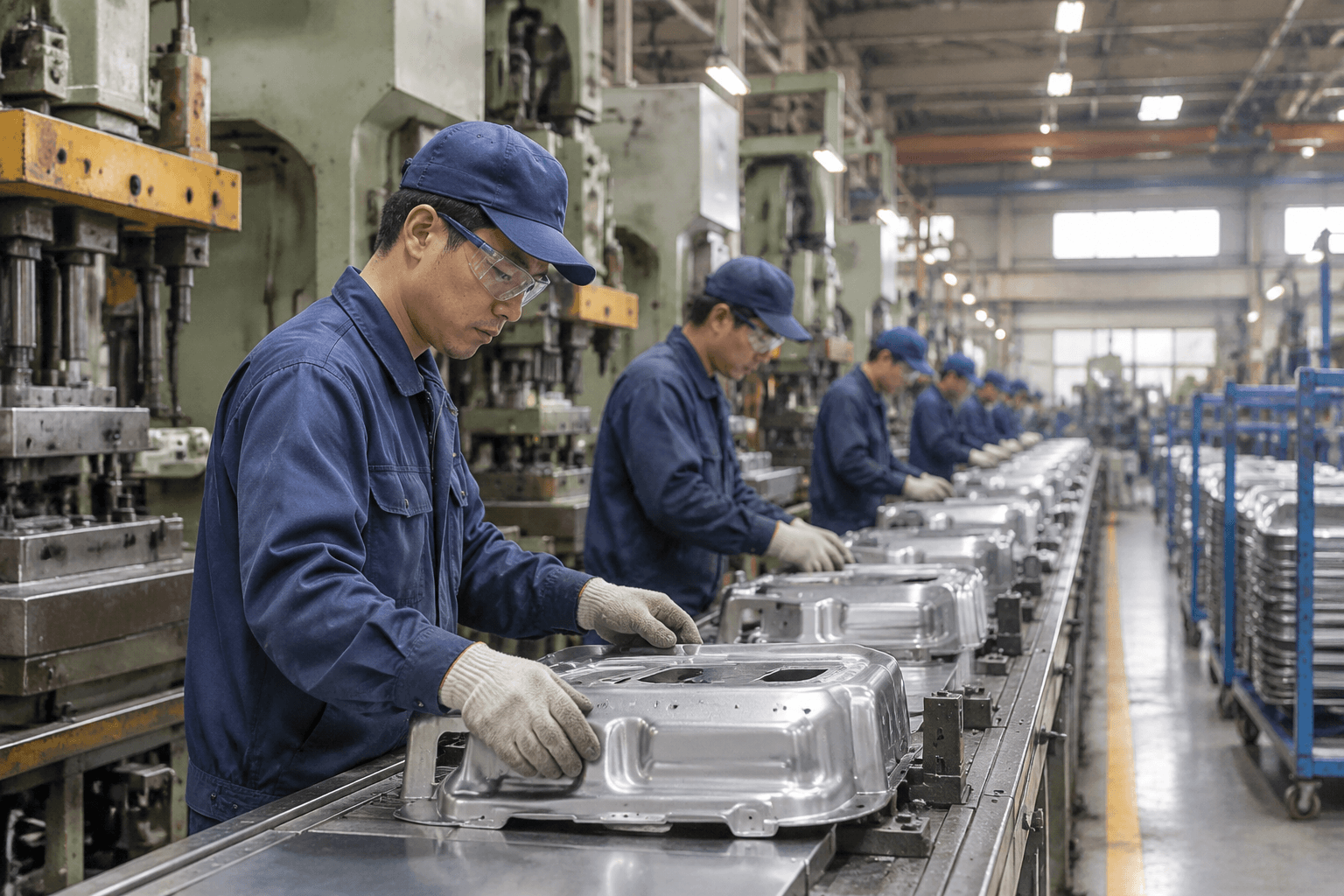
The main advantages of mass production are higher output, lower unit-cost potential, more consistent products, improved labor efficiency, and more predictable delivery planning. These benefits are realized only when demand is sufficient, the design is standardized, and the production documentation and controls are ready for repeatable manufacturing.
Mass production is a standardized system for making large quantities of the same product, or a tightly controlled family of product variations. It uses defined operation sequences, repeatable work instructions, specialized workstations, and, where appropriate, dedicated tooling or automation. It is not automatically the best method for every custom metal product: the initial production commitment must be justified by expected volume and design stability.
What Mass Production Means in Practice
Mass production is more than making many units. The defining feature is a controlled, repeatable production system built around a stable product specification. Approved drawings, bills of materials, process instructions, inspection requirements, and packaging expectations give each workstation a consistent basis for completing its work.
For a drawing-based metal component, the sequence might include material preparation, sheet metal fabrication, separate machining operations where required, welding, finishing, assembly, and inspection. These processes remain technically distinct even when they contribute to the same finished product. For example, a turned spacer may be installed in a fabricated enclosure, but CNC turning is a machining process rather than a sheet metal fabrication method.
Once the sequence is stable, materials, labor, equipment, and inspection resources can be planned around repeat demand. Repeatable components such as custom metal brackets built to controlled drawings may be suitable candidates when geometry, material, finish, and order patterns remain consistent.
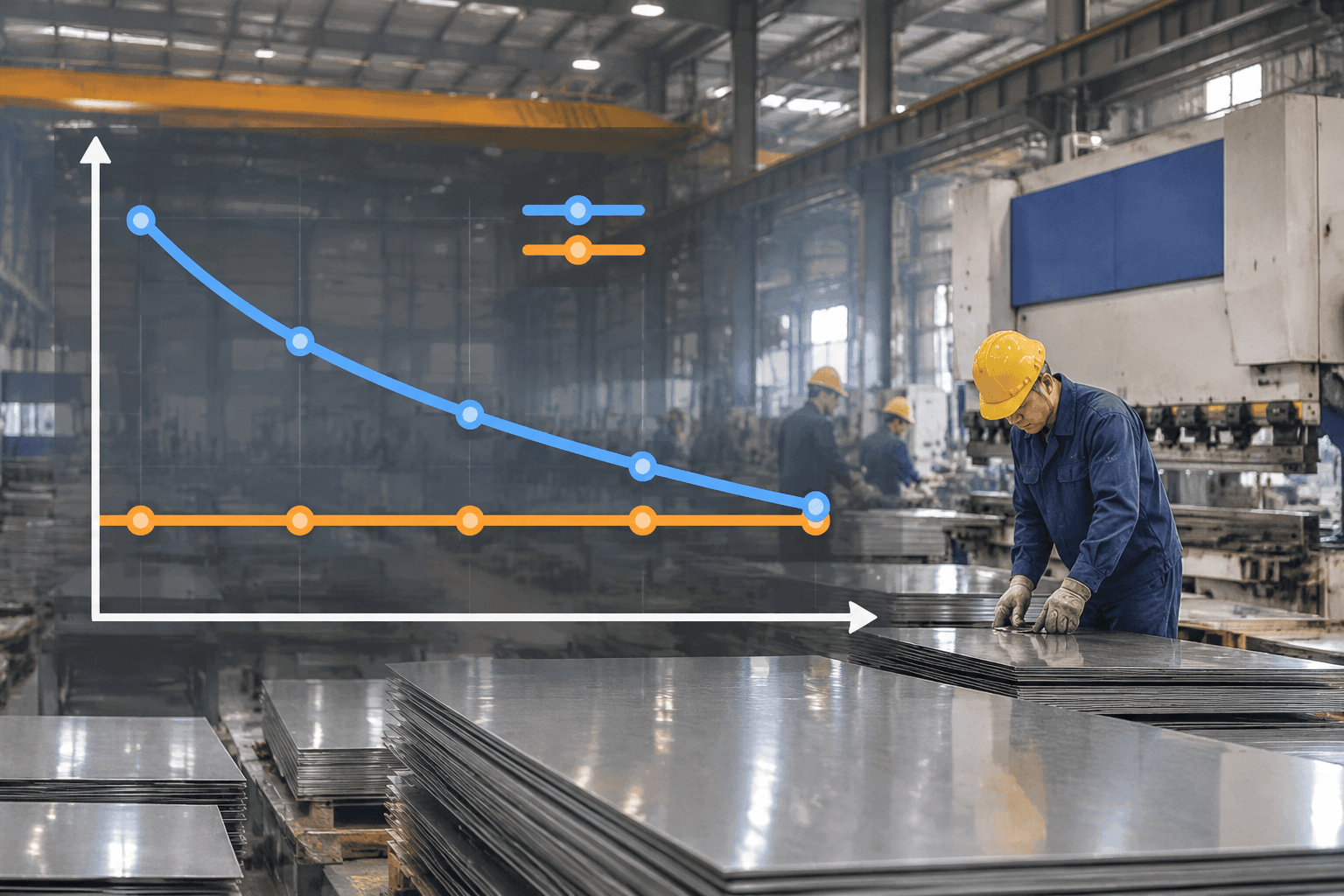
How Production Volume Changes Unit Cost
One of the most important advantages of mass production is the opportunity to distribute fixed production commitments across more acceptable units. A conceptual unit-cost model is:
Unit cost = allocated fixed production commitment + variable cost per unit
The allocated fixed portion can be expressed as:
(Tooling + setup + programming + workflow planning) ÷ accepted production units
Variable costs may include material, direct labor, processing, inspection, packaging, and logistics. Some of these costs can also change with volume, but they do not disappear simply because the order is larger.
Why Fixed Commitments Decline Per Unit
Suppose two production plans require similar engineering review, fixture preparation, machine setup, and work-instruction development. If the first plan makes a small quantity, each unit must absorb a relatively large share of those initial commitments. If the second plan produces a much larger quantity of the same stable design, the fixed allocation per unit becomes smaller.
Higher volume can also support more efficient material purchasing. Standard sheet sizes, purchased components, packaging, and finishing supplies may be ordered in planned quantities, reducing repeated purchasing and handling. However, bulk procurement does not guarantee savings. Pricing depends on material grade, thickness, market conditions, supplier terms, storage needs, usable yield, and the risk that demand changes before the material is consumed.
This is why the lowest quoted unit price should not be considered separately from volume risk. A production run becomes economical only when the expected savings from repeated processing and fixed-cost allocation outweigh tooling, setup, inventory, and change-management exposure. Low, irregular, or uncertain demand may never reach that break-even point.
From Repeatable Workflow to Output and Delivery
Mass production can increase output because the work is organized before repeated units enter the process. Operation sequences are defined, workstation responsibilities are assigned, material routes are planned, and recurring decisions are incorporated into drawings or instructions rather than being reconsidered for every unit.
Less repeated handling and decision-making
When workers receive consistent material, approved settings, suitable fixtures, and clear acceptance criteria, they can focus on executing the process. Dedicated equipment, assembly-line arrangements, or automation may reduce repositioning and manual handling where the product geometry and volume justify them. Automation is an optional enabler, not a requirement for mass production and not a substitute for process control.
Cycle time and project lead time are different
A faster operation cycle does not always mean a shorter total project lead time. Before production begins, time may be needed for design review, prototyping, tooling, material purchasing, production scheduling, finishing coordination, and approval of the first acceptable unit. Once those preparations are complete, repeatable flow can improve throughput and make subsequent delivery schedules more predictable.
Stable demand supports capacity planning
Forecast visibility helps a manufacturer reserve material, equipment, labor, finishing capacity, and inspection resources. It may also support scheduled releases instead of one large shipment. In industries such as automotive and transportation equipment manufacturing, controlled workflows and delivery planning can be especially important when repeated metal products feed later assembly operations.
Quality at Scale Requires Checkpoints, Not Assumptions
Standardization can improve consistency because every unit is produced against the same controlled requirements. It reduces avoidable variation in dimensions, hole patterns, joint locations, finish instructions, hardware, labeling, and assembly steps. Nevertheless, automation or high volume alone does not guarantee quality. A repeatable error can produce a large quantity of nonconforming parts unless controls detect it early.
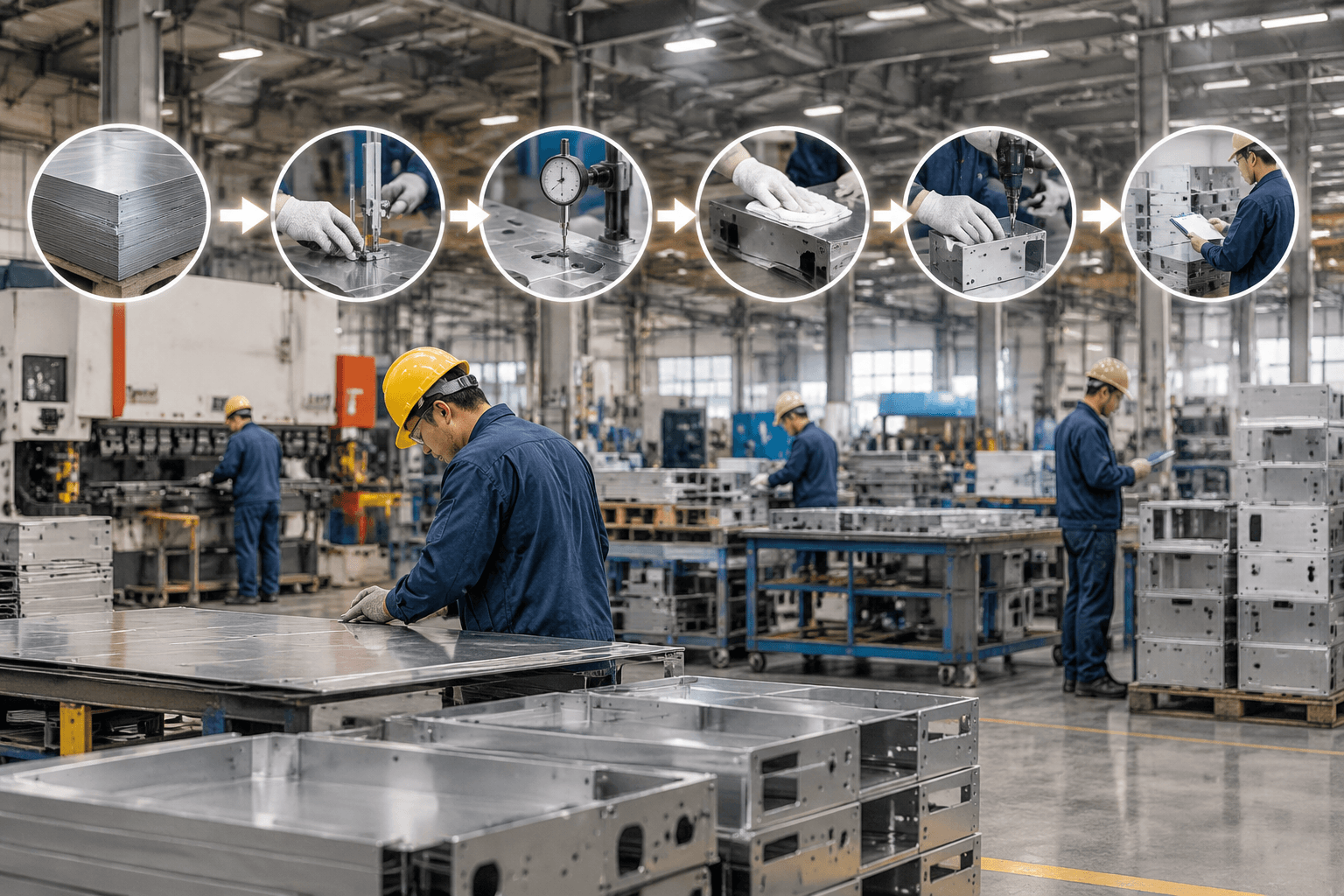
- Incoming-material verification: Confirm that material identity, form, thickness, condition, and purchased components correspond to the production requirements. This is only the first checkpoint.
- Setup or first-piece verification: Check the initial output after tooling, programming, fixture, or machine settings are prepared. Production should not continue merely because the equipment is running.
- In-process checks: Inspect defined characteristics after relevant operations. Dimensional checks may follow cutting, bending, or machining, while visual and joint-related checks may follow welding. The inspection method should match the drawing, process, and product risk.
- Finishing inspection: Review the specified coating, plating, polishing, or other finish separately from fabrication. Coverage, appearance, masking, threaded areas, and handling damage may require attention depending on the specification.
- Assembly verification: Confirm that hardware, inserts, machined interfaces, purchased parts, labels, and subassemblies are installed correctly. For custom sheet metal enclosures supplied ready for assembly, fabrication accuracy, finish condition, and assembly readiness are related but distinct requirements.
- Final inspection and release: Verify the completed product, quantity, packaging, documentation, and any specified functional requirements before shipment.
Inspection records and lot or production references can support traceability when an issue is found. Corrective action should identify where the variation entered the process, contain affected units, and update the relevant instruction, setting, fixture, material control, or inspection step. The purpose is not only to sort defects at the end, but to prevent recurrence.
Choosing Mass Production or a More Flexible Model
The advantages and disadvantages of mass production depend on how closely the product and demand match the system. The following comparison helps identify whether the initial commitment is justified.
| Decision factor | Good fit for mass production | Consider batch or flexible production |
|---|---|---|
| Demand | High enough and sufficiently stable to support repeated production | Low, seasonal, experimental, or difficult to forecast |
| Design maturity | Approved design with limited expected engineering changes | Frequent revisions, testing, or unresolved interfaces |
| Product variation | Identical units or a tightly controlled variation family | Many configurations, finishes, dimensions, or custom options |
| Documentation | Production-ready drawings, specifications, bills of materials, and acceptance criteria | Incomplete drawings or requirements that still depend on interpretation |
| Inventory exposure | Reliable consumption plan and acceptable storage commitment | High risk of obsolete materials or unsold finished goods |
| Production investment | Tooling, fixtures, setup, and planning can be spread across sufficient volume | Initial commitments are too high for the expected quantity |
The disadvantages of mass production include reduced flexibility, exposure to forecasting errors, potentially expensive design changes, and the risk of producing excess inventory. Dedicated tooling or tightly optimized equipment may become a constraint when dimensions, materials, interfaces, or finishes change.
Batch production is often more appropriate for moderate quantities, recurring product families, or orders with meaningful variation. Products are made in defined groups, allowing setup changes between batches. Flexible production may be preferable for prototypes, early market introduction, replacement products, or highly customized assemblies.
Lean production is different: it is a waste-reduction and flow-improvement philosophy rather than a volume category. Lean methods can support mass, batch, or flexible production by reducing unnecessary movement, waiting, inventory, overprocessing, and rework.
Frequently Asked Questions
What are the main disadvantages of mass production?
The main disadvantages are high initial commitments, limited design flexibility, inventory risk, and greater consequences when a process error is repeated. Tooling, fixtures, setup, material purchasing, and workflow planning may not be economical when demand is uncertain. Design changes can also require revised programs, instructions, fixtures, inspection plans, or purchased inventory.
How is batch production different from mass production?
Batch production makes products in defined groups and permits planned changes between batches. It generally offers more flexibility for moderate volumes or product variations. Mass production emphasizes continuous or highly repeated output of standardized products, making it more dependent on stable demand, mature documentation, and enough volume to justify the setup.
Can lean production and mass production be used together?
Yes. Lean production can improve a mass-production system by identifying waste, simplifying material movement, balancing work, reducing waiting, and addressing recurring defects. Lean does not replace production planning or quality control, and it can also be applied to batch and flexible manufacturing environments.
What must a product design include before scaling to mass production?
The production package should clearly define geometry, materials, thicknesses, interfaces, finishes, purchased components, assembly requirements, inspection criteria, packaging, and permitted variations. CAD models and prototypes can help validate the design, but they are preparation tools rather than production methods. Unresolved requirements should be corrected before committing substantial material or dedicated tooling.