
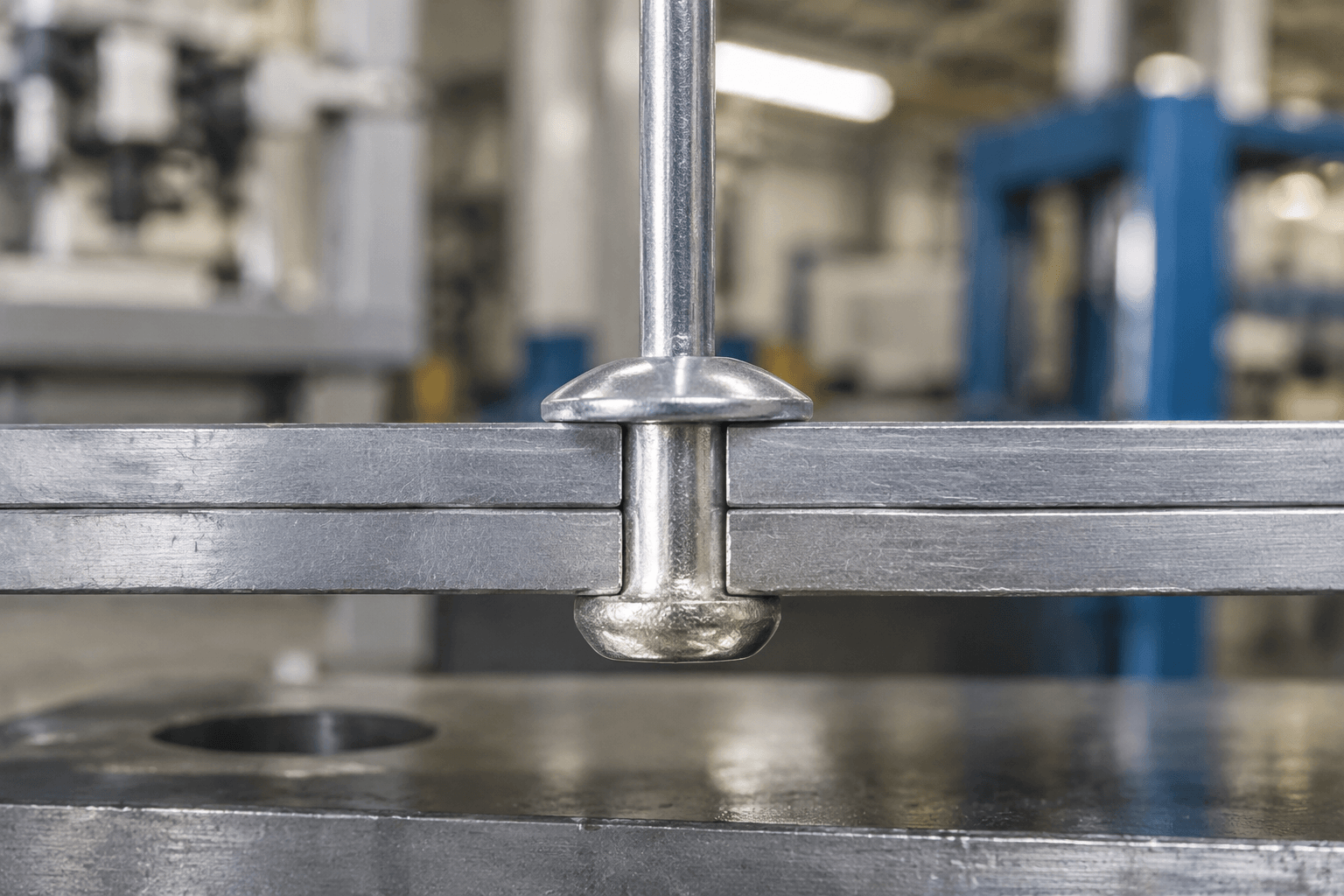
“Alum rivets” commonly means aluminum rivets, usually aluminum blind rivets when the fastener is installed from only one side. However, “aluminum rivet” is not a complete specification: the body material, mandrel material, diameter, grip range, head style, and required hole size must all be confirmed.
A blind rivet creates a permanent mechanical connection by expanding on the inaccessible side of a prepared hole. It is widely used in sheet metal assemblies, but compatibility depends on the complete joint—not simply on the word “aluminum.”
What Does “Alum Rivets” Mean?
“Alum” is an informal abbreviation rather than a complete engineering term. In product searches, catalogs, and purchasing messages, it usually refers to aluminum rivets. The description should still identify the rivet design because several fasteners can be made with aluminum components.
This article focuses on break-stem blind rivets. A typical blind rivet consists of four functional features:
- Rivet body: The hollow sleeve that passes through the prepared holes and deforms during installation.
- Manufactured head: The preformed head that remains on the accessible side of the assembly.
- Mandrel: The stem pulled by the installation tool to expand the body. Its material may differ from the body material.
- Blind-side expansion: The bulb, fold, or deformed section that clamps the material stack from the inaccessible side.
An aluminum body does not automatically mean an aluminum mandrel. Product descriptions may specify aluminum/aluminum, aluminum/steel, or another documented body-and-mandrel combination. Buyers should read the two materials separately because the mandrel affects installation behavior, retained material, corrosion considerations, and the completed joint.
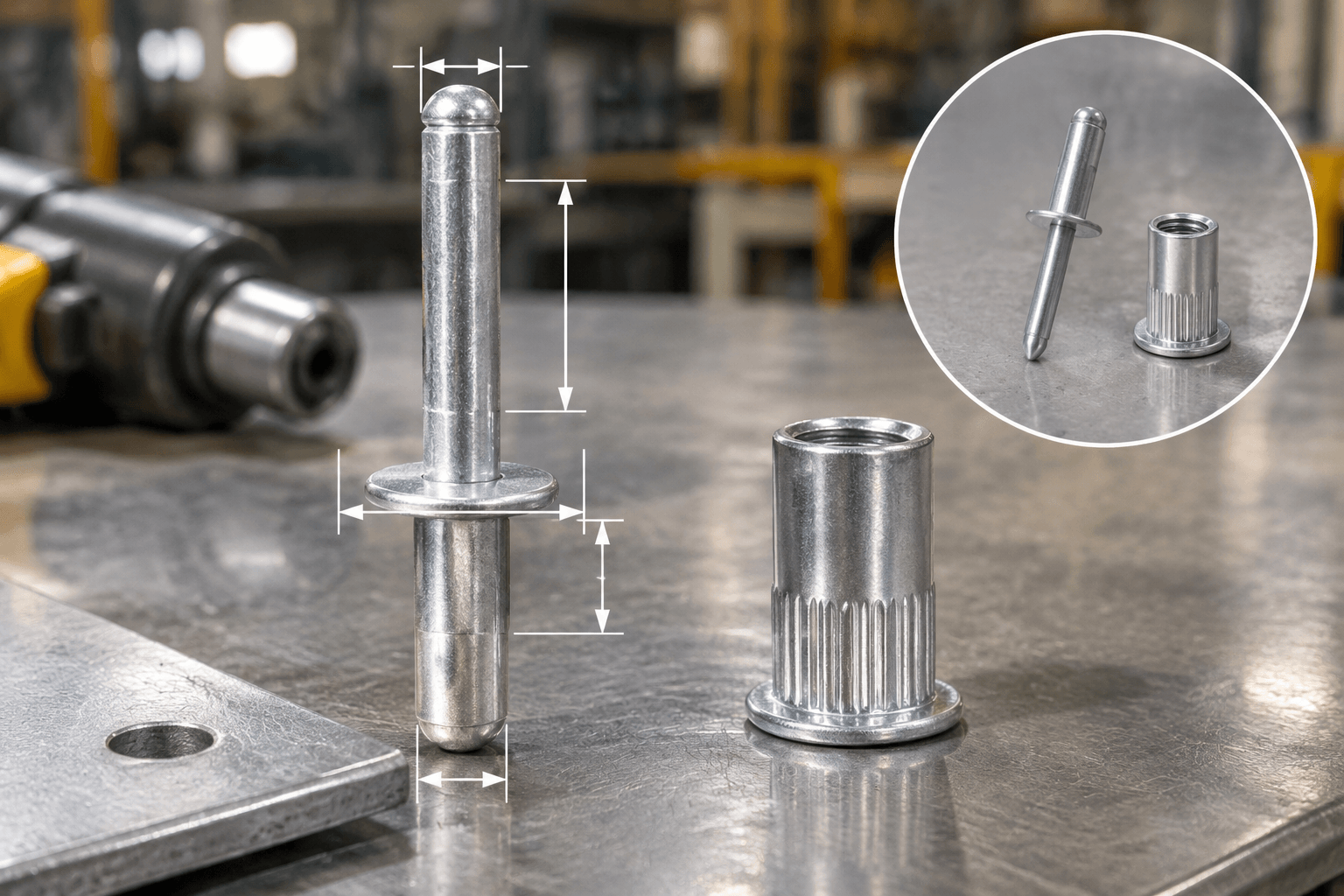
Blind rivets should also not be confused with rivet nuts. A blind rivet permanently clamps sheets together, while a rivet nut is an internally threaded insert installed to create a reusable attachment point for a screw or bolt. Solid and semi-tubular rivets are separate designs with different access and installation requirements.
How an Aluminum Blind Rivet Forms the Joint
A blind rivet is useful when an operator or automated tool can reach the front of an assembly but cannot place a nut, bucking bar, or forming tool behind it. This condition is common in closed sections, housings, panels, and some custom sheet metal enclosures.
- Prepare and align the holes. The holes in the mating parts must align and be suitable for the selected rivet diameter. Burrs, distortion, coating buildup, or excessive clearance can interfere with seating.
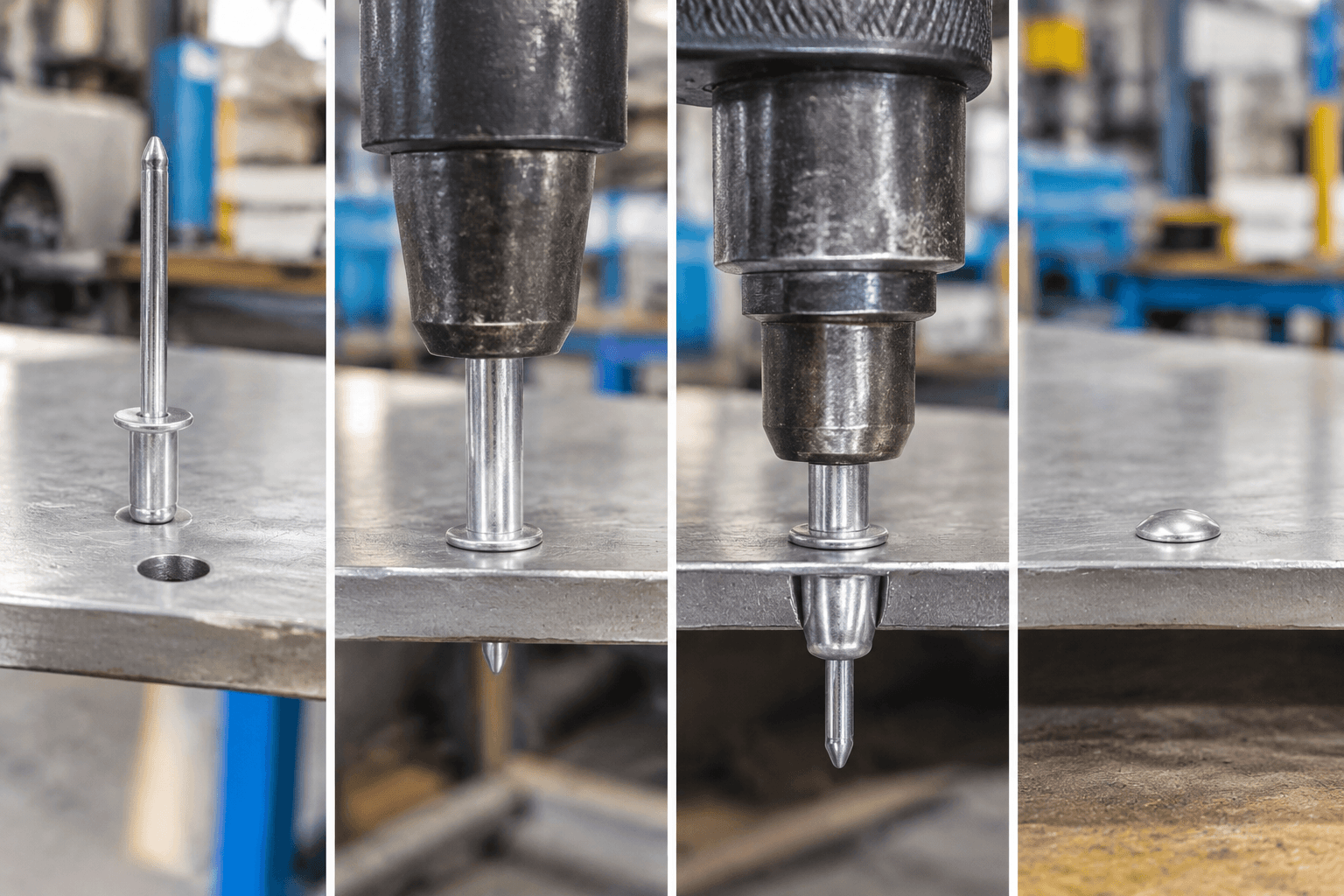
- Insert the rivet. The body passes through the complete material stack until the manufactured head sits against the accessible surface.
- Engage the mandrel. The installation tool grips and pulls the projecting stem while supporting the manufactured head with its nosepiece.
- Expand the blind side. Mandrel movement causes the body to deform behind the assembly. This creates a blind-side head or bulb and draws the layers together.
- Break the mandrel. Once the design-specific setting condition is reached, the mandrel breaks at or near its intended break area. A portion may remain inside the body, depending on the rivet configuration.
The result is considered permanent because the fastener is not designed to be unscrewed and reused. Removal normally requires a destructive operation, such as drilling away the manufactured head and pushing the remaining body through the hole. Care is needed to avoid enlarging the hole or damaging the surrounding sheet.
“Permanent” does not mean that every blind-riveted joint has the same structural, vibration, sealing, or corrosion performance. Those properties depend on the selected rivet, the joined materials, hole quality, installation control, and application requirements.
The Dimensions That Determine Fit
Rivet diameter, body length, and grip range describe different features. Treating them as interchangeable is a common cause of incorrect orders and poorly seated joints.
- Rivet diameter
-
This is the nominal diameter of the body inserted into the hole. It is the starting point for selecting the corresponding hole requirement, but the acceptable hole condition must come from the rivet manufacturer, drawing, or governing customer specification.
- Body length
-
This is generally measured along the rivet body beneath the manufactured head. It is a physical fastener dimension, not automatically the thickness that the rivet can clamp.
- Grip range
-
The grip range is the permitted combined thickness of all layers at the riveted location. It can include sheet, brackets, washers, gaskets, or other components captured in the joint. The actual stack thickness must fall within the documented grip range for the selected rivet.
- Head style
-
The head controls contact area, installed profile, and appearance on the accessible side. Common categories include protruding dome-style heads, larger-flange heads for increased bearing area, and countersunk configurations for a lower profile. The mating sheet and hole preparation must suit the chosen geometry.
- Required hole size
-
The hole must admit the rivet without excessive looseness. A hole that is too small may prevent insertion or damage coatings; one that is too large can reduce support, affect alignment, or produce an irregular set. Numeric limits should be taken from the approved rivet data rather than estimated from nominal diameter alone.
For a drawing-based assembly such as a custom metal bracket, the designer should define both the hole and the joint stack. Specifying only a rivet length leaves uncertainty about whether the selected grip range matches the finished parts.
Comparing Body, Mandrel, Head, and Rivet Design
Selection requires several linked decisions. A change to one feature can affect installation tooling, surface appearance, blind-side clearance, corrosion exposure, and how the load is distributed into thin sheet.
| Selection field | What it describes | What to verify |
|---|---|---|
| Body material | The deformable sleeve that remains in the joint | Compatibility with the substrates, environment, finish, and engineering requirements |
| Mandrel material | The stem pulled during setting | Exact material combination, break-stem design, and whether part of the mandrel remains |
| Dome or protruding head | A general-purpose raised head profile | Available surface area, appearance, clearance, and drawing requirements |
| Large-flange head | A wider manufactured head with more contact area | Whether the sheet needs broader load distribution and whether the larger head fits the assembly |
| Countersunk head | A head intended to sit closer to flush | Sheet thickness, prepared geometry, remaining material, and visible-surface requirements |
| Specialty blind design | A configuration developed for particular retention, sealing, structural, or access conditions | Manufacturer documentation, installation method, tool compatibility, and application approval |
Material pairing deserves particular attention. Aluminum rivets joining aluminum parts may reduce some dissimilar-metal concerns, but the exact alloys, coatings, and service environment still matter. When an aluminum rivet joins galvanized steel or another metal, moisture and electrical contact can create a corrosion path. The risk varies with the materials, exposed area, coating condition, contaminants, and service environment.
Possible design responses include choosing a documented compatible fastener combination, preserving protective coatings, adding an approved isolation layer, sealing the joint, or changing the fastener material. These are application decisions rather than universal rules. Assemblies exposed to vibration, road contaminants, or outdoor conditions—such as some automotive and transportation metal products—require evaluation against their actual operating requirements.
How to Read an Aluminum Blind Rivet Description
An abbreviated listing may look complete while omitting information needed for engineering approval. The following decoder shows how to turn a short product name into verification questions.
| Listing term | Likely meaning | Information still needed |
|---|---|---|
| “Aluminum blind rivet” | The body is presented as aluminum and the fastener installs from one side | Mandrel material, exact design, dimensions, finish, and approved application |
| “Aluminum/aluminum” | Usually describes body material first and mandrel material second | Confirmation of the supplier’s notation, retained-mandrel condition, and finish |
| “Dome head” | A protruding manufactured-head category | Actual head dimensions, surface clearance, and appearance requirement |
| Diameter × length | Nominal body diameter and physical body length | Usable grip range and recommended hole specification |
| “For thin sheet” | A general application statement | Permitted stack thickness, substrate details, bearing condition, and test basis |
| Price shown online | A displayed commercial value | Whether it covers one rivet, a package, a carton, or another quantity unit |
If the listing does not show grip range, hole size, mandrel material, finish, and quantity unit, it should not be treated as a complete purchasing specification. Request the controlled technical data or identify the approved manufacturer and part number on the drawing or bill of materials.
What to Confirm Before Approving the Rivet
A complete rivet callout should let engineering, purchasing, production, and inspection identify the same fastener and verify the same installed condition. Depending on the project, record the following information:
- Fastener category, such as break-stem blind rivet, rather than only “alum rivet.”
- Rivet body material and mandrel material as separate fields.
- Nominal body diameter and the associated prepared-hole requirement.
- Grip range matched to the minimum and maximum finished material stack.
- Head style, visible profile, contact-area needs, and any countersink preparation.
- Finish, coating, color, sealing feature, or isolation requirement where applicable.
- Base materials, sheet thicknesses, coatings, and access conditions at each location.
- Approved manufacturer, part number, drawing revision, or customer specification when required.
- Packaging or pricing unit so purchasing does not confuse pieces, packs, or cartons.
- Inspection criteria for head seating, blind-side formation, gaps, surface damage, and mandrel condition.
Installation access should be reviewed at the same time. The tool nosepiece must reach the manufactured head squarely, while the blind side needs enough clearance for the body to expand. A rivet can match the nominal dimensions and still be unsuitable if nearby bends, flanges, hardware, or internal components obstruct installation.
Frequently Asked Questions
Are aluminum rivet nuts strong, and are they the same as aluminum blind rivets?
They are different fasteners. A rivet nut creates an internal thread for a removable screw or bolt, while an ordinary blind rivet directly clamps the joined materials. Rivet-nut performance depends on its design, material, installation, host-sheet condition, and applied loads, so strength should be checked against documented product data.
What do rivet diameter, length, and grip range each measure?
Diameter describes the body inserted into the hole. Body length is the physical length beneath the manufactured head. Grip range defines the combined material thickness the rivet is designed to clamp; it is therefore the key value for matching the rivet to the assembly stack.
How permanent is an aluminum blind-rivet joint?
A set blind rivet cannot normally be unscrewed or reused. It is usually removed by drilling off the accessible head and extracting the remaining body. Because removal destroys the fastener and may affect the hole, the joint is classified as permanent even though disassembly is possible with tools.
What should be checked before using aluminum rivets with galvanized steel?
Check the exact rivet and mandrel materials, coating condition, moisture exposure, contaminants, expected service environment, and any specified corrosion-isolation method. Also confirm hole quality and avoid unnecessary damage to the galvanized coating during fabrication and installation. Final material approval should follow the project’s engineering requirements.