
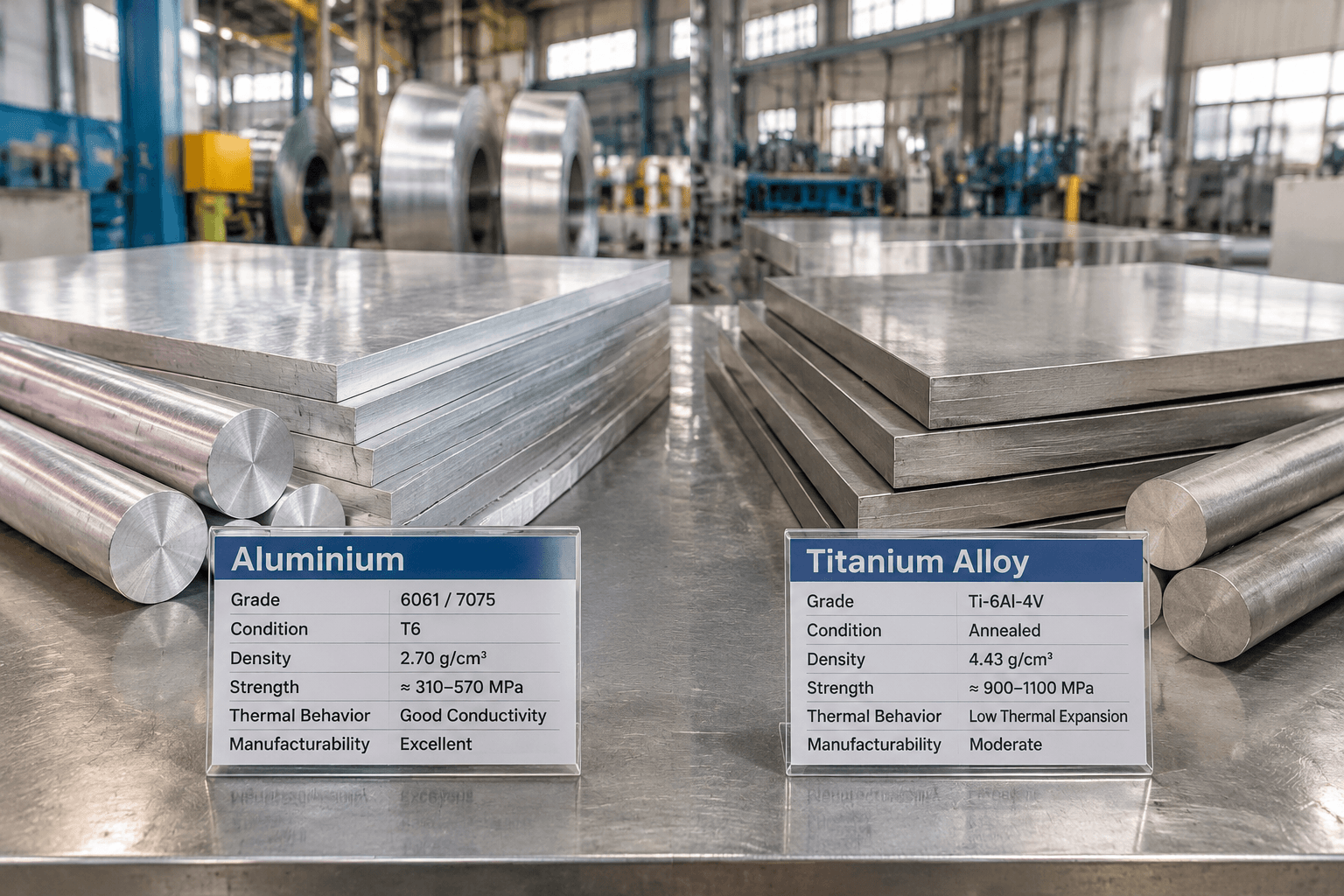
“Aluminium and titanium alloy” usually refers to a comparison between two separate alloy families, not one universally defined material. Aluminum generally offers lower density, easier heat transfer, and practical sheet fabrication, while titanium is often considered for high specific strength, corrosion resistance in selected environments, or elevated-temperature service. The correct choice still depends on the exact grade, condition, product form, geometry, loading, finish, and operating environment.
This guide uses 6061 aluminum, 7075 aluminum, and Ti-6Al-4V Grade 5 as representative examples. They illustrate important differences, but they do not represent every aluminum or titanium alloy.
Does “Aluminium and Titanium Alloy” Mean One Material?
Aluminum and titanium are distinct base metals, each with its own family of alloy grades. In British English, the first metal is written “aluminium”; in American engineering documents, it is “aluminum.” Both terms describe the same element, but an RFQ should use the designation expected by the applicable material standard.
Some titanium alloys contain aluminum as an alloying element. Ti-6Al-4V, commonly called Grade 5 titanium, nominally contains approximately 6% aluminum and 4% vanadium, with titanium forming the balance subject to specification limits. It remains a titanium-base alloy—not an aluminum alloy and not a generic aluminum-titanium material.
Grade designations matter because composition and processing condition change performance. “6061 aluminum” is incomplete when temper affects the requirement; 6061-O, 6061-T4, and 6061-T6 do not have the same strength or forming behavior. Likewise, Ti-6Al-4V may be supplied annealed or in another specified heat-treatment condition and product form.
How 6061, 7075, and Ti-6Al-4V Compare
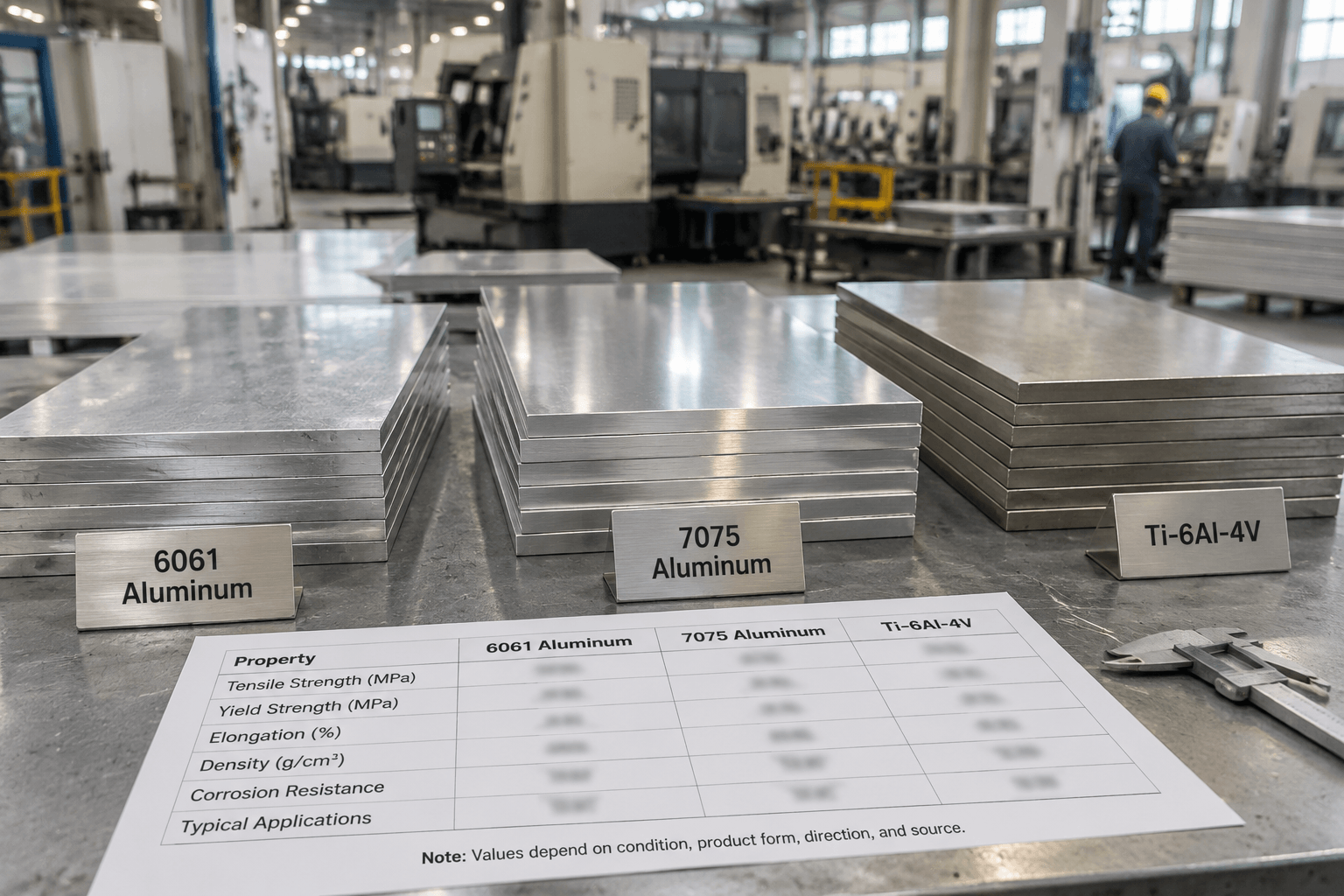
The following values are representative room-temperature figures commonly published in Aluminum Association, ASM, producer, and titanium mill technical references. They are useful for initial screening, not as design allowables. Actual values vary with governing specification, temper or heat treatment, thickness, product form, test direction, and source.
| Property | 6061-T6 aluminum | 7075-T6 aluminum | Ti-6Al-4V Grade 5, annealed |
|---|---|---|---|
| Density, approximate | 2.70 g/cm³ | 2.81 g/cm³ | 4.43 g/cm³ |
| Elastic modulus, approximate | 69 GPa | 72 GPa | 110–114 GPa |
| Typical yield-strength level | About 275 MPa | About 500 MPa | About 825 MPa or higher, depending on specification and form |
| Typical tensile-strength level | About 310 MPa | About 570 MPa | About 895 MPa or higher, depending on specification and form |
| Thermal conductivity, approximate | Often reported near 167 W/m·K | Often reported near 130 W/m·K | Often reported near 6.7 W/m·K |
| General engineering implication | Balanced fabrication, corrosion, and thermal properties | Higher aluminum strength, but more forming, welding, and corrosion limitations | High specific strength and low heat transfer, with more demanding manufacturing controls |
Mass and strength are different decisions. Aluminum is substantially less dense than Ti-6Al-4V, but Grade 5 titanium has much higher representative strength. Whether the completed titanium part is lighter depends on how loads, buckling, fatigue, joints, wall thickness, and safety factors affect the design. Direct substitution at the same dimensions may increase rather than reduce mass.
Stiffness cannot be inferred from tensile strength. Titanium has a higher elastic modulus than aluminum, but it is also denser. Deflection depends on both modulus and section geometry. Increasing a flange depth or adding a formed rib can sometimes improve an aluminum component more efficiently than changing alloy.
Thermal behavior can reverse the preference. Aluminum commonly suits heat-spreading enclosures, covers, and thermal interfaces. Ti-6Al-4V conducts heat much more slowly, which can be useful for limiting heat flow but creates machining challenges. Published conductivity ratios should not be applied without checking the exact grade, temperature, and condition.
Both families form protective oxide films, yet corrosion performance remains environment-specific. 6061 generally provides useful atmospheric corrosion resistance. 7075 may require more attention to corrosion protection and stress-corrosion conditions. Titanium performs well in many aggressive environments, but it is not immune to every chemical, crevice, or high-temperature exposure. Elevated-temperature suitability must be verified using temperature-dependent strength, creep, oxidation, and fatigue data rather than room-temperature values.
How to Match the Alloy to the Requirement
| Design priority | Likely starting point | What must be verified |
|---|---|---|
| Low raw-material density | 6061 or 7075 aluminum | Required section size, stiffness, fatigue, joints, and final part mass |
| High heat transfer | Often 6061 aluminum | Interface flatness, surface finish, coating, contact pressure, and operating temperature |
| High strength within the aluminum family | 7075 in an appropriate temper | Forming direction, corrosion exposure, joining method, and product-form availability |
| High strength relative to mass | Ti-6Al-4V may justify evaluation | Load case, fatigue, notch sensitivity, section redesign, manufacturing route, and total cost |
| Complex formed sheet geometry | Often a formable aluminum temper | Bend radius, grain direction, springback, cracking risk, and post-form heat treatment |
| Cosmetic anodized surface | Aluminum, with grade and finish trials | Color range, gloss, texture, lot variation, masking, and acceptable defects |
| Demanding environment or temperature | Titanium may merit consideration | Actual fluid, contaminants, stress, exposure time, galvanic contacts, and temperature data |
The matrix identifies a starting point, not a winner. For example, a custom sheet metal enclosure may prioritize thermal transfer, bent geometry, appearance, grounding, and assembly fit. A transportation component may place greater weight on fatigue, impact loads, mass, corrosion exposure, and production repeatability. These requirements must be evaluated together.
How Grade and Condition Affect Manufacturing
Sheet forming
6061 can be formed, but its temper strongly affects bendability. Softer conditions generally allow tighter forming than T6, while a design may require heat treatment after forming if final strength is critical. Bend radius, sheet thickness, rolling direction, hole-to-bend distance, and surface condition should all be reviewed.
7075-T6 offers high strength but limited formability compared with softer aluminum grades and conditions. Sharp bends can crack, especially when orientation and radius are unfavorable. Ti-6Al-4V sheet presents different issues: higher springback, greater forming loads, sensitivity to surface damage, and possible need for controlled-temperature forming depending on geometry. A drawing for a custom metal bracket should therefore define function and interfaces rather than assume that identical bend details suit all three materials.
Milling
Aluminum milling generally permits effective heat removal through chips, but tool geometry, chip evacuation, workholding, and avoidance of built-up edge remain important. Thin walls may move after material removal because of residual stress or insufficient support.
Ti-6Al-4V has low thermal conductivity, so more cutting heat remains near the tool edge. Milling plans must address tool engagement, heat management, tool wear, chatter, and rigid workholding. This is a machining issue, not sheet metal fabrication, even when the machined feature later interfaces with a fabricated assembly.
Welding and mechanical joining
6061 is commonly fusion welded using a compatible procedure and filler selection, but welding can reduce strength in the heat-affected zone of heat-treated material. Final design values and any post-weld requirements must reflect this change.
7075 is generally not selected for conventional fusion-welded structures because of cracking and property concerns; mechanical fastening, machining from solid, or a different alloy may be more appropriate. Ti-6Al-4V can be welded, but molten and hot titanium requires effective shielding from atmospheric contamination. Joint cleanliness, shielding coverage, procedure qualification, and acceptance criteria are essential.
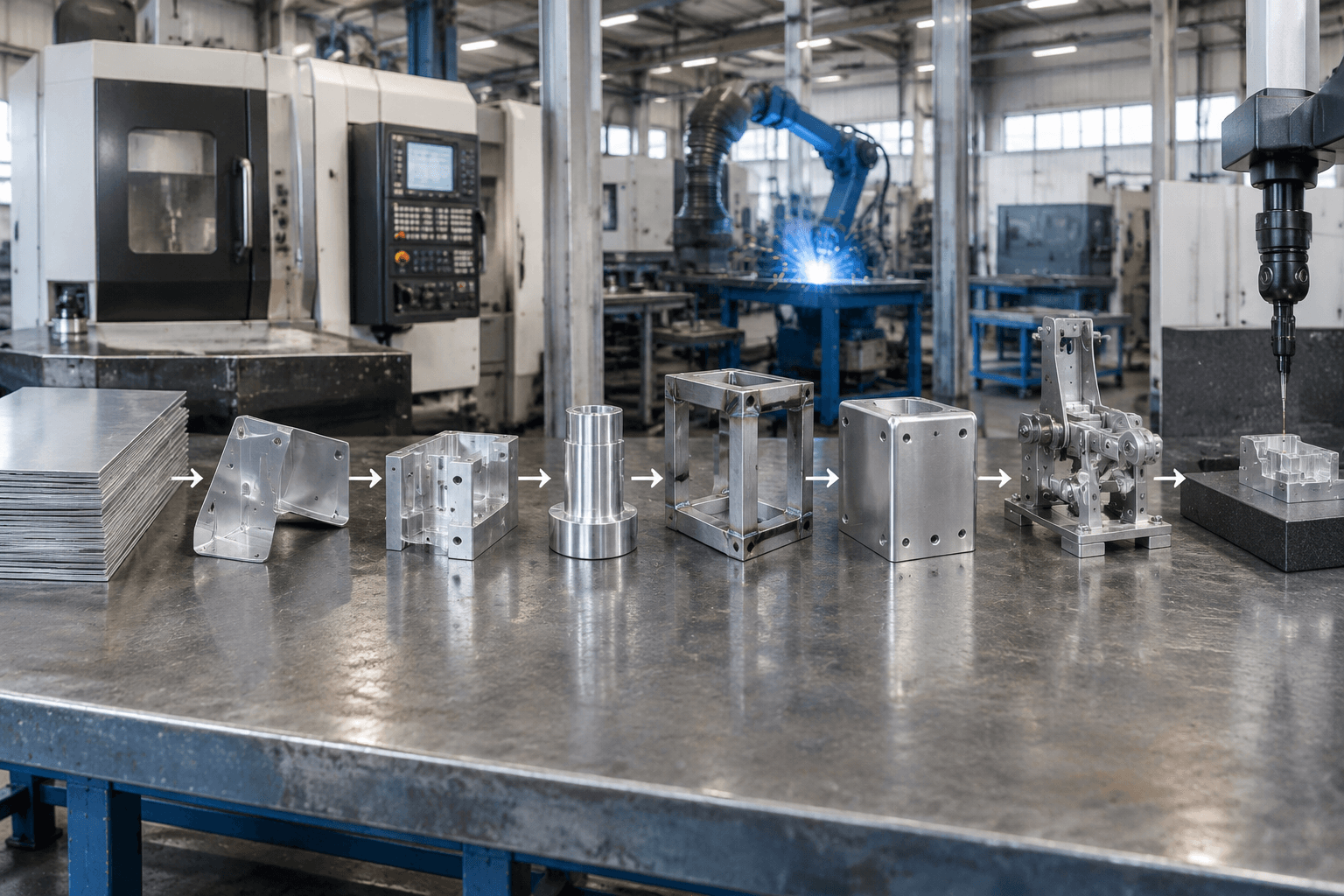
Dimensional control must be planned around process sequence. Forming, welding, heat treatment, machining, and coating can each alter geometry. Datums should represent how the part functions and how it can be held and measured, rather than applying tight tolerances indiscriminately.
Finishing and Aluminum-to-Titanium Assembly
Aluminum may be anodized, conversion coated, painted, or powder coated when compatible with the alloy and service requirement. Anodized color and appearance can vary with alloy, temper, surface preparation, thickness, and processing lot; 6061 and 7075 should not automatically be expected to match. Titanium may be cleaned, passivated where specified, mechanically finished, coated, or anodized for functional or decorative effects, but titanium anodizing is not equivalent to conventional aluminum anodizing.
Finish requirements should be measurable. Instead of “black anodized, perfect appearance,” define the treatment specification, coating or oxide requirement, color range or approved sample, gloss or texture where relevant, masking areas, contact surfaces, and permitted cosmetic defects. Coating buildup must also be considered on holes, threads, locating features, and mating surfaces.
When titanium and aluminum are electrically connected in the presence of an electrolyte, the aluminum can become the more vulnerable member of a galvanic couple. Risk depends on area ratio, environment, exposure duration, coatings, drainage, and joint design. Isolation washers, sealants, compatible coatings, drainage, and controlled electrical bonding may be considered, but the correct solution is application-specific. This is particularly relevant in transportation metal fabrication, where moisture, road contaminants, vibration, and maintenance conditions interact.
Build an Unambiguous Material and Drawing Specification
A useful callout does more than state “aluminum” or “titanium.” Consider this annotated example:
Material: 6061-T6 aluminum sheet, 2.0 mm nominal thickness, supplied to the stated procurement standard; substitutions require written approval. Geometry: critical datums A, B, and C control the mounting pattern and mating face. Finish: specified anodizing process, with threads and electrical-contact areas masked; cosmetic acceptance applies only to identified Class A surfaces. Inspection: report the drawing-identified critical dimensions and provide the requested material documentation.
The exact standard, thickness tolerance, finish designation, and inspection method must be selected for the project rather than copied from this example. For Ti-6Al-4V, state Grade 5, condition, product form, governing specification, and any directional or traceability requirements. For 7075, include the temper and confirm that the proposed forming, joining, and corrosion-protection route is compatible.
A production-ready package should also identify quantity and production stage, critical loads or functional surfaces, datum structure, joining details, coating-sensitive dimensions, cosmetic zones, inspection scope, and whether alternative grades or tempers are allowed. If substitutions are possible, define who approves them and what technical evidence is required. Prototype-to-production control may also cover material source documentation, drawing and process revisions, inspection method, and change approval.
Frequently Asked Questions
What is the main difference between aluminum and titanium alloys?
Aluminum alloys are less dense and generally transfer heat more effectively. Titanium alloys such as Ti-6Al-4V can provide higher strength and useful performance in selected corrosive or elevated-temperature conditions, but they are denser and typically more demanding to form and machine. The final decision must be grade- and application-specific.
Does Ti-6Al-4V count as an aluminum-titanium alloy because it contains aluminum?
It is more accurately described as a titanium alloy containing aluminum and vanadium. Titanium is the base metal, so Ti-6Al-4V belongs to the titanium alloy family. Calling it simply an “aluminum-titanium alloy” can create procurement ambiguity.
Why might a product change from titanium to aluminum?
Possible reasons include thermal management, mass distribution, forming requirements, finish, manufacturing complexity, supply strategy, or total product design. Without reliable product-specific evidence, a particular company’s reason should not be presented as fact. Such a change also does not prove that aluminum is universally better than titanium.
Why must an RFQ identify the grade, temper or condition, and product form?
These details affect strength, formability, machining response, welding suitability, corrosion behavior, finish, dimensional stability, availability, and inspection. A vague callout such as “aluminum plate” permits assumptions that may not satisfy the design and makes quotations difficult to compare.