
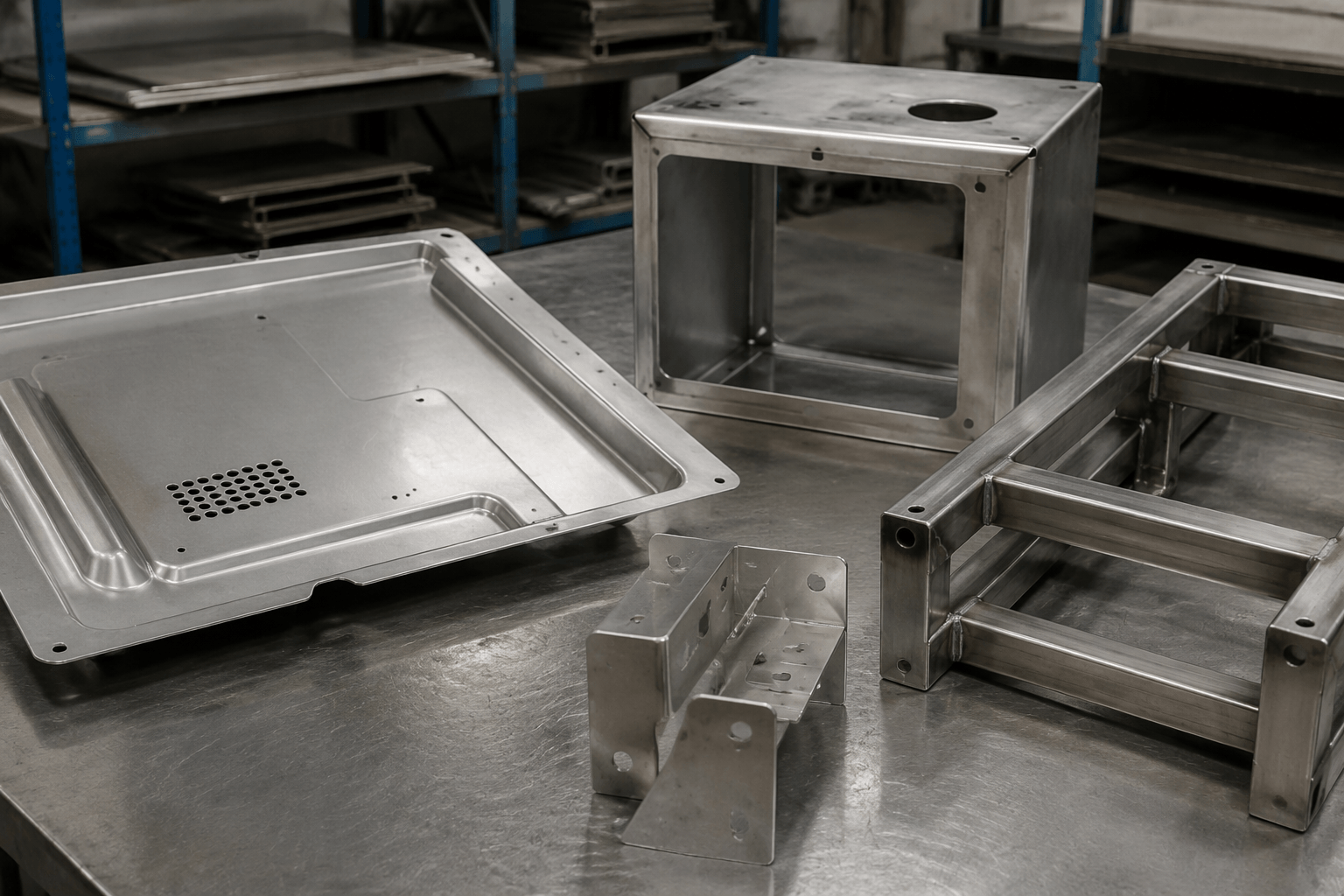
“Alloy stainless products” most likely refers to a supplier or brand-oriented search, although it can also be used loosely to describe products made from stainless steel alloys. Stainless steel is an alloy family, but the alloy designation alone does not define a finished product. This article focuses on how OEM buyers specify custom stainless panels, enclosures, frames, brackets, cabinets, covers, and welded assemblies—not on any company that may use a similar name.
Does “Alloy Stainless Products” Mean a Supplier or a Material Category?
The exact phrase often functions as a supplier-name or navigational query. It can also create technical ambiguity because “alloy” may be interpreted incorrectly as a material category separate from stainless steel.
Stainless steel is already an alloy: its properties come from a defined chemical composition rather than from a single pure metal. In industrial purchasing, however, identifying the material family is only the beginning. A usable product also needs a defined form, grade or material specification, geometry, manufacturing route, surface condition, joining method, assembly state, and acceptance criteria.
There is no implied affiliation between Yishang and any business named Alloy Stainless Products. Nor should a search snippet be treated as evidence of a supplier’s product range, engineering scope, certifications, or manufacturing capability. Those details require confirmation from the relevant company.
Material, Standard Item, or Custom Fabricated Product?
Buyers can avoid early misunderstandings by separating three purchasing categories:
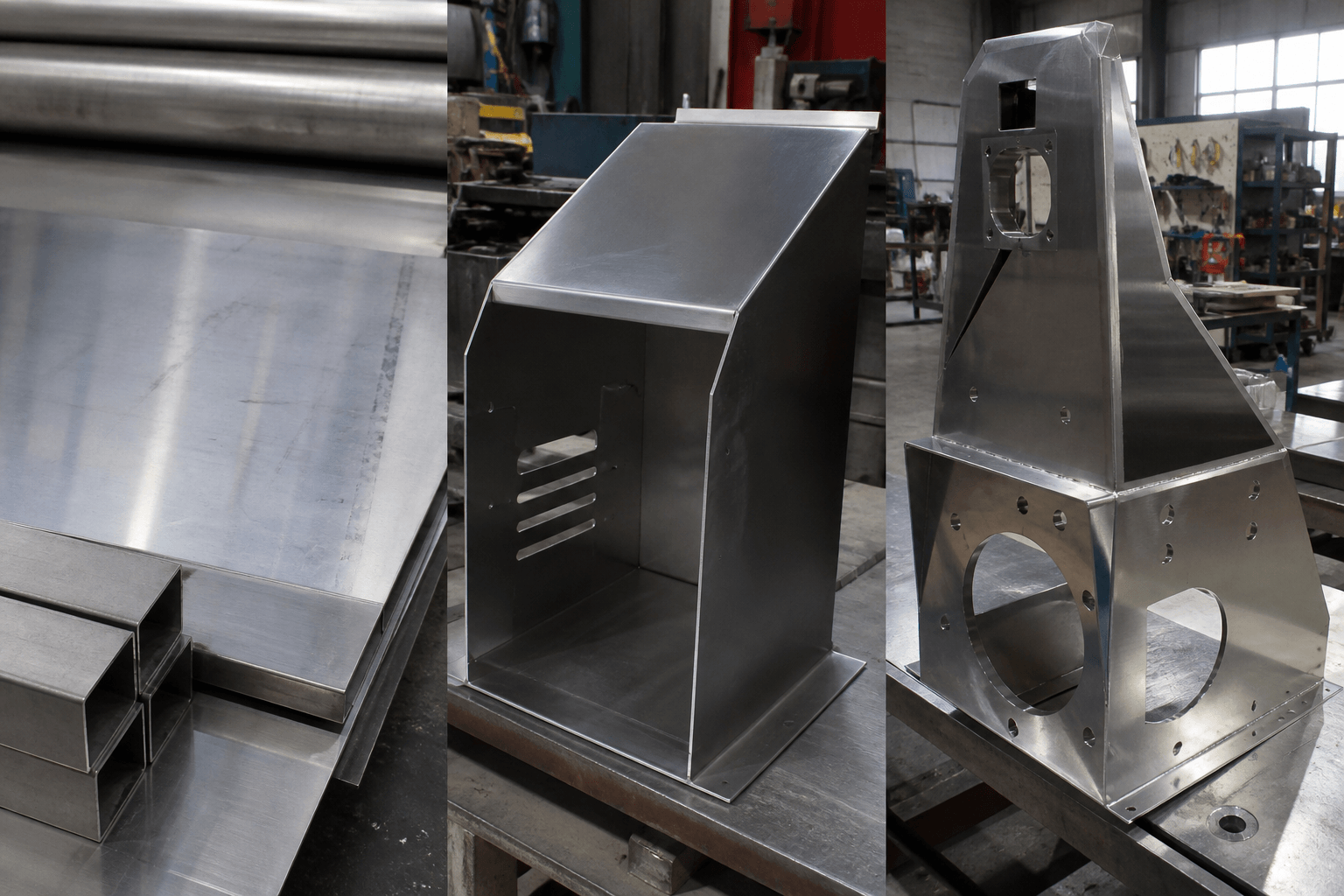
- Raw stainless stock is material supplied in forms such as sheet, plate, bar, or tube. The order normally defines the material specification, dimensions, quantity, and required documentation. It is input material rather than a completed OEM component.
- A standard stainless product is an off-the-shelf item made to a catalog description. Its dimensions, configuration, finish, and interface are generally selected from the supplier’s established options rather than created for one drawing.
- A custom fabricated stainless product is manufactured to buyer-controlled drawings, models, samples, or agreed design requirements. Examples include formed panels, covers, brackets, cabinets, frames, enclosures, and multi-part welded assemblies.
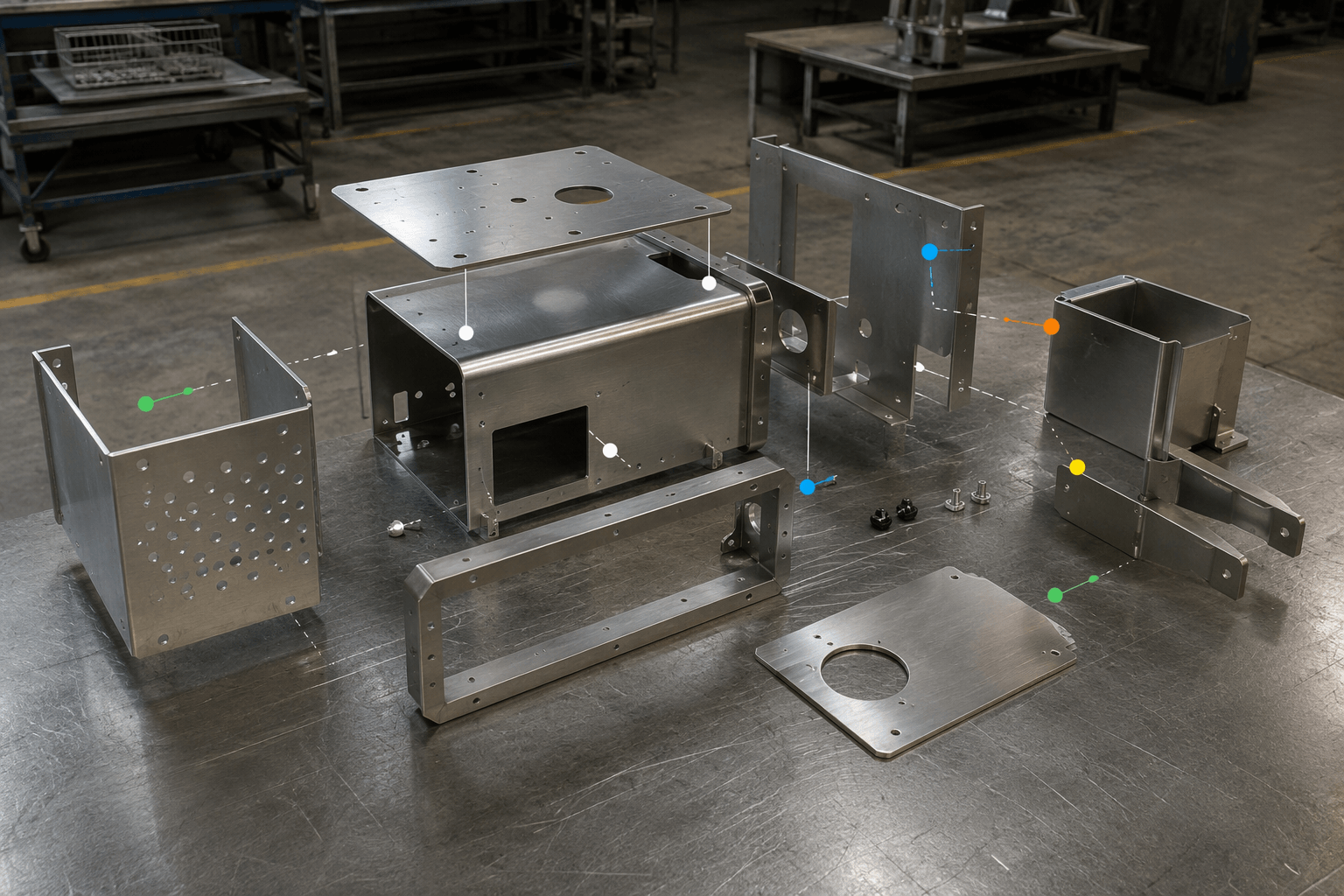
A custom enclosure, for example, is not adequately defined as “a stainless box.” Hole locations may need to align with controls, doors may require controlled gaps, hardware must suit the assembly method, and exposed surfaces need an agreed appearance. These considerations are illustrated in drawing-based custom sheet metal enclosures, where dimensions, finish, hardware, and assembly interfaces are treated as separate requirements.
Fabrication processes should also remain conceptually distinct. Cutting creates profiles; forming changes geometry; welding joins components; finishing changes or protects surfaces; and assembly combines parts and hardware. Machining may be specified for a particular interface, but it is not interchangeable with sheet metal fabrication. Inspection verifies defined requirements rather than creating them.
What Defines a Custom Stainless Product?
The following specification matrix separates decisions that are often compressed into a vague request such as “make this in stainless.” Each field affects manufacturability, inspection, cost, or final fit in a different way.
| Specification field | What the buyer should define | What can go wrong if it is unclear |
|---|---|---|
| Product form | Panel, bracket, cover, cabinet, enclosure, frame, or welded assembly | The supplier may interpret the required production and assembly scope differently. |
| Material | Required stainless grade or governing material specification, stock form, and any documentation expectations | Material may be unsuitable for the environment or inconsistent with the buyer’s approval requirements. |
| Dimensions | Overall size, thickness, hole patterns, bend geometry, and interface locations | The product may not fit neighboring parts, equipment, or packaging constraints. |
| Tolerances | Critical dimensional and geometric limits rather than an unnecessarily tight blanket tolerance | Important features may be uncontrolled, while noncritical features add avoidable manufacturing difficulty. |
| Surface finish | Required texture, appearance direction, coating or treatment if applicable, and areas with special requirements | Visible panels may vary in appearance, or contact and cleaning surfaces may not meet end-use expectations. |
| Joining | Weld locations and acceptance expectations, fastener types, inserts, or other joining instructions | Distortion, access problems, visible joints, or incompatible assembly methods may result. |
| Assembly and fit | Installed hardware, mating components, gap conditions, alignment points, and delivery state | Individually acceptable parts may fail to assemble as a complete product. |
| Inspection | Critical characteristics, inspection method where necessary, sampling expectations, and required records | Buyer and manufacturer may use different acceptance criteria. |
Grade and operating conditions
The material callout should follow the product’s operating environment and applicable design requirements. Exposure to moisture, cleaning chemicals, heat, contaminants, or outdoor conditions can change what is suitable. Material selection may also be influenced by forming, welding, appearance, or contact requirements. A generic “stainless” note leaves these decisions unresolved.
Geometry and tolerance
Dimensions define nominal shape; tolerances define acceptable variation. Buyers should identify interfaces that affect function: mounting holes, hinge axes, frame squareness, door openings, datum surfaces, and the location of attached components. Tolerance feasibility varies with thickness, geometry, process sequence, heat input, and the way the finished assembly is measured.
Finish and appearance
A material grade does not automatically establish the surface finish. The drawing or finish specification should distinguish cosmetic faces from hidden faces and identify directional appearance, handling expectations, or post-weld treatment where relevant. If multiple panels are viewed together, the expected visual relationship should be discussed before production.
Welds, fasteners, and complete assemblies
Joining instructions need to account for access, strength, appearance, distortion, cleaning, and later maintenance. A fabricated frame may require controlled geometry after welding as well as suitable mounting interfaces. The same principle applies to custom metal frames intended to arrive ready for assembly: weld requirements, stability, and fit cannot be inferred from the material name.
How the Application Changes the Product Requirements
The end use determines which characteristics deserve priority. These are application requirements; they are not manufacturing processes. The manufacturer then selects and reviews appropriate operations against the product definition.
| Application condition | Product questions to resolve | Likely specification focus |
|---|---|---|
| Corrosive or wet exposure | What substances contact the product, for how long, and under what temperature or cleaning conditions? | Material specification, joint design, drainage, surface condition, and treatment expectations |
| Frequent cleaning | Are there crevices, inaccessible seams, rough areas, or trapped liquids? | Contact surfaces, weld treatment, edge details, access, and cleanable geometry |
| Visible equipment exterior | Which faces are cosmetic, and how will adjacent panels be viewed? | Finish direction, scratch expectations, joint visibility, gaps, and panel alignment |
| Load-bearing frame | What loads, mounting points, and connected equipment must the assembly accommodate? | Section geometry, weld definition, stability, datum scheme, and assembly fit |
| Equipment cover or enclosure | What components, cables, doors, seals, and service access must be accommodated? | Cutouts, hardware, clearances, bend geometry, and interface control |
| Food and beverage equipment context | Which areas contact products or cleaning agents, and which are non-contact structural or exterior parts? | Cleaning access, contact-surface definition, finish expectations, and operating environment |
For example, a hypothetical exterior cabinet and a food-contact-area component may both be described as stainless products, yet their important characteristics are different. The cabinet may prioritize panel alignment and cosmetic consistency, while the contact-area component may place greater emphasis on cleanable geometry and clearly defined surfaces. Further application context is available in this overview of custom metal fabrication for food and beverage equipment.
Preparing a Product Definition for Manufacturing Review
Before discussing manufacturability, prototype work, or batch production, buyers can organize the project in a short sequence:
- Identify the product and application. Explain what the part does, where it operates, what it contacts, and whether it is visible to the end user.
- Provide controlled design data. Send the current drawing revision and, where applicable, matching 3D data. Identify which document governs if information conflicts.
- State material and finish requirements separately. Include the required material specification, surface expectations, treatment instructions, and documentation needs.
- Mark critical interfaces. Highlight functional dimensions, datums, mating parts, hole patterns, gaps, alignment conditions, and features that influence installation.
- Define joining and delivery state. Clarify welds, fasteners, supplied hardware, subassemblies, and whether the product should arrive loose, partially assembled, or complete.
- Set inspection expectations. Identify critical characteristics, acceptance criteria, inspection records, and any approved reference sample or appearance standard.
- Explain the production context. State whether the request concerns a concept, prototype, design revision, or batch requirement. This supports process planning without assuming that prototype and production conditions are identical.
Change control matters throughout this workflow. Revised drawings, finish substitutions, hardware changes, and altered inspection requirements should be documented so that commercial and technical discussions refer to the same product definition.
Frequently Asked Questions
Is stainless steel an alloy or a standalone metal?
Stainless steel is an alloy family, not a pure standalone metal. Its composition and governing specification influence corrosion behavior, fabrication, welding, and other properties. The alloy designation still does not define the final product geometry, finish, assembly, or inspection plan.
What distinguishes a custom stainless product from a standard catalog item?
A catalog item is selected from predefined dimensions and configurations. A custom product is controlled by buyer-specific drawings, models, interfaces, finish instructions, joining details, or acceptance requirements. Even a simple bracket becomes custom when its geometry or fit is made for a particular assembly.
Does specifying a stainless grade automatically define the surface finish?
No. Grade and finish are separate specification fields. Surface appearance can also be affected by stock condition, forming, welding, finishing operations, handling, and the distinction between cosmetic and non-cosmetic faces. Buyers should state the required finish independently.
When should drawings include weld, assembly-fit, and inspection requirements?
They should be included whenever those requirements affect function, appearance, installation, cleaning, structural behavior, or acceptance. Defining them before manufacturing review reduces reliance on assumptions and helps the supplier evaluate the complete product rather than isolated parts.
Request a Technical Specification Review
For a technical specification review, provide the product drawing or concept, intended application and operating environment, material and finish requirements, and critical fit, assembly, and inspection expectations. Yishang can then review whether the product definition is sufficiently complete for an OEM or ODM manufacturing discussion and identify information that should be clarified before quotation.