
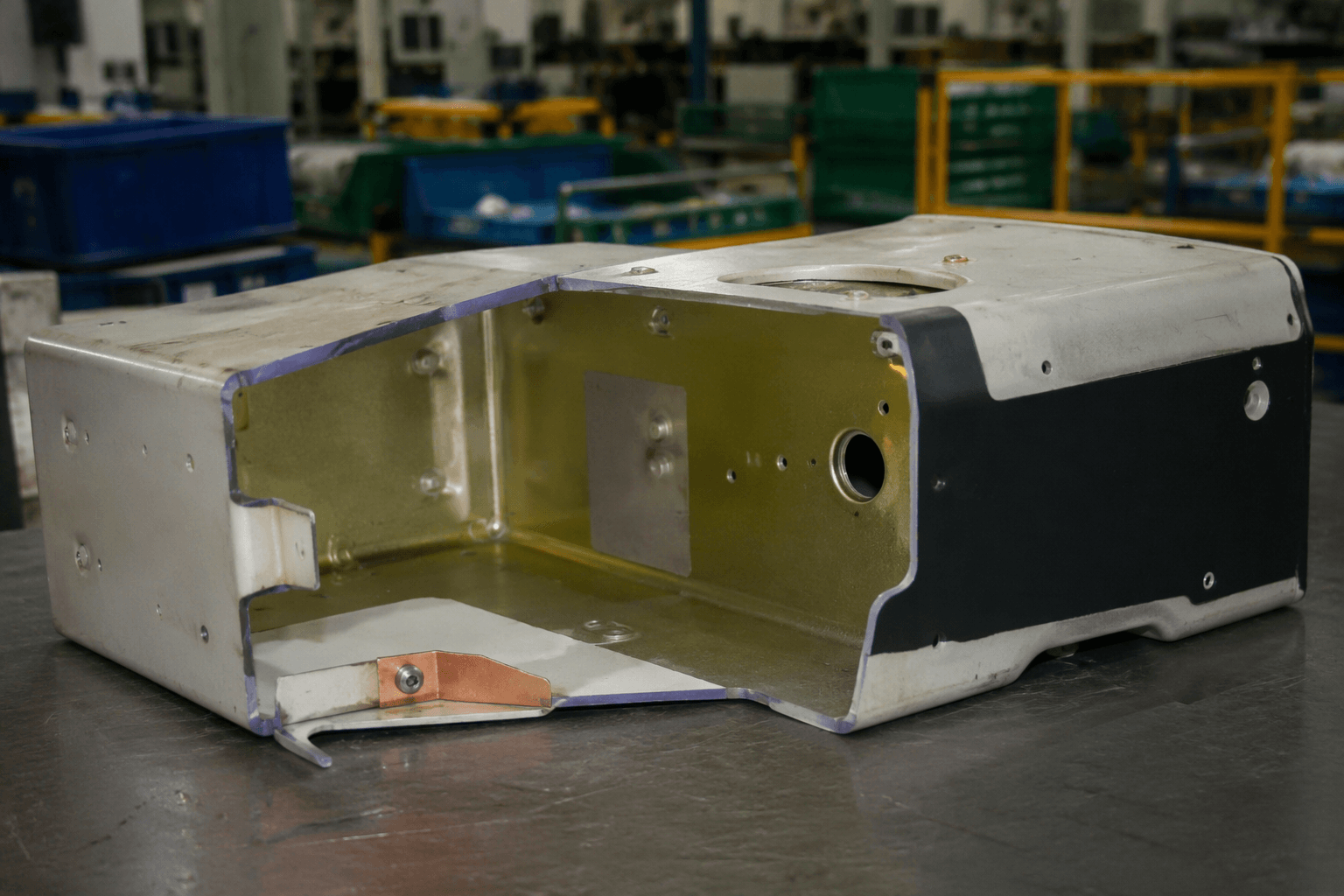
Alodine chromate conversion coating is a chemical surface treatment used primarily on aluminum to improve corrosion protection, support paint adhesion, and retain electrical contact where required. It modifies the aluminum surface through a chemical reaction instead of depositing a thick structural layer, but the required class, chemistry type, substrate preparation, and acceptance criteria must be defined before the term becomes a complete manufacturing instruction.
Two drawings may both state Alodine while requiring very different results. One part may need corrosion protection beneath paint; another may need a low-resistance grounding area, non-hexavalent chemistry, selective masking, or application-specific testing. Treating those callouts as equivalent creates avoidable finishing and inspection risks.
What Alodine, Chem Film, and Conversion Coating Mean
Chemical conversion coating is the technical process category. MIL-DTL-5541 describes coatings formed by a reaction between chemical conversion materials and aluminum or aluminum-alloy surfaces. The process is also commonly called chem film or chromate conversion coating, although the exact chemistry does not always contain hexavalent chromium. ([quicksearch.dla.mil](https://quicksearch.dla.mil/Transient/C2DC8261558345B898F9626EA82C731C.pdf))
Alodine originated as a Henkel product name and is still used generically on many engineering drawings. Henkel technical documentation now identifies various BONDERITE products as previously or commonly known by specific Alodine names. These products can use different formulations and process instructions, so the word Alodine alone does not identify a universal chemical bath or qualified result. ([gated.datasheets.tdx.henkel.com](https://gated.datasheets.tdx.henkel.com/gated/BONDERITE-M-CR-1001-AERO-Technical-Process-Bulletin-en_US.pdf?utm_source=openai))
- Chemical conversion coating
- The process family: a treatment chemically reacts with the aluminum surface.
- Alodine
- A trade name often used as a general shop or drawing term.
- Chem film
- Common shorthand for a chemical film on aluminum.
- Chromate
- A chemistry-related term that may be used broadly, but does not by itself define the MIL-DTL-5541 type, class, or product.
Products qualified within the same specification type and class are intended to meet the applicable performance requirements, but their proprietary ingredients, equipment, application methods, and operating controls can differ. Therefore, buyers should compare the specified outcome rather than assuming that every named conversion product is interchangeable in production.
How the Treatment Changes an Aluminum Surface
Unlike plating, painting, or powder coating, this treatment does not add a separate, thick covering. The prepared aluminum reacts with the conversion solution to form a closely integrated surface film. Its dimensional effect is generally small, making it useful for fabricated components with fitted edges, threaded features, holes, and assembly interfaces. It should not, however, be specified as a wear-resistant buildup comparable to anodizing.
Corrosion protection
The converted surface helps reduce corrosion on exposed aluminum and can provide protection beneath a subsequent paint system. The required performance depends on the selected class, material qualification, alloy, surface preparation, processing controls, and acceptance requirements—not simply whether the finished part looks yellow or clear.
Electrical contact and grounding
A suitable conversion coating can preserve lower electrical contact resistance than a thicker insulating oxide finish. This is valuable around grounding points, enclosure joints, mounting pads, and some EMI-related contact surfaces. Class 3 indicates the intended electrical-contact function, but it does not guarantee a particular resistance under every assembly condition. Contact pressure, surface roughness, joint design, cleanliness, test method, and acceptance limit can all affect the measured result.
Paint and adhesive preparation
Conversion coating can improve the surface condition for paint adhesion, provided that cleaning, coating, handling, primer selection, and painting remain compatible. Henkel also identifies paint-bond improvement as a function of specific conversion products. ([next.henkel-adhesives.com](https://next.henkel-adhesives.com/us/en/products/surface-treatments/central-pdp.html/bonderite-m-cr-1200s-aero/62183IB.html))
Adhesive bonding requires more caution. A conversion-coated surface may form part of a qualified bonding process, but the coating name alone does not establish bond strength or long-term durability. The adhesive manufacturer’s instructions, surface-preparation procedure, cure conditions, environmental exposure, and program qualification still control the bonding result.
Class 1A, Class 3, Type I, and Type II
MIL-DTL-5541 separates the coating requirement into class, which describes the intended functional emphasis, and type, which identifies whether the material contains hexavalent chromium. These choices answer different engineering questions.
| Designation | Practical intent | Points requiring confirmation |
|---|---|---|
| Class 1A | Prioritizes corrosion protection for painted or unpainted aluminum. | Exposure, paint system, coated areas, appearance requirement, and applicable corrosion acceptance. |
| Class 3 | Provides corrosion protection where lower electrical contact resistance is required. | Contact surfaces, masking, resistance test method, electrode or assembly conditions, and acceptance limit. |
| Type I | Uses compositions containing hexavalent chromium. | Customer, regulatory, workplace, disposal, and program restrictions. |
| Type II | Uses compositions containing no hexavalent chromium. | Qualified product, required class, color expectations, and downstream-process compatibility. |
The governing specification identifies Class 1A for maximum corrosion protection and Class 3 for corrosion protection where low electrical resistance is needed. It defines Type I as containing hexavalent chromium and Type II as containing no hexavalent chromium. Substitution between the two types is not permitted unless the contract or order allows it. ([quicksearch.dla.mil](https://quicksearch.dla.mil/Transient/C2DC8261558345B898F9626EA82C731C.pdf))
This distinction matters when a program restricts hexavalent chromium. A note such as RoHS compliant or hexavalent chromium prohibited should not be left for the processor to infer from the application. The drawing or purchase documentation should identify the required chemistry category and any separate material-declaration obligations.
Why Results Vary Between Aluminum Parts
A coating label does not erase differences in substrate and processing. Even parts treated on the same line may differ in appearance or response because the underlying material and surface history are different.
| Variable | Possible effect | Engineering response |
|---|---|---|
| Aluminum alloy and temper | Copper, silicon, cladding, and other alloy constituents can influence reaction, color, and corrosion behavior. | Identify the actual alloy and temper instead of specifying only aluminum. |
| Welds, castings, and heat-affected areas | Oxides, impurities, and local composition changes can create less uniform appearance. | Define functional acceptance separately from purely cosmetic expectations. |
| Oil, oxide, and shop contamination | Poor preparation may prevent a continuous, effective film from forming. | Control cleaning, rinsing, deoxidizing, handling, and water-break-free preparation. |
| Bath condition and application method | Concentration, pH, temperature, time, immersion, spray, or brush application can change the coating response. | Use approved materials and controlled instructions for the applicable type, class, form, and method. |
| Rinsing and drying | Carryover, contamination, or unsuitable drying can affect appearance and subsequent finishing. | Protect the treated surface from damage and contamination before painting, bonding, or assembly. |
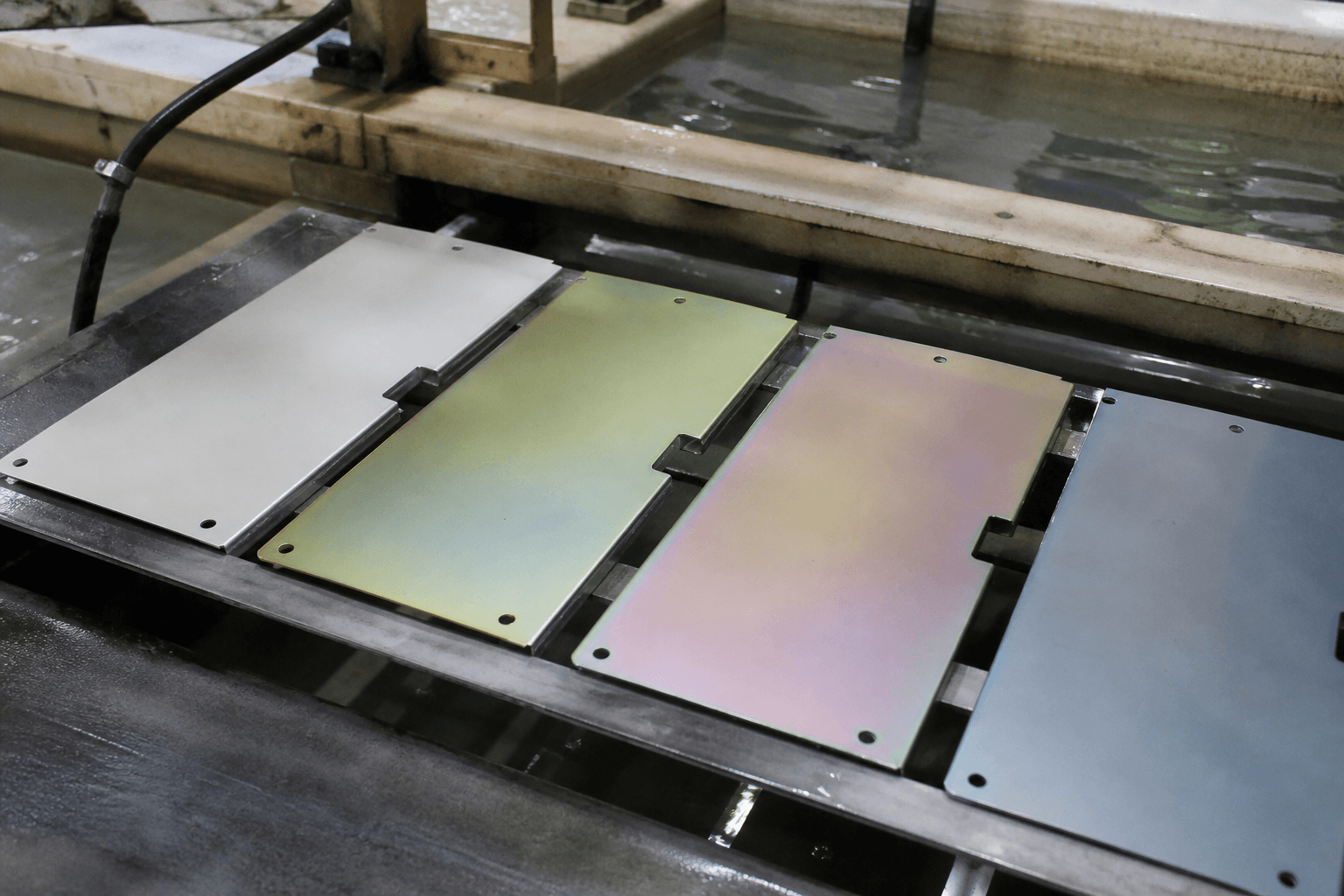
MIL-DTL-5541 notes that qualified coatings can range from clear or colorless through yellow, brown, gray, or blue. It also recognizes that color can vary between alloys and that welds or castings may be less uniform than wrought material. Color therefore supports visual inspection, but it does not independently prove the coating class, chemistry type, or complete specification compliance. ([quicksearch.dla.mil](https://quicksearch.dla.mil/Transient/C2DC8261558345B898F9626EA82C731C.pdf))
Selective masking should also be planned before processing. An aluminum sheet metal enclosure, for example, may require a painted exterior, conductive grounding pads, protected threaded inserts, and masked cosmetic areas. Likewise, custom aluminum extrusion components may have cut ends, machined interfaces, or assembly surfaces needing different finishing instructions.
Turning an Alodine Note into a Usable Requirement
A drawing that says only Alodine leaves several engineering decisions unresolved. Before production, the drawing owner or authorized engineering function should clarify the missing information rather than allowing a supplier to choose a convenient class, color, or chemistry.
- Identify the substrate. State the aluminum alloy, temper, and whether the part includes welds, cast sections, clad material, or dissimilar-metal inserts.
- Invoke the specification and revision. State the applicable MIL-DTL-5541 revision, or formally resolve a legacy MIL-C-5541 reference. The contractually invoked revision controls; a supplier should not silently replace it with a different edition.
- Specify class and type. Define Class 1A or Class 3 and Type I or Type II as required by corrosion, electrical, and restricted-substance needs.
- Define coverage and masking. Mark surfaces that must be coated, left bare, painted, bonded, grounded, or protected from the treatment.
- State downstream operations. Identify primer, paint, powder coating, adhesive bonding, electrical assembly, sealant, or other processes that depend on surface condition.
- Define verification. Reference the applicable appearance, process-control, conformance, corrosion, adhesion, electrical, documentation, sampling, or traceability requirements.
The specification includes process-control and conformance inspections, while electrical contact-resistance testing for Class 3 must be specified by the acquisition activity when required. This is why writing only Class 3 may still be insufficient for a critical grounding interface. ([quicksearch.dla.mil](https://quicksearch.dla.mil/Transient/C2DC8261558345B898F9626EA82C731C.pdf))
Match the Requirement to the Surface Function
| Primary surface function | Likely specification focus | Still needs engineering confirmation |
|---|---|---|
| Unpainted corrosion protection | Corrosion-focused class and complete coated coverage | Exposure, alloy, chemistry restrictions, appearance, and acceptance testing |
| Grounding or electrical contact | Class 3 and clearly identified contact areas | Resistance limit, test method, contact pressure, masking, and assembly condition |
| Preparation for paint | Compatible conversion treatment and controlled cleanliness | Primer system, time before painting, handling, adhesion test, and cosmetic criteria |
| Adhesive-bonding surface | Bond-process-approved preparation | Adhesive compatibility, qualification, environmental durability, and contamination control |
| Restricted chemistry program | Explicit Type II or other approved non-hexavalent requirement | Qualified material, declarations, color expectations, and customer approval |
For an aluminum bracket manufactured to a drawing, the correct finish instruction may need to distinguish the exposed body, a painted face, a bolted grounding pad, and masked threads. That functional map is more useful than a general instruction to Alodine the entire part.
Frequently Asked Questions
What is chromate conversion coating used for on aluminum?
It is used to improve corrosion protection, prepare aluminum for compatible paint systems, and support lower-resistance electrical contact where the specified class and joint design require it. The intended function should determine the class, chemistry type, coated areas, and inspection requirements.
Can aluminum be anodized after a chemical conversion coating has already been applied?
Anodizing should not routinely be applied directly over an existing conversion coating. The prior film normally requires removal and the surface must be prepared according to the approved anodizing process. Reprocessing should follow engineering and processor instructions because stripping may affect dimensions, surface condition, or previously finished areas.
Is trivalent chromate plating the same as Type II conversion coating on aluminum?
No. Trivalent chromate plating often describes a passivation used over zinc or another plated metal. MIL-DTL-5541 Type II describes conversion materials for aluminum that contain no hexavalent chromium. Some Type II products may use trivalent chromium, while others use different non-hexavalent chemistries, so the substrate and governing specification must be identified.
Does a yellow or clear appearance prove the coating class or specification compliance?
No. Color can vary with the conversion material, alloy, surface condition, application, and process controls. A clear coating is not automatically Type II or Class 3, and a yellow coating is not automatically Type I or Class 1A. Compliance must be established through the specified material, controlled process, inspection, testing, and documentation.