
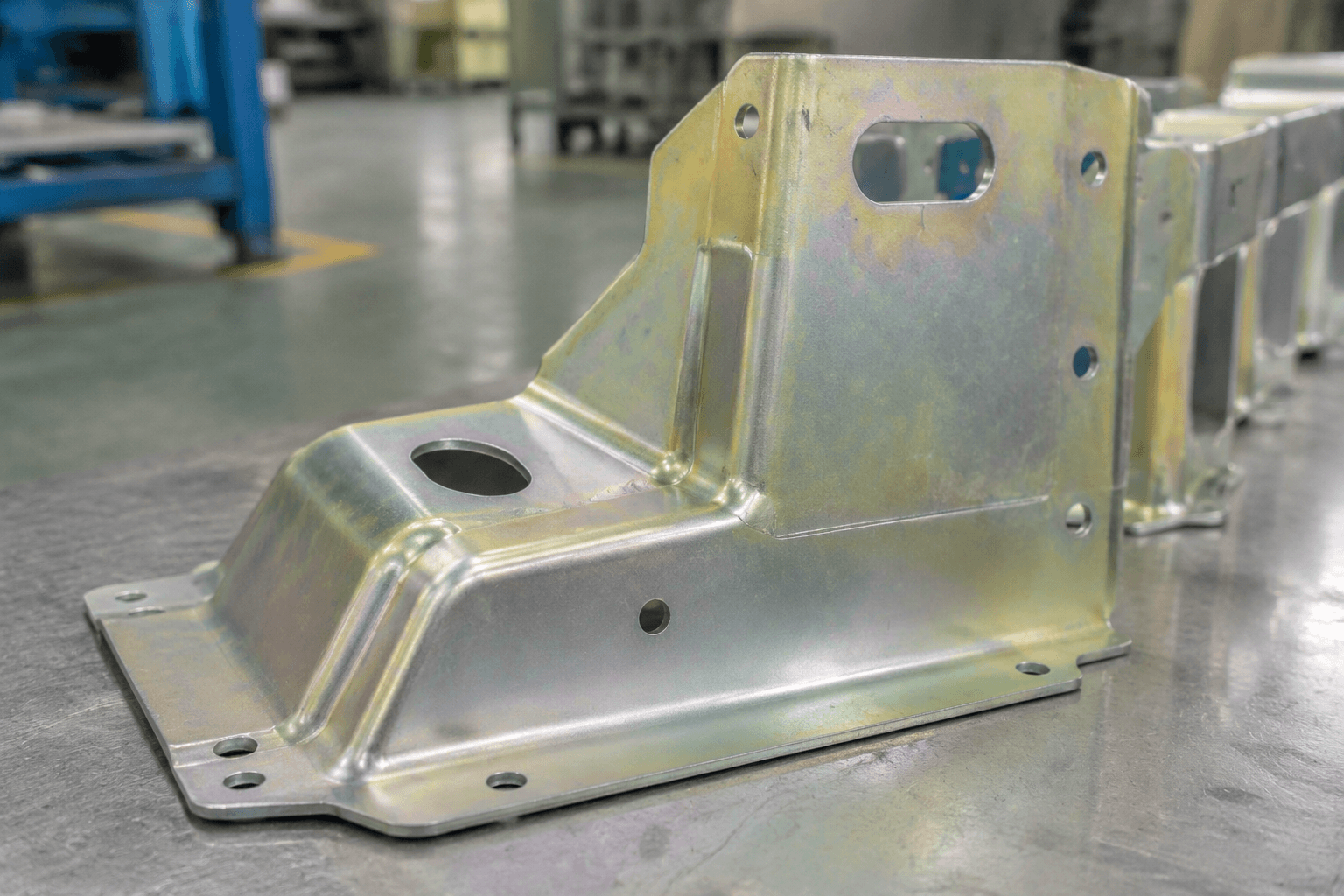
An alodine finish is a thin chemical conversion treatment used mainly on aluminum and aluminum alloys; it is not anodizing, plating, or a decorative paint film. Engineers typically select it for corrosion protection, electrical contact compatibility, paint adhesion, and minimal dimensional change, but the word alodine alone does not define the required chemistry, class, appearance, or compliance standard.
Alodine originated as a trade-associated name and is now commonly used in drawings and purchasing discussions as shorthand for chemical conversion coating, chromate conversion coating, or chem film. Because different conversion materials can produce different results, the functional requirement should be stated more precisely than the trade name.
What the Treatment Changes on Aluminum
A chemical conversion process reacts with the aluminum surface to form a very thin protective layer. Unlike paint, it does not create a separate organic film, and unlike anodizing, it does not build a comparatively substantial engineered oxide layer. Its dimensional effect is therefore usually treated as minimal for many aluminum-part dimensions, although critical fits, threads, electrical interfaces, and tightly controlled contact surfaces should still be reviewed.
The finish can slow corrosion and provide a suitable base for subsequent primers or paints. Certain coating classes are also used where low electrical contact resistance is important. These benefits are conditional: alloy, cleaning quality, conversion chemistry, application control, handling, exposure, and the required test method all affect the finished result.
| Surface attribute | Practical engineering meaning | What should be verified |
|---|---|---|
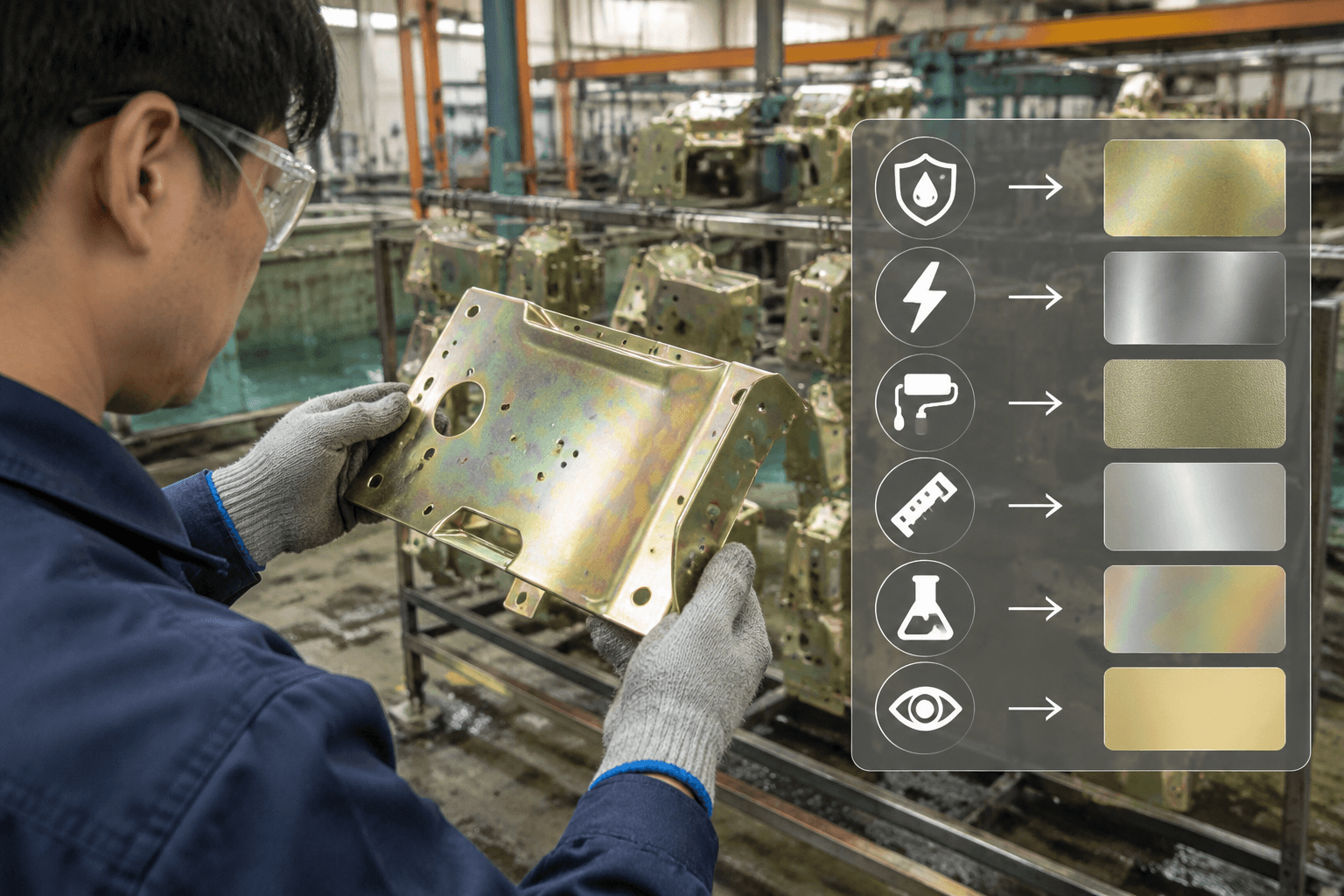
| Appearance | The surface may appear clear, faintly iridescent, yellow, gold, or brown. Some non-hexavalent systems are difficult to see. | Whether color is controlled, merely informative, or not an acceptance criterion. |
| Corrosion protection | The conversion layer improves the resistance of aluminum to environmental attack and can protect unpainted areas. | Applicable class, alloy, exposure condition, and specified corrosion test. |
| Electrical behavior | It can preserve more useful contact behavior than insulating finishes such as paint or many anodized surfaces. | Required class, contact location, assembly pressure, and resistance test conditions. |
| Paint adhesion | A properly prepared conversion-coated surface can act as a pretreatment for liquid paint or powder coating systems. | Primer or paint system, maximum delay before coating, cleanliness, and adhesion test. |
| Dimensional effect | The reaction layer produces far less build than most painted or anodized finish systems. | Masking, threaded areas, grounding pads, and any tolerance-sensitive interfaces. |
Visual appearance should not be used as a substitute for performance verification. A uniform gold color does not by itself prove corrosion resistance, and a nearly clear surface does not prove that no treatment is present.
When Alodine Fits Better Than Other Finish Options
The correct choice depends on what the part must do after finishing. For example, an aluminum electronics enclosure may need corrosion protection while retaining conductive mounting or grounding areas. A visible consumer panel may instead prioritize controlled color and abrasion resistance. A transport bracket may require conversion coating beneath a painted system rather than as the final exposed appearance.
| Finish condition | Typical selection priority | Electrical contact | Wear and appearance | Dimensional consideration |
|---|---|---|---|---|
| Alodine or chem film | Corrosion protection, paint pretreatment, or conductive interfaces | Often preferred where low contact resistance must be maintained, subject to class and testing | Limited wear protection; color can vary | Minimal change |
| Anodizing | Greater surface durability, abrasion resistance, or controlled decorative appearance | The oxide layer is generally electrically insulating | Better wear resistance and broader appearance control | Build-up and dimensional effects require allowance |
| Paint or powder coating | Color, environmental barrier, branding, or broader exterior protection | Normally insulating unless contact areas are masked or prepared | Good visual control; durability depends on the coating system | Film build must be considered |
| Bare aluminum | Lowest process complexity where exposure and appearance permit | No added coating barrier, but oxide and corrosion can affect contacts | Limited corrosion and appearance control | No added finish build |
Alodine is not a thick, wear-resistant coating. If sliding contact, repeated abrasion, decorative uniformity, or a specific color is the primary requirement, anodizing or an organic coating may be more appropriate. Conversely, chem film can be useful on custom sheet metal enclosures when conductive joints, masked grounding pads, paint preparation, and corrosion protection must be coordinated.
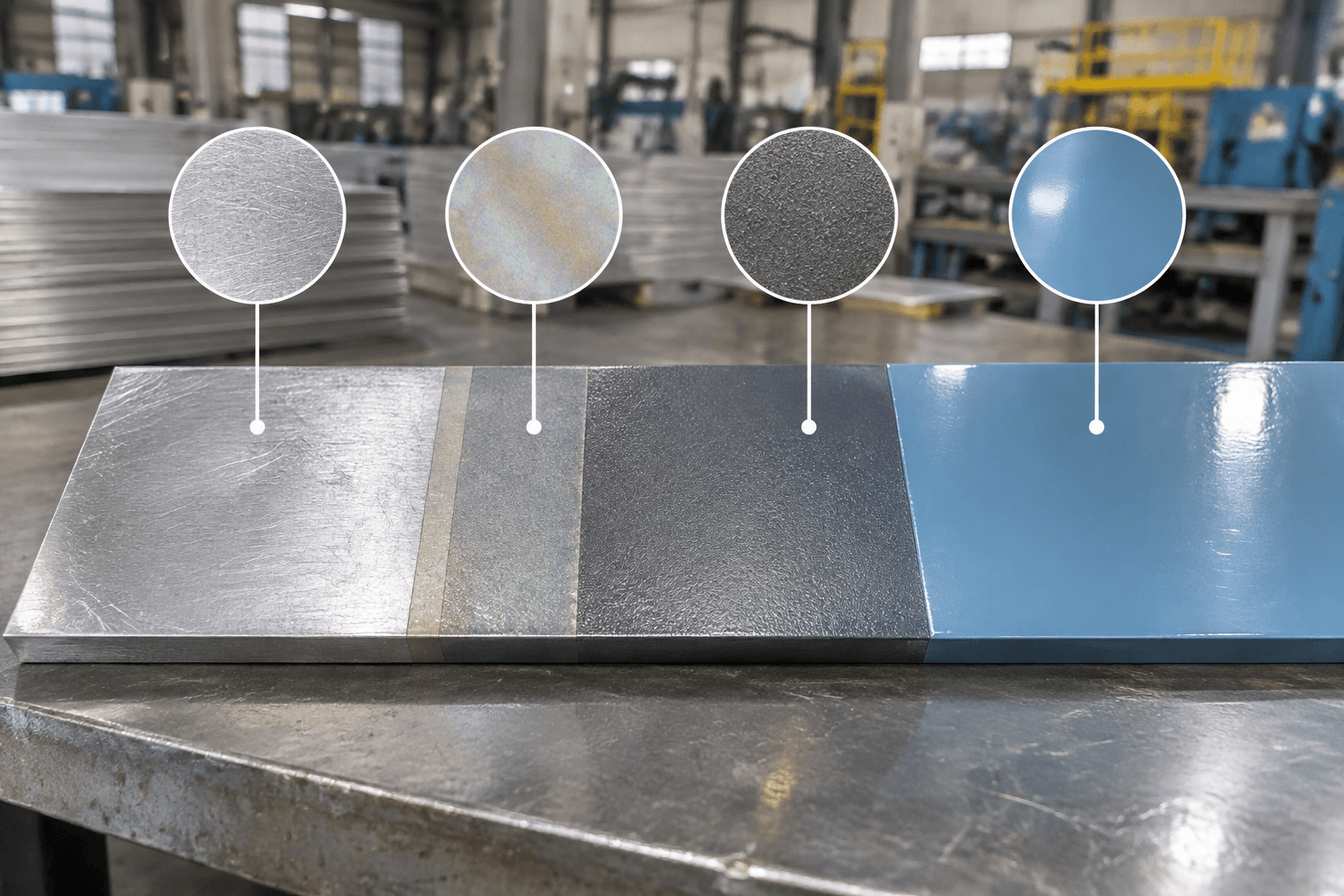
Type, Class, and Specification Roles
Type I and Type II describe chemistry categories
Under MIL-DTL-5541, Type I compositions contain hexavalent chromium, while Type II compositions contain no hexavalent chromium. Type I has a long history of corrosion protection and may produce clear-to-gold or brown tones depending on the qualified material and process. Type II is selected when hexavalent chromium is restricted, but its appearance, corrosion performance, and electrical behavior should be confirmed against the required material, class, alloy, and test conditions rather than assumed to match Type I. Type alone does not establish the finished coating’s conductivity.
Type II does not automatically mean a particular color or universal regulatory outcome. Procurement teams should state the applicable substance restriction or customer specification instead of relying only on terms such as “RoHS finish,” “clear alodine,” or “chromium-free.” Some non-hexavalent products still contain other forms of chromium, while other systems use different chemistry.
Class identifies the performance priority
MIL-DTL-5541 Class 1A is intended for maximum corrosion protection on painted or unpainted surfaces. Class 3 is intended for corrosion protection where low electrical resistance is required. These classes are not simply color grades, and neither should be selected by visual preference alone. The specification also does not permit Type I and Type II to be treated as automatically interchangeable. ([anodiq.com](https://anodiq.com/media/pages/home/features/conversion-chromique-trivalente-rohs/2345287709-1659573605/norme-militaire-chromate.pdf?utm_source=openai))
The standards perform different jobs
- MIL-DTL-5541 addresses the required chemical conversion coating formed on aluminum and aluminum alloys, including types, classes, application requirements, and coating performance.
- MIL-DTL-81706 covers the chemical conversion materials used to form those coatings and their qualification by type, class, form, and application method. Calling out MIL-DTL-5541 does not make every conversion product acceptable.
- AMS 2473 is a separate SAE aerospace material specification establishing requirements for producing general-purpose chemical-film coatings on aluminum alloys and for the resulting coating properties.
At the time of publication, the U.S. ASSIST database lists MIL-DTL-5541F and MIL-DTL-81706B as active with validation notices dated February 7, 2024. SAE lists AMS2473K as the current revision, dated May 3, 2025. Contract documents should still identify the required revision or establish how the current revision is determined. ([quicksearch.dla.mil](https://quicksearch.dla.mil/qaDocDetails.aspx?ident_number=5499&utm_source=openai))
Why Alodine Appearance and Performance Vary
Conversion coating performance starts before the treatment solution touches the part. Oil, polishing residue, marking compounds, embedded abrasive, oxidation, or poor rinsing can cause patchiness and weak performance. The applicable work instructions may vary, but a controlled sequence commonly includes cleaning, rinsing, surface conditioning or deoxidizing when required, conversion treatment, another rinse unless a qualified no-rinse system is used, and controlled drying.
The surface normally needs to be uniformly wettable after cleaning. Water breaks can indicate remaining contamination, which may interfere with conversion, painting, or sealing. Rinse quality also matters around seams, formed returns, fasteners, threaded features, and other areas where chemical residue can become trapped. ([faa.gov](https://www.faa.gov/documentLibrary/media/Advisory_Circular/AC_43-4B.pdf?utm_source=openai))
Treatment concentration, temperature, contact time, solution condition, alloy, and application method influence consistency. Drying and handling must avoid overheating, contamination, fingerprints, or mechanical damage. Parts intended for painting should be protected from contamination and coated within the time allowed by the governing process and paint requirements. A generic statement such as “dip in alodine” is therefore not an adequate production instruction.
Define the Required Surface Outcome Before Naming the Finish
| Design question | Information to place on the drawing or purchase requirement |
|---|---|
| What is the substrate? | Aluminum alloy, temper, part condition, and any cast, clad, welded, brazed, or repaired areas. |
| How severe is the corrosion exposure? | Governing finish specification, class, environmental test, and whether the surface remains unpainted. |
| Are conductive contacts required? | Contact locations, Class 3 or other requirement, masking details, assembly conditions, and verification method. |
| Will the part be painted? | Paint or primer system, areas to coat, pretreatment compatibility, timing, and adhesion acceptance criteria. |
| Is hexavalent chromium restricted? | Required Type II chemistry plus the applicable regulatory, customer, or material-substance requirement. |
| Does appearance matter? | Reference sample or realistic visual criteria, permitted variation, viewing conditions, and whether color is functional or cosmetic. |
| Are any areas finish-free? | Masking boundaries for threads, bearings, adhesive surfaces, electrical pads, identification marks, or precision interfaces. |
| What documentation is needed? | Certificate of conformance, process-material identification, inspection results, test reports, or customer approval requirements. |
A complete requirement might therefore identify the alloy, governing standard, revision policy, Type I or II, Class 1A or 3, paint system, masked areas, appearance criteria, and required inspection documentation. It should not copy a universal callout without confirming the application.
This level of detail is particularly important for drawing-defined aluminum brackets, where mounting interfaces and tight fits may conflict with paint build, and for transportation metal components that combine environmental exposure with assembly and secondary-coating requirements.
Before production, Yishang can review the finished-condition requirements for a B2B OEM or ODM sheet metal project. Share the aluminum alloy and drawing, required standard, type and class if defined, corrosion environment, electrical-contact areas, and any paint, masking, appearance, or inspection requirements. The purpose of this review is to identify unclear or conflicting finish instructions—not to assume a chemistry or qualification that the drawing does not specify.
Frequently Asked Questions
Can alodine be used on steel?
Alodine is primarily discussed as a chemical conversion treatment for aluminum and aluminum alloys. Steel generally uses material-specific pretreatments or coatings. Do not transfer an aluminum chem-film callout to steel without an applicable steel process specification and supporting evidence.
Are alodine and anodizing the same finish?
No. Alodine is a thin chemical conversion treatment, while anodizing electrochemically develops a more substantial aluminum oxide layer. Anodizing is commonly selected for wear resistance or decorative control; chem film is often selected for minimal dimensional effect, paint preparation, corrosion protection, or conductive contacts.
Why can alodine-finished parts vary from clear to yellow or brown?
Appearance varies with conversion chemistry, alloy, surface preparation, class, treatment time, bath condition, and process control. Non-hexavalent systems may be nearly clear. Color alone should not be used to identify the type or confirm compliance.
Can aluminum be painted after an alodine finish is applied?
Yes. Chemical conversion coating is widely used as an aluminum paint pretreatment because it can improve adhesion and corrosion protection. The conversion material, primer, paint system, cleanliness, drying, and permitted delay before painting must be compatible and controlled.