
Aluminium alloys 6061 are heat-treatable wrought aluminium-magnesium-silicon alloys, not one fixed material condition. The properties that matter in fabrication depend on the temper, product form, thickness, and applicable material specification.
For example, a drawing that states only “6061 aluminium” does not tell a supplier whether the part requires formable 6061-O sheet, naturally aged 6061-T4 material, higher-strength 6061-T6, stress-relieved plate, or an extruded profile. Those differences affect bending, welding, machining, dimensional control, finishing, and inspection.
What “6061” Actually Specifies
The number 6061 identifies the alloy composition within the 6000 series. Magnesium and silicon are its principal alloying elements, with controlled additions of elements such as copper and chromium. It is a heat-treatable alloy, meaning that solution heat treatment and ageing can change its mechanical properties substantially. ([hydro.com](https://www.hydro.com/globalassets/01-products–services/extruded-profiles/americas/ena-resources/alloy-data-sheets/hydro_2019_data_sheet_6061.pdf?utm_source=openai))
The alloy number is only the first part of a complete material description. Three elements should normally be considered together:
- Alloy designation: identifies the permitted chemical composition, such as 6061.
- Temper: identifies the material condition created by thermal treatment, ageing, strain hardening, or stress relief. Examples include O, T4, T6, T451, T651, and T6511.
- Product form: identifies whether the material is supplied as sheet, plate, bar, tube, or extrusion.
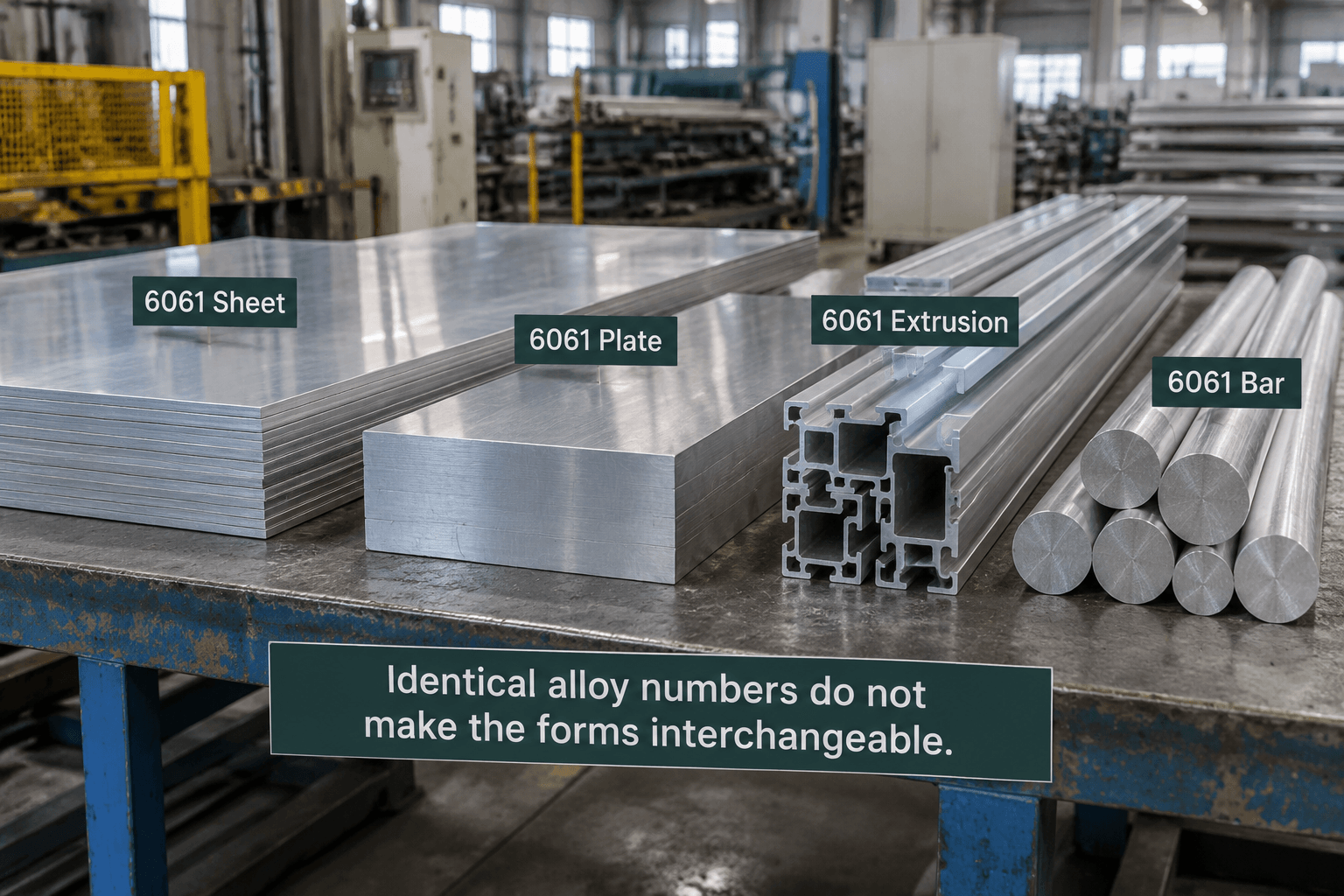
Product form is not a minor purchasing detail. Sheet and plate are rolled products, while an extrusion is pushed through a die to create a defined cross-section. Bar and tube have their own dimensional standards and available tempers. A 6061-T6 extrusion therefore cannot automatically replace 6061-T6 sheet merely because the alloy and temper labels match. The dimensional tolerances, grain structure, surface condition, and mechanical-property requirements may be different.
This distinction is especially important for components combining profiles and fabricated panels. A project may use a custom 6061 aluminium extrusion for a frame and sheet or plate for brackets, covers, or mounting panels. Each item needs its own product-form specification.
How Temper Changes 6061 Properties
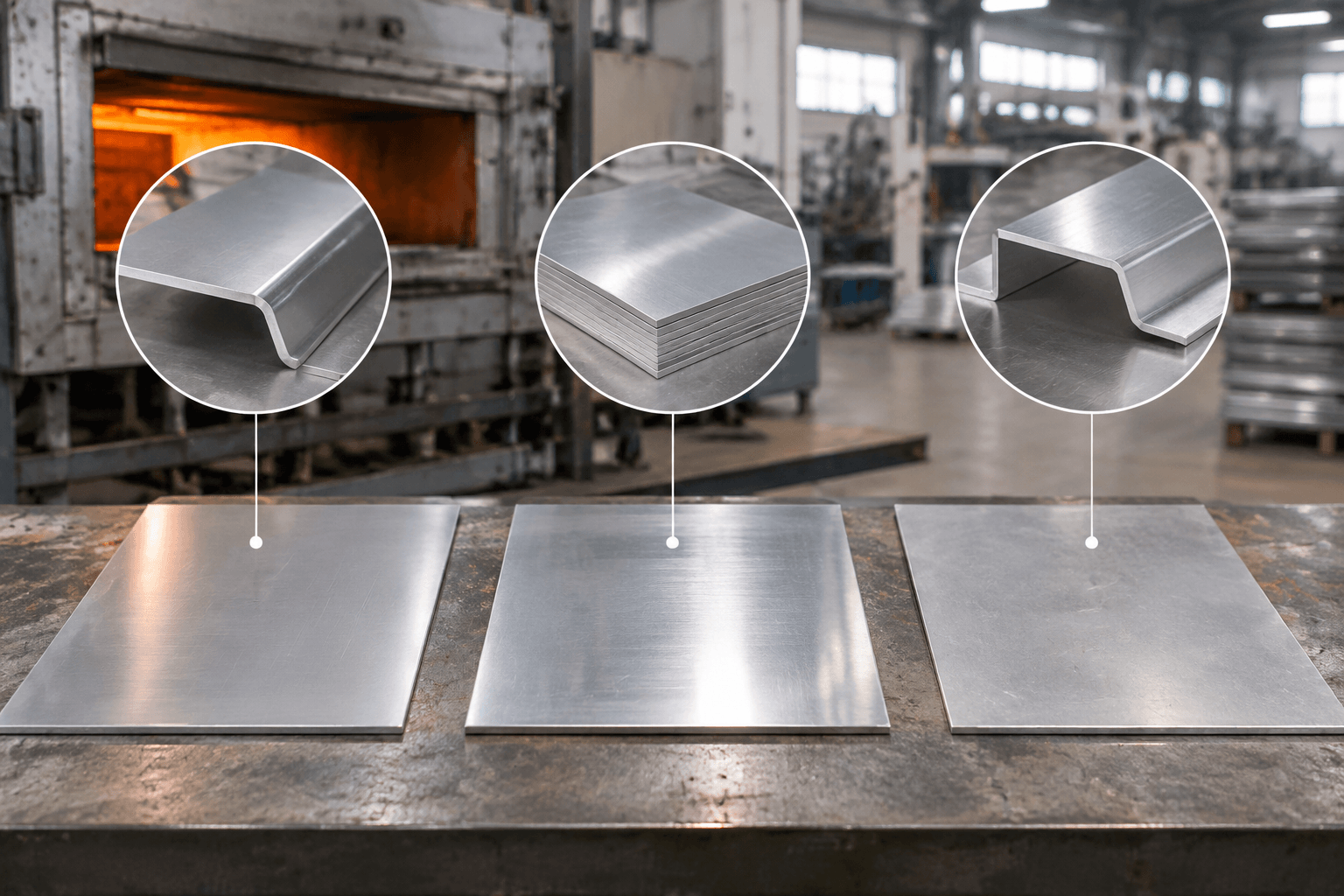
The O condition is annealed and relatively soft. T4 is solution heat-treated and naturally aged, while T6 is solution heat-treated and artificially aged. Stress-relieved suffixes such as T451, T651, and T6511 add further processing intended to reduce residual stress in particular product forms.
The following values illustrate why a temper must accompany the alloy number. They are representative published limits for 6061 extrusions, not universal design values for every sheet, plate, tube, or bar. The applicable purchasing specification and mill certificate should govern acceptance.
| Supplied condition | Representative extrusion properties | Practical fabrication meaning |
|---|---|---|
| 6061-O | Ultimate tensile strength up to 150 MPa; yield strength up to 110 MPa; minimum elongation 16% | Lower strength but greater ductility. Generally the most suitable of these conditions for demanding forming. |
| 6061-T4 or T4511 | Minimum ultimate strength 180 MPa; minimum yield strength 110 MPa; minimum elongation 16% | A balance between formability and strength. The material may continue to age after solution treatment. |
| 6061-T6 or T6511 | Minimum ultimate strength 260 MPa; minimum yield strength 240 MPa; minimum elongation 8% or 10%, depending on section thickness | Higher strength and hardness but reduced forming margin. Bend feasibility becomes more sensitive to radius, orientation, thickness, and tooling. |
| T451, T651, or related stress-relieved conditions | Requirements vary by plate, bar, or extrusion specification | Often selected when machining stability or residual-stress control matters. The suffix must match the ordered product form. |
Published sheet and plate limits also change with thickness. For example, one producer lists minimum values for 6061-T6 sheet of approximately 290 MPa ultimate strength and 241 MPa yield strength, while minimum elongation varies across thickness ranges. ([online.kaiseraluminum.com](https://online.kaiseraluminum.com/depot/PublicProductInformation/Document/1010/Kaiser_Aluminum_Sheet___Plate.pdf?utm_source=openai))
Hardness follows the same general trend. Representative producer data for 6061 tube reports typical Brinell hardness values of about 30 in O, 65 in T4, and 95 in T6. These figures describe that producer’s tested material and should not be copied into a drawing as universal acceptance limits. ([online.kaiseraluminum.com](https://online.kaiseraluminum.com/depot/PublicProductInformation/Document/1011/Kaiser_Aluminum_Soft_Alloy_Tube.pdf?utm_source=openai))
How 6061 Temper Affects Fabrication
Bending and sheet metal forming
6061 can be bent, but the temper and geometry determine how forgiving the operation will be. O-temper material offers the greatest forming margin, and T4 is generally more formable than T6. Fully aged T6 material has higher strength and lower ductility, so a tight inside radius, a short flange, an edge close to the bend, or an unfavorable grain direction can increase cracking risk.
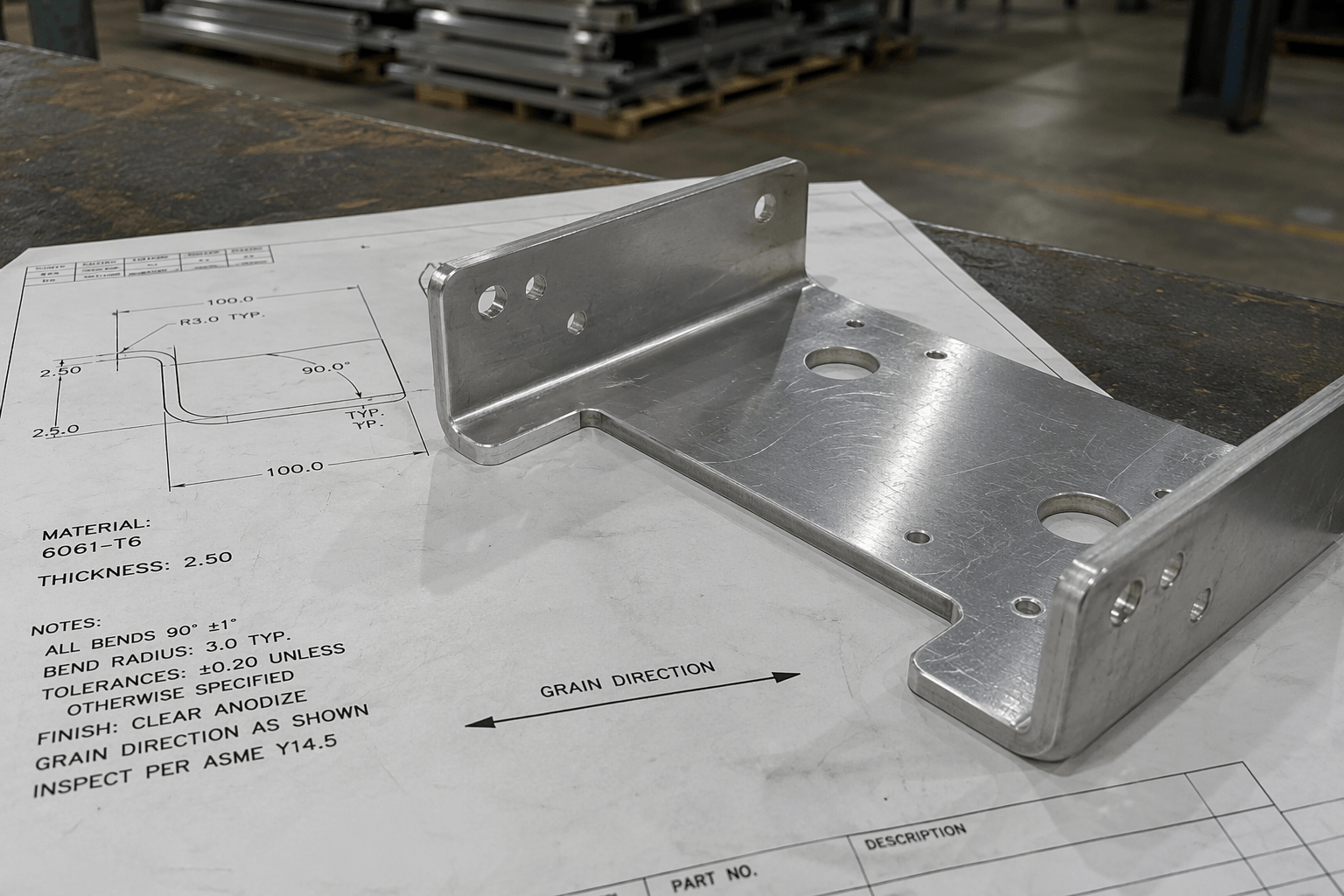
There is no reliable universal minimum bend radius for every 6061-T6 part. Thickness, rolling direction, bend angle, tooling, surface condition, hole location, and the required cosmetic standard must be reviewed together. For a bent custom aluminium bracket, the drawing should therefore specify the temper and intended inside radius instead of leaving the supplier to infer both.
Welding
6061 is commonly fusion welded, but welding does not preserve the original T6 properties throughout the joint. Heat changes the precipitation-hardened structure near the weld, and the lowest strength commonly occurs in the heat-affected zone rather than in unaffected parent metal. Heat input, section thickness, joint design, filler selection, cooling, and post-weld condition influence the result. ([ch-delivery.lincolnelectric.com](https://ch-delivery.lincolnelectric.com/api/public/content/3353e67959b74173b336498aface1f3f?v=d5d4eabf&utm_source=openai))
A welded assembly should not be designed by applying unwelded T6 properties to every location. If joint strength is critical, the engineer should define the required welded-condition properties, inspection method, and whether any controlled post-weld treatment is part of the manufacturing plan.
Machining
T6 and stress-relieved conditions are often more predictable for machining than soft O material because harder material is less prone to smearing. However, machining can release residual stress and cause movement, especially when large amounts of material are removed asymmetrically from plate, bar, or extrusion. Stress-relieved product forms may help, but final stability still depends on stock condition, geometry, clamping, cutting sequence, and inspection timing.
Finishing
6061 generally responds well to anodizing and can also receive painting, powder coating, or conversion treatment where appropriate. The finish specification must still define colour, gloss or texture, coating requirement, masking areas, contact points, and the acceptance standard for visible surfaces. Weld zones, machining marks, surface preparation, and different material lots can affect appearance.
Assembly and dimensional fit
Material selection does not replace tolerance planning. Hole position, bend angle, flatness, thread engagement, fastener access, coating buildup, and mating-part variation determine whether an assembly fits. These interactions are particularly important in sheet metal enclosures supplied ready for assembly, where several bends and panels contribute to the final alignment.
Is 6061 the Right Fit for the Component?
| Design priority | 6061 assessment | What to review |
|---|---|---|
| Moderate-to-high strength with low weight | Often a suitable candidate in an appropriate temper | Product-form properties, load direction, joints, fatigue, and service conditions |
| Complex or tight sheet forming | Possible in softer conditions; T6 may be restrictive | Consider O or T4 processing, a larger radius, or a more formable sheet alloy |
| Welded structure requiring T6-level strength everywhere | Requires careful engineering | Use welded-condition properties and evaluate heat treatment or design compensation |
| Machined plate or structural profile | Frequently appropriate | Stress-relieved condition, stock allowance, distortion control, and datums |
| Appearance-led extrusion | Usable, but not always the first choice | 6063 may offer a more appearance-oriented extrusion and anodizing balance |
| Corrosive or elevated-temperature service | Application-specific | Environment, finish, galvanic contacts, operating temperature, and governing standard |
6061 is not automatically better than other aluminium alloys. A highly formed cover may favor a more formable sheet alloy, while an appearance-led extrusion may favor 6063. Conversely, 6061 may be preferable where strength, machining, welding, and availability must be balanced. Material selection should follow the finished component’s requirements rather than a generic alloy ranking. ([hydro.com](https://www.hydro.com/us/global/aluminum/products/extruded-profiles/alloys-for-aluminum-extrusions/6063-alloy/?utm_source=openai))
How to Specify 6061 Aluminium on a Drawing or RFQ
A production drawing should convert the material decision into requirements that can be purchased, fabricated, and inspected consistently.
| Specification field | What to define | Why it matters |
|---|---|---|
| Material | 6061 plus the required temper | Prevents substitution between conditions with different strength and formability |
| Product form | Sheet, plate, bar, tube, or extrusion | Connects the part to the correct dimensional and mechanical-property specification |
| Thickness or section | Nominal size and permitted variation | Properties and fabrication behavior may vary with thickness |
| Material specification | The applicable ASTM, EN, AMS, customer, or other agreed specification | Defines composition, properties, tolerances, and test requirements |
| Bend requirements | Inside radius, bend angle, direction where relevant, and crack acceptance | Allows tooling and temper suitability to be reviewed before production |
| Dimensions and tolerances | Datums, critical dimensions, hole positions, flatness, and assembly interfaces | Separates functional requirements from general tolerances |
| Finish | Finish type, colour, texture, masking, visible faces, and cosmetic limits | Avoids subjective appearance decisions after fabrication |
| Joining and assembly | Weld symbols, filler or process requirements when controlled, fasteners, and inserts | Clarifies where heat, distortion, or coating buildup may affect fit |
| Certification | Whether a material certificate, compliance statement, or other document is required | Ensures documentation is planned and priced rather than requested after shipment |
| Inspection | Critical characteristics, sampling, gauges, reports, and acceptance criteria | Aligns prototype approval and production inspection |
An annotated material note might read: “Material: aluminium alloy 6061-T4 sheet, 2.0 mm nominal thickness, to the specified material standard. Form to drawing; maintain the indicated inside bend radii and critical hole positions. Apply the defined finish after fabrication. Provide material certification and inspection records for identified critical dimensions.”
The exact standard, tolerances, finish, and document type must be selected for the project. A material note should not include requirements that cannot be verified or that conflict with the intended fabrication sequence.
Prototype approval also needs context. A prototype made from T4 material, bent with one tool setup, and later aged will not necessarily predict a batch produced from T6 sheet using different tooling or a different material source. Consistency depends on controlling the material condition, thickness, grain orientation where relevant, bend setup, welding parameters, finishing route, and inspection method.
Before production planning, Yishang can review whether the specified 6061 temper, product form, bends, welds, finish, and inspection requirements are mutually compatible. For a technical specification review, provide the part drawing or 3D model, intended temper and product form if known, quantity and assembly context, plus the required finish, cosmetic, certification, and inspection details.
Frequently Asked Questions
What are the mechanical properties of 6061-T6 aluminium?
There is no single value that covers every 6061-T6 product. Published minimums depend on whether the material is sheet, plate, extrusion, bar, or tube and can change with thickness. Representative extrusion data lists minimum ultimate tensile strength of 260 MPa and minimum yield strength of 240 MPa, but the applicable material specification and certificate should be used for design and acceptance.
Can 6061-T6 aluminium be bent without cracking?
It can be bent in suitable geometries, but it offers less forming margin than O or T4 material. Bend radius, thickness, grain direction, edge quality, angle, tooling, and nearby holes all affect risk. A bend trial may be appropriate for a demanding geometry, but the approved material condition and tooling must then remain controlled for production.
Does welding reduce the strength of 6061 aluminium?
Welding can reduce strength in the heat-affected zone, particularly when fully aged material such as T6 is used in the as-welded condition. Joint design should use properties appropriate to the welded condition rather than assuming the entire assembly retains unwelded T6 strength.
Are 6061 sheet, plate, bar, and extrusion interchangeable?
No. Although they can share the same alloy and temper designation, they are produced by different routes and may have different property limits, tolerances, surface conditions, grain structures, and available dimensions. The drawing or purchase specification should identify the required product form explicitly.