
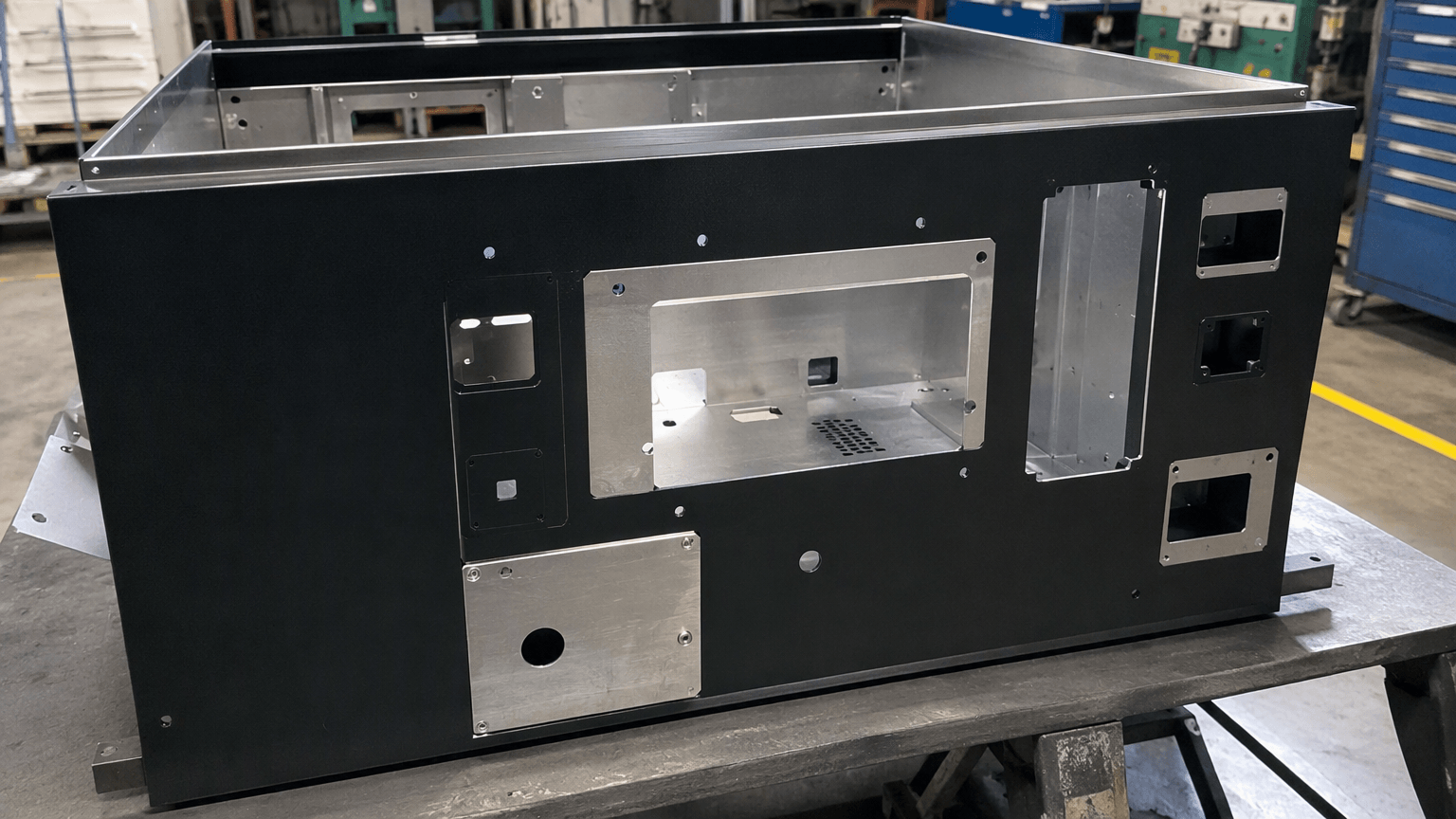
In metal manufacturing, the application of a CNC machine means using programmed equipment to cut, drill, mill, turn, route, or form a part to a defined geometry. Metal powder coated describes a later finish: dry powder is applied to a metal substrate and heat-cured on its surface; it does not normally mean that the metal itself was made from powder.
For an OEM enclosure, cabinet, bracket, frame, display rack, or welded assembly, CNC operations establish the shape and functional features. Powder coating is a separate downstream operation, so the coated, masked, and inspected areas must be specified independently.
CNC machine applications by part objective
A CNC machine application is selected according to the part geometry, material, thickness, feature accuracy, production quantity, and whether the result is a finished component or a fabrication blank. One OEM part may use several operations before it reaches welding, assembly, and surface finishing.
| Manufacturing objective | Typical CNC application | Common OEM result and finish question |
|---|---|---|
| Cut and profile sheet | CNC laser cutting | Panels, brackets, plates, and enclosure blanks; decide whether profiles, edges, and openings receive full or controlled coating. |
| Create repeated openings | CNC punching | Mounting panels and sheet-metal components with repeated holes or slots; review whether coating could affect the openings. |
| Make holes and threads | CNC drilling or related machining | Mounting, fastening, and alignment features; identify tapped holes, precision bores, and press-fit areas before finishing. |
| Create faces and pockets | CNC milling | Machined plates, blocks, slots, pockets, and mounting faces; mating or dimensional surfaces may need bare or controlled coating. |
| Produce cylindrical features | CNC turning | Spacers, collars, shafts, and other round components; functional diameters need a separate finish review. |
| Cut suitable profiles | CNC routing where the material and machine are suitable | Flat sheet or plate profiles and cutouts; check edge condition, internal access, and the selected substrate. |
| Form and join the part | CNC-controlled bending followed by welding fabrication | Channels, cabinets, frames, and welded assemblies; weld cleanup, seams, corners, and assembly order affect coating access. |
These applications occur in OEM electrical enclosures, industrial equipment housings, display fixtures, brackets, frames, and other fabricated metal products. CNC cutting or machining creates the geometry; it does not replace cleaning, pretreatment, powder application, curing, or finished-part inspection.
Where CNC fabrication ends and powder coating begins
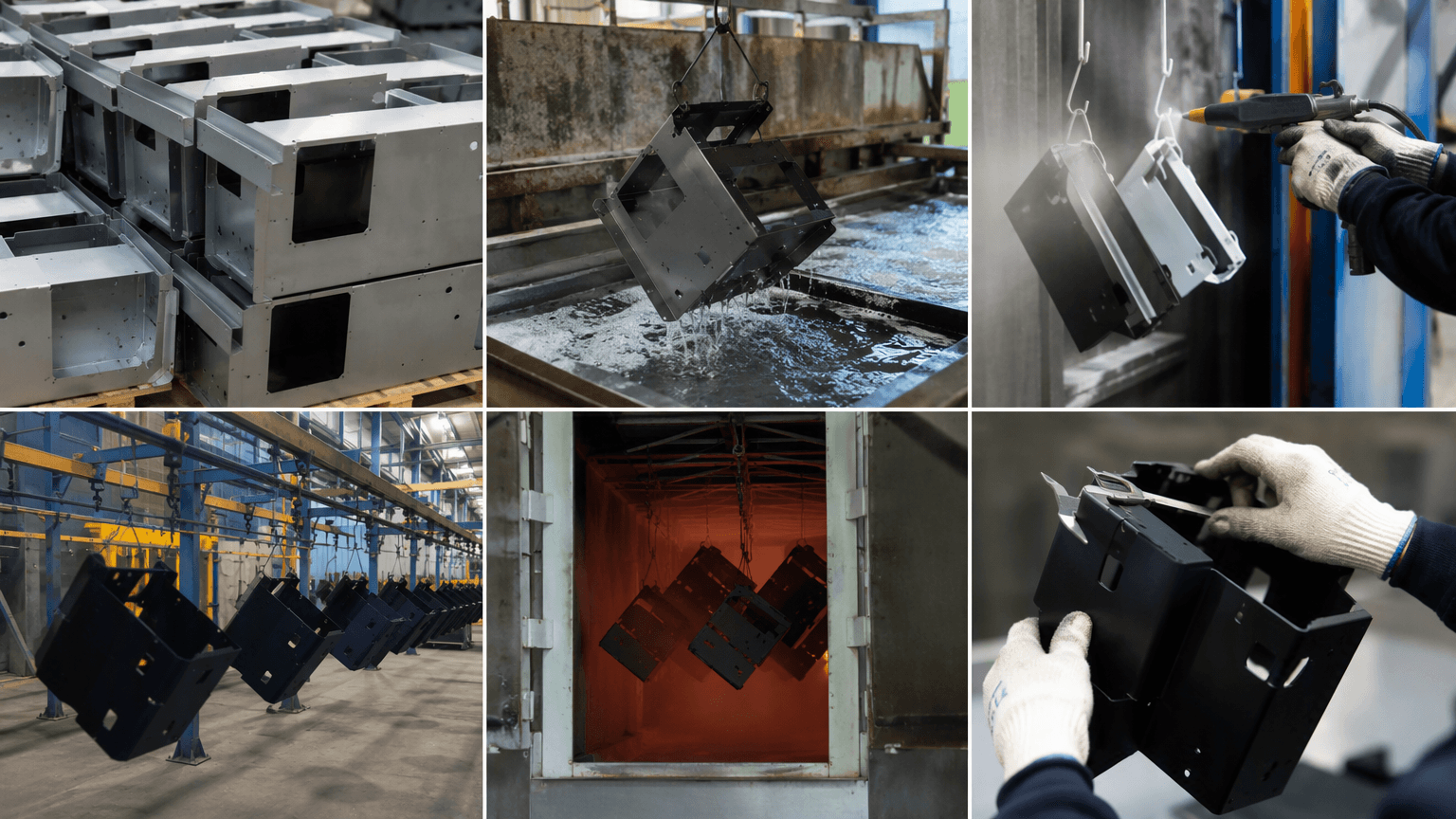
Once the cutting, machining, bending, and welding scope is complete, the part enters a separate finish route. The usual sequence is shown below, although the exact order depends on the substrate, coating system, geometry, and assembly plan. The underlying custom sheet metal fabrication scope should be reviewed together with the finish requirement.
- Release the part definition: Confirm the metal type, relevant grade, thickness, geometry, critical interfaces, and required CNC operations.
- Complete fabrication: Perform laser cutting, punching, drilling, milling, turning, routing, bending, and any required welding or assembly work.
- Clean and prepare: Remove oil, dirt, oxidation, weld spatter, residue, and other contamination that could affect adhesion or appearance.
- Select pretreatment: Match surface preparation to the substrate, weld condition, coating system, and intended environment where applicable.
- Mask and hang: Plug or mask designated threads, holes, mating faces, grounding points, and other no-coat areas. Orientation affects access and coverage.
- Apply the powder: Electrostatic equipment charges the dry powder, and a suitably prepared and grounded metal surface attracts it. Geometry and access influence coverage.
- Heat-cure the film: Heat allows the deposited powder to melt and form a cured coating. The route depends on the selected powder, substrate, part design, and process requirements.
- Inspect the component: Check appearance, coverage, masking, film thickness when specified, and the usability of functional interfaces against the agreed requirements.
Powder coating commonly follows major cutting, forming, and welding because later fabrication can damage or contaminate the finish. Weld cleanup is important at seams and transitions. Assembly may take place before or after coating depending on access, internal coverage, masking, handling, and damage risk. Powder should not be assumed to cover every hole or concealed internal area uniformly.
Choose the finish around the part and its service conditions
For custom sheet metal parts, enclosures, cabinets, display racks, brackets, frames, and welded assemblies, finish selection should consider the substrate, exposure environment, required appearance, dimensional interfaces, heat or chemical exposure, and repair expectations. Outdoor, corrosive, or chemically exposed service requires a coating system and pretreatment suited to the actual environment; the words powder coated alone cannot establish suitability.
| Finish route | Process identity | Application question |
|---|---|---|
| Powder coating | Dry powder is electrostatically applied and heat-cured on prepared metal. | Can the substrate, geometry, interfaces, and selected curing route support the required appearance and service conditions? |
| Liquid painting | A liquid coating is applied and then dried or cured. | Would the application, repair, appearance, access, or curing constraints favor a liquid route? |
| Anodizing | An electrochemical conversion process generally associated with aluminum. | Is the aluminum suited to a conversion finish rather than an added powder film? |
| Electroplating | A separate metallic layer is deposited on the base material. | Does the part require a specified metallic deposit or surface function? |
| Galvanizing | A zinc-based coating route for steel. | Does the steel part require a zinc coating system, and does its geometry support that route? |
These processes are not interchangeable names. The broader surface-finishing scope should be selected after the part geometry, substrate, exposure, and functional surfaces have been reviewed.
Mark the interfaces before the part goes to coating
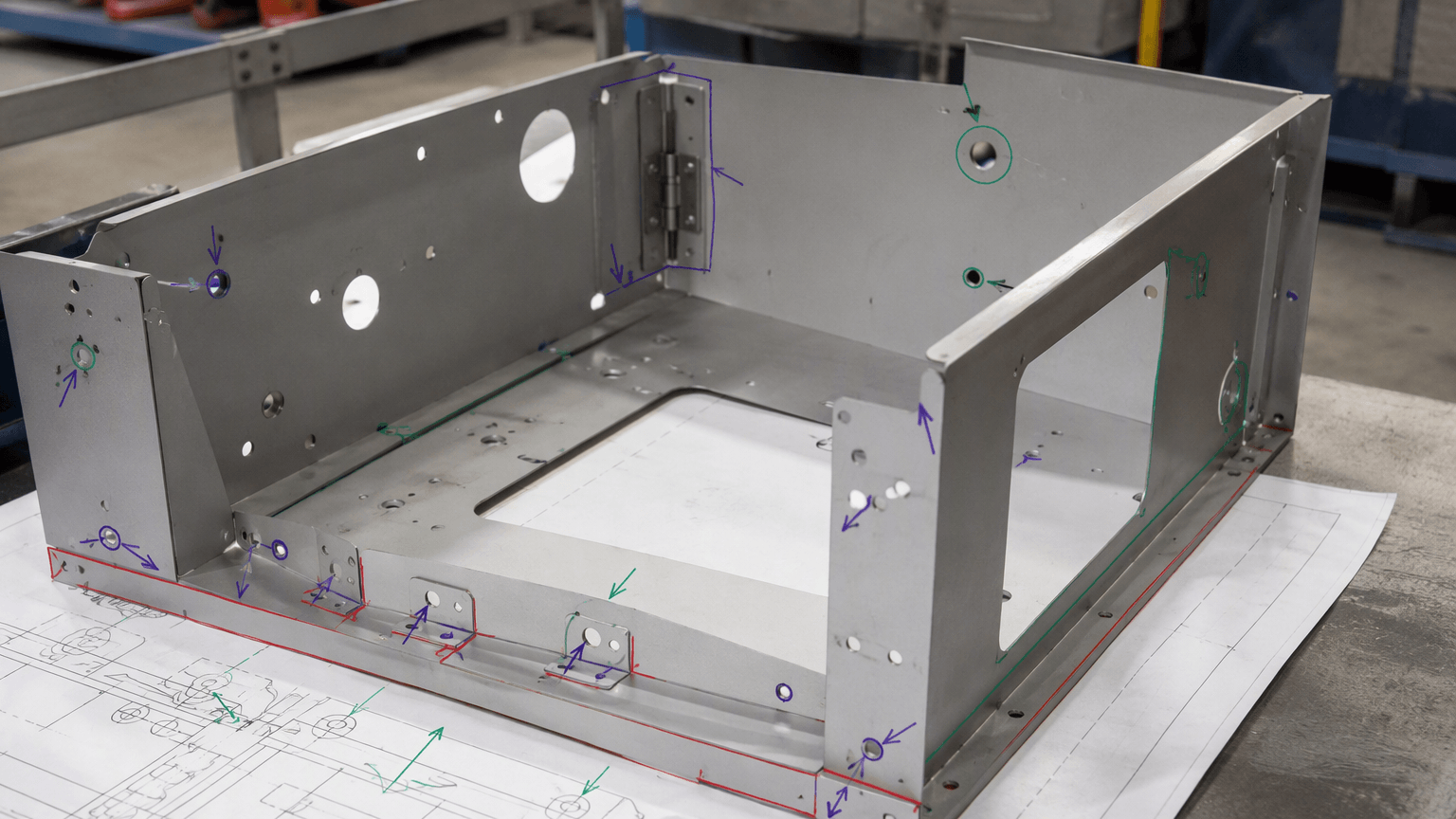
Any feature that must fit, move, seal, conduct electricity, or remain accessible needs a finish boundary. Coating thickness and overspray can affect fastener engagement, press fits, electrical continuity, hinge movement, installation access, and assembly alignment.
- Threads and precision holes: Mark tapped holes, external threads, bores, counterbores, and press-fit areas for masking, plugging, or controlled coating.
- Mating and sealing faces: Identify flanges, rails, covers, gasket seats, and seating surfaces that require bare metal or limited coverage.
- Grounding and electrical contacts: Show where continuity requires bare metal or controlled coating. The temporary process ground used during application is not automatically the product grounding point.
- Hinges, pivots, and sliding areas: Control hinge barrels, pins, adjustment features, and moving surfaces that must remain usable.
- Edges and weld transitions: Review sharp edges, seams, weld cleanup, internal corners, and concealed surfaces for required coverage and acceptable appearance.
- Labels and service access: Identify label zones, identification plates, openings, and areas that must remain visible or reachable.
Show no-coat, controlled-coat, and full-coat zones on the drawing, finish layer, or marked-up sample. For a custom sheet metal enclosure, this review may include door edges, flanges, hinges, mounting faces, and internal surfaces.
Turn the CNC and finish requirement into an executable callout
An OEM drawing, purchase order, or RFQ should give fabrication, finishing, assembly, and inspection teams the same instructions. The following matrix turns a general finish phrase into a workable manufacturing requirement.
| Callout field | Information to define |
|---|---|
| CNC scope and geometry | Required cutting, punching, drilling, milling, turning, routing, bending, and welding operations; critical features and interfaces that must remain functional. |
| Substrate | Metal type, grade where relevant, sheet or component thickness, and any existing coating such as zinc. |
| Part condition | Whether the item is cut, bent, welded, machined, partially assembled, or supplied as separate components. |
| Coated area | Exterior, interior, both sides, selected faces, or clearly marked surface zones. |
| Finish appearance | Coating system where required, color reference or approved physical sample, gloss level, texture, and visual expectations. |
| Film thickness | A target or acceptable range only when agreed for the selected coating system and application. |
| Masking | Threads, holes, mating faces, grounding points, hinge areas, labels, and other bare or controlled-coat zones. |
| Environment | Indoor or outdoor use, moisture, chemicals, temperature exposure, and any buyer-defined validation requirement. |
| Acceptance | Viewing conditions, visible-surface limits, edge and weld appearance, exposed-substrate limits, defect criteria, and inspection methods. |
| Approval and logistics | Sample or first-article reference, repeat-production comparison, quantity, batch grouping, identification, traceability, and packaging protection. |
For an early finish-specification and manufacturability review, provide 2D drawings, 3D files, or marked-up images; base material and thickness; coated and uncoated areas; finish references; application environment; inspection requirements; estimated quantity; project status; and target delivery window.
Yishang can review fabrication, welding, powder coating, masking, and inspection as one OEM or ODM project. The company has more than 26 years of custom metal manufacturing experience, exports to more than 50 countries, and serves B2B custom manufacturing projects.
Approve the finish, then plan the production run
Inspection criteria should be agreed before production rather than inferred from the phrase powder coated. Appearance-sensitive parts also benefit from a reference that can be compared during repeat production.
- Compare color, gloss, and texture with the approved sample or documented appearance requirement under agreed viewing conditions.
- Inspect visible surfaces for runs, thin areas, contamination, pinholes, exposed substrate, and inconsistent texture.
- Review edge coverage, weld-area appearance, internal corners, and masking accuracy.
- Confirm that the marked functional zones remain usable during assembly or electrical installation.
- Measure film thickness or perform adhesion and cure checks only when the project defines the method and acceptance limit.
- Use a sample or first-article approval when appearance matters, then compare repeat production with the approved reference.
| Planning factor | Possible effect on cost or schedule |
|---|---|
| Part envelope and hanging | Size, balance, orientation, rack or fixture needs, and curing-equipment constraints may require a process review. |
| Quantity and batch grouping | Small quantities, many components, or split batches can change setup and scheduling efficiency. |
| Color, texture, and masking | Changeovers, batch separation, threads, holes, and small controlled zones add preparation and handling work. |
| Pretreatment and weld condition | Substrate differences, existing zinc, contamination, and weld cleanup can change preparation effort. |
| Assembly order | Coating before or after assembly changes access, masking, handling, damage risk, and interface verification. |
| Rework and approval | Appearance defects, damaged film, rejected parts, repeated samples, or late acceptance decisions can extend the schedule. |
A process review is especially useful when large visible surfaces combine with many interfaces, multiple finishes, or strict appearance requirements. The quality control plan should match the drawing and finish callout.
Planning a CNC-fabricated, powder-coated metal part? Share the drawing or 3D file, marked coating zones, material, finish reference, application environment, inspection requirements, quantity, and target timing. Yishang can review the CNC work, sheet metal fabrication, welding, finishing, assembly, and inspection scope together before project release.
Frequently Asked Questions
These questions connect common CNC machine applications with the downstream finish decision.
Does metal powder coated mean that the metal itself is made from powder?
No. It normally means that a metal substrate received a dry powder coating applied and heat-cured on its surface. A powder-based metal-production method would be a separate specification.
Can powder coating be applied to welded sheet-metal assemblies?
Welded enclosures, frames, brackets, and cabinets can be evaluated for powder coating, provided surface preparation, seams, corners, grounding points, and assembly interfaces are addressed.
Will powder coating change the fit of holes, threads, mating faces, or grounding points?
It can. Film and overspray may affect fastener engagement, press fits, movement, mating access, or electrical contact, so these areas should be marked for masking or controlled coating.
Is powder-coated metal suitable for outdoor or corrosive service?
The finish name alone cannot answer that. Suitability depends on the substrate, pretreatment, coating system, geometry, exposure, and buyer-defined validation for the actual environment.
What should an OEM drawing or purchase order include for a powder-coated metal part?
Specify the CNC and fabrication scope, substrate and thickness, coated areas, masking, color reference, gloss, texture, film-thickness requirement when agreed, environment, acceptance criteria, sample reference, quantity, and packaging.