
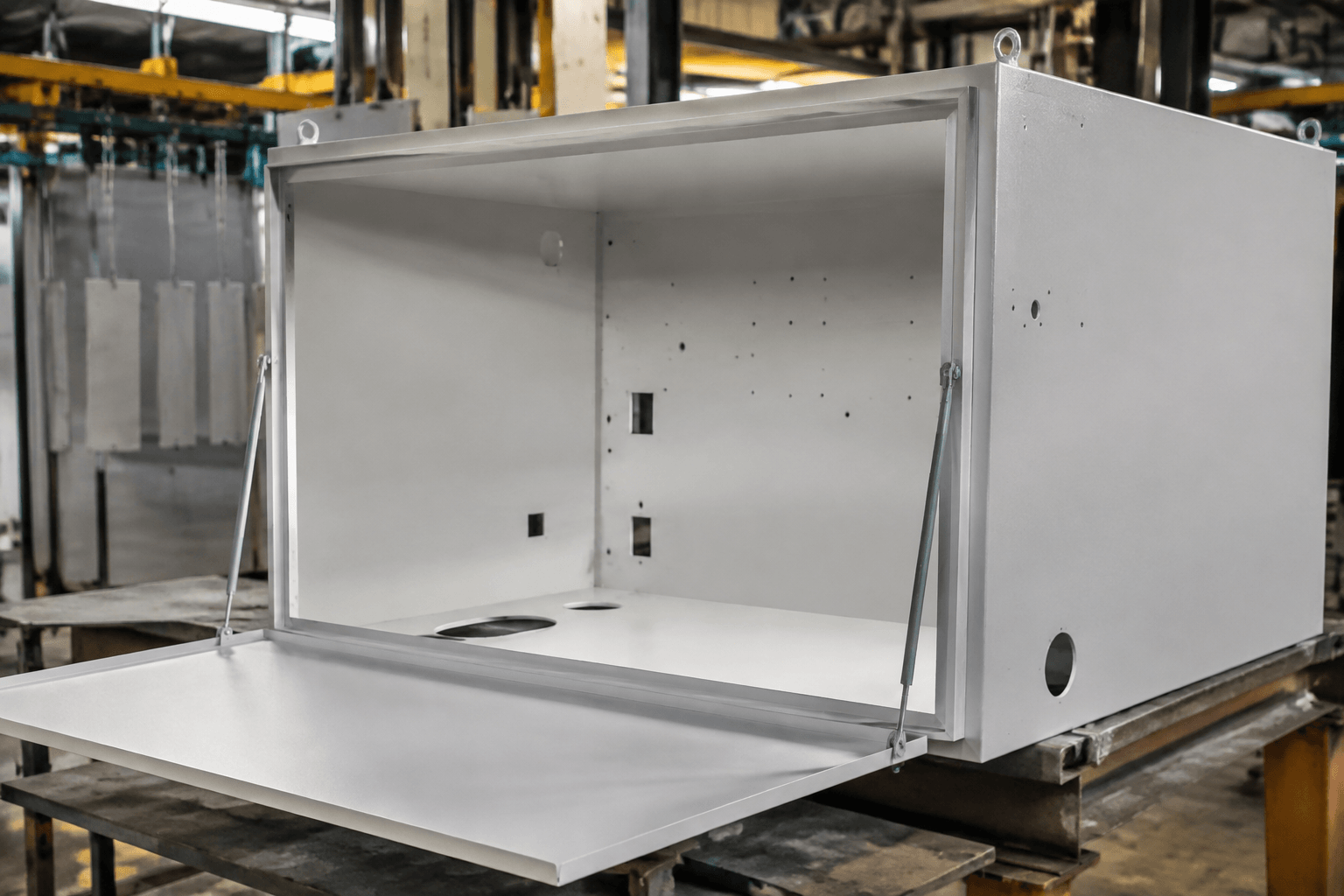
Commercial powder coating usually means a factory-applied dry-powder finish for metal products used in commercial or industrial settings. It is an application and market description, not one universal coating grade, chemistry, performance class, or standard. For OEM purchasing, the specification must connect the substrate, service environment, preparation, powder system, cure conditions, finish target, masking, and inspection requirements.
If a drawing for a cabinet, frame, rack, enclosure, or welded assembly says only “commercial powder coating,” important decisions remain open. This guide focuses on how OEM buyers can define those decisions before requesting quotations, approving prototypes, and releasing production parts rather than treating the term as a complete finish specification.
What the term leaves open
When an OEM drawing simply calls for commercial powder coating, the missing decisions often appear later as quotation exclusions, sample disagreements, coverage concerns, or assembly problems. Powder coating is supplied as a dry, free-flowing material, commonly applied to metal through an electrostatic process and then cured to form a finish on the substrate. That basic process description does not determine how the coating will perform in a particular application.
The phrase commercial powder coating does not, by itself, guarantee:
- A particular resin, powder family, or coating chemistry
- A universal grade, performance class, certification, or standard
- Outdoor UV or weathering resistance
- Defined corrosion, chemical, impact, or abrasion performance
- A particular color, gloss, texture, or film thickness
- Compatibility with every carbon steel, aluminum, or stainless steel substrate
An indoor office cabinet, outdoor equipment frame, retail display rack, and industrial enclosure exposed to process chemicals may all be commercial products, but their coating requirements can be substantially different. Appearance and repeatability may be especially important for retail and commercial equipment; the related retail and commercial metal fabrication context can help buyers consider those requirements alongside the finished part. Suitability depends on the full combination of substrate preparation, powder selection, application control, cure, service exposure, and acceptance criteria.
Start with the substrate and service environment
One visible finish color can be used on different metals, but that does not make the underlying coating specification interchangeable. Begin with the base metal, its surface condition, and the conditions the finished part will face; cleaning, conversion treatment, primer selection, and other pretreatment steps should then be agreed with the coating supplier.
| Substrate | Preparation and coating considerations | Questions for the specification |
|---|---|---|
| Carbon steel | Oil, scale, oxidation, welding residue, and exposed edges can affect adhesion and corrosion behavior. Required cleaning and pretreatment depend on the part condition and exposure. | Will the product face humidity, condensation, outdoor weather, chemicals, or moisture-retaining joints? Is a primer or enhanced system required? |
| Aluminum | Its oxide layer and alloy-specific surface condition require an aluminum-compatible preparation route. Fabrication lubricants and handling contamination must be removed. | Is the product indoors or outdoors? What UV, corrosion, appearance, and adhesion requirements apply to the selected alloy and pretreatment? |
| Stainless steel | A smooth or contaminated stainless surface can present adhesion challenges. Cleaning, surface conditioning, and masking should reflect the intended function of coated and uncoated areas. | Why is stainless being coated, and will any areas remain bare for appearance, electrical contact, cleaning, or another functional reason? |
The service environment further narrows the requirement. Describe indoor or outdoor placement, humidity, UV exposure, cleaning frequency, cleaning chemicals, abrasion, handling, and possible moisture traps. If the application requires corrosion, adhesion, impact, abrasion, or chemical-resistance verification, define the agreed test method and acceptance requirement. A primer or enhanced corrosion system should be specified as part of the coating system when needed, rather than inferred from the word commercial. Color approval alone cannot demonstrate functional performance.
Application controls meet part geometry
A fabricated part can meet a color target and still create coating or assembly trouble if its surface condition, hanging method, spray access, or critical dimensions were not considered before production. For a buyer, the useful process sequence is the set of controls that connects fabrication readiness to the finished assembly:
- Fabrication readiness: Cutting, forming, and welding matter where they leave sharp burrs, weld spatter, heat discoloration, oil, difficult seams, or distorted interfaces. Powder coating does not correct these defects or restore incorrect dimensions.
- Cleaning and pretreatment: Parts should enter coating clean and dry, with preparation suitable for the substrate and specified performance. Residue trapped in folded seams, tubes, or welded gaps can later affect appearance or adhesion.
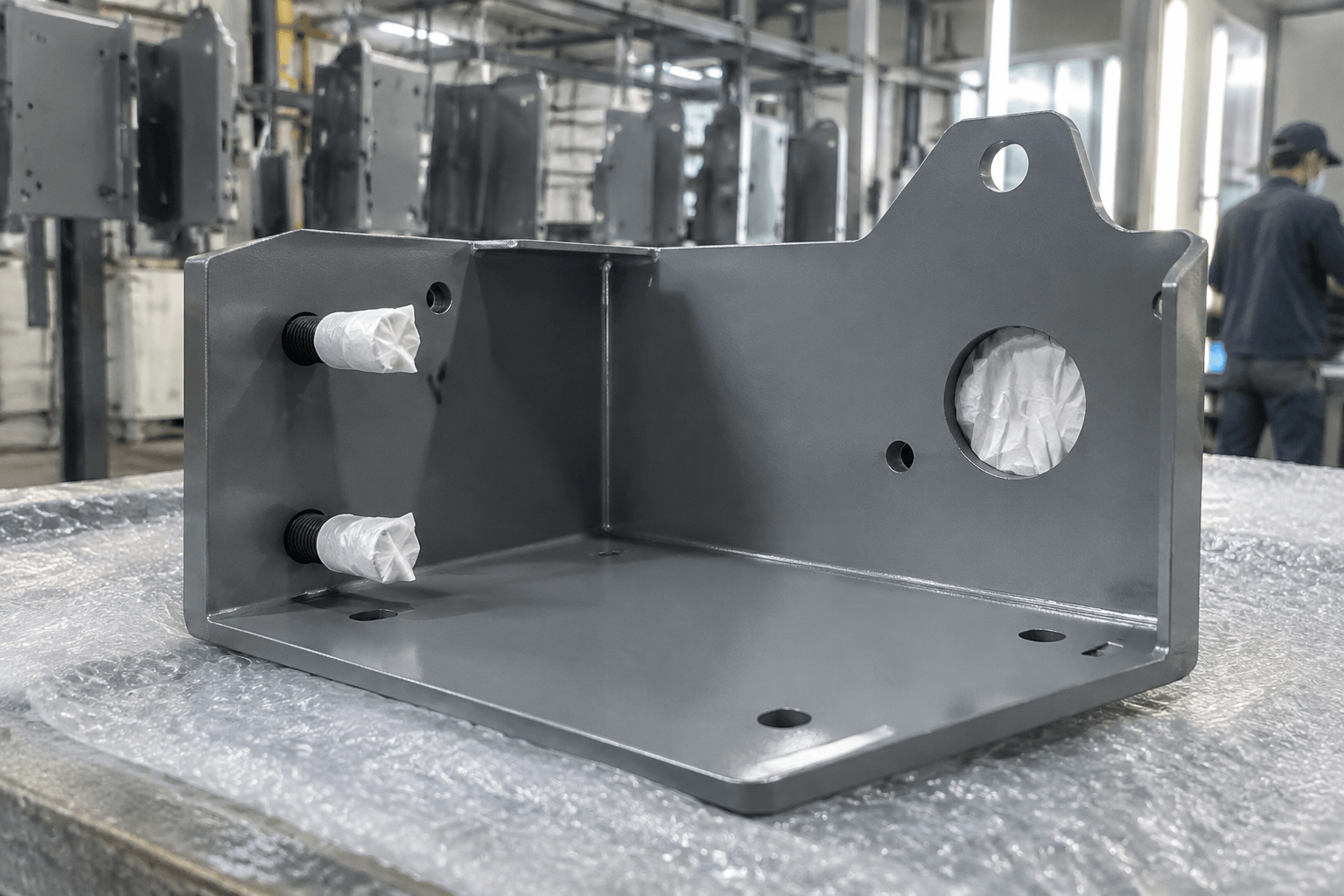
- Masking and hanging: Threads, grounding contacts, mating faces, bearing locations, precision holes, and other no-coat zones may need protection. Hang points should be planned because they can leave contact marks while also providing a reliable path to ground.
- Electrostatic application: Part grounding and spray access affect powder transfer. Deep recesses, tight inside corners, shielded areas, and complex welded geometry may receive different coverage from broad external faces.
- Curing: Cure conditions must follow the powder supplier’s defined window and account for the actual part and oven conditions. An oven air-temperature indication alone does not prove that the complete part received the required cure.
- Cooling and handling: Contact, stacking, assembly, and packaging practices must avoid marking or damaging the finish after it leaves the oven.
Edges, recesses, weld areas, and sheltered corners can show differences in coverage, film build, or appearance. Powder build can also affect tabs, slots, hinges, door gaps, fasteners, and close mating components. Review these risks with the upstream custom sheet metal fabrication drawings, particularly when coated components must assemble without secondary adjustment.
Put the finish on the drawing and RFQ
A request such as “black commercial powder coat” leaves too many decisions open for a comparable quotation. The drawing, finish schedule, or purchase request should separate visual requirements from performance requirements and state how each will be approved.
Commercial Powder Coating RFQ Matrix: Requirement, Why It Matters, and Supplier Evidence
| Requirement | Why it matters | Supplier response or evidence to request |
|---|---|---|
| Base-metal grade and thickness | Influences preparation, heating behavior, geometry, and coating-system selection. | Confirmation that the proposed preparation and coating route applies to the specified material and part construction. |
| Service environment | Indoor use, outdoor UV, humidity, chemicals, abrasion, moisture, and cleaning can require different systems. | Proposed powder family, pretreatment, primer if applicable, and stated suitability for the defined exposure. |
| Pretreatment and coating system | Adhesion and corrosion behavior depend on more than powder color. | Defined preparation steps and any primer or enhanced system included in the quotation. |
| Color, gloss, and texture | A color reference alone may not control gloss or surface character. | Powder reference plus an approved physical sample or reference panel where appearance is critical. |
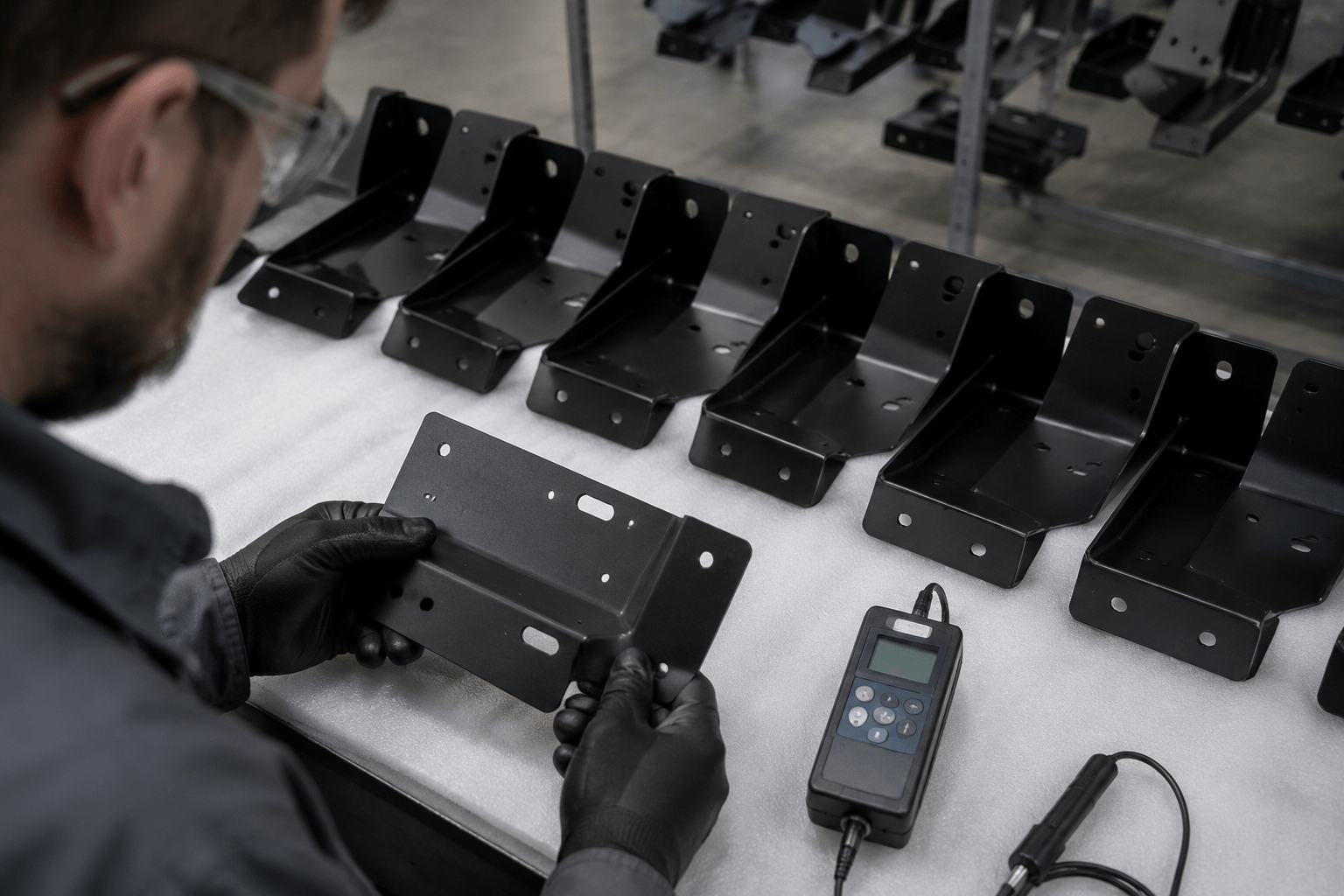
| Film thickness | Coverage and functional fit can vary with geometry and coating build. | An agreed target or acceptable range, measurement method, and inspection locations based on the coating system and end-use requirement. |
| Masking and no-coat zones | Coating can obstruct threads, alter hole fit, insulate grounding contacts, or interfere with mating faces. | Marked drawing zones, masking method, and allowable boundary condition. |
| Assembly-critical dimensions | Door gaps, hinges, inserts, moving interfaces, and close fits can change after coating. | Confirmation of dimensional allowances and post-coating fit checks for the identified features. |
| Visual inspection | Surface appearance depends on viewing conditions, critical surfaces, and agreed defect limits. | Inspection lighting or viewing basis, critical areas, acceptable appearance, and treatment of hang marks or minor noncritical areas. |
| Performance tests | Appearance inspection does not establish adhesion, impact, corrosion, abrasion, or chemical performance. | Agreed test method, sample type, frequency, acceptance criteria, and responsibility where testing is required. |
| Sample approval | A sample establishes the visual target before a production batch is released. | Approval process for a representative part or reference panel, including who owns the release decision. |
| Quantity and packaging | Batch size, handling, protection, and color changes affect planning and cost. | Prototype and production quantities, packing method, contact protection, and labeling requirements. |
| Production records and changes | Changes to powder, pretreatment, gloss, or cure route can affect batch consistency. | Agreed lot identification, inspection records, change-notification process, and nonconformance documentation. |
For coated sheet metal enclosures and cabinets, include door gaps, hinge interfaces, removable panels, threaded inserts, electrical grounding points, and other assembly-critical dimensions. Provide 2D drawings and available 3D files so coating allowances can be reviewed in the context of the finished assembly.
Preparing an RFQ? Send the base-metal grade and thickness, color reference or finish sample, gloss and texture, indoor or outdoor exposure, masked zones, threads, holes, mating surfaces, critical dimensions, prototype and production quantities, testing requirements, packaging expectations, and available drawings. A combined fabrication and coating review can help identify coverage or assembly risks before quotation and prototype approval.
Approve the finish and control batch consistency
A pilot part can look acceptable in isolation while a production batch varies in color, gloss, texture, film build, or assembly fit. Use an approval sequence that establishes the visual target, checks the functional requirements, and records the conditions that need to remain consistent.
- Establish the reference. Approve a coated sample, reference panel, or documented finish target. Record the powder reference, color, gloss, texture, substrate, and relevant process assumptions.
- Define visual inspection. Agree on viewing conditions, lighting, orientation, critical surfaces, and acceptable treatment of hang marks or minor noncritical areas. Use the same basis when comparing production batches.
- Check film thickness where it matters. Use agreed locations that represent broad faces as well as geometry prone to coverage variation. Requirements should be based on the coating system and end-use specification, not an arbitrary universal number.
- Verify required performance. Where the application demands adhesion, impact, corrosion, abrasion, or chemical resistance, agree on methods and acceptance criteria before production. Visual approval remains separate from these functional checks.
- Confirm dimensional and assembly fit. Inspect threads, holes, door clearances, mating surfaces, grounding points, moving interfaces, and hardware installation after coating.
- Control production changes. Require approval or notification for relevant changes to the powder source, color, gloss, texture, pretreatment, cure route, or production process.
Buyers may request project-appropriate lot identification, inspection results, nonconformance disposition, and approved rework records. The exact documentation should be agreed in advance rather than presumed. A documented quality control plan should connect drawing requirements to the sample, batch inspection, assembly checks, and release decision.
Compare quotations by scope
Two quotations may show the same color and still cover different technical work. Before comparing unit prices, check whether each supplier has included the same preparation, masking, testing, inspection, packaging, and responsibility assumptions.
- Part size, exposed surface area, recesses, tight gaps, geometry, and handling difficulty
- Pretreatment complexity, masking quantity, special fixtures, and protection of threads or mating areas
- Color, gloss, texture, powder availability, batch size, and color-change cleaning
- Sample approval, testing, inspection documentation, packaging, and special handling
- The readiness of the upstream fabricated parts, including the condition of edges, weld areas, seams, and assembly interfaces
Schedule can change when a part needs extra masking, a special fixture, an approved sample, external testing, or a different coating sequence. Late discovery of weld residue, inaccessible recesses, unsuitable hang points, or coating-sensitive fits can trigger rework before or after finishing. Ask each supplier to identify what is included, excluded, or subject to approval so the quoted price and delivery plan have the same technical basis.
Before placing the order, identify who can approve cosmetic deviations, repairs, recoating, stripping, or replacement. Define whether repaired areas are acceptable, which surfaces are critical, and who carries responsibility when an upstream dimensional defect causes a coated assembly to fail. This is more useful than asking for a single commercial-grade price without the supporting requirements.
Frequently Asked Questions
Is commercial powder coating a specific coating type?
No. In an OEM RFQ, it generally describes the intended commercial or industrial application. The buyer still needs to define the substrate, environment, powder system where required, preparation, finish, masking, performance tests, and acceptance criteria.
Can one specification be used for carbon steel, aluminum, and stainless steel?
Not automatically. Each substrate has different surface conditions and preparation considerations. A common visual target may be possible, but pretreatment, adhesion strategy, primer needs, and performance expectations should be evaluated for the actual metal and environment.
Should holes, threads, grounding points, and mating surfaces be masked?
They should be masked when coating would interfere with fit, electrical continuity, fastener engagement, sealing, movement, or another functional requirement. The drawing should identify each no-coat zone, related tolerances, and acceptable masking boundaries.
How should an OEM approve color, gloss, and texture?
Use an agreed powder reference together with a representative physical sample or reference panel when appearance is important. Compare production parts under consistent viewing conditions, and keep visual approval separate from functional coating tests.
What inspection and traceability information should a buyer request?
Request only what the project needs, such as batch identification, visual inspection results, film-thickness records at agreed locations, dimensional or assembly checks, required performance-test results, nonconformance decisions, and approved rework records. Confirm the available format and timing with the supplier before ordering.
Yishang supports OEM and ODM B2B custom manufacturing and has more than 26 years of custom metal-product manufacturing experience, with exports to more than 50 countries. For a project-specific review, provide 2D drawings and available 3D files, base-metal grade and thickness, finish sample or color reference, gloss and texture, service exposure, masked and assembly-critical areas, prototype and production quantities, and the required inspection, testing, documentation, and packaging. This gives the coating and fabrication requirements a shared basis for reviewing coverage, fit, appearance, and production responsibilities before the order is released.