
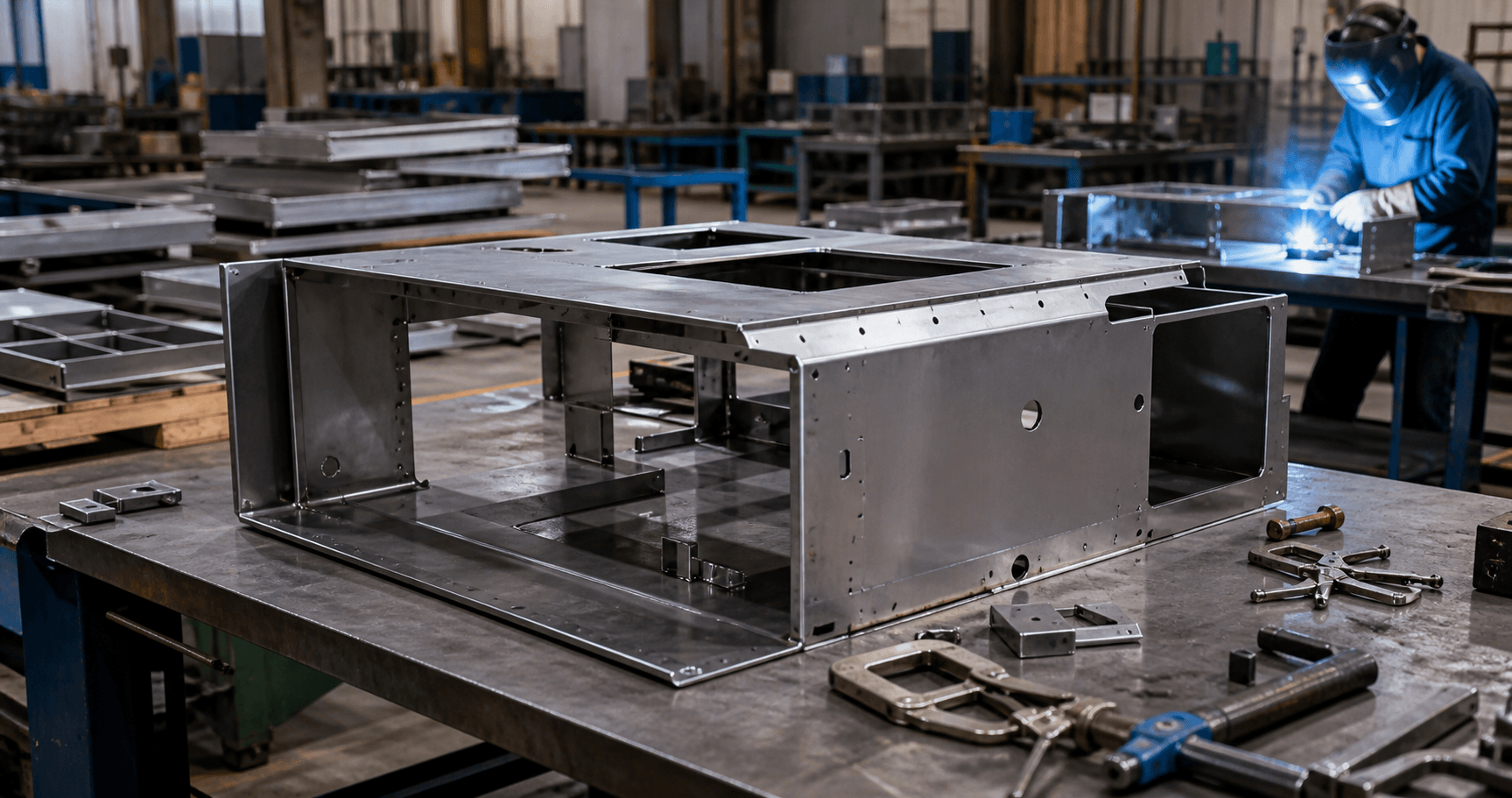
Contract welding and fabricating is an outsourced manufacturing arrangement in which an OEM hires a manufacturer to produce welded parts or assemblies according to agreed drawings, materials, quantities, and acceptance requirements. The scope may range from welding customer-supplied pieces to delivering cut, bent, welded, finished, assembled, and packaged products. It does not refer to welding employment contracts or identify a particular welding technology.
For an OEM preparing an RFQ, the key question is not simply whether a supplier can weld. The contract must define who is responsible for materials, part preparation, fabrication, inspection, finishing, assembly, documentation, packaging, and delivery. Depending on that scope, the deliverable could be a welded frame, sheet metal cabinet, equipment enclosure, display rack, bracket, or another completed assembly.
What the Manufacturing Contract Can Include
A buyer may need a supplier to join prepared components, manufacture an unfinished weldment, or deliver a coated and packaged assembly. Those requests can look similar on a drawing but assign very different responsibilities. A clear contract connects the required product to an agreed technical package, production route, inspection plan, and delivery condition.
Welding is the operation that joins components. Sheet metal fabrication is broader: flat material may be cut, punched, and bent before the resulting components are joined. Laser cutting separates profiles from sheet, CNC punching creates programmed holes and features, and bending forms the parts into the required geometry. These operations prepare the components; they are not forms of welding.
Polishing and powder coating are separate post-weld finishing operations. Assembly may add specified hardware, panels, doors, inserts, or other components after the individual parts have been produced. Inspection verifies agreed characteristics but does not make or finish the product.
CNC turning and milling are machining processes rather than sheet metal fabrication operations. A machined insert, shaft, spacer, or mounting block may be incorporated into a fabricated assembly, but its material, dimensional interface, supply responsibility, and joining method should be defined separately. Post-weld machining may also be specified for a functional interface, although it should not be assumed to be part of the standard fabrication route.
The available welding method must be confirmed against the material, joint design, access, appearance requirements, and project specification. The phrase “contract welding” does not by itself indicate MIG, TIG, spot, robotic, coded, or any other method. Buyers can review Yishang’s welding service scope and confirm project-specific alignment during drawing review.
Yishang serves B2B wholesale and custom manufacturing projects, with OEM and ODM support. Verified product categories include welded assemblies, metal frames, cabinets, enclosures, display racks, and other custom sheet metal products.
Choose the Right Contract Scope: Welding Only, Fabricated Weldment, or Finished Assembly
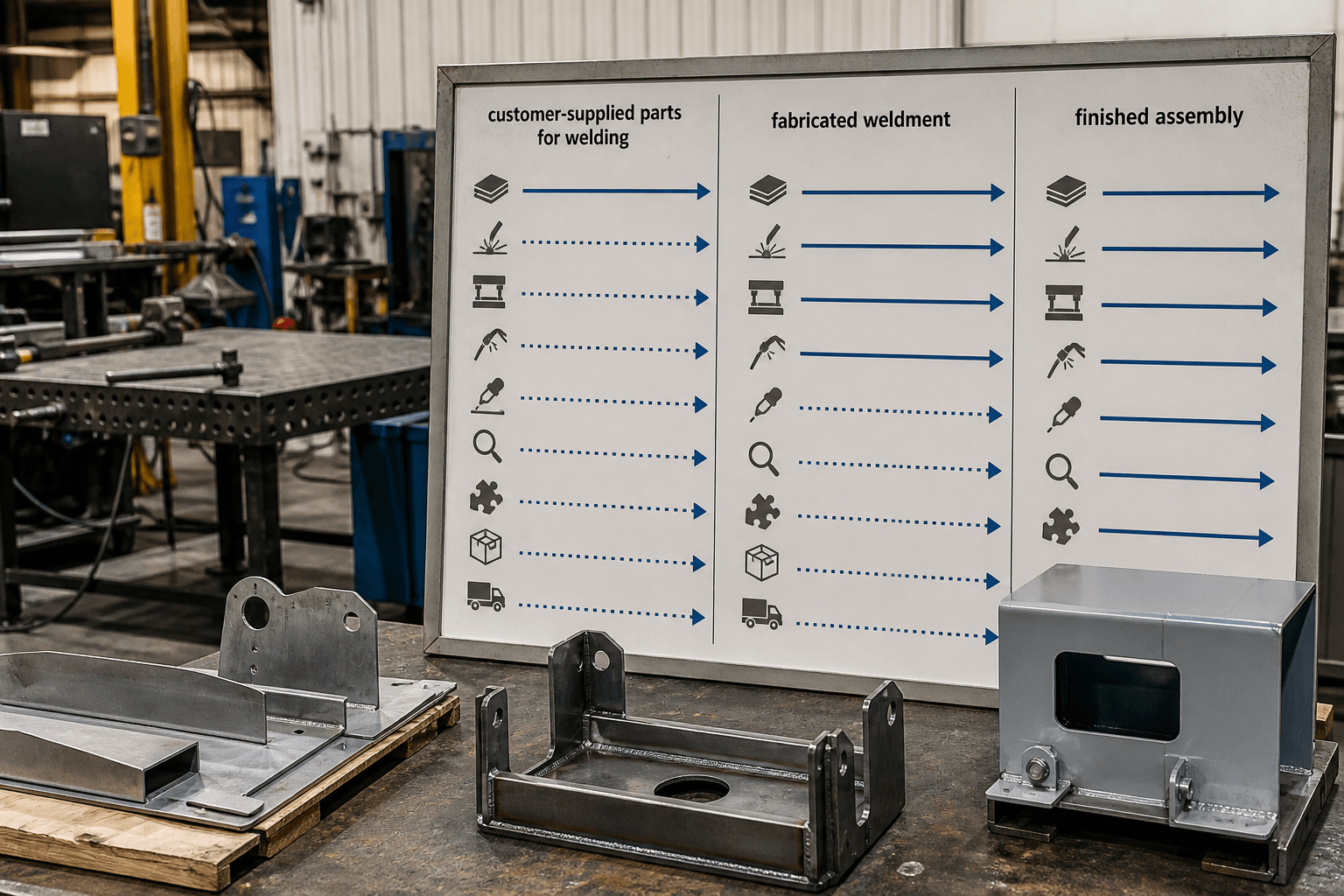
The right purchasing scope depends on what the buyer will supply and the condition in which the product must arrive. If these boundaries are unclear, one quotation may cover joining alone while another includes material sourcing, forming, finishing, or packaging. The following matrix separates the three common scope levels; availability still needs to be confirmed against the drawing, material, geometry, process route, quantities, and destination requirements.
| Scope | Buyer typically supplies | Manufacturer responsibility | Inspection handoff | Delivery condition |
|---|---|---|---|---|
| Welding only | Prepared and identified components, joint details, drawings, quantities, and acceptance criteria | Review component condition, plan handling and joining, perform the agreed welding, and complete specified checks | Usually focused on weld locations, defined weld characteristics, appearance criteria, and specified post-weld dimensions | Unfinished welded components unless additional work is listed |
| Fabricated weldment | Product drawings, BOM, materials, revision level, weld requirements, critical dimensions, and quantities | Agreed material sourcing or preparation, cutting or punching, bending, fixture planning, welding, and inspection | Covers the formed components and assembled weldment characteristics identified in the drawing | Raw or finished only to the condition stated in the contract |
| Finished assembly | Complete product definition, approved components, finish requirements, assembly boundary, packaging instructions, and destination | Fabrication plus agreed finishing, mechanical assembly, labeling, packaging, and release documentation | May cover dimensions, weld condition, fit, appearance, finish, assembly, and packaging | Finished and packaged according to the agreed shipment scope |
This distinction is especially important for cabinets and enclosures. For example, a quotation for a “welded enclosure” might exclude removable panels, purchased hardware, coating, masking, labels, final assembly, or export packaging unless those items appear in the BOM and contract scope. Buyers defining a broader production route can review the scope of custom sheet metal structures and assemblies.
From Design Files to Prototype and Batch Production
Once an OEM submits its files, each review and manufacturing decision affects the stages that follow. Material selection influences forming and joining, while datum and fixture decisions affect welding, inspection, and downstream assembly. The sequence below is illustrative rather than mandatory because geometry, finish, joint access, heat input, inspection access, and assembly requirements may change the actual order.
- Review the files and scope: Check the controlled 2D drawings, available 3D files, BOM, revisions, quantities, materials, weld locations, finish, inspection criteria, and delivery scope. Conflicts between files or missing requirements should be resolved before the production route is finalized.
- Confirm materials and components: Align material grades, thicknesses, purchased items, customer-supplied parts, permitted substitutions, and required material documentation. Supplied components also need an agreed identification method and incoming-condition requirements.
- Prepare the parts: Produce sheet metal components through the specified cutting or punching route, then form them by bending where required. Locating features, joint gaps, fastener positions, bend relationships, and downstream assembly access must remain consistent with the product definition.
- Plan datums and fixtures: Determine how the parts will be located and restrained, which datums control the assembly, and where joints and inspection points can be accessed. A temporary prototype holding method may not provide the locating repeatability required for batch production.
- Plan the welding route and sequence: Confirm the joining process for the project and establish a sequence that considers component fit, restraint, access, and heat-related movement. Any project-specific qualification or documentation requirement must be stated rather than inferred from the term “contract welding.”
- Complete welding and in-process control: Join the components according to the agreed product definition while monitoring dimensions and interfaces that could be affected by assembly buildup or localized heating.
- Inspect before finishing: Check accessible weld characteristics, datums, critical dimensions, and cosmetic requirements before coating or assembly makes them difficult to examine. Results should be evaluated against buyer-defined or mutually agreed criteria.
- Finish, assemble, and release: Complete polishing, powder coating, mechanical assembly, labeling, and packaging only where specified. Record prototype or first-sample findings, control revisions, and establish the approved reference before releasing batch production.
These stages cannot always be planned independently. A coating requirement may affect weld cleanup, masking, hanging points, drainage, and assembly order. Likewise, a critical frame interface may determine fixture contact locations, weld sequence, inspection timing, and whether a separately machined component is installed before or after finishing.
Design Controls That Affect Fit, Appearance, and Repeatability
Many weldment problems begin with requirements that are visible in the final product but not fully defined in the drawing package. Joint access, functional datums, fixture contact, weld sequence, and acceptance criteria should therefore be reviewed together. The goal is to connect the production plan to the interfaces and surfaces that matter to the completed assembly.
Joint access and component fit
The drawing should identify where joining is required and whether each joint remains accessible after forming or partial assembly. Edge condition, joint gaps, bend variation, and accumulated component tolerances can all affect positioning. For a visible joint, identify the cosmetic surface and acceptable post-weld condition rather than relying on a subjective note such as “good appearance.”
Functional datums and fixture contact
Datums should relate the weldment to the interfaces that control its use. A frame may need to align with equipment feet, doors, panels, mounting holes, or a separately manufactured component. Fixture contact should support those relationships without damaging designated cosmetic surfaces or obstructing required joints. The discussion of custom metal frame geometry and assembly readiness is relevant when squareness, mounting locations, and downstream fit drive the design.
Weld sequence and heat-related movement
Localized heating and cooling can move sheet, channels, brackets, and frame members. Joint placement, restraint, sequence, component fit, and intermediate checks are therefore connected planning decisions. Because the acceptable result depends on the product definition, the buyer should identify allowable distortion or mark the post-weld dimensions and interfaces that must be maintained.
Dimensional tolerances and weld acceptance
General dimensional tolerances may control length, hole location, flatness, or assembled position. They do not necessarily define weld size, continuity, profile, penetration, surface condition, or permissible discontinuities. Critical joints, cosmetic areas, acceptance criteria, and required inspection or test methods must be identified by the buyer or agreed during technical review. Named codes, qualifications, or examinations should be included only when required by the project and supported by the contract.
Build an RFQ That Produces Comparable Quotations
Quotations can only be compared when suppliers are pricing the same deliverable and responsibility boundary. A drawing may define the part geometry without establishing who supplies purchased hardware, which post-weld dimensions are critical, whether coating and masking are included, or how the assembly must be packed. The RFQ package should close those gaps without turning the project into a generic supplier checklist.
| Scope category | Information to provide or agree | Decision established |
|---|---|---|
| Product definition | Controlled 2D drawings, available 3D files, BOM, revision level, and part identification | Identifies the design being quoted and the controlling documents |
| Materials and components | Grades, thicknesses, purchased items, customer-supplied parts, approved substitutions, and documentation needs | Assigns purchasing responsibility and permitted alternatives |
| Welding requirements | Joint locations, symbols or written instructions, critical joints, cosmetic expectations, and applicable project requirements | Defines what must be joined and how the result will be accepted |
| Dimensional control | Datum scheme, critical interfaces, post-weld dimensions, allowable distortion, and mating-part information | Identifies the features that control fit and function |
| Finish and assembly | Polishing or coating requirements, color or approved reference, masking, hardware, labels, and assembly boundary | Defines the required delivery condition |
| Validation | Prototype quantity, inspection criteria, report or sample expectations, appearance approval, and acceptance documents | Establishes the approval route before production release |
| Commercial scope | Prototype and batch quantities, fixture or tooling responsibility, change control, delivery terms, and required documentation | Separates development responsibilities from recurring production scope |
| Logistics | Packaging method, protection requirements, unit or bulk packing, markings, destination country, and shipment responsibilities | Defines where the manufacturer’s responsibility ends |
For overseas projects, product approval and packaging approval may need to be handled as separate decisions. A dimensionally accepted cabinet could still require specified corner protection, accessory segregation, carton markings, pallet arrangements, or destination-specific packaging. Delivery terms should also establish responsibility for freight, export handling, insurance, and import activities.
Prototype Approval and Production Release for Overseas Orders
For an overseas OEM, the approval route needs to establish more than whether a sample looks acceptable. It should create a controlled reference for dimensions, interfaces, weld condition, finish, assembly, and packaging before repeat orders begin. A practical path starts with drawing and BOM review, followed by a prototype or first sample where appropriate.
The buyer and manufacturer can evaluate the agreed product characteristics and record any required changes. Findings should be incorporated through controlled drawing, BOM, or specification revisions rather than remaining only in emails or informal messages. The approved reference may include a drawing revision, physical sample, finish reference, inspection record, or an agreed combination of these items.
Prototype approval does not prove that every temporary holding method is suitable for batch production. Expected quantity, locating repeatability, loading access, component variation, inspection access, fixture ownership, and the proposed production sequence should be reviewed before release. If production tooling or the process route changes, the parties should agree whether another sample or verification stage is necessary.
Supplier inspection checks the characteristics assigned to the manufacturer within the agreed scope. Buyer acceptance defines what the application requires and which evidence authorizes production. Yishang’s quality control information provides additional context for defining project-specific inspection and release expectations.
Yishang has more than 26 years of custom sheet metal and metal-product manufacturing experience and exports to more than 50 countries. It holds ISO and RoHS certifications, but buyers should confirm which certifications, records, and industry-specific requirements apply to the individual project. Packaging, shipping documentation, and delivery responsibility also require explicit approval for overseas orders.
Frequently Asked Questions
These answers address common scope questions that arise when OEM buyers prepare drawings, tolerances, finish requirements, quantities, and prototype plans for quotation.
Does welding count as manufacturing?
Yes. Welding is a manufacturing operation because it joins prepared components into a part or assembly. It is not synonymous with the complete fabrication route, which may also include cutting, punching, bending, finishing, inspection, and assembly.
What is the difference between contract welding and metal fabrication?
Contract welding may describe a joining-only assignment, particularly when the buyer supplies prepared pieces. A metal fabrication contract can also cover making and forming those pieces, welding them, applying the specified finish, and completing agreed assembly or packaging work.
Is contract welding the same as friction welding?
No. Contract welding describes a commercial arrangement between a buyer and manufacturer, while friction welding is a specific solid-state joining process. The contract description does not establish that this process is required or available; both points need separate technical confirmation.
What files are needed to quote a welded sheet metal assembly?
Provide controlled 2D drawings, available 3D files, a BOM, material grades and thicknesses, revision level, prototype and batch quantities, weld requirements, critical dimensions, datums, finish requirements, inspection criteria, assembly boundaries, packaging expectations, destination, and required documents. Clearly identify which files control if the 2D and 3D data differ.
Can prototype weldments and production batches use the same fixture and process?
They can in some projects, but this should not be assumed. Prototype tooling may support early design review, while production fixtures may require different locating, loading, durability, and inspection access. Geometry, quantities, component variation, tolerances, process sequence, approval requirements, and fixture responsibility should be reviewed before batch release.
Define the scope before requesting a firm quotation. Send the controlled drawings, BOM, material specifications, weld requirements, critical tolerances, finish, prototype and batch quantities, assembly boundary, packaging expectations, and destination details so the requested manufacturing and approval scope can be reviewed before pricing.