
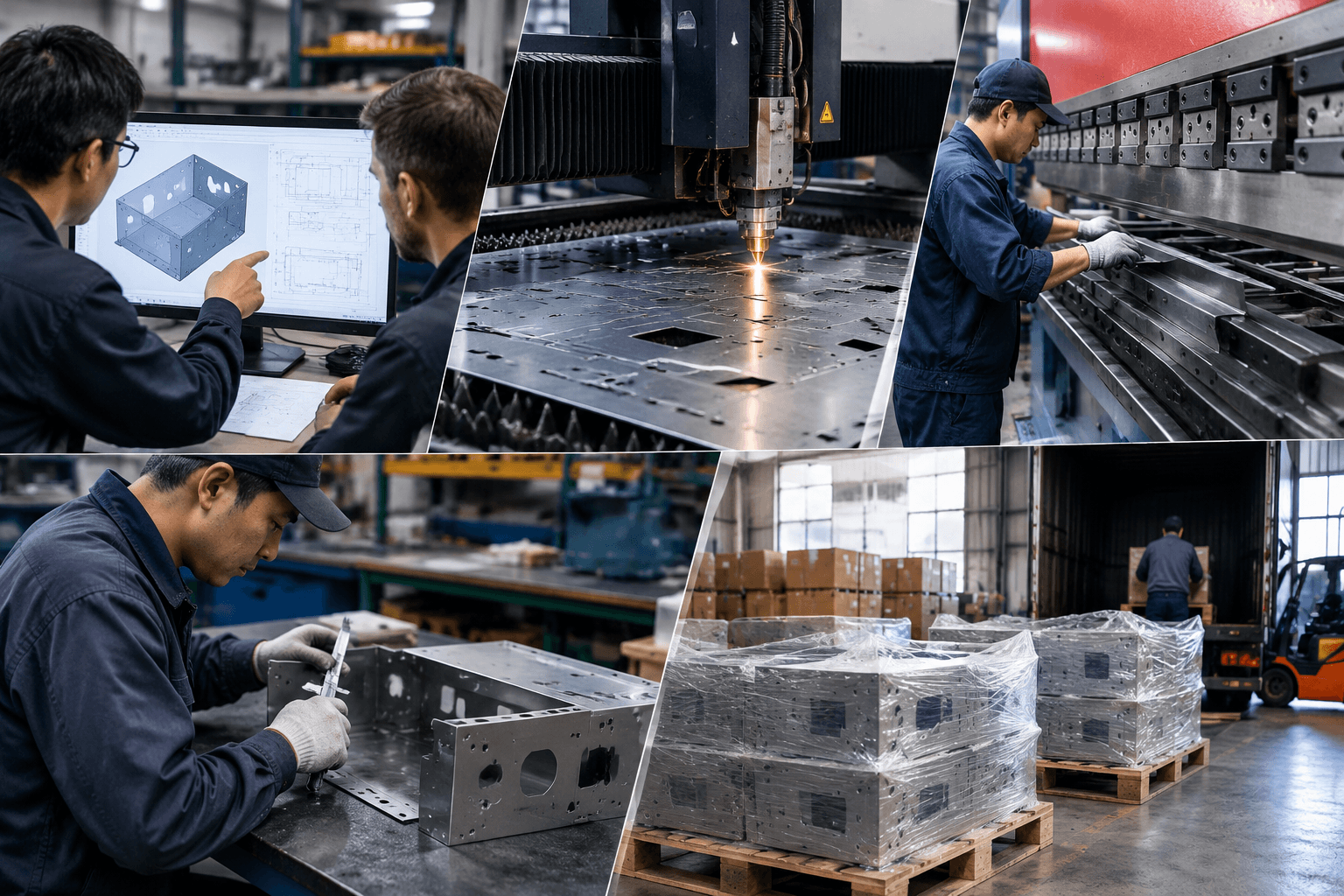
Fast fabrication for custom sheet metal parts means reducing the total elapsed project schedule in a controlled way—not quoting a fixed number of days or assuming one process suits every part. For an overseas OEM buyer ordering enclosures, frames, cabinets, or welded assemblies, the relevant clock can include engineering, material preparation, fabrication, inspection, finishing, assembly, packing, and shipping.
Answer first: A credible fast-fabrication plan targets the shortest realistic schedule for the defined scope while keeping revision control, approvals, and appropriate quality checks in place. It should show which milestones are confirmed, which depend on the buyer or an outside service, and where responsibility transfers to shipping.
For a buyer preparing an RFQ or comparing suppliers, a quick inquiry response is only one milestone. The finished product may still require drawing clarification, material purchasing, forming, joining, inspection, surface treatment, hardware, assembly, and export logistics.
Start with the complete schedule, not the quote
When an OEM team is comparing suppliers for a cabinet or welded frame, a quick quotation can hide waiting for material, approvals, outside finishing, or freight. Compare the full chain from the agreed schedule start to the required delivery point.
| Milestone | What it covers | Main dependency |
|---|---|---|
| Response and quotation | File review, questions, route selection, and commercial assumptions. | Complete technical scope. |
| Engineering review | Geometry, material, thickness, tolerances, bends, joining, finish, and assembly review. | Released 2D drawings and matching 3D data where available. |
| Material preparation | Purchasing or reserving the required grade and thickness and preparing it for production. | Stock status, purchasing, and any approved alternative. |
| Fabrication | Cutting, punching, bending, and joining in the agreed sequence. | Approved information, material, programming, setup, and batch planning. |
| Inspection and approval | Dimensional, material, appearance, fit, alignment, or other agreed checks. | Acceptance criteria and any sample or first-article decision. |
| Finishing and assembly | Surface treatment, hardware installation, subassembly, or final assembly. | Outside services, purchased items, finish approval, and assembly scope. |
| Packing and shipping | Transit protection, freight handoff, customs activity, and destination delivery. | Packaging requirements, carrier, shipping arrangement, and destination. |
Cutting, punching, and bending create sheet-metal components; welding joins prepared components into frames or assemblies. Finishing, assembly, and inspection are separate downstream or control stages, while shipping continues after manufacturing completion. Ask which dates are confirmed and which depend on stock, buyer approval, outside processing, purchased hardware, customs, or transit. For the broader scope, see custom sheet metal fabrication built to your drawings.
Lead time follows the project variables
A part that looks simple in an RFQ can still require a longer route when its files, material, tolerance, quantity, or completion level are unclear. Those inputs affect programming, setup, inspection, and the number of approval points.
| Project variable | Schedule effect | Buyer clarification |
|---|---|---|
| Drawing completeness and revision | Missing dimensions, mismatched 2D and 3D files, or active changes can create clarification loops. | Which revision is released, and who approves changes? |
| Material grade, thickness, and stock | Availability and purchasing can affect the production start and may influence forming, welding, appearance, or fit. | Is the grade mandatory, and are alternatives allowed? |
| Size, geometry, and feature density | Part size, holes, bends, profiles, and detail density affect planning and checking. | Which features control function, fit, appearance, or assembly? |
| Tolerances and inspection | Tighter or more extensive acceptance requirements can add review and approval work. | What criteria apply, and is a first-piece or first-article review needed? |
| Quantity and batch structure | Programming, nesting, tooling, setup, repeatability, and sequencing can change with quantity. | What is the initial quantity and expected repeat-order basis? |
| Joining and assembly | Welding, hardware, fit checks, alignment, and subassembly add operations beyond flat parts. | Are parts supplied individually, as welded subassemblies, or ready to install? |
| Finishing and external processing | Surface treatment, outside-service queues, and finish approval can extend the downstream route. | What surface condition is required, and who manages outside processing? |
| Approvals and logistics | Engineering changes, sample approval, export packing, freight, customs, and destination requirements affect delivery. | Who approves release, and where does the shipping handoff occur? |
Buyer-controlled delays often begin with an incomplete drawing, an undefined surface condition, or a tolerance that is not tied to a functional requirement. A stable revision and named approval owner help the supplier plan without guessing. Also distinguish a confirmed supplier lead time from a conditional estimate that depends on material, approval, an outside service, hardware, or shipping arrangements.
Choose the route from the finished part backward
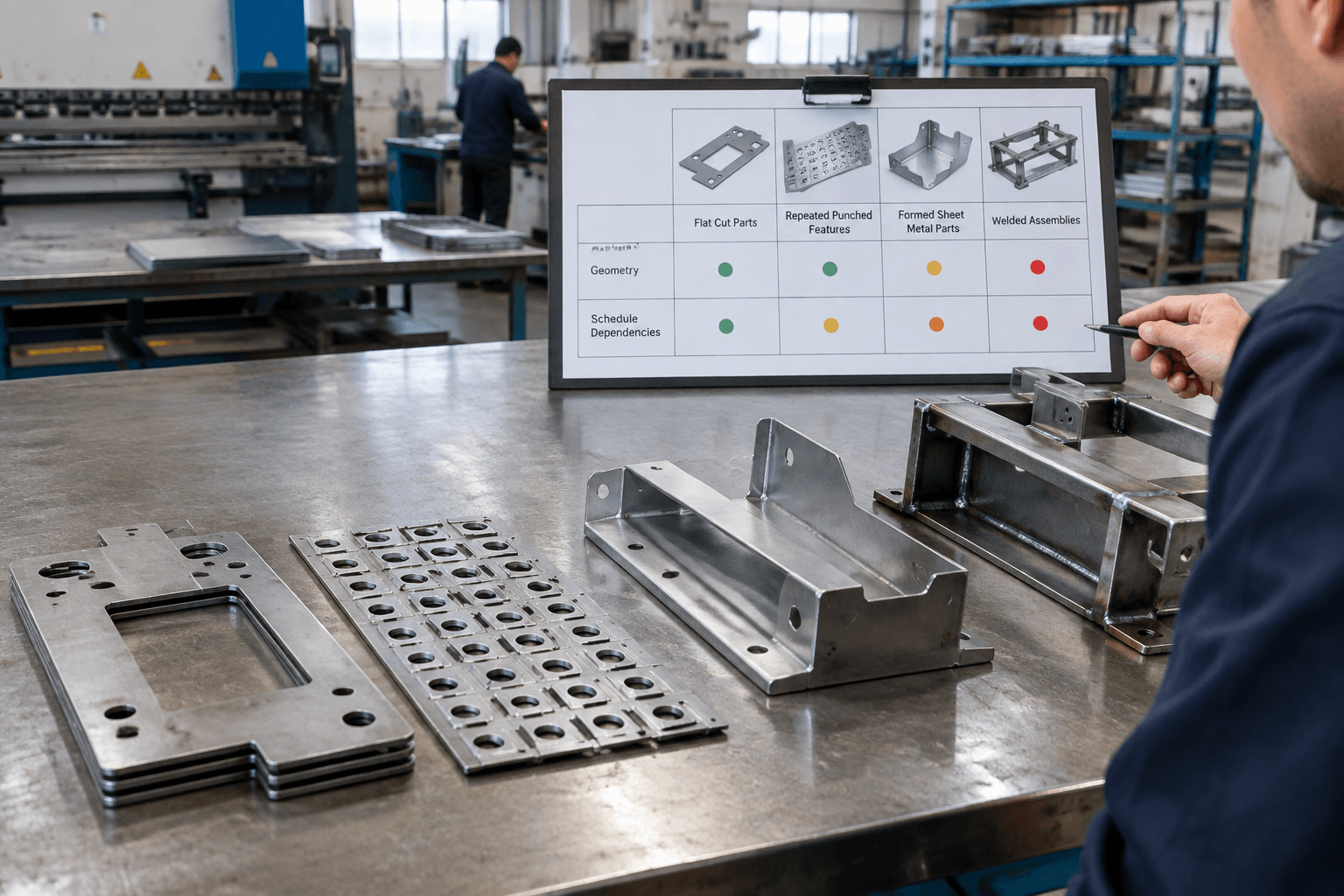
Route selection matters when a buyer needs more than a flat blank. Laser cutting, CNC punching, metal bending, and welding serve different geometries and production conditions, and a completed product may use several stages in sequence.
| Part condition or requirement | Route that may fit | Schedule questions to review |
|---|---|---|
| Flat profiles with varied cut geometry | Laser cutting may suit the material, thickness, drawing, and cut pattern. | Are files and material ready, and are deburring or later forming included? |
| Repeated holes or feature patterns | CNC punching may fit when geometry, tooling, material, and quantity support it. | What programming or tooling is needed, and will forming follow? |
| Three-dimensional sheet-metal parts | Bending adds a forming stage after flat preparation. | Have tooling, bend sequence, springback control, inspection, and fit been considered? |
| Frames and welded assemblies | Welding joins prepared parts into a structural or functional assembly. | What joint preparation, fixturing, weld sequence, alignment, deformation, and inspection are needed? |
| Ready-to-install products | Finishing, hardware installation, and assembly may follow fabrication. | Are outside processing, finish approval, hardware, fit checks, and packaging included? |
Laser cutting is not automatically the fastest route. Repeated punched features may suit CNC punching under suitable conditions, while a formed enclosure still needs bending and a welded frame still needs joining and fit control. CNC machining is a separate subtractive route for geometry or tolerances that do not suit sheet metal. The drawing, material, quantity, and required completion level should guide the choice.
Run a controlled workflow with visible gates
A reliable workflow removes avoidable waiting while keeping responsibility and approval points visible to both the buyer and manufacturer.
- Submit the technical package. The buyer provides drawings, available 3D CAD files, material and thickness, quantity, finish, assembly requirements, critical tolerances, inspection criteria, destination, and target milestones.
- Complete manufacturability review. The manufacturer identifies a likely route and flags unclear dimensions, difficult features, joining concerns, finish requirements, or missing information.
- Resolve questions and control the revision. Both parties document answers and release the applicable revision. A revision freeze helps reduce the risk of production using superseded information.
- Confirm quotation assumptions and schedule. The supplier identifies dependencies such as material purchasing, buyer approval, external finishing, hardware, prototype review, or shipping arrangements.
- Decide on a prototype or first article. A sample can reveal fit or appearance issues before batch production, but it can also add an approval stage.
- Approve the production release. The buyer confirms the drawing, finish, acceptance criteria, and any sample result before controlled production information is released.
- Fabricate and inspect in process. Cutting, punching, bending, welding, and related checks follow the agreed route. Formed parts and welded assemblies may need fit, alignment, or deformation checks.
- Complete finishing and assembly. Surface treatment, hardware installation, and assembly follow the approved scope, with outside-service handoffs identified.
- Perform final inspection, pack, and ship. The product is checked against the agreed requirements, protected for transit, and transferred to shipping. Manufacturing completion is separate from final delivery.
For an OEM enclosure or cabinet, the required scope may include flat preparation, forming, hardware, surface treatment, assembly, and packaging. See custom sheet metal enclosures that arrive ready to assemble when defining that completion level.
Compare schedules on the same basis
Use the worksheet below when comparing suppliers. Request milestone dates, dependencies, and exclusions instead of one undifferentiated delivery promise.
| Item to record | Supplier A | Supplier B | Owner or dependency |
|---|---|---|---|
| Event that starts the schedule clock | Buyer and supplier agree | ||
| Drawing revision and 2D/3D status | Engineering | ||
| Quote and engineering-review milestone | Supplier conditions | ||
| Material grade, thickness, and stock | Supplier to confirm | ||
| Quantity, batch structure, and repeat-order basis | Procurement | ||
| Proposed cutting, punching, forming, and welding route | Manufacturability review | ||
| Prototype or first-article requirement | Buyer approval owner | ||
| Production-complete milestone | Supplier conditions | ||
| Inspection gates and acceptance criteria | Quality or engineering | ||
| Finishing, hardware, and assembly included | Scope confirmation | ||
| Outside processing or purchased-item dependency | Supplier to identify | ||
| Final inspection and packing milestone | Supplier to confirm | ||
| Freight handoff and destination basis | Logistics responsibility | ||
| Change-control and approval process | Buyer and supplier |
Do not compare one supplier’s production-complete date with another supplier’s delivered date. Confirm who approves samples or first articles, what happens after a drawing change, how outside-processing delays are reported, how dimensions, material, finish, and assembly will be checked, and when responsibility transfers to the carrier. The shipping stage should remain separate from manufacturing completion.
Yishang has more than 26 years of experience in custom sheet metal and metal-product manufacturing, exports to more than 50 countries, and supports B2B OEM and ODM projects. It also holds ISO and RoHS certifications. These facts may support supplier evaluation, but they do not establish a project-specific lead time or product outcome.
Request a project-specific schedule-feasibility review with:
- 2D drawings and available 3D CAD files;
- material grade, thickness, and required surface condition;
- estimated quantity, batch structure, and repeat-order expectations;
- critical dimensions, tolerances, assembly requirements, and inspection criteria;
- target milestone or delivery date and destination; and
- prototype, first-article, packaging, or shipping requirements.
Keep quality controls inside the fast path
When an OEM buyer is under schedule pressure, quality controls should be planned with the route rather than added after production. They protect fit, finish, and repeatability without treating inspection as an optional delay.
Late drawing changes: Control the released revision, document changes before production, and reassess schedule impact after a change.
Material mismatch: Identify the required grade and thickness and check material identity where forming, welding, appearance, or fit depends on it.
Formed-part or welded-assembly distortion: Include fit, alignment, deformation, or correction checks when the product’s function requires them.
Inspection gaps: Define agreed tolerances, first-piece or first-article review when needed, in-process checks, and final inspection before release.
Finish, assembly, or transit rejection: Confirm surface condition, hardware, assembly scope, acceptance criteria, and packaging protection before handoff.
Link each control to the buyer’s drawings, acceptance criteria, and intended assembly use. For related inspection considerations, see Quality Control.
Planning a fast-fabrication project? Share the drawings, material, quantity, tolerances, finish, assembly scope, prototype needs, target date, and destination for a schedule-feasibility review. The goal is a documented route with visible milestones, dependencies, approval points, and information gaps—not an unqualified rush promise.
Where RFQ Assumptions Create Cost and Production Risk
Many sheet metal fabrication problems begin before production starts. If drawings, tolerances, finish expectations, material grades, or assembly requirements are unclear, suppliers may quote based on different assumptions. That can make prices difficult to compare and may lead to rework, cosmetic rejection, assembly misalignment, or production delays later.
For OEM buyers, the goal is not simply to request the lowest price. The goal is to make sure each supplier is quoting the same manufacturing reality. Before confirming an order, clarify which dimensions are fit-critical, which surfaces are cosmetic, whether prototypes must match batch-production conditions, and how finished parts will be inspected.

Frequently Asked Questions
What fast fabrication details should buyers define before requesting a quote?
Buyers should define the functional requirement, drawing notes, critical dimensions, material or process expectations, and any inspection points related to fast fabrication. This helps suppliers quote the same manufacturing scope instead of making different assumptions.
How can RFQ details affect cost, fit, or lead time?
RFQ details can change tooling, forming, welding, finishing, inspection, or rework requirements. If buyers do not clarify it early, two supplier quotes may look comparable while covering different production risks.
Why should drawing requirements be reviewed before prototype approval?
drawing requirements may look acceptable on a single sample but become harder to control during batch production. Buyers should confirm whether the prototype reflects the same process, finish, and inspection conditions expected for production.
What inspection points matter most for fast fabrication projects?
Important inspection points usually include fit-critical dimensions, holes or mating areas, cosmetic surfaces, finish build-up, welded or formed features, and any dimensions that affect downstream assembly. These points should appear in the RFQ or drawing notes.
How can buyers reduce prototype approval risk before batch production?
Buyers can reduce risk by clarifying drawings, locking key material and finish assumptions, defining inspection timing, approving a representative sample, and confirming which dimensions or surfaces require tighter process control.
How can Yishang help review fast fabrication requirements?
Yishang can review drawings, RFQ notes, material requirements, tolerance expectations, finish details, samples, and assembly needs to identify unclear assumptions before quoting or batch production.