
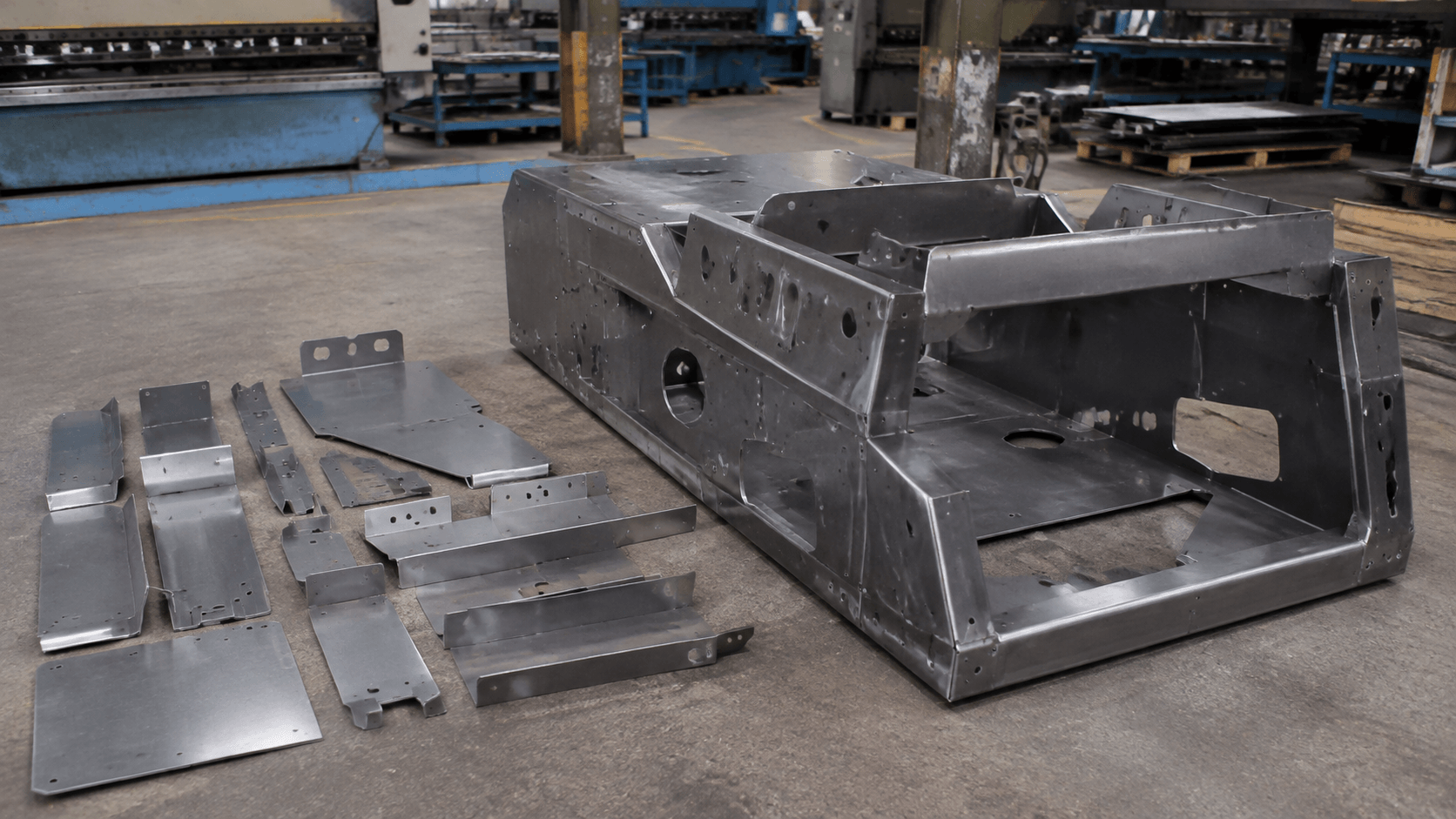
A metal fabricator is a manufacturer that converts metal stock into specified parts or assemblies through a coordinated route that may include cutting, forming, joining, finishing, and assembly. The term describes a company or production partner; it does not mean every fabricator is also a machine shop, stamping plant, foundry, extrusion supplier, or structural steel contractor.
For an overseas OEM buyer, identifying a supplier as a “metal fabricator” is only the starting point. One company may focus on sheet metal enclosures, while another produces welded frames or construction-oriented steelwork. Whether a project fits depends on the starting material, part geometry, quantity, tooling economics, dimensional requirements, finish, and assembly scope.
Metal Fabricator and Metal Fabrication: Two Related Meanings
When an OEM sends a drawing for review, the metal fabricator is the company responsible for turning that design into a component, structure, or assembly. Depending on its actual capabilities, the company may work with sheet, plate, tube, bar, or previously formed and purchased components.
Metal fabrication is the sequence of manufacturing operations used to make the product. Cutting creates blanks and openings, forming changes geometry, and welding joins components. Finishing and assembly are separate downstream operations that may be coordinated within the overall production route. Inspection verifies specified characteristics at appropriate stages; it does not create the part or replace process control.
This distinction matters when reviewing a supplier’s proposed route. A company can describe itself as a fabricator without performing every operation in-house, and it may subcontract coating, plating, machining, specialized welding, or another process. That arrangement is not inherently unsuitable, but the division of responsibility should be clear.
Products Commonly Suited to Fabrication
Product geometry offers a more useful starting point than a generic list of fabrication services. By examining how the part is shaped, joined, and delivered, a buyer can determine whether fabrication is likely to lead the project or support another primary process. Representative categories include:
- Flat and bent parts: panels, covers, brackets, mounting plates, guards, and supports cut from flat stock and formed where required.
- Folded housings: enclosures and cabinet bodies built from bent panels, doors, internal supports, hinges, fasteners, and other hardware.
- Built-up structures: frames, racks, and equipment supports made by welding or mechanically joining sheet, plate, tube, or formed components.
- Welded assemblies: products in which multiple cut, bent, tubular, machined, or purchased components are joined into one unit.
The starting form influences the production route. A sheet metal bracket may require blanking and bending, whereas a cabinet may combine folded panels, welded supports, installed hardware, coating, and final assembly. A frame made mainly from tube follows a different preparation and joining route, even if sheet metal panels are attached later.
A product name alone does not establish capability. For example, an enclosure can require forming access, controlled interfaces, hardware installation, weld access, masking, and assembly. A repeated bracket might instead suit stamping if its geometry, demand pattern, and tooling economics support a dedicated die.
OEM buyers can explore the sheet metal fabrication route for custom structures and assemblies while confirming the specific processes required by their drawings.
From Drawing to Finished Assembly
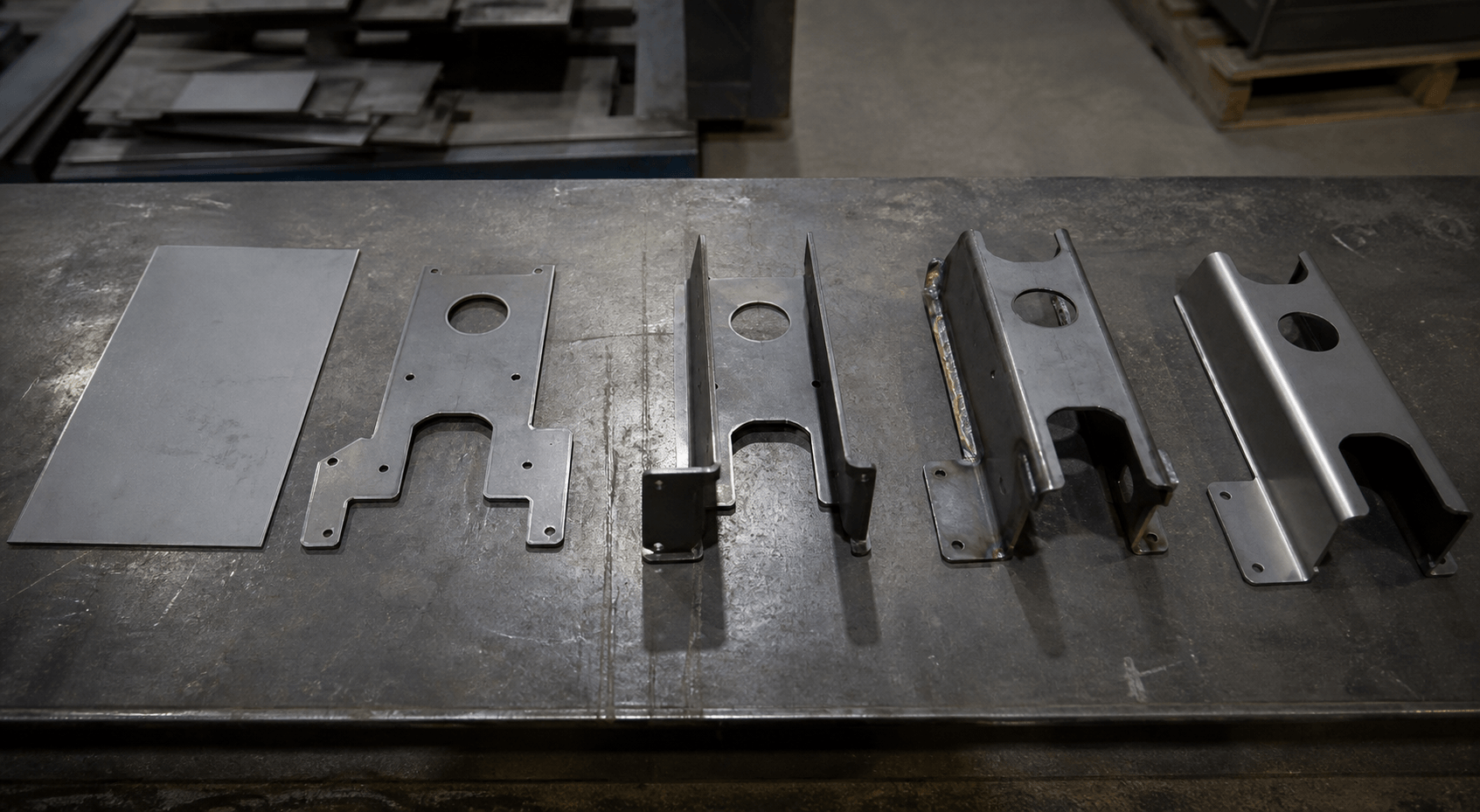
A buyer may receive one completed assembly, but the manufacturer reaches that result through several linked operations. The route below shows how a fabricated product can progress from design files to a finished deliverable. It is not universal: operations may be omitted, reordered, subcontracted, or supplemented according to the geometry, material, quantity, finish, and assembly requirements.
- Drawing and process review. The fabricator examines the current 2D drawing, available 3D model, material, thickness, critical dimensions, tolerances, finish, and assembly requirements. This review establishes the intended manufacturing route and identifies information that must be clarified.
- Material preparation. The specified sheet, plate, tube, or other stock is allocated and prepared. Material grade and thickness affect forming behavior, welding response, weight, and compatibility with the required finish.
- Laser cutting. Laser cutting removes material along programmed paths to produce external profiles, openings, and slots. Suitability depends on the stock, geometry, edge requirements, and the supplier’s available equipment.
- CNC punching. A CNC punch press uses tooling to make holes, notches, and repeated cut features. With suitable tooling, it can also produce localized formed features such as louvers. Punching does not replace bending or every other cutting method.
- Bending and forming. A press brake or another forming process deforms the blank into the required shape rather than removing material at the bend. Bend radius, material behavior, tool access, bend sequence, and holes near bends can all affect the resulting geometry.
- Welding and mechanical joining. Welding uses heat, with filler material where applicable, to join separate components. Because heat input can produce shrinkage or distortion, joint design, fixturing, weld sequence, access, and appearance are relevant. Mechanical fasteners or installed hardware may provide an alternative or complementary joining method.
- Finishing. Deburring, polishing, powder coating, and other specified treatments are distinct from cutting, forming, and welding. These operations can affect appearance, corrosion protection, surface condition, masking requirements, and fit at mating interfaces.
- Hardware installation and assembly. Threaded inserts, hinges, latches, fasteners, and purchased components may be installed before the product is assembled. The drawing and order should distinguish loose fabricated parts from a finished or ready-to-install assembly.
- Verification. Inspection may occur between operations and after assembly to check characteristics required by the approved documentation. Required records and acceptance criteria should be defined for the project rather than inferred from a general service list.
For a product-specific illustration, see how these separate operations can be coordinated for custom sheet metal enclosures.
Which Manufacturing Route Should Lead Your Metal Part?
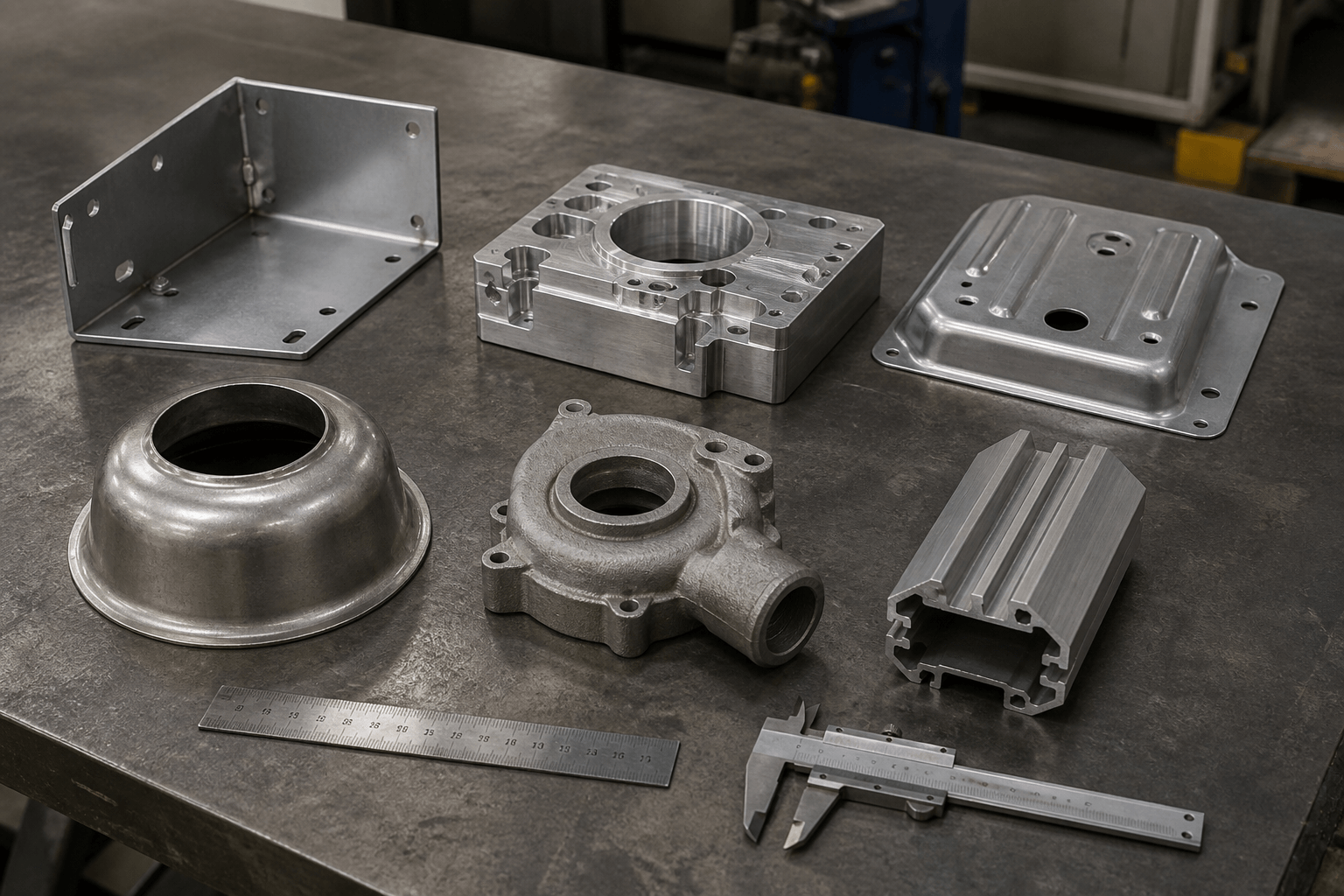
Classifying the process early helps an OEM direct each component to the right type of manufacturer. Sheet metal fabrication is one option among several, and a hybrid product may contain a fabricated housing, machined mounting blocks, stamped clips, cast covers, or extruded rails. Each component retains its own manufacturing classification even when all the components meet in one assembly.
| Manufacturing route | Typical starting form | Geometry or feature pattern | Primary fit considerations |
|---|---|---|---|
| Sheet metal fabrication | Flat sheet or relatively thin plate, sometimes combined with tube or purchased components | Panels, brackets, folded housings, cabinets, guards, and built-up assemblies | Cut-and-form geometry, joining, finish, assembly scope, quantity, and whether dedicated forming dies are justified |
| CNC machining | Solid bar, block, billet, or near-net-shape stock | Pockets, bores, threads, contours, machined interfaces, and rotational features | Material removal, tool access, solid geometry, dimensional requirements, and surface requirements |
| Stamping | Sheet or coil strip | Repeated pierced, blanked, and formed features produced with press tooling | Part geometry, tooling investment, repeat demand, and the production pattern |
| Deep drawing | Flat sheet blank | Deep seamless or near-seamless cups, shells, and hollow forms | Draw depth, material flow, forming stages, tooling, and geometry |
| Casting | Molten metal introduced into a mold | Three-dimensional forms, substantial sections, cavities, and shapes difficult to build from cut and bent stock | Alloy, mold and part design, required secondary operations, and production economics |
| Extrusion | Billet forced through a die | Rails, channels, heat sinks, and other substantially constant cross-sections | Cross-sectional geometry, length requirements, secondary operations, and die economics |
A machined component does not become sheet metal fabrication simply because it is installed in a fabricated assembly. For example, a folded cabinet could receive a CNC-machined mounting block at a bolted interface. The cabinet and block require different manufacturing routes, followed by a defined joining or assembly step. Buyers can compare CNC machining with fabrication for solid, rotational, or precision-machined features.
Structural steel fabrication is also a distinct category. It commonly involves larger load-bearing members, construction-oriented work, and possible site installation. Although an OEM equipment frame can use similar cutting and welding principles, its interfaces, finish, documentation, packaging, and assembly expectations may differ from those of structural work.
Use the matrix to identify which route deserves technical review, rather than assuming universal advantages in cost, tolerance, volume, or lead time. If a product combines several routes, define the interfaces and decide which supplier will coordinate the completed assembly.
Capability Matching Happens at Drawing Level
Once a likely manufacturing route has been identified, the drawing determines whether a particular metal fabricator can execute it. A service list alone does not establish usable capacity, tooling access, material compatibility, or achievable results for a specific design. The fabricator needs enough information to evaluate the complete route and the interfaces between operations.
- Current 2D engineering drawings with revisions and units.
- A 3D model when available, especially for formed geometry and assemblies.
- Material grade, condition where relevant, thickness, and approved alternatives.
- Prototype quantity, expected batch quantity, and recurring demand pattern.
- Critical dimensions, tolerances, datums, flatness requirements, and mating interfaces.
- Surface finish, visible-surface requirements, coating or polishing details, and masking areas.
- Weld locations and requirements, purchased hardware, and assembly scope.
- Required inspection records, material documents, traceability, or approval steps where applicable.
- Destination country and required delivery stage, such as loose parts, subassemblies, or completed assemblies.
Drawing review can then address bend radius, holes near bends, possible feature deformation, weld shrinkage, distortion, flatness, tool and weld access, and tolerance accumulation through the assembly. These issues cannot be resolved through one universal design rule because their effects depend on the material, thickness, geometry, process, and product specification.
Quantity influences route selection but does not determine it alone. Programmable cutting and bending may suit one production pattern, while recurring parts with stable geometry may justify stamping tooling. Deep seamless shells point toward deep drawing, and constant-profile rails point toward extrusion. A drawing-level design and manufacturability review can help classify the part before quotation or prototyping.
Yishang’s Scope for OEM Process-Fit Review
For overseas OEM teams evaluating a fabricated part or assembly, Yishang provides a B2B review path for OEM and ODM projects. The company has more than 26 years of experience in custom sheet metal and metal product manufacturing and exports custom metal products to more than 50 countries.
Its stated scope includes laser cutting, CNC punching, bending, welding, powder coating, polishing, assembly, prototype review, and batch production. Product categories include custom sheet metal parts, enclosures, cabinets, display racks, frames, and welded assemblies. These categories define an area for evaluation; project suitability still depends on the drawing, material, finish, quantity, and assembly requirements.
Yishang also states that it holds ISO and RoHS certifications. Such documentation may support a supplier review, but certification alone does not establish part-level conformance, material compliance, dimensional capability, or process suitability. Those points depend on the approved product requirements and the evidence agreed for the project.
For a process-fit review, send the current 2D engineering drawing and an available 3D model, along with the material grade and thickness, prototype and expected batch quantities, critical dimensions and tolerances, and surface-finish requirements. Include welding details, purchased hardware, assembly scope, destination country, and the required delivery stage. Yishang can then review whether the project fits its sheet metal fabrication, finishing, and assembly scope and identify requirements that need clarification before quotation or prototyping.
Frequently Asked Questions
These answers address the process distinctions and project information OEM buyers commonly need before sending drawings for review.
What is the difference between a metal fabricator and a machinist?
A metal fabricator commonly creates parts and assemblies by cutting, forming, and joining sheet, plate, tube, or related stock. A machinist removes material through operations such as milling and turning to create solid, rotational, or precision-machined features. Fabricated and machined components can meet at an assembly interface, but they remain products of different processes.
Can one metal fabricator handle cutting, bending, welding, finishing, and assembly?
Some fabricators coordinate the complete route, while others provide selected operations or use outside partners. Before issuing an RFQ, confirm which processes are performed directly, which are subcontracted, and whether the requested deliverable is a loose part, finished component, or completed assembly.
Does a metal fabricator work only with sheet metal?
No. Depending on its scope, a fabricator may also work with plate, tube, bar, formed components, or purchased parts. However, the label does not guarantee machining, stamping, casting, extrusion, deep drawing, or structural steel capability.
What files should an OEM buyer send for a process-fit review?
Send the latest 2D drawing and a 3D model when available, together with the material grade and thickness, prototype and batch quantities, critical dimensions, tolerances, finish, welding details, hardware, and assembly scope. Also identify required documentation, the destination country, and whether delivery should be as loose parts, subassemblies, or completed assemblies.