
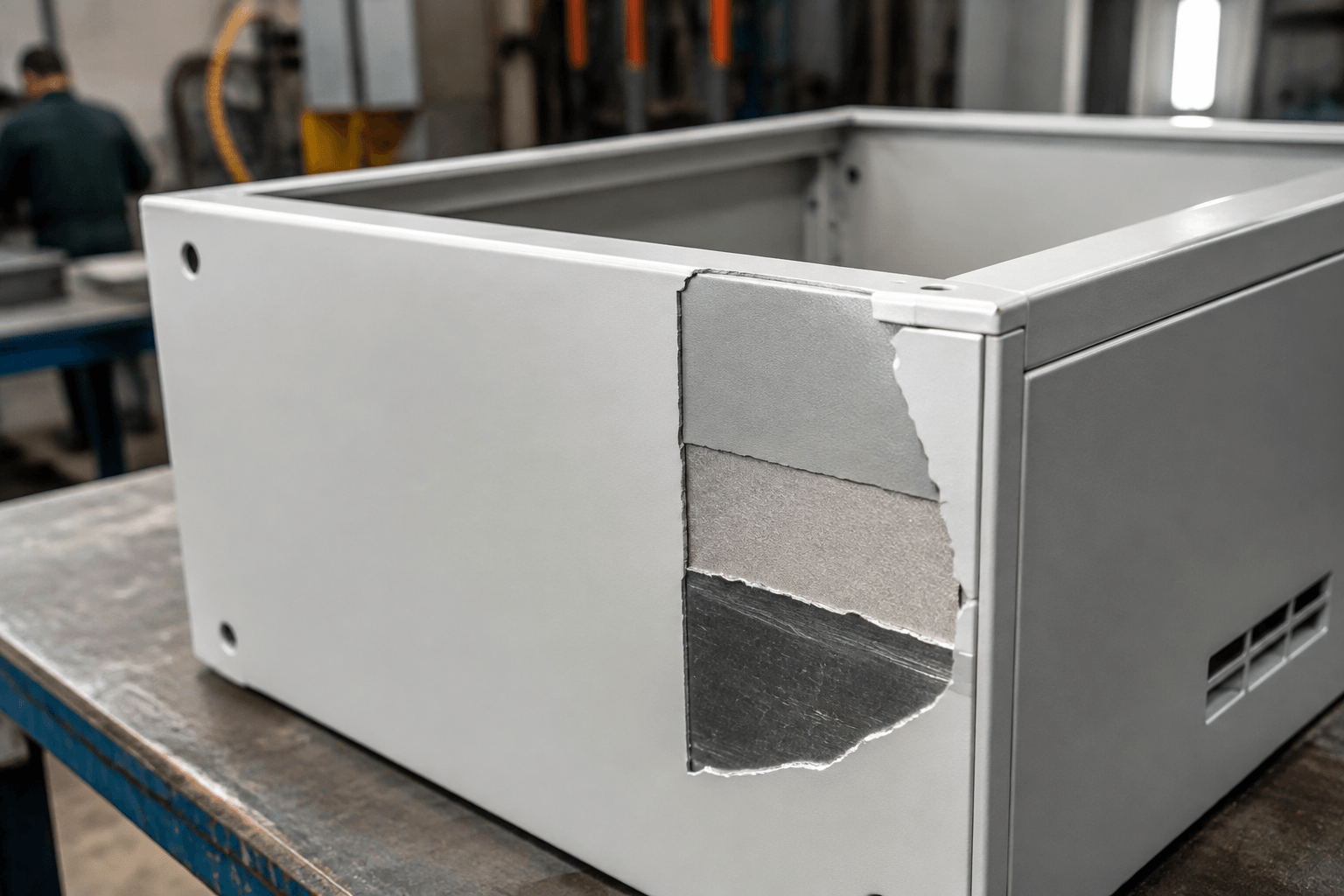
Metal powder coated means a finished metal part whose surface is covered with an electrostatically applied powder and then heat-cured into a solid coating. It does not mean that the part is made from powdered metal. The steel, aluminum, galvanized sheet, stainless steel, or other substrate remains the structural material beneath the finish.
The finished result depends on the complete coating system. Substrate preparation, powder chemistry, part geometry, masking, curing, and the operating environment all influence adhesion, appearance, corrosion protection, dimensions, and assembly fit.
For an OEM buyer reviewing a bracket, enclosure, frame, or sheet metal assembly, the key question is not simply whether the part can be powder coated. The finish must also suit the metal, exposure, visible surfaces, tolerances, electrical interfaces, and expected service conditions.
What “Metal Powder Coated” Means in Practice
When a buyer adds powder coating to a part drawing, the underlying metal still determines the part’s shape, strength, weight, and fabrication requirements. Powder coating is a finishing process applied after the metal part has been prepared; it changes the surface without replacing the substrate or increasing the product’s structural load capacity.
The surface is first cleaned to remove oils, dirt, oxides, scale, and other contaminants that could interfere with adhesion. Depending on the substrate and required service conditions, preparation may also include a compatible chemical pretreatment or another surface treatment.
Dry powder is then applied, commonly through an electrostatic process. The powder receives an electrical charge while the grounded part attracts and holds the particles. The coated part enters a heated curing stage specified by the selected powder system. During curing, the particles flow together and form a solid organic film.
A simplified cross-section looks like this:
- Metal substrate: steel, aluminum, galvanized sheet, or stainless steel provides the part’s shape and mechanical strength.
- Prepared or pretreated surface: this interface supports adhesion and helps manage the substrate’s corrosion behavior.
- Cured powder layer: the visible finish provides color, gloss, texture, and a degree of surface protection.
Because the coating is a surface layer, the part should still be evaluated as a metal component. Material selection, sheet thickness, joint design, and structural engineering remain separate from finish selection.
Surface changes that affect appearance and assembly
On a production part, powder coating can determine whether the finished enclosure looks consistent across visible faces and whether a bracket still fits its mating hardware. The most obvious change is appearance: powder systems may be available in different colors, gloss levels, and textures, although the actual range depends on the supplier, product line, batch, and application.
A color name alone may not define the expected result. Buyers may need to specify a color reference, gloss direction, smooth or textured surface, and which faces are visually important. When appearance consistency has commercial importance, a physical approved sample is more reliable than a screen image or an informal color description.
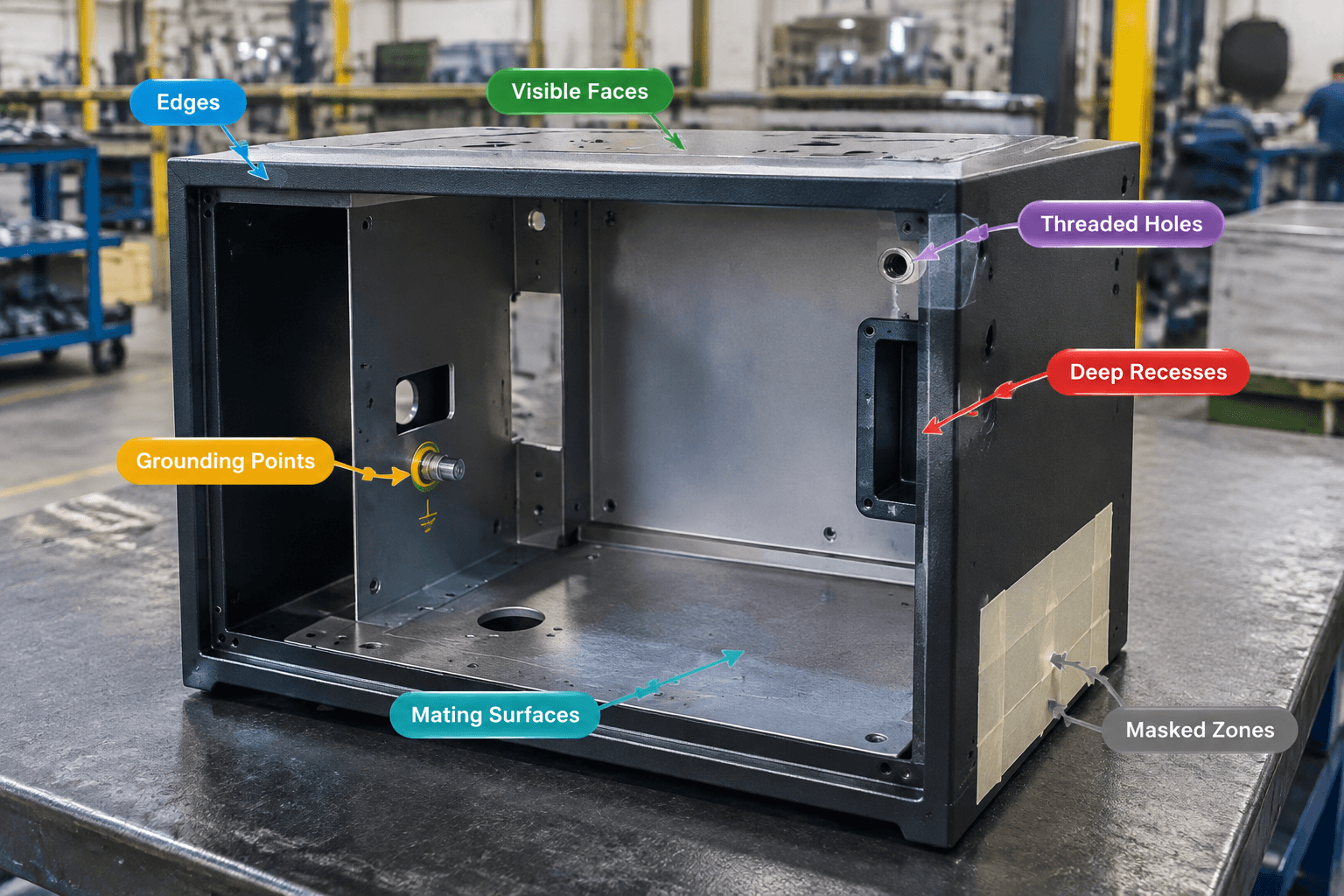
The coating also adds a physical layer. That can matter around close-fitting interfaces, threaded holes, press-fit locations, grounding points, hinges, sliding surfaces, and mating faces. Commonly masked areas include threads, earth contacts, bearing seats, precision holes, labels, and surfaces that must make direct metal-to-metal contact.
Masking is not limited to holes. A product may require selected edges, mounting pads, internal faces, or contact areas to remain uncoated. The required pattern should be shown on the drawing or otherwise agreed with the manufacturer. On a custom enclosure, the review should include openings, fasteners, grounding points, internal faces, and assembly interfaces. See custom sheet metal enclosures that arrive ready to assemble for a related product context.
Geometry affects preparation and coverage as well. Sharp edges, weld zones, deep recesses, enclosed corners, narrow gaps, and drainage-sensitive pockets can make cleaning, powder access, curing, or moisture management more difficult. Coating thickness is therefore a dimensional consideration: more coating is not automatically better if it affects fit, threads, appearance, curing, or drainage.
Corrosion protection is conditional rather than automatic. A well-adhered, continuous coating can separate the substrate from moisture and contaminants, but performance is affected by pretreatment, edge coverage, scratches, cut edges, weld areas, trapped moisture, and actual exposure. Powder coating does not make every metal product rustproof or maintenance-free.
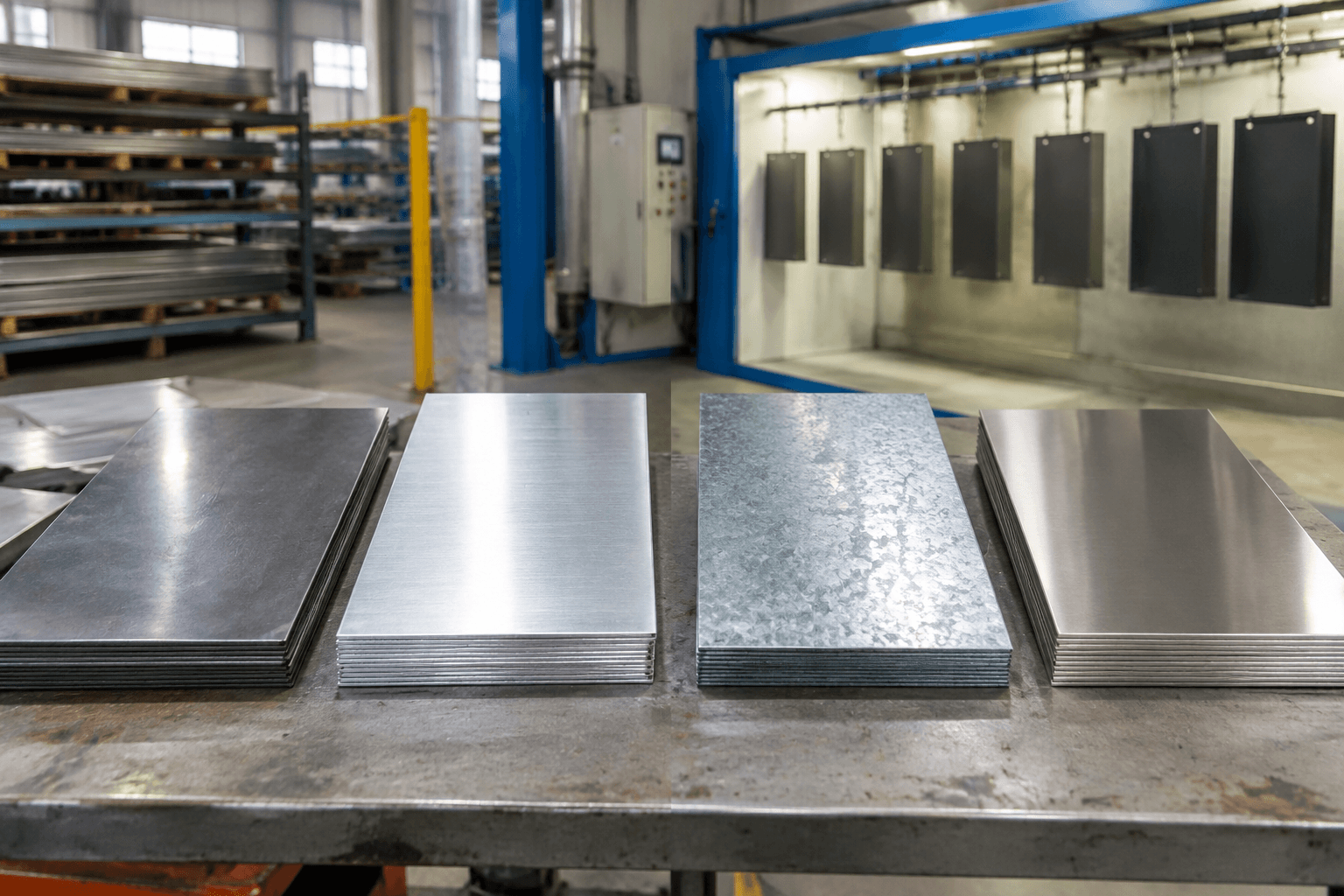
Is powder-coated metal suitable for your substrate and service environment?
A finish that works well on an indoor steel cabinet may need a different preparation or powder system on an aluminum outdoor frame. Steel, aluminum, galvanized sheet, and stainless steel can all be considered for powder coating, but they are not interchangeable; the substrate should guide the preparation, finish selection, and service review.
| Substrate | Indoor or decorative use | Outdoor exposure | Electrical and mating interfaces | Repair and service question | Decision point |
|---|---|---|---|---|---|
| Carbon or mild steel | Often considered for equipment, frames, brackets, cabinets, fixtures, and other colored or textured parts. | Review pretreatment, edge coverage, drainage, scratches, cut edges, and moisture exposure rather than relying on the coating name alone. | Mark grounding points, threads, precision holes, and metal-to-metal contact areas for masking or post-finish treatment. | If damage exposes the steel, ask how the area will be protected and whether a visible repair is acceptable. | Is the coating system appropriate for the expected moisture and handling conditions? |
| Aluminum | Can suit lightweight housings, frames, enclosures, decorative components, and color-matched parts. | Use cleaning and pretreatment compatible with aluminum and the selected exterior powder system. | Check conductivity, heat-transfer surfaces, close fits, and interfaces where the coating must not remain. | Confirm whether a repair can meet the required appearance and whether the aluminum surface will remain protected after damage. | Does the finish support the required appearance and service exposure without compromising functional surfaces? |
| Galvanized sheet | May be selected when the zinc-coated substrate and an additional colored surface are both useful. | Review the zinc surface, pretreatment, heating, venting, and geometry before specifying the finish for exterior use. | Identify contact points and holes where the combined substrate and coating could affect fit or electrical continuity. | Consider how damage, exposed zinc, and any visible repair will be handled after assembly or installation. | Has the system accounted for preparation and possible heating-related outgassing? |
| Stainless steel | Can be coated when a particular color, texture, or visual match is required. | Compare the selected coating with the natural stainless surface and actual exposure; coating is not automatically an improvement. | Decide whether conductivity, cleanability, or natural metal-to-metal contact should be preserved. | Ask whether coating damage or touch-up would be more objectionable than leaving the stainless surface visible. | Would the product benefit more from a coated appearance or from retaining the stainless substrate? |
Steel presents a familiar corrosion question: a scratch or chip can expose the substrate to moisture and contaminants. Aluminum has different surface chemistry and needs compatible cleaning and pretreatment for reliable adhesion. Galvanized surfaces require their own preparation and heating considerations because gases released during curing can affect the finish if the system or part design is unsuitable.
Stainless steel can be powder coated, but coating is not always the best default. If the buyer values the natural metallic appearance, easy cleaning, or direct electrical contact associated with stainless steel, selected surfaces may be better left unfinished. For custom work, the substrate should be reviewed with the complete product design, such as the sheet metal part made to the buyer’s drawings.
Where powder coating fits—and where it needs caution
Powder-coated metal often suits indoor equipment, retail fixtures, cabinets, frames, machine guards, furniture components, and enclosures that need a colored, textured, or gloss surface. It can provide a clean finished appearance and help shield a prepared substrate from ordinary handling and indoor exposure when the coating system is correctly selected.
Outdoor use requires a more specific review. An indoor decorative powder should not automatically be assumed to provide the ultraviolet and weathering behavior needed for an exterior product. The substrate, pretreatment, powder formulation, drainage design, edges, fasteners, and expected exposure should be considered together. For garden or outdoor products, finish selection should follow the actual environment rather than color alone; custom metal fabrication for garden and outdoor products provides a relevant application context.
Powder coating may be less suitable, or require additional controls, where the part experiences sustained high temperatures, aggressive chemicals, repeated abrasion, or a surface that must remain electrically conductive. Tight fits, threaded interfaces, sliding contacts, and areas requiring field repair also deserve attention before the drawing is released.
Part geometry can determine whether the finish is practical. Deep internal corners may be harder to prepare and coat consistently, while sharp edges may receive different coverage from broad faces. Enclosed areas need suitable access, drainage, and curing consideration. These factors do not automatically rule out powder coating; they mean the part should be reviewed as a finished assembly rather than as a flat drawing.
Powder coating compared with other metal finishes
The right alternative depends on the substrate, appearance target, electrical function, exposure, access to the surface, and repair expectations. The process name alone does not guarantee a particular level of corrosion, UV, chemical, or impact performance.
| Finish | When it may fit | Substrate, access, and appearance considerations | Points to confirm |
|---|---|---|---|
| Powder coating | When a colored, textured, or gloss organic film is wanted on a prepared metal part. | Works as a surface layer over selected metals; masking and access to recesses affect the result. | Substrate preparation, powder formulation, cure conditions, film build, fit, outdoor exposure, and repair expectations. |
| Liquid paint | When field touch-up, a particular liquid coating system, complex access, or a specified appearance is important. | May offer practical access or repair options in some applications, but application and drying conditions differ from powder coating. | Application conditions, solvent or drying requirements, film build, overspray, and suitability for the exposure. |
| Anodizing | Primarily when aluminum needs a converted aluminum-oxide surface and a metallic appearance or related surface behavior. | It modifies the aluminum surface rather than applying a powder film. It does not apply to steel. | Alloy response, color range, masking, dimensional effects, conductivity requirements, and intended appearance. |
| Plating | When a deposited metallic or other selected layer is needed for appearance, conductivity, or a specific functional surface. | Coverage at edges and recesses, base-metal compatibility, and process access differ from an organic powder coating. | The plating system, contact requirements, environmental controls, and behavior required from the deposited layer. |
| Unfinished metal | When the natural substrate, conductivity, later processing, or a visible metallic surface is preferred. | Can be appropriate for stainless steel and selected other parts, but the substrate remains exposed to its service environment. | Exposure, fingerprints, oxidation, cleaning, visible scratches, and whether the bare substrate provides the required surface behavior. |
Anodizing and powder coating are not interchangeable. Anodizing is an electrochemical conversion of an aluminum surface, while powder coating applies and cures an organic powder layer. Plating also differs because it deposits a metallic or other selected layer rather than forming a cured organic film.
Liquid paint can sometimes be easier to touch up in the field, particularly when an exact invisible repair is not required. Powder-coated damage may also be repairable with an appropriate method, but the repaired area may remain visible and may not reproduce the original color, gloss, texture, or protection. Repair expectations should be settled before selecting the finish for a serviceable product.
Set the finish expectations before sampling or production
A finish specification does not need to become a full inspection manual, but several decisions should be unambiguous before a prototype or production batch is reviewed. This helps prevent a part that meets the drawing mechanically from failing an appearance, grounding, or assembly expectation.
- Substrate and environment: identify the metal and whether the part will remain indoors, face outdoor weather, contact chemicals, experience temperature exposure, or receive frequent handling.
- Appearance: define the color reference, gloss or texture direction, visible faces, and whether a physical approved sample is needed.
- Coated and masked areas: identify threaded holes, grounding points, mating surfaces, sliding areas, precision openings, labels, and zones that must remain uncoated.
- Acceptance priorities: decide whether appearance, assembly fit, conductivity, corrosion protection, repairability, or another functional requirement has priority when trade-offs arise.
- Finish data: review the selected powder’s technical information when cure, weathering, chemical exposure, or appearance consistency is commercially important. Do not assume that one powder system suits every substrate or environment.
- Prototype approval: use the same defined expectations for the prototype and later production so color, texture, masking, and assembly fit are not judged differently at each stage.
When a sample matters, approve a physical finish reference under an agreed viewing condition rather than relying only on a color name or screen image. Broader manufacturing and inspection context is available through Yishang’s quality control information.
Need to check finish suitability before sampling? Share the part drawing or 3D model, metal substrate, indoor or outdoor service environment, color, gloss, or texture reference, visible and masked areas, grounding and mating interfaces, expected tolerances, and prototype and production quantity. Yishang can review whether the selected substrate, geometry, assembly interfaces, and powder-coated finish are compatible before an OEM or ODM sample moves toward batch production. Yishang serves B2B custom manufacturing projects and has more than 26 years of custom metal manufacturing experience.
Frequently Asked Questions
These questions commonly arise when a buyer is comparing finish samples, checking an enclosure drawing, or deciding whether a coated part is ready for prototype approval.
Does powder-coated metal rust if the coating is scratched?
It can. A scratch or chip may expose steel or another susceptible substrate to moisture and contaminants. The risk depends on the substrate, pretreatment, coating continuity, edge condition, exposure, and how the damage is handled. Powder coating should not be described as making every part rustproof.
Can aluminum be powder coated, and how is that different from anodizing?
Yes. Aluminum can be powder coated when it receives compatible cleaning and pretreatment. Powder coating creates a cured organic layer on the prepared surface. Anodizing is an electrochemical conversion of the aluminum surface, often selected when a metallic appearance or anodized surface behavior is wanted. The finishes have different appearance, masking, dimensional, and service considerations.
Is every powder-coated finish suitable for outdoor use?
No. Outdoor suitability depends on the powder formulation, substrate, pretreatment, geometry, cure, and actual exposure to sunlight, moisture, temperature changes, and contaminants. An indoor decorative powder should not automatically be specified for an exterior product.
Can powder-coated parts be touched up after assembly or shipping damage?
Touch-up may be possible, but an invisible repair should not be assumed. The repair method must suit the coating and service condition, and the color, gloss, texture, and protection may differ from the original cured finish. Masking vulnerable interfaces and agreeing on repair expectations before production can reduce later problems.