
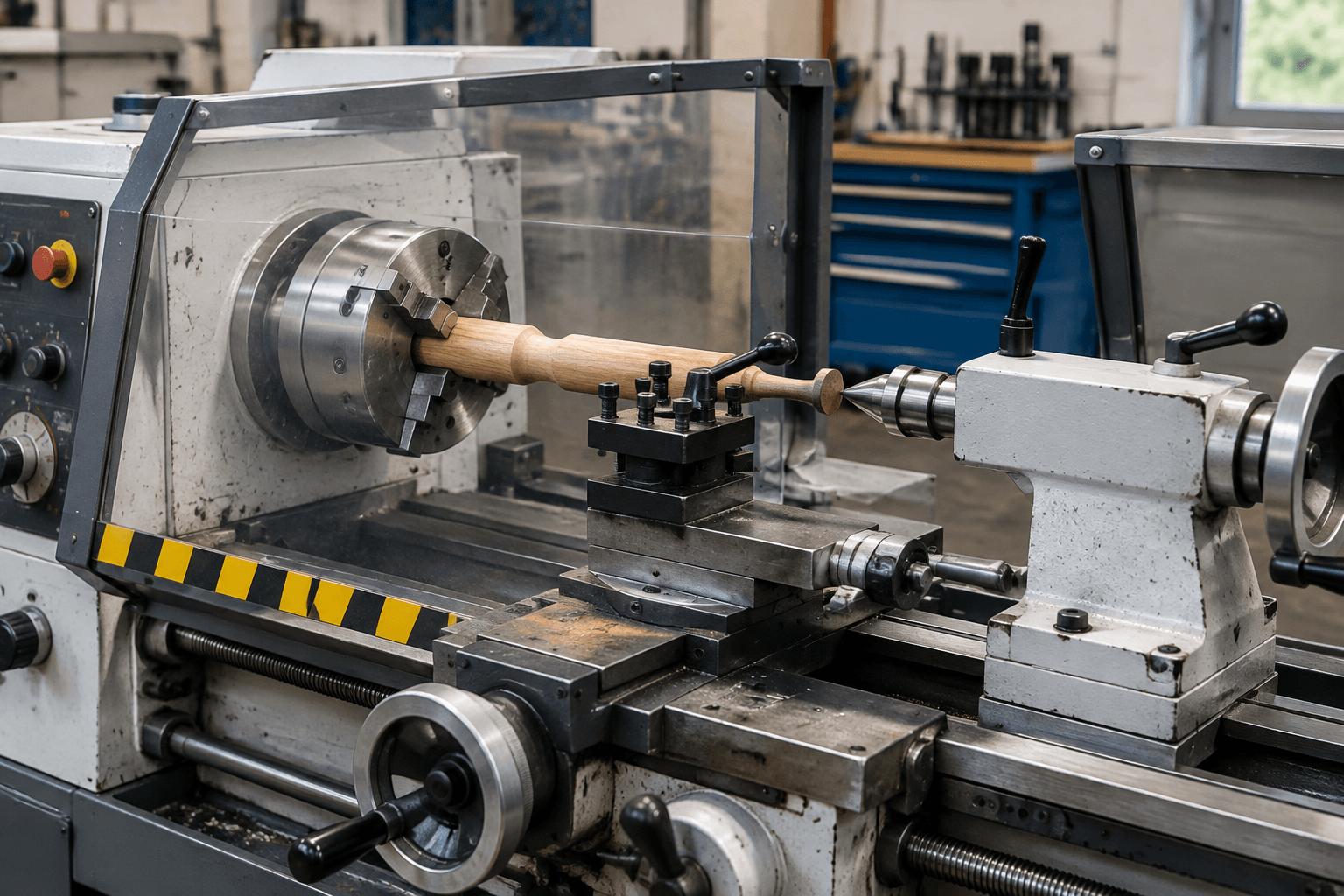
If you are evaluating an existing metal lathe for a prototype handle, short spindle, or similar wood component, the answer is conditional: some metal lathes can turn suitable wood blanks, but the machine and setup must be appropriate. The key fabrication consequences are secure workholding, supported tooling, controlled speed, vibration management, and protection from wood dust.
Can wood be turned on a metal lathe?
For a shop trying to use an existing machine instead of specifying another turning system, a metal lathe’s carriage, cross-slide, chuck, and tailstock can support a limited operation. They do not automatically provide the open tool-rest access, operator position, or clearance normally expected on a dedicated wood lathe.
The arrangement is more likely to suit a small, sound, balanced blank that is close to a cylinder or spindle. Large irregular blanks, bowls, vessels, loose-knot timber, and repetitive production require a more detailed review because balance, clearance, and tool access can change during cutting.
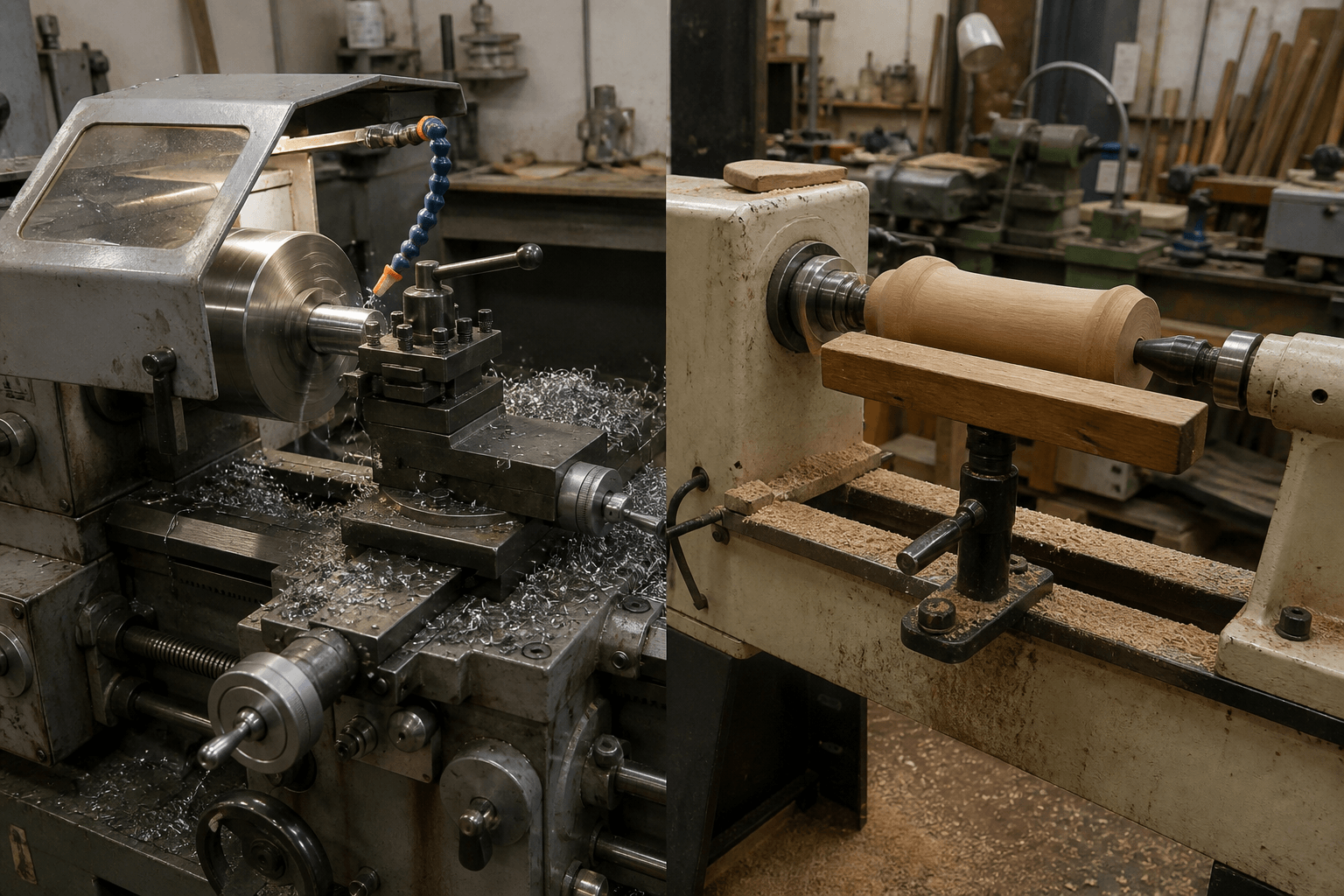
| Feature | Metal lathe | Dedicated wood lathe |
|---|---|---|
| Tool support | Typically uses a carriage, cross-slide, or tool post intended for metal-cutting operations. | Normally provides an adjustable tool rest positioned close to the wood as the profile changes. |
| Work geometry | Often better suited to controlled cylindrical or spindle-like work, subject to machine limits. | Designed for broader woodturning access within the machine’s stated rating. |
| Workholding | Chuck, centers, or faceplate arrangements must be approved for the machine and workpiece. | Spindle, chuck, faceplate, and tailstock arrangements are intended for woodturning use. |
| Dust exposure | Wood dust and chips can contaminate the chuck, carriage, ways, spindle area, and other components. | Dust and housekeeping requirements still depend on the specific machine and workplace controls. |
This is a functional comparison, not a universal capacity statement. The manual, chuck instructions, and workplace risk assessment control the decision.
Mounting and supporting the wood blank
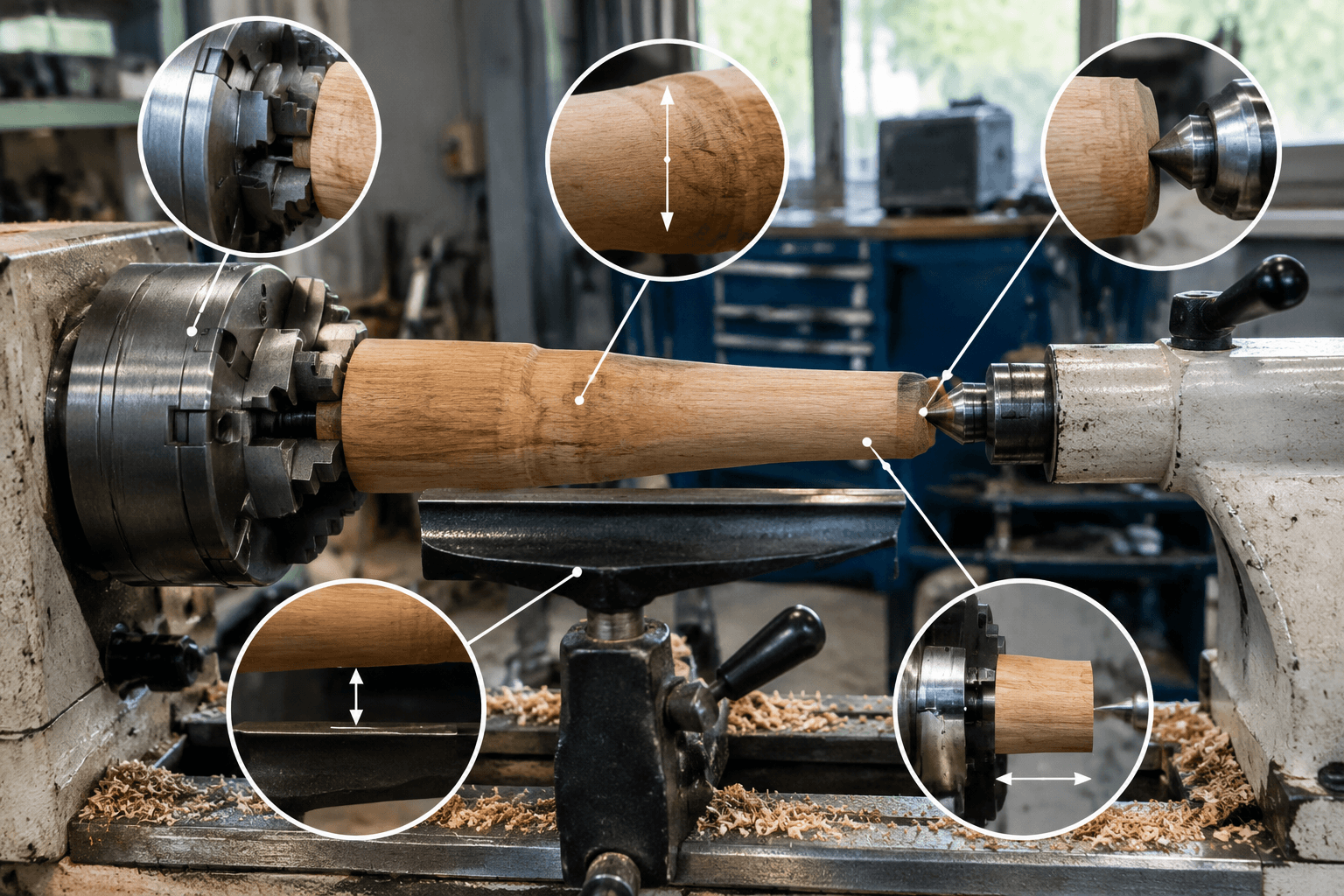
Before a blank becomes part of a prototype or production sample, review its condition, mounting method, and clearance as one workholding decision. Complete these checks before the spindle starts; they supplement rather than replace the lathe and chuck manufacturers’ instructions.
- Inspect the blank. Look for cracks, loose knots, severe end checks, loose bark, delamination, uneven ends, and other defects that could release material. Also consider moisture, density, grain direction, and visible imbalance.
- Confirm the approved method. Use only a chuck, drive-center arrangement, faceplate, or other mounting method permitted for that lathe, spindle, chuck, and workpiece. An online setup is not automatically suitable for another jaw set or machine.
- Check contact and engagement. Verify jaw engagement, center contact, tailstock alignment, and locking procedures. A shallow or uneven grip is not corrected simply by tightening harder.
- Minimize unsupported overhang. Keep the distance between supports as short as practical. Long overhang, uneven material, or a small contact area can amplify vibration and loading. Use tailstock support where the machine procedure and workpiece geometry allow it.
- Check clearance with power isolated. Rotate the workpiece by hand and confirm clearance from the bed, carriage, cross-slide, guards, tailstock, tool holder, and enclosure. Do not rely on a check made while the spindle is running.
- Recheck security after seating. Wood can compress, shift, or reveal a weak area as its surface changes. Stop the machine completely before any inspection, adjustment, or re-tightening.
Tailstock support can help with a suitable spindle-like blank, but it does not make a cracked or badly unbalanced blank safe. A chuck cannot compensate for poor jaw engagement, weak material, or excessive overhang.
Speed and cutting approach are machine-specific
When an existing metal lathe is being considered for a wood prototype, speed must be selected from the specific machine manual rather than a general RPM chart. Check approved limits for the spindle, chuck, workholding arrangement, speed-control system, and guarding. Then consider blank diameter, balance, shape, condition, density, moisture, and the amount of material remaining.
Begin conservatively within the approved operating range and observe the machine before making a deeper or faster cut. Stop if the blank moves, vibration increases, burning appears, unusual noise develops, or the cutter becomes unstable. A speed chart from another machine or blank is not a substitute for the manufacturer’s instructions.
| Condition or observation | Why it matters | Practical response |
|---|---|---|
| Large diameter or visible imbalance | Rotational forces and vibration can increase as mass moves farther from the axis. | Review the manual and workholding limits before considering operation. |
| Light, controlled cut | Smaller engagement reduces sudden loading and helps reveal instability. | Use a rigid, machine-compatible cutter and do not force it into the work. |
| Interrupted grain, knots, or changing density | Cutting force can change abruptly and increase catch risk. | Use controlled feed and depth of cut; stop if the tool or blank becomes unstable. |
| Burning, chatter, or unusual noise | These may indicate friction, blunt tooling, vibration, movement, or unsuitable speed. | Withdraw the tool when safe, then stop the spindle before investigating. |
A cutter secured in an approved tool post or holder may suit a simple cylindrical operation after the required checks. Do not hand-hold an unsupported woodturning tool against a rotating workpiece, improvise an adapter, or assume an unreviewed tool holder is validated.
For a supported cutter, keep the cutting edge in the orientation intended by the tool geometry and approved setup. Avoid a position that lets the rotating work pull the edge into the material or trap the tool. Keep the tool supported, take light passes, and avoid forcing the feed.
Controlling vibration, catches, and wood dust
For a prototype workstation or occasional shop operation, stability and housekeeping must be planned together. Turning wood on a metal lathe combines rotating-work hazards with changing grain and cutting forces. Main risks include ejection, catches, tool instability, flying fragments, entanglement, loose clothing, incomplete guarding, and airborne dust.
Apply the machine’s guarding and PPE requirements together with the workplace risk assessment. Eye and face protection, and respiratory protection where required by the assessment, may be necessary. Keep loose clothing, hair, and jewelry away from rotating parts. Do not use gloves near rotating machinery unless a documented site procedure specifically addresses that risk.
- Confirm that the operator can remain outside the expected ejection path and that the guard or enclosure suits the workholding arrangement.
- Use suitable local extraction or housekeeping controls where required. General room ventilation alone should not be treated as eliminating dust exposure.
- Keep chips and dust away from the chuck, spindle nose, carriage, cross-slide, ways, and bearing areas as far as the machine permits. Any temporary protection must not interfere with moving parts, cooling, guarding, lubrication, or inspection.
- If vibration, movement, a catch, burning, or abnormal noise appears, withdraw the tool if this can be done without entering the hazard zone, then stop and isolate the machine.
- Wait for complete stoppage before measuring, touching the blank, removing chips, changing workholding, or inspecting the chuck.
- Clean according to the manufacturer’s procedure. Use a suitable vacuum or approved housekeeping method rather than uncontrolled compressed air, and restore way protection or lubrication only as specified.
Extraction and cleanup reduce exposure and contamination, but they do not prove that a metal lathe is designed for wood dust or that its bearings, ways, chuck, spindle, or other components are unaffected.
Choose the machine around the job
When a shop is deciding between an existing metal lathe and a dedicated wood lathe, review the workpiece, operator access, dust controls, and production expectations together. A dedicated wood lathe is generally the better direction for irregular geometry, large or changing mass distribution, frequent bowl or vessel work, broad tool-rest access, or a repeatable woodturning workflow. A metal lathe may suit a controlled prototype or occasional small spindle, but that does not establish production suitability.
Can this wood-turning job be performed on a metal lathe? Use this matrix as a screening tool, then confirm the result against the machine manual and site risk assessment.
| Job condition | Go/no-go direction | Reason |
|---|---|---|
| Small, sound, balanced blank; approved mounting; rigid tool support; clear guarding | Proceed only after manual and risk checks. | The operation may be manageable if every machine-specific limit and workplace control is satisfied. |
| Large, irregular, cracked, loose-knot, or visibly unstable blank | Use a dedicated wood lathe or another process. | Workholding, balance, clearance, and tool access become harder to control. |
| Improvised tool rest, adapter, chuck arrangement, or guard | Obtain an engineering review before proceeding. | An unreviewed modification may alter clearance, rigidity, load paths, or safety functions. |
| Repeated production with defined output, dust control, guarding, and operator-access requirements | Obtain an engineering review for a productized workstation. | Repeatability, maintenance, guarding, and exposure controls must be designed rather than inferred from a hobby setup. |
Defining an OEM workstation around the lathe
If a one-off trial is becoming an OEM workstation, document the application before specifying a frame or enclosure. The surrounding metal structure must fit the actual lathe, workholding arrangement, access pattern, and service requirements; it does not replace engineering the turning system.
- Blank diameter, length, mass range, shape, material condition, and mounting method.
- Lathe make and model, spindle and chuck details, tailstock arrangement, approved speed limits, and existing guarding.
- Operator access, exclusion zones, loading method, service access, dust collection, and cleaning procedure.
- Mounting points, base footprint, floor or bench interface, surrounding equipment, and operating environment.
- Target quantity, prototype or pilot status, repeat-production expectations, tolerances, finish requirements, inspection points, and acceptance criteria.
Separate the requested scope into sheet-metal fabrication, any machined interface, welded assembly, finishing, and inspection requirements. These specifications describe the surrounding product and do not validate the lathe, conversion, tooling, or turning procedure.
For an enclosure concept, see custom sheet-metal enclosures for a turning workstation. For a structural support concept, see custom metal support frames for industrial equipment.
Request an application review: Send Yishang a drawing, sketch, or photos of the proposed enclosure, support frame, or workstation. Include overall dimensions, mounting points, access requirements, operating environment, material preference, surface requirements, dimensional tolerances, inspection expectations, and target quantity. State whether the need is a prototype, pilot batch, or repeat-production project. This review is for the surrounding custom metal structure, not for supplying or certifying the lathe itself.
Where RFQ Assumptions Create Cost and Production Risk
Many sheet metal fabrication problems begin before production starts. If drawings, tolerances, finish expectations, material grades, or assembly requirements are unclear, suppliers may quote based on different assumptions. That can make prices difficult to compare and may lead to rework, cosmetic rejection, assembly misalignment, or production delays later.
For OEM buyers, the goal is not simply to request the lowest price. The goal is to make sure each supplier is quoting the same manufacturing reality. Before confirming an order, clarify which dimensions are fit-critical, which surfaces are cosmetic, whether prototypes must match batch-production conditions, and how finished parts will be inspected.
Frequently Asked Questions
What wood on a metal lathe details should buyers define before requesting a quote?
Buyers should define the functional requirement, drawing notes, critical dimensions, material or process expectations, and any inspection points related to wood on a metal lathe. This helps suppliers quote the same manufacturing scope instead of making different assumptions.
How can RFQ details affect cost, fit, or lead time?
RFQ details can change tooling, forming, welding, finishing, inspection, or rework requirements. If buyers do not clarify it early, two supplier quotes may look comparable while covering different production risks.
Why should drawing requirements be reviewed before prototype approval?
drawing requirements may look acceptable on a single sample but become harder to control during batch production. Buyers should confirm whether the prototype reflects the same process, finish, and inspection conditions expected for production.
What inspection points matter most for wood on a metal lathe projects?
Important inspection points usually include fit-critical dimensions, holes or mating areas, cosmetic surfaces, finish build-up, welded or formed features, and any dimensions that affect downstream assembly. These points should appear in the RFQ or drawing notes.
How can buyers reduce prototype approval risk before batch production?
Buyers can reduce risk by clarifying drawings, locking key material and finish assumptions, defining inspection timing, approving a representative sample, and confirming which dimensions or surfaces require tighter process control.
How can Yishang help review wood on a metal lathe requirements?
Yishang can review drawings, RFQ notes, material requirements, tolerance expectations, finish details, samples, and assembly needs to identify unclear assumptions before quoting or batch production.