
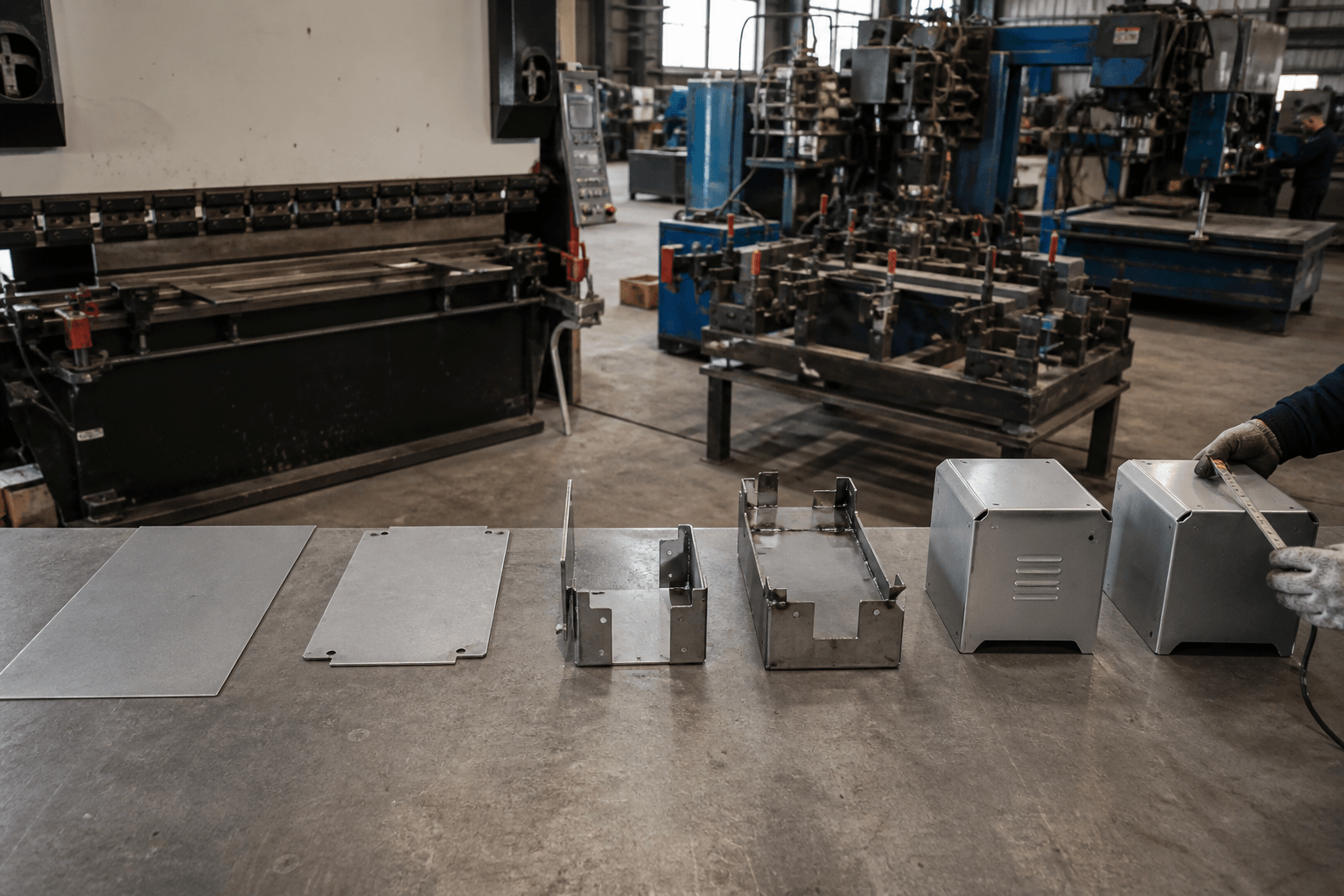
Steel sheet processing is the downstream conversion of flat steel sheet into parts or assemblies through cutting, forming, joining, optional finishing, and inspection. It begins after the sheet has been produced. A flat profile may need only blanking, while an enclosure or frame may also require bending, welding, coating, or assembly.
The appropriate route depends on steel grade, surface condition, thickness, geometry, tolerances, quantity, appearance, service environment, and final interfaces.
For OEM engineering and procurement teams, the key question is not whether a supplier offers every fabrication process. It is which operations the specific part needs and what must be verified before prototype or batch production.
What steel sheet processing covers
Steel sheet processing turns purchased flat sheet into a usable component or subassembly. A typical route moves from material confirmation to a cut blank, formed part, joined assembly, optional finish, and inspected product. The sequence changes with the design.
- Material confirmation: verify the grade, thickness, surface condition, and coated or uncoated state.
- Blanking: cut the profile, holes, slots, and other two-dimensional features.
- Forming: bend the blank into flanges, channels, panels, brackets, or other three-dimensional shapes.
- Joining: weld or mechanically fasten separate parts when the design requires a combined structure.
- Optional finishing: apply the specified treatment when appearance, corrosion exposure, handling, or service conditions require it.
- Inspection and assembly: verify the relevant features and combine parts or hardware if the product must arrive assembled.
Not every part passes through every stage. A mounting plate may require cutting and inspection only. A folded cover may need cutting and bending but no welding. A frame may require cut or formed members, welded joints, and checks of its final interfaces.
This is downstream fabrication, not steelmaking, hot rolling, cold rolling, or asymmetric rolling. Those processes produce or modify the sheet before fabrication begins. For a broader view of the downstream route, see custom sheet metal fabrication built to your drawings.
Variables that determine the processing route
The material name alone is not enough to select a route. The drawing, application, and delivery form should establish the following variables:
- Steel grade: strength, ductility, weldability, and forming behavior can influence cutting, bending, and joining decisions.
- Surface condition: coated and uncoated sheets can require different handling, weld planning, masking, or cut-edge treatment.
- Thickness and blank size: these affect equipment selection, handling, nesting, tooling, and feasible geometry.
- Part geometry: contours, holes, slots, internal corners, formed features, and bend locations affect the operation and sequence.
- Tolerances: critical hole locations, bend-related dimensions, and assembly interfaces should be identified instead of applying one assumption to every feature.
- Quantity and production stage: prototypes, repeat batches, and dedicated high-volume production can justify different tooling decisions.
- Function and environment: structural load, corrosion exposure, visibility, handling, and cleaning requirements influence material and finish selection.
- Delivery form: a bracket, enclosure, welded frame, and assembled product each require a different scope.
Interfaces can be more important than isolated part dimensions. A panel may need controlled hole and bend locations because it must align with a door, insert, frame, or piece of equipment. Stamping or deep drawing may also be evaluated for compatible high-volume shapes, but these are separate route decisions rather than default replacements for flexible sheet fabrication.
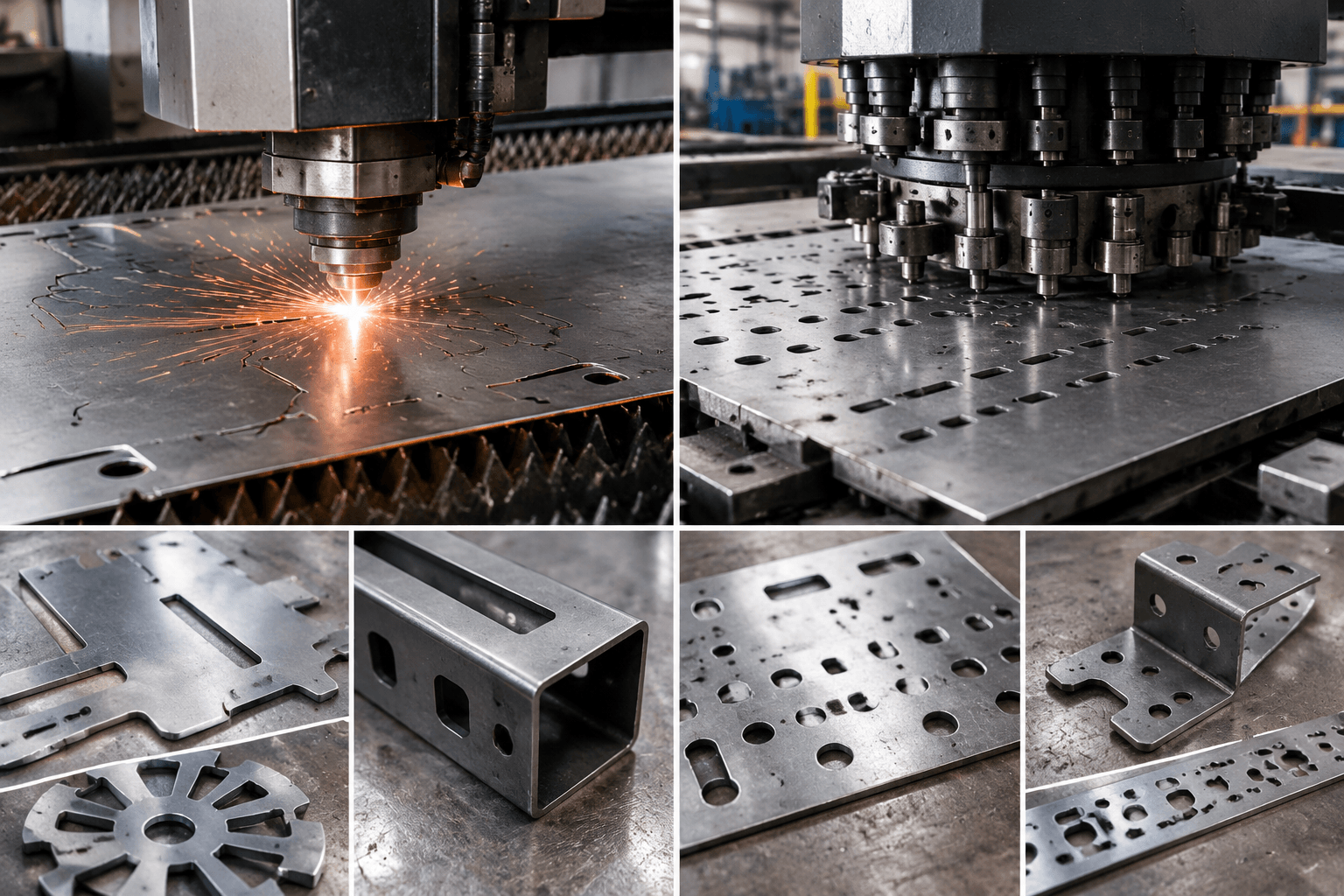
Laser cutting compared with CNC punching
Laser cutting and CNC punching are both sheet blanking operations. They create the two-dimensional blank but do not by themselves produce a finished three-dimensional enclosure, bracket, or frame.
| Consideration | Laser cutting | CNC punching |
|---|---|---|
| Suitable features | Flexible contours, slots, and varied hole patterns. | Repeated holes, compatible patterns, and tool-produced sheet features. |
| Geometry context | Often considered for changing profiles, intricate contours, or frequent revisions. | Often considered when features match available tools and repeat across the sheet. |
| Planning factors | Programming, nesting, material handling, cut condition, and edge requirements. | Tool selection, access, feature spacing, tool marks, and any special-tool requirement. |
| Buyer question | Can the specified profile and edge condition be produced in the selected material? | Can compatible tooling produce the repeated features while maintaining location and appearance requirements? |
Neither method is universally better. Selection depends on geometry, repetition, tooling compatibility, revision frequency, quantity, surface expectations, and available equipment. The drawing should identify critical profiles, holes, slots, and edge requirements because errors at the blanking stage can affect later bends and assembly fit.
How forming and joining change the blank
Bending is a forming operation. It converts a flat blank into flanges, channels, folded panels, or brackets. Planning should account for bend sequence, tool access, bend direction, internal geometry, and the relationship between cut features and formed dimensions. Critical bend angles, flange dimensions, and mating interfaces should be identified for inspection.
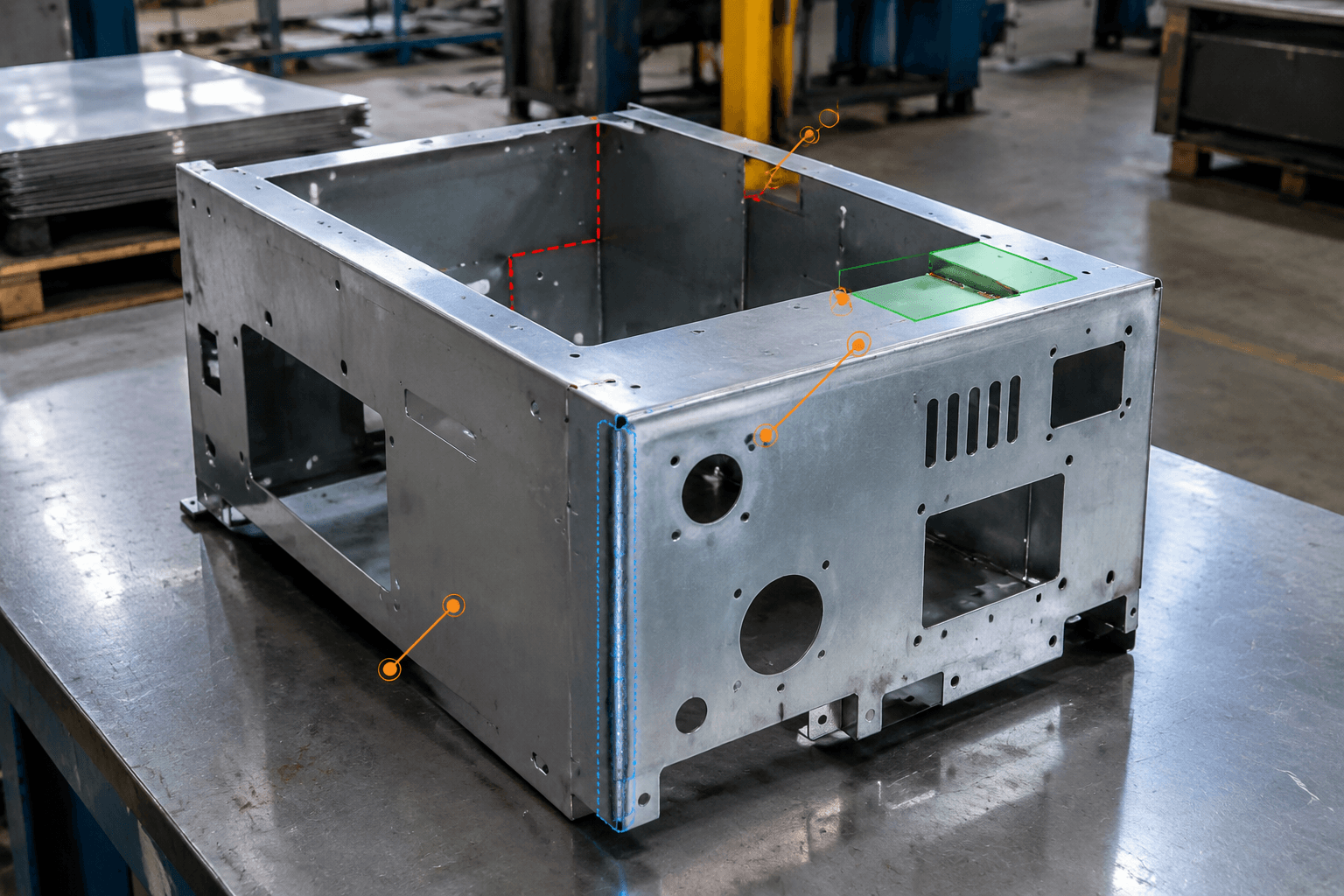
In a custom enclosure, blanking may produce the perimeter, mounting holes, cable openings, and ventilation features. Bending then creates walls, returns, and mounting flanges. The enclosure may use hardware or welded joints, depending on the design; it does not automatically require welding, coating, or supplier assembly.
Welding is a joining operation. It combines separate sheet components or formed parts. Joint location, access, sequence, fit-up, surrounding geometry, and distortion risk should be considered before production.
A welded frame may use cut members that are bent where needed, positioned, and joined into a structure. Relevant checks can include joint fit, overall dimensions, squareness, mounting-hole alignment, weld appearance, and interfaces with panels or equipment. See custom metal frames built square, stable and ready to assemble for this type of application.
When finishing and assembly become relevant
Finishing is included when the specification calls for a defined surface condition based on corrosion exposure, appearance, handling, cleaning, or service conditions. The scope should state whether the sheet is already coated, whether cut or welded areas need treatment, and whether finishing follows fabrication.
Powder coating is optional rather than automatic. When specified, the review should address the requested appearance or coating system, preparation, masking, edge and cavity coverage, curing route, and inspection criteria for the actual material and geometry.
Assembly becomes relevant when the supplier must combine panels, frames, fasteners, hinges, inserts, hardware, or other subcomponents. Buyers should distinguish individual fabricated parts from a welded subassembly, coated component set, or ready-to-install product.
From product requirement to a likely processing route
| Product requirement | Operations to evaluate | Key review point |
|---|---|---|
| Flat plate or mounting panel | Material confirmation, laser cutting or punching, optional edge treatment, inspection | Profile, hole pattern, edge condition, and functional flatness or fit |
| Folded bracket or channel | Blanking, bending, and inspection | Bend sequence, flange dimensions, angles, and mating interfaces |
| Custom enclosure or cabinet | Cutting, bending, optional joining, optional coating, and optional hardware assembly | Openings, panel fit, mounting points, finish, and installation interfaces |
| Welded frame | Cutting, forming where needed, welding, inspection, and optional finish | Joint fit, weld access, distortion, squareness, and connection points |
| Ready-to-use subassembly | Fabrication plus specified finishing and assembly | Part identity, hardware, functional fit, surface condition, and final interfaces |
The matrix is a starting point for drawing review. It shows why cutting, bending, welding, finishing, and assembly are conditional rather than mandatory stages.
Checks before prototype or batch approval
- Material: verify grade, thickness, surface condition, coated state, and required documentation against the purchase specification.
- Cut blank: inspect the profile, hole and slot locations, critical dimensions, burrs, edges, and bend-reference features.
- Formed geometry: check bend angles, flange or wall dimensions, and fit where the part must close, mount, or align.
- Joined structure: where welding is specified, review joint fit, weld appearance, accessible joint locations, and distortion affecting function.
- Surface: confirm that uncoated, pre-coated, or finished areas meet the agreed requirement, including protected interfaces.
- Assembly: verify hardware, mating parts, mounting points, doors, covers, fasteners, and installation interfaces where applicable.
A prototype review can expose unclear dimensions, access limitations, or finish assumptions before production release. Batch inspection should then follow the agreed characteristics and inspection plan rather than an unsupported universal sampling rule. Additional context is available on Yishang’s quality control page.
Planning a custom steel sheet part or assembly? Send Yishang a 2D drawing or 3D model, steel grade and thickness, dimensions, estimated quantity or production stage, required bends, welds, finish, inspection points, application, and delivery requirements. The review can identify the relevant fabrication stages and clarify prototype or batch-production requirements. For enclosure applications, explore custom sheet metal enclosures.
Send the drawing and application details to Yishang for a review of whether the product needs blanking alone or a broader route involving forming, joining, finishing, and assembly.
Frequently Asked Questions
What steel sheet processing details should buyers define before requesting a quote?
Buyers should define the functional requirement, drawing notes, critical dimensions, material or process expectations, and any inspection points related to steel sheet processing. This helps suppliers quote the same manufacturing scope instead of making different assumptions.
How can RFQ details affect cost, fit, or lead time?
RFQ details can change tooling, forming, welding, finishing, inspection, or rework requirements. If buyers do not clarify it early, two supplier quotes may look comparable while covering different production risks.
Why should drawing requirements be reviewed before prototype approval?
drawing requirements may look acceptable on a single sample but become harder to control during batch production. Buyers should confirm whether the prototype reflects the same process, finish, and inspection conditions expected for production.
What inspection points matter most for steel sheet processing projects?
Important inspection points usually include fit-critical dimensions, holes or mating areas, cosmetic surfaces, finish build-up, welded or formed features, and any dimensions that affect downstream assembly. These points should appear in the RFQ or drawing notes.
How can buyers reduce prototype approval risk before batch production?
Buyers can reduce risk by clarifying drawings, locking key material and finish assumptions, defining inspection timing, approving a representative sample, and confirming which dimensions or surfaces require tighter process control.
How can Yishang help review steel sheet processing requirements?
Yishang can review drawings, RFQ notes, material requirements, tolerance expectations, finish details, samples, and assembly needs to identify unclear assumptions before quoting or batch production.