
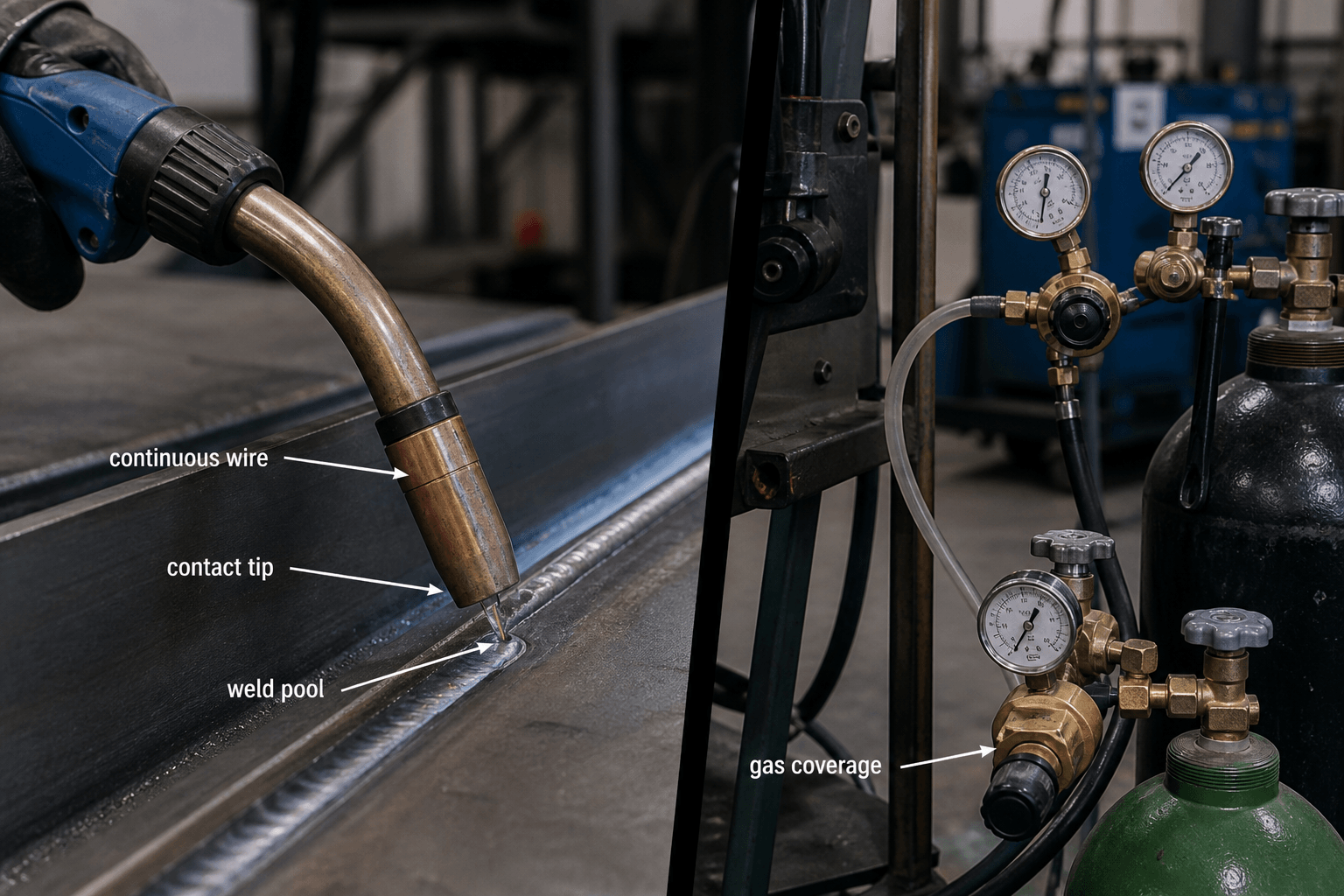
MIG welding is fast, repeatable, and productive when joints are accessible and shielding gas can remain stable. Its continuous wire feed reduces electrode-change interruptions and supports efficient shop fabrication. However, gas sensitivity, equipment mobility, joint preparation, access, and parameter control can make MIG unsuitable for some materials, joint designs, and field conditions.
MIG, formally known as gas metal arc welding (GMAW), creates an arc between the workpiece and a continuously fed consumable wire electrode. An external shielding gas protects the weld pool from the surrounding atmosphere. Whether the process delivers the required strength, appearance, consistency, and cost depends on the material, joint design, preparation, settings, operating environment, and operator control—not simply on choosing MIG.
| Advantages of MIG Welding | Disadvantages of MIG Welding |
|---|---|
| Continuous wire feeding supports steady production | Wind and drafts can disrupt shielding-gas coverage |
| Fewer electrode-change interruptions | Power source, wire feeder, gun, and gas equipment reduce portability |
| Settings can be repeated for similar joints | Incorrect parameters can cause porosity, spatter, burn-through, or lack of fusion |
| Generally limited slag compared with flux-protected processes | Contamination and inadequate preparation can affect weld quality |
| Well suited to repetitive, accessible shop welds | The welding gun may restrict access to tight or obstructed joints |
| Can balance production speed and bead control in suitable applications | Equipment setup, consumables, maintenance, and training must be managed |
Practical Advantages of MIG Welding
The main advantages of MIG welding come from its wire-feed mechanism and its suitability for controlled production. These characteristics can improve workflow, but their value changes with the part geometry, production quantity, and required result.
1. Continuous Wire Feeding Supports Production Speed
The consumable wire feeds through the welding gun as the operator works. Unlike processes that require frequent replacement of short electrodes, MIG can continue as long as wire and shielding gas remain available and operating conditions are stable.
This process continuity is useful for repeated seams, frames, brackets, enclosures, and assemblies with multiple accessible welds. It does not mean every joint can be completed faster with MIG: positioning, fit-up, heat control, inspection, and part handling may still determine the total production time.
2. Reduced Electrode-Change Interruptions
A wire spool provides a continuing electrode supply, reducing stops associated with replacing individual electrodes. For repeated production, fewer interruptions can help operators maintain a consistent work rhythm and reduce non-welding time.
The advantage is less important when a part has only a few short welds, requires frequent repositioning, or contains joints the gun cannot reach. Process efficiency should therefore be evaluated across the complete fabrication sequence rather than by arc-on time alone.
3. Repeatable Settings for Similar Joints
Once suitable wire feed, voltage, travel technique, gas flow, and other variables have been established, the same setup can be used as a starting point for comparable joints. This supports repeatability in production involving consistent materials, joint geometry, and fit-up.
Repeatable machine settings do not automatically produce identical welds. Changes in joint gaps, surface condition, gun angle, travel speed, contact-tip condition, gas coverage, and operator technique can still affect penetration, fusion, bead shape, and spatter.
4. Relatively Limited Slag Cleanup
Because MIG relies on external shielding gas rather than a flux-coated stick electrode, it generally does not leave the heavy slag layer associated with many flux-protected operations. This can reduce slag-removal work between passes or before later finishing steps.
Cleanup is not eliminated. Spatter, smoke residue, discoloration, or surface contamination may still need attention, particularly where the part will be painted, powder coated, plated, assembled against another surface, or presented as a visible product feature.
5. Suitable for Controlled Shop Fabrication
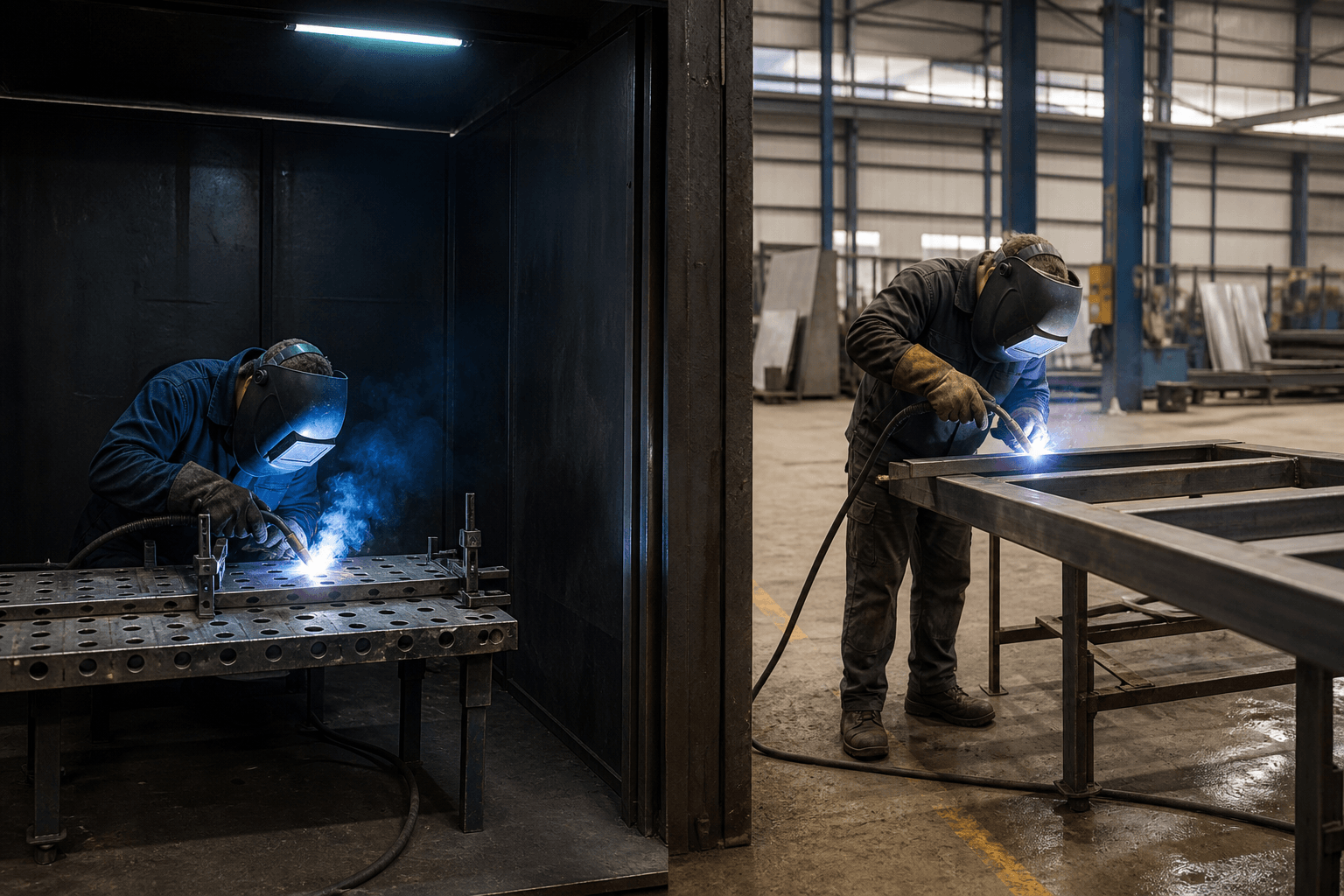
MIG equipment fits well into indoor production areas where parts, fixtures, electrical supply, gas cylinders, and consumables can remain organized. Stable conditions help maintain shielding-gas coverage and make it easier to reproduce established settings.
This can benefit repeated frame and assembly work where squareness, weld sequence, and distortion control matter. The geometry considerations described for custom metal frames illustrate why process selection must be considered alongside fixturing, stability, and final assembly requirements.
6. Useful Balance of Speed and Operator Control
MIG gives the operator control over gun position, travel speed, work angle, and bead placement while the machine continuously feeds the electrode. For suitable joints, this can provide a practical balance between production output and control.
The resulting strength and appearance remain application-dependent. A fast weld with unsuitable settings or poor joint preparation may not meet the required outcome, while a carefully controlled MIG procedure can produce consistent results on an appropriate part.
Specific Disadvantages of MIG Welding
The disadvantages of MIG welding become most important when work moves outside controlled shop conditions or when the part presents contamination, access, mobility, or heat-control challenges.
1. Shielding Gas Is Sensitive to Air Movement
The external gas must cover the molten weld pool long enough to protect it from atmospheric contamination. Wind, fans, open doors, or strong drafts can disturb that coverage and increase the risk of porosity or other weld-quality problems.
MIG can be used outside only when conditions and protective measures allow reliable gas coverage. For exposed field work, stick or a suitable flux-cored process may deserve consideration because their shielding arrangements can be more practical in moving air.
2. Equipment Can Limit Portability
A typical setup includes a power source, wire-feeding system, welding gun, leads, consumable wire, and shielding-gas supply. Moving this equipment around a large assembly or between work locations can be less convenient than moving a compact setup that does not require an external gas cylinder.
Portability depends on the actual equipment configuration and worksite. A MIG unit can be practical within a shop but cumbersome where welds are widely separated, access is restricted, or the equipment must frequently be moved over uneven ground.
3. Joint Cleanliness and Preparation Matter
Oil, moisture, paint, rust, scale, coatings, and other contaminants can interfere with arc stability and weld-pool protection. Joint edges may require cleaning before welding, while inconsistent gaps or poor fit-up can make heat and bead control more difficult.
Preparation is especially important for sheet-metal assemblies where fit, appearance, and distortion affect later operations. For example, the joint layout and assembly requirements associated with custom sheet metal enclosures may influence weld placement, sequence, finishing, and process choice.
4. Parameter Errors Can Create Weld Defects
Wire-feed speed, voltage, travel speed, gun angle, contact-tip position, gas flow, and material condition interact. If the combination is unsuitable, possible results include porosity, lack of fusion, excessive spatter, irregular bead shape, burn-through, or distortion.
These are potential outcomes, not unavoidable characteristics of MIG welding. Procedure development, equipment condition, preparation, and operator technique determine whether the process remains stable for a particular joint.
5. Thin or Heat-Sensitive Parts Require Control
Continuous wire feeding can introduce heat quickly. On thin sections or assemblies that are sensitive to movement, the welding sequence, fit-up, travel speed, and time between welds may need careful control to reduce burn-through and distortion.
Part geometry matters as much as nominal thickness. A bracket with short, accessible joints behaves differently from a large panel with long seams. Drawing-defined joint access and production requirements should be reviewed together, as illustrated by the design considerations for custom metal brackets.
6. Gun Size Can Restrict Joint Access
The gun, nozzle, and required working angle need enough space around the joint. Deep corners, narrow channels, enclosed assemblies, and obstructions can prevent the operator from maintaining the intended angle or contact-tip position.
A process that is productive on an open bench joint may therefore be difficult to control after surrounding components have been assembled. Weld access should be considered during part and assembly planning rather than after the joint becomes inaccessible.
7. Setup and Maintenance Affect Operation
Wire size and type, shielding gas, drive-roll setup, liner condition, contact tips, gun components, polarity, and machine settings must be appropriate for the application. Feeding problems or worn consumables can interrupt production and affect arc behavior.
MIG is often described as easy to learn because the operator does not manually feed a separate filler rod. Even so, consistently producing acceptable welds requires understanding joint fit-up, heat input, travel technique, gas protection, defect recognition, and equipment care.
When MIG Welding Is a Good Fit
MIG is generally worth considering when fabrication occurs in a controlled indoor environment, joints are clean and accessible, and production includes repeated welds on similar parts. It is particularly useful when reducing electrode changes and maintaining a steady production rhythm have practical value.
The process may be a good fit when:
- Shielding gas can remain stable around the weld pool.
- The selected wire and gas are appropriate for the base material.
- Joint preparation and fit-up can be controlled.
- The gun can reach the joint at a suitable working angle.
- Parts or joints repeat often enough to benefit from established settings.
- Limited slag supports later inspection, coating, or assembly operations.
An alternative deserves consideration when work is exposed to wind, equipment must be moved frequently, surfaces cannot be adequately prepared, joint access is restricted, or the required bead control and appearance favor another process.
Material compatibility also requires application-specific review. MIG can be configured for multiple metals, but changing the base material may require different wire, shielding gas, equipment setup, preparation, and technique. The fact that one material welds successfully with a particular setup does not establish that the same configuration is appropriate for another.
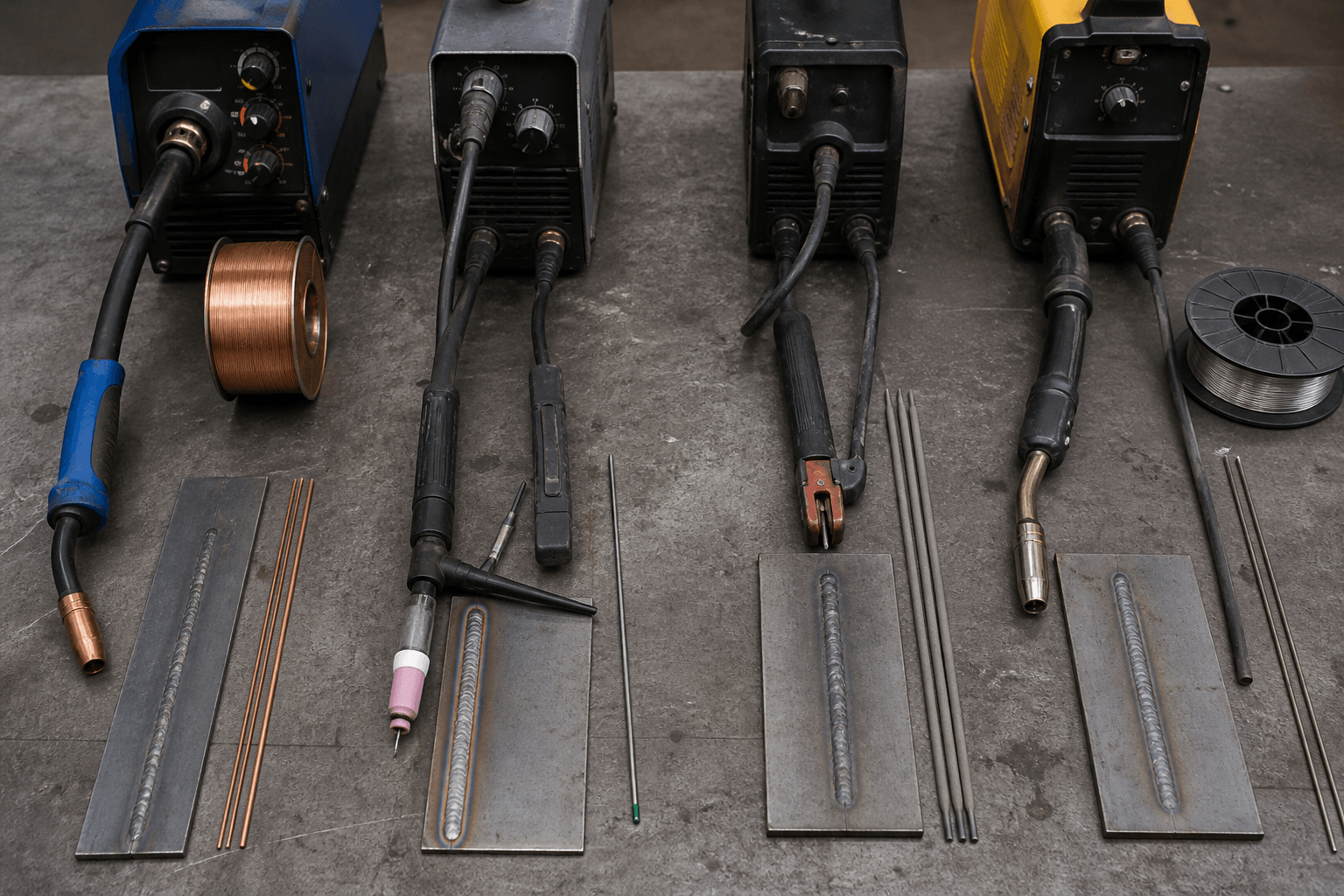
MIG, TIG, Stick, or Flux Core: Which Conditions Favor Each Process?
| Selection Factor | MIG | TIG | Stick | Flux Core |
|---|---|---|---|---|
| Production pace | Continuous wire can support steady production | Often selected when control has priority over speed | Electrode changes interrupt continuous welding | Continuous wire can support productive welding |
| Bead and heat control | Good control when settings and travel are stable | High operator control over arc and filler addition | Depends strongly on electrode and technique | Depends on wire type, settings, and technique |
| Outdoor suitability | External gas can be disrupted by air movement | External gas is also sensitive to air movement | Often practical for exposed or mobile work | Some configurations suit site work better than gas-shielded MIG |
| Portability | Gas and wire-feed equipment add components | Gas and additional equipment must be managed | Can offer a comparatively simple mobile arrangement | Mobility depends on whether external gas is required |
| Cleanup | Generally limited slag, but spatter may remain | Typically selected where clean bead control is important | Slag removal is commonly required | Slag and spatter cleanup may be required |
| Typical decision driver | Repeated shop production and accessible joints | Precision, appearance, and detailed heat control | Portability and practical outdoor operation | Productive welding on suitable sections or site conditions |
MIG versus TIG: MIG commonly favors production continuity, while TIG offers more independent control over the arc and filler addition. TIG may be considered when appearance, precise heat control, or detailed manual control has priority. Neither process guarantees a better weld without the correct procedure and execution.
MIG versus stick: MIG generally offers continuous wire feeding and less slag, while stick can be more practical when portability and resistance to changing site conditions matter. Stick still requires appropriate preparation and technique; it is not automatically preferable for every outdoor joint.
MIG versus flux core: Both use continuously fed wire, but flux-cored wire provides shielding through flux and, depending on the configuration, may also use external gas. Flux core can be attractive for certain site conditions and substantial joints, while MIG may reduce slag cleanup in controlled shop work. Wire type, material, position, environment, and required result should guide the choice.
Separate Process Characteristics from Weld Outcomes
Continuous wire feeding, external shielding gas, relatively limited slag, and the need for wire-feed equipment are inherent MIG characteristics. Strength, cost, finish quality, consistency, and productivity are outcomes influenced by the application.
A MIG weld can be strong when the joint design, material, preparation, procedure, and execution are suitable. It can also be unacceptable if it lacks fusion, contains porosity, or does not match the service requirement. Likewise, MIG may reduce labor interruptions in repeated production but may not be the lowest-cost choice for a small field repair requiring extensive equipment movement.
The best selection therefore comes from comparing the process with the complete part: base material, section thickness, joint geometry, access, production quantity, operating environment, appearance expectations, later finishing, and service requirements.
Frequently Asked Questions
What advantages and disadvantages of mig welding details should buyers define before requesting a quote?
Buyers should define the functional requirement, drawing notes, critical dimensions, material or process expectations, and any inspection points related to advantages and disadvantages of mig welding. This helps suppliers quote the same manufacturing scope instead of making different assumptions.
How can RFQ details affect cost, fit, or lead time?
RFQ details can change tooling, forming, welding, finishing, inspection, or rework requirements. If buyers do not clarify it early, two supplier quotes may look comparable while covering different production risks.
Why should drawing requirements be reviewed before prototype approval?
drawing requirements may look acceptable on a single sample but become harder to control during batch production. Buyers should confirm whether the prototype reflects the same process, finish, and inspection conditions expected for production.
What inspection points matter most for advantages and disadvantages of mig welding projects?
Important inspection points usually include fit-critical dimensions, holes or mating areas, cosmetic surfaces, finish build-up, welded or formed features, and any dimensions that affect downstream assembly. These points should appear in the RFQ or drawing notes.
How can buyers reduce prototype approval risk before batch production?
Buyers can reduce risk by clarifying drawings, locking key material and finish assumptions, defining inspection timing, approving a representative sample, and confirming which dimensions or surfaces require tighter process control.
How can Yishang help review advantages and disadvantages of mig welding requirements?
Yishang can review drawings, RFQ notes, material requirements, tolerance expectations, finish details, samples, and assembly needs to identify unclear assumptions before quoting or batch production.