
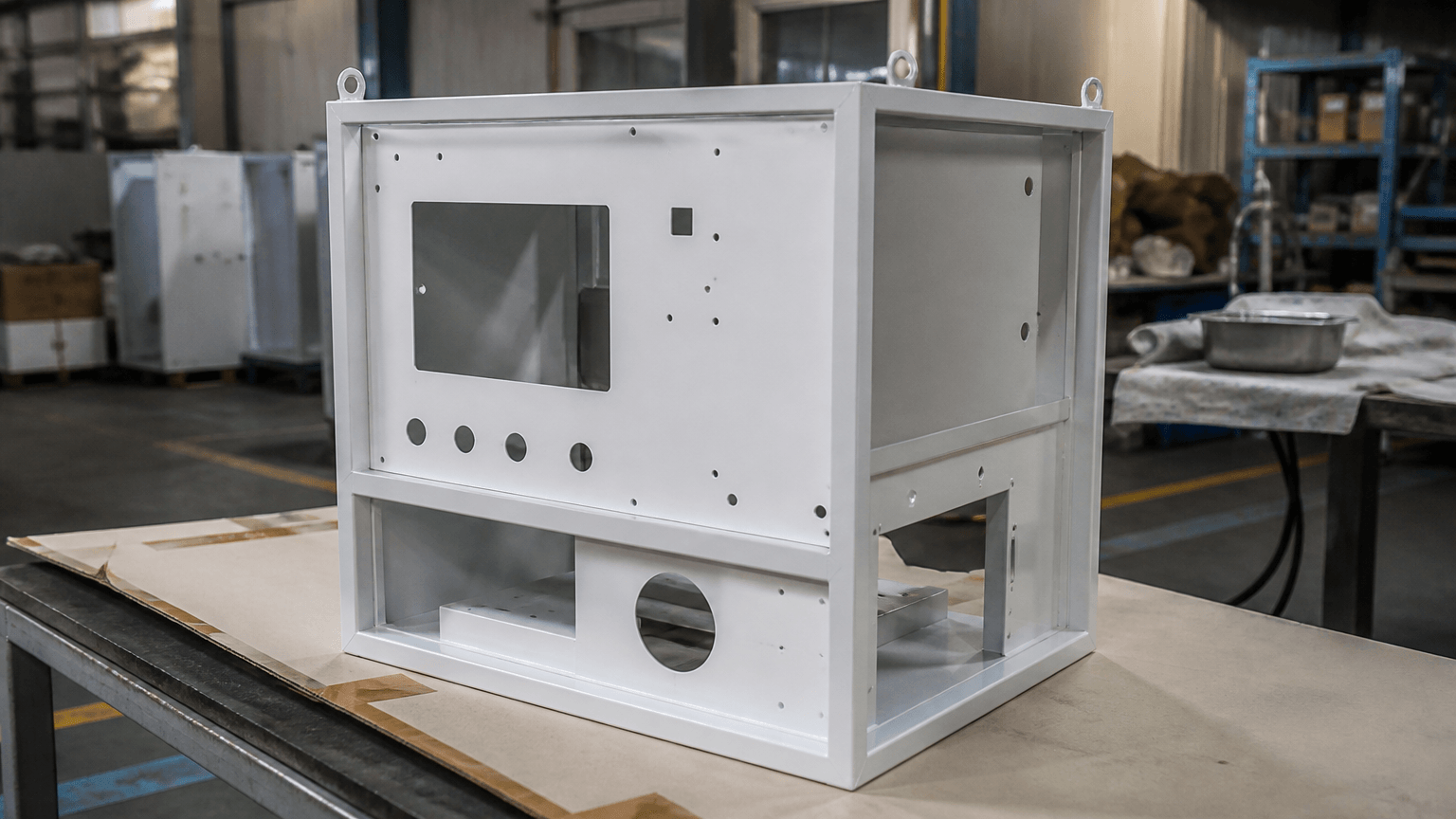
The average price for powder coating metal parts is not a dependable number until the part and finishing scope are defined. For an OEM quote, suppliers may price the work by part, batch, coated area, or process load. The result can change with the substrate, preparation, coated area, geometry, powder system, masking, quantity, inspection, and packaging.
If a drawing calls for a powder-coated enclosure, bracket, or frame, metal powder coated means that a fabricated or machined metal part has been finished with dry powder. The powder is electrostatically deposited on prepared metal, then heated so it melts and cures into a continuous film. It does not remain as loose powder, and the phrase describes a finished surface condition rather than a metal grade or fabrication process.
What "metal powder coated" means on an OEM drawing
When an OEM drawing calls for a powder-coated enclosure or bracket, the wording can hide several decisions: the base metal, preparation route, visible surfaces, no-coat interfaces, cure conditions, and inspection basis. The finish description is useful, but it is not yet a complete manufacturing requirement.
The underlying part may be mild steel, galvanized steel, stainless steel, or aluminum, provided the selected powder system and preparation route are suitable for that substrate. The powder contains a resin system and color or other specified ingredients. During application, charged powder is directed toward a grounded metal part and adheres to accessible surfaces.
After heating, the selected powder melts and cures into a continuous coating. The required cure condition depends on the powder supplier's technical data, the part's material and mass, and the finishing process. A specification should therefore identify the powder system, color, gloss, texture, coating boundaries, and inspection method instead of using powder coated as a complete requirement.
This finish usually follows the required product-manufacturing stages. A sheet metal enclosure may be cut, punched, bent, and welded before it is prepared and coated, while a machined insert, bracket, or fitting may require a different treatment or masking approach. Welding joins components; powder coating finishes the assembled or individual metal surfaces. Assembly and inspection remain separate activities, even when one supplier manages the full project.
For an enclosure, cabinet, frame, bracket, or welded assembly, the preceding custom sheet metal fabrication route affects the finished appearance. Burrs, weld spatter, sharp edges, distortion, dents, or poor fit can remain visible after coating. The finish cannot substitute for correcting a fabrication problem.
How the coating route controls the finished result
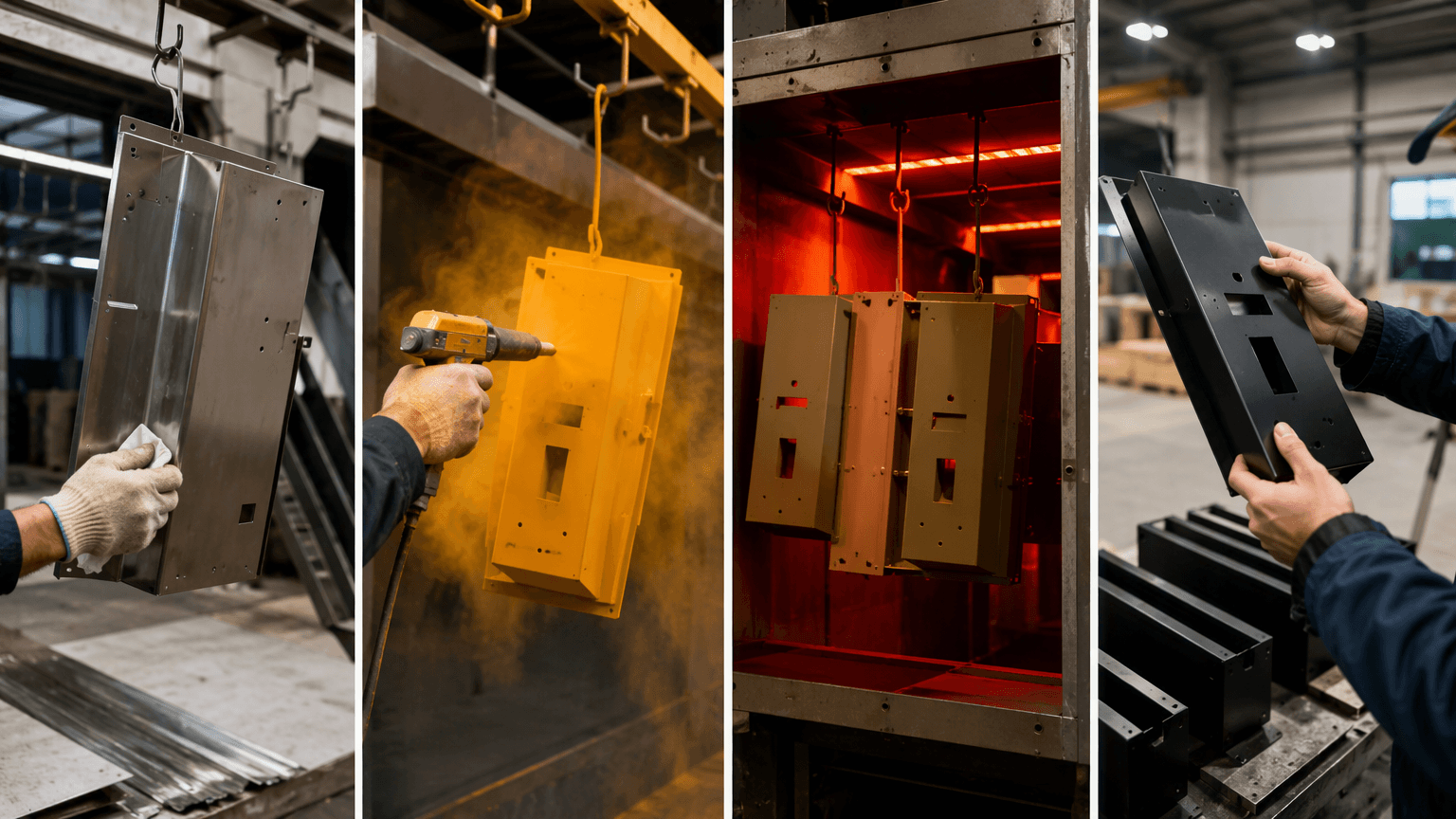
A buyer may see powder application as one finishing step, but quality can be lost before the powder reaches the part or after it leaves the oven. A typical route includes the following checkpoints:
- Review the fabricated condition. Before finishing, the supplier checks the part for burrs, sharp edges, weld residue, spatter, slag, oil, rust, moisture, and other conditions that could affect preparation or appearance. If a machined component interfaces with a sheet metal part, the drawing should identify which surfaces must remain dimensionally or electrically functional.
- Prepare the substrate. Cleaning and pretreatment remove contamination and establish a surface suitable for adhesion. Mild steel, galvanized steel, stainless steel, and aluminum can require different preparation approaches. Existing oxide, oil, dust, weld residue, or porous contamination may contribute to adhesion failure, blistering, pinholes, uneven appearance, or corrosion beneath the coating.
- Define masking and hanging. Threads, holes, grounding points, mating faces, labels, hinges, sliding surfaces, and sealing areas may need plugs, masks, or another agreed treatment. The hanging method must allow the part to be grounded during application while controlling rack marks and access to internal surfaces.
- Apply the powder. Powder is deposited on the prepared metal. Broad external faces may receive powder differently from deep recesses, blind holes, folded returns, corners, or surfaces behind flanges. Part orientation, geometry, and access influence coverage and appearance.
- Cure the coating. Heat causes the powder to melt and cure according to the selected system. The powder supplier's technical data should establish the required part-temperature and time conditions. One generic oven setting is not a universal requirement for every powder, alloy, or part geometry. Incomplete curing can affect the final film, while porous or contaminated material may release gas during heating.
- Inspect and protect. Inspection may address color, gloss, texture, coverage, edge condition, adhesion, cure, and visible defects according to the agreed method. The inspector should distinguish a coating defect from a dent, weld irregularity, hole distortion, or other fabrication issue revealed by the finish. Approved parts then need packaging and handling that prevent rubbing, impact, and contamination.
Design details that protect coating boundaries and assembly fit
A finish that looks acceptable on a flat sample can still interfere with assembly when it is applied to a real product. Review powder coating with the part drawing, particularly for custom sheet metal enclosures, cabinets, and welded assemblies that combine visible panels with functional interfaces.
Functional interfaces need defined coating boundaries
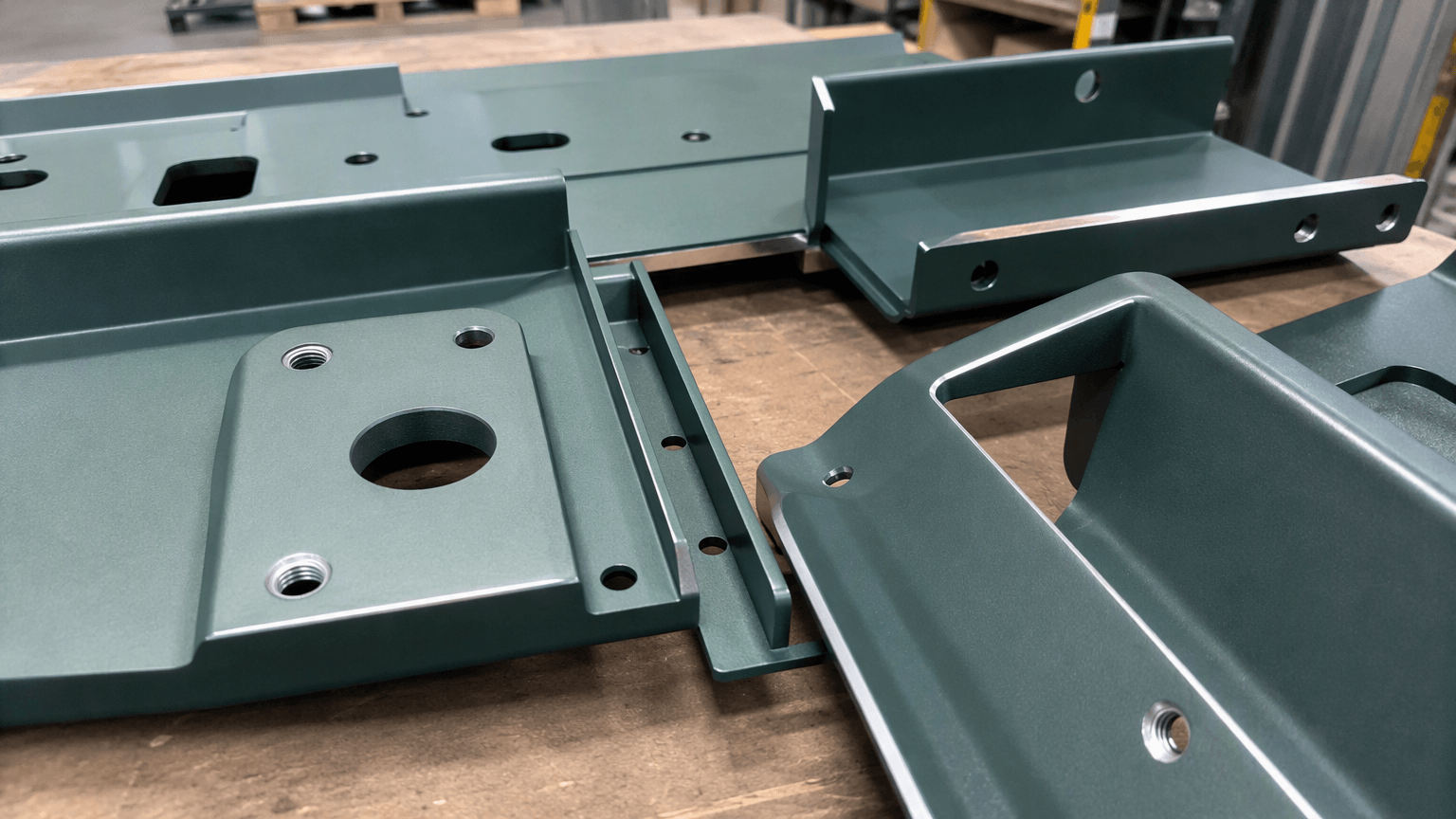
State whether holes, internal threads, press-fit areas, sliding surfaces, sealing faces, hinges, labels, and mating faces must remain uncoated. Grounding points may require bare-metal contact. Unintended coating in a thread or close-fitting hole can interfere with assembly, while coating on an electrical contact area can interrupt continuity.
Show no-coat zones on the drawing or in a separate masking view. The supplier may use plugs, masks, hanging arrangements, or an agreed post-coating cleaning operation. Do not assume that a general instruction such as coat all surfaces resolves these interfaces.
Edges, welds, and recesses require specific review
Edges and corners do not receive powder in exactly the same way as broad faces. Sharp edges, deep recesses, blind holes, folded returns, and weld transitions deserve specific review because access and contamination can vary across the part. Trapped oil, moisture, or weld residue can become visible during curing. Suitable edge preparation and a clean weld condition support more consistent coverage, but the acceptance requirement still depends on the part and selected powder system.
Size, orientation, and rack contact affect the route
Part size, rack orientation, hanging points, access to internal surfaces, and the supplier's oven limitations must be confirmed for the actual product. A large cabinet, a small bracket, and a welded frame can require different hanging strategies. Place rack contact marks in an agreed hidden or functional area where possible, and include unavoidable contact points in the appearance discussion. The relevant constraint is the supplier's actual equipment and the product's geometry, not a generic maximum size.
When powder coating is not the only finish option
Powder coating is one possible finish route, not a synonym for painted, plated, anodized, or galvanized metal. Selection should consider the substrate, environment, appearance, conductivity, dimensional interfaces, thermal exposure, repair conditions, batch requirements, and available validation evidence. The surface finishing service should be selected against those requirements rather than against a color name alone.
| Finish route | Process and substrate considerations | Potential fit | Validate before approval |
|---|---|---|---|
| Powder coating | Dry powder is electrostatically deposited and thermally cured on a suitable conductive metal part. The substrate and geometry must tolerate the selected cure route. | Enclosures, cabinets, brackets, frames, and welded assemblies that need a defined organic color or texture. | Pretreatment, recess coverage, masking, cure, film build, environment, and repair approach. |
| Liquid paint | A liquid coating is applied by spraying, brushing, or another method, then dries or cures according to the selected system. | Projects requiring a specified liquid system, multiple coating layers, or a service situation where touch-up may be part of the maintenance plan. | Substrate compatibility, drying, solvent or chemical exposure, appearance, film build, and handling time. |
| Electroplating | An electrochemical process deposits a metal layer on a conductive substrate. Bath access, racking, and geometry affect coverage and thickness distribution. | Applications requiring a metallic surface, conductivity, or a defined plated layer. | Dimensional change, recess and thread coverage, preparation, appearance, and environmental data. |
| Anodizing | An electrochemical oxide layer is formed primarily on aluminum rather than adding an organic paint film. | Aluminum parts where the oxide surface, appearance, or specified electrical and dimensional behavior is appropriate. | Alloy, color consistency, masking, fit, conductivity, and operating environment. |
| Galvanizing | A zinc-based protective layer is applied to iron or steel through a galvanizing process. It can affect dimensions, openings, and post-treatment interfaces. | Steel products whose corrosion-protection strategy and geometry suit a zinc coating route. | Drainage and venting, weld areas, dimensions, appearance, handling, and compatibility with any subsequent finish. |
For elevated or fluctuating temperatures, review the selected powder's continuous and peak temperature data. If bare-metal conductivity is essential, the substrate is heat-sensitive, or the environment requires a different validated system, another finish may be more appropriate. No finish should be selected on a universal durability, corrosion, or weathering assumption without project-specific data.
Specification fields that make an OEM price comparable
A price request becomes useful only when suppliers are pricing the same finishing scope. Put the following information on the drawing, finish schedule, or purchase specification so the quoted average price for powder coating can be compared on a like-for-like basis:
- Part and substrate: Identify the metal, thickness, fabricated condition, dimensions, quantity, and any existing oil, rust, oxide, or coating that must be removed.
- Color: Provide the powder color system or code and, where appearance is critical, an approved physical sample. A screen image or descriptive color name is not sufficient for precise comparison.
- Appearance: Define gloss, texture, visible surfaces, color-uniformity expectations, and an appearance class describing acceptable marks or defects.
- Film thickness: Give a target or agreed supplier range based on the selected powder system, fit requirements, and technical data. Film-thickness limits are system-specific rather than universal.
- Boundaries and interfaces: Mark no-coat areas for holes, threads, grounding points, mating faces, hinges, labels, sliding surfaces, and sealing interfaces.
- Environment: Describe indoor or outdoor use, moisture, chemicals, cleaning agents, UV exposure, and operating temperature. The powder supplier's data should support the intended conditions.
- Inspection and approval: Define how color, gloss, coverage, adhesion, cure, edge condition, and visible defects will be assessed. An acceptance sample can align the buyer, supplier, and quality team before batch production.
- Handling: State prototype or batch status, protective separators, packaging, and shipping requirements so finished surfaces are not damaged before assembly.
For a quotation review, ask whether the supplier is charging per part, batch, coated area, or process load. Request the assumptions for preparation, masking, application, curing, inspection, packaging, and any special multi-stage system. Geometry, color changes, small quantities, extra preparation, and extensive masking can change the price, so an unexplained average is not a reliable purchasing benchmark.
Preparing an RFQ? Send the part drawing or 3D model, material and thickness, expected quantity, finish requirements, masking zones, operating environment, and inspection expectations. That information allows the fabrication and coating scope to be reviewed together rather than quoted as an isolated surface treatment.
Project review before prototype or batch production
Powder coating is a candidate when the metal substrate can tolerate the selected cure route and the project needs a defined finished surface. It is not suitable by default for every alloy, size, geometry, temperature, outdoor exposure, or assembly interface. The decision should be based on the selected powder system, the actual operating environment, and agreed inspection evidence.
Before prototype or batch review, provide the drawing or 3D model, material and thickness, dimensions, quantity, production status, color, gloss, texture, approved sample requirements, masking zones, grounding and mating-surface requirements, operating environment, and inspection expectations.
A prototype or first-article review can confirm fit, coating boundaries, thread and grounding function, visible-surface appearance, rack marks, handling, and packaging before batch production. This is useful for enclosures with doors and apertures, brackets with mating faces, and custom metal frames where squareness and assembly fit remain important after finishing.
Yishang supports OEM and ODM custom manufacturing, prototype review, and batch production for custom sheet metal parts, enclosures, cabinets, frames, brackets, and welded assemblies. The company has more than 26 years of custom metal-product manufacturing experience, exports to more than 50 countries, and holds ISO and RoHS certifications. These statements do not replace a project-specific review of the fabrication and finishing scope.
Next step: Request a project-specific review using the drawing or model, material and thickness, quantity, finish specification, masking and interface requirements, operating environment, and inspection expectations. Yishang can clarify the information needed for an OEM or ODM prototype or batch-production quotation.
Frequently Asked Questions
These questions often determine whether a powder-coating requirement is clear enough for an RFQ, drawing review, or prototype approval.
Is metal powder coated the same as painted metal?
Not exactly. Powder coating is an organic coating route that uses dry powder deposited electrostatically and cured with heat. Liquid paint uses a liquid coating system and may dry or cure under different conditions. The drawing should identify the required route rather than use painted metal as a general term.
Can holes, threads, grounding points, and mating surfaces be left uncoated?
Yes, when the requirement is defined before production. The supplier may use masking, plugs, hanging arrangements, or an agreed post-coating cleaning operation. Show these areas as no-coat zones and define how assembly fit and electrical contact will be checked.
Does every metal substrate require the same powder-coating preparation?
No. Mild steel, galvanized steel, stainless steel, and aluminum have different surface conditions and pretreatment needs. Oil, rust, oxide, weld residue, existing coatings, and porous material can also change the preparation route. Compatibility should be confirmed for the actual substrate and powder system.
What finish information should an OEM buyer provide for a powder-coated part?
Provide the drawing or 3D model, material and thickness, quantity, color code or approved sample, gloss, texture, visible-surface requirements, film-thickness basis, masking zones, grounding and mating requirements, operating environment, inspection method, and packaging expectations. Include relevant dimensional or assembly tolerances where coating build could affect fit. This gives suppliers a common basis for scope and price comparison.