
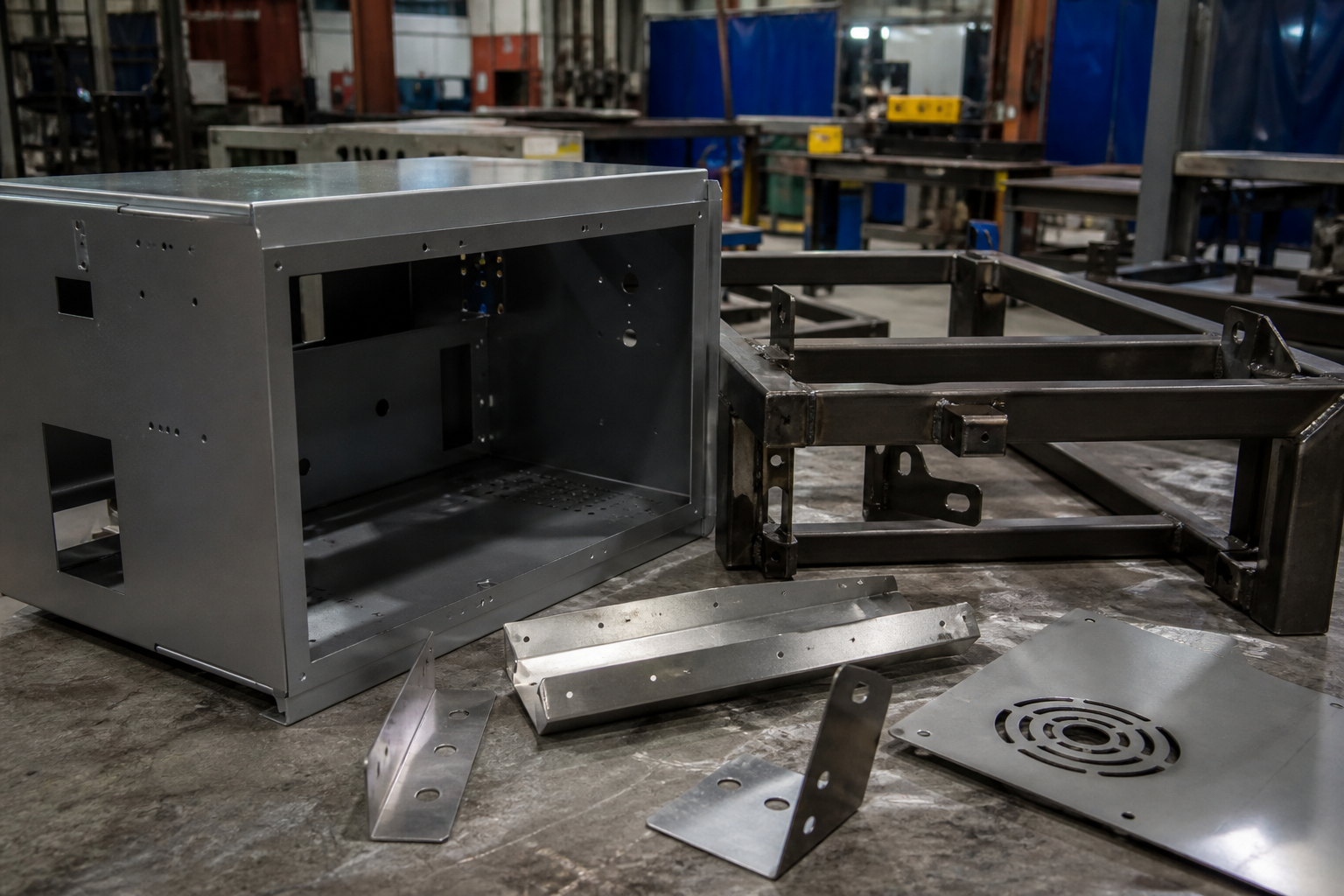
Engineering metal products are parts or assemblies designed for a defined function, interface, service environment, appearance, and production method. Unlike raw stock or generic catalog hardware, their material, geometry, joining, finish, and inspection requirements are engineered together.
For a custom enclosure or welded frame, the drawing shape is only the starting point. Mounting interfaces, loads, access, visible surfaces, hardware, finish, and production quantity influence whether the product can be fabricated and assembled as intended. Typical products include enclosures, cabinets, frames, display racks, brackets, panels, laser-cut components, and welded assemblies. This article focuses on fabricated sheet metal products and identifies when machining, extrusion, casting, or deep drawing requires a different route.
Sheet, plate, bar, tube, coil, and structural sections are material forms. Standard fasteners and catalog hardware are finished items selected to an existing specification. An engineering metal product is instead made or configured around an application. A cabinet may protect equipment while providing mounting rails, ventilation, cable entry, and service access. A frame may carry equipment while maintaining the interfaces required for panels and other components.
A product can combine several manufacturing routes. An enclosure might use laser-cut and bent panels, welded seams, installed hardware, and a separately machined block at a mounting interface. The block remains a machined component even when it is integrated into a sheet metal assembly.
Product Families Based on Fabricated Sheet
Product architecture should be established before individual operations are selected. A buyer evaluating a cabinet, rack, or frame needs to consider how its parts support, protect, locate, and provide access to the equipment, because those relationships determine where bends, joints, hardware, and reinforcements are needed.
Enclosures and cabinets. These products protect equipment and provide mounting, ventilation, cable-routing, and service interfaces. Doors, hinges, latches, removable panels, seals, and visible faces must be coordinated as parts of the assembly. See how these requirements apply to custom sheet metal enclosures.
Frames and welded assemblies. Frames carry or position components and may combine folded profiles, tube, plate, gussets, or formed sections. Joint access, welding sequence, distortion, squareness, finish, and assembly state affect interface alignment. More detail is available on custom metal frames.
Brackets, panels, covers, and guards. Mounting holes, formed returns, stiffening features, access openings, inserts, and cosmetic faces are governed by the larger OEM product in which the part fits.
Display racks and presentation structures. Structural stability and visible finish both matter. Floor contact, handling, shelf installation, exposed joints, edge condition, color, texture, and replaceable elements can influence construction.
Laser-cut and formed components. Panels, supports, and gussets can be cut or punched before bending into flanges, channels, boxes, or brackets. Bend allowance, radius, material behavior, hole position, and fastening access determine whether the flat pattern produces the required part.
These families often overlap. A cabinet may contain a welded frame and formed brackets, while a display assembly may combine sheet panels, tube, fasteners, and decorative finished parts.
Requirements That Shape the Design
An indoor cover, an outdoor equipment housing, and a cabinet supporting machinery may all be described as metal enclosures, but they create different design decisions. Defining operating conditions before selecting a material helps prevent a light-duty panel, corrosion strategy, or access arrangement from being applied to the wrong service conditions.
- Loads and movement: Define load direction, stiffness, vibration, impact, mounting conditions, and whether the product will be lifted, transported, or repeatedly opened. Bends, returns, ribs, gussets, and frame members can contribute stiffness.
- Service environment: Identify indoor or outdoor use, humidity, salt, chemicals, temperature, cleaning practices, and hygiene-sensitive conditions. Joints, cut edges, fasteners, crevices, and weld areas can be as important as the base material.
- Weight and maintenance: Consider handling, installation, service clearance, access panels, ventilation, drainage, cable routing, cleaning, and replacement parts. Reducing weight may require changes to section geometry, reinforcement, joining, or handling protection.
- Interfaces: Define mating parts, hole patterns, hinges, inserts, connectors, seals, alignment features, and fastening access. Appearance alone does not confirm that an assembly will fit.
- Appearance: Identify cosmetic faces, color, texture, grain direction, exposed welds, edge condition, and acceptable visual variation. Powder coating applies an organic coating; polishing mechanically changes the metal surface.
- Production quantity: Separate prototype demand from expected batch demand. Quantity and pattern repetition may affect whether laser cutting, CNC punching, or dedicated forming arrangements should be evaluated.
Electrical, structural, fire, hygiene, and other regulatory requirements must come from the buyer’s applicable specification. A material designation or RoHS status alone does not establish suitability for a regulated application.
Comparing Candidate Metals
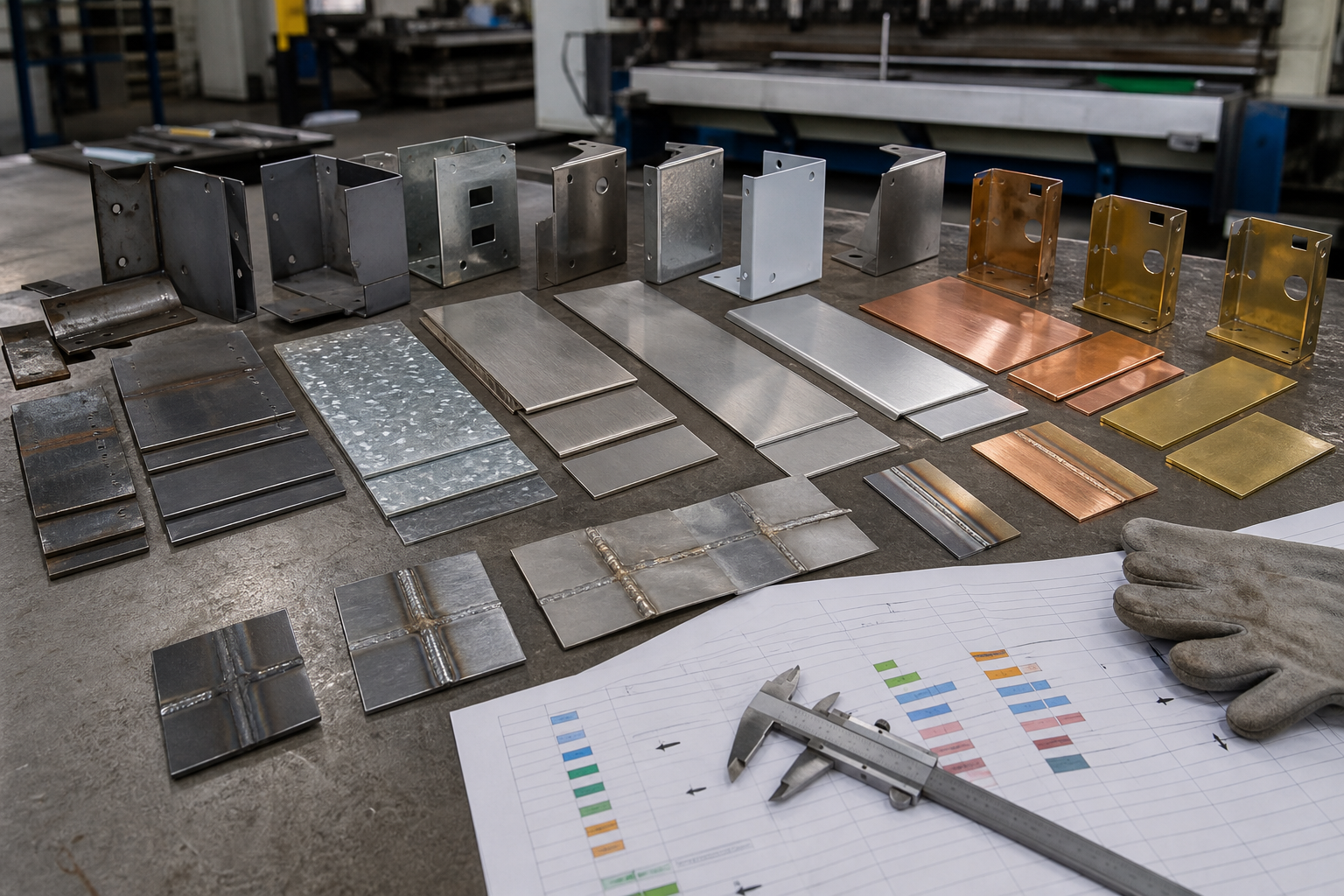
Material selection changes forming behavior, joining, finish, weight, service performance, and procurement. Buyers therefore need to specify more than a grade name: product form, temper, thickness, surface condition, fabrication route, exposure, and regional specification can all affect the result.
| Material | Reasons to evaluate it | Design and production checks |
|---|---|---|
| Mild or low-carbon steel | Stiffness, availability, weldability, and compatibility with painted or coated finishes. | State the grade and form. A36 is generally associated with structural steel products, while 1018 is commonly specified for certain cold-finished forms; they are not interchangeable across sheet, plate, and bar. Review corrosion protection and weld preparation. |
| Galvanized steel | The zinc-coated surface can contribute to a corrosion-control strategy. | Define the coated product. Cutting and welding affect edges and local coating areas, so edge protection, welding-area treatment, and coating compatibility need review. |
| 304 stainless steel | Corrosion resistance and an exposed metallic appearance for appropriate service conditions. | Review exposure, finish, forming, weld heat effects, post-weld treatment, and maintenance. It is not suitable for every chemical or salt environment. |
| 316 stainless steel | Often evaluated when stronger pitting-corrosion resistance than 304 is sought, including for some chloride exposures. | Concentration, temperature, crevices, finish, weld areas, and maintenance still govern suitability. |
| 5052 aluminum | Lower weight and sheet-forming suitability can support bent-panel and enclosure designs. | Confirm temper, thickness, bend direction, radius, joining, distortion, and finish. |
| 6061 aluminum | Strength-to-weight characteristics may suit appropriate forms and structural requirements. | 6061-T6 is generally less accommodating of tight sheet bends than 5052. Review temper, bend geometry, cracking risk, weld-zone changes, and finish. |
| Copper | Electrical or thermal conductivity may govern selection. | Define conductivity, contact surfaces, burr control, oxidation, joining, surface protection, and permitted substitutions. |
| Brass | Appearance or selected functional and conductive properties may support its use. | Define alloy and form; review forming or machining behavior, edges, oxidation, handling, and protective finish. |
No material in the table is universally best. Actual procurement cost also depends on current pricing, local availability, thickness, sheet size, certification requirements, and material yield.
Building the Sheet Metal Production Route
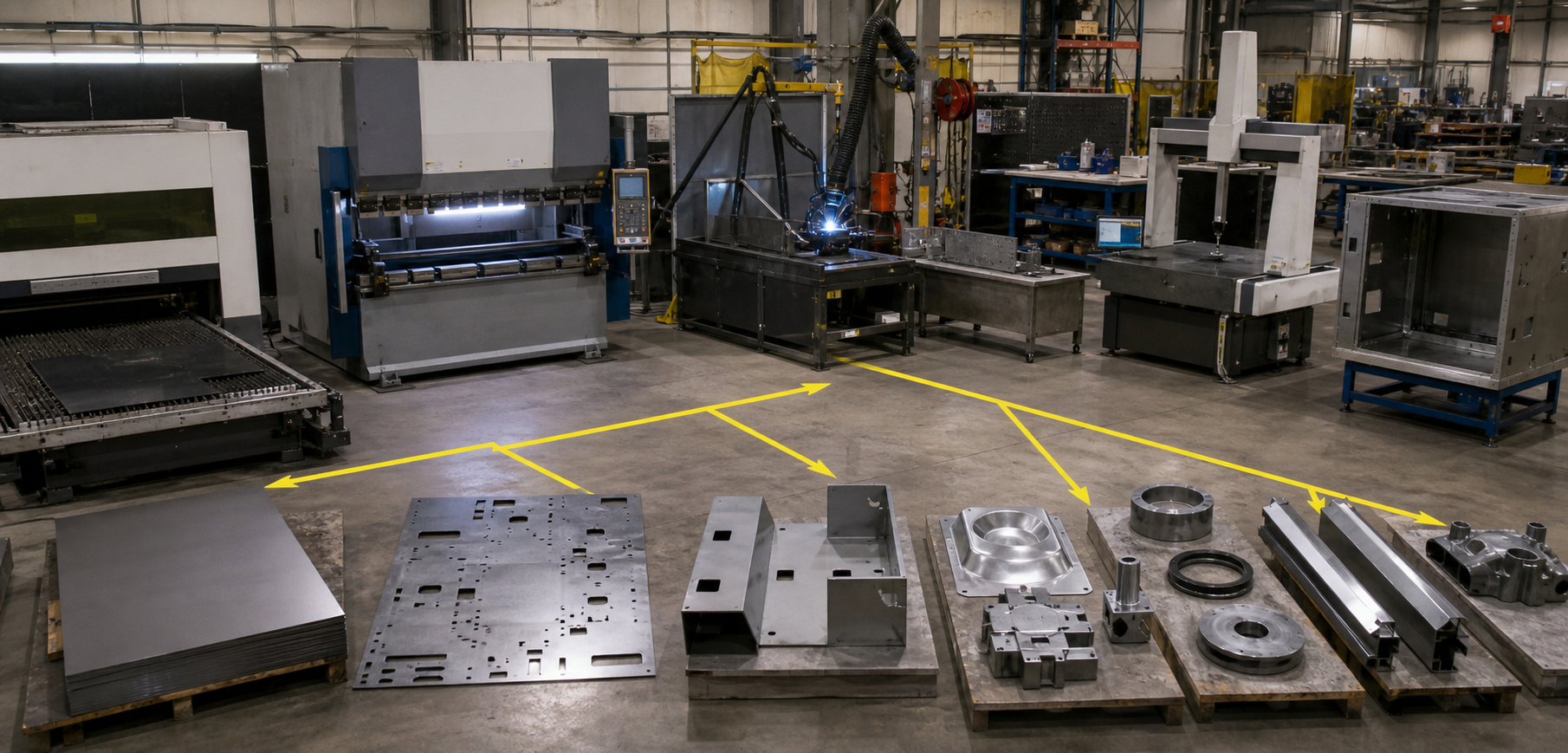
A workable route accounts for dependencies between operations. Cutting establishes profiles and bend references, bending changes access, welding can affect shape and visible surfaces, and finishing introduces preparation, masking, and handling requirements. Inspection and assembly must be planned, but they are not cutting or forming processes.
- Laser cutting creates flexible profiles and openings in flat sheet. Nesting, edge condition, heat effects, and downstream references can influence the result.
- CNC punching creates repeat holes, slots, suitable formed features, or recurring patterns with tooling. Tool access, pattern density, marks, and material behavior affect suitability.
- Bending creates flanges, channels, boxes, returns, and structural sections. Bend allowance, radius, springback, hole-to-bend relationships, temper, and visible-face orientation require consideration.
- Welding permanently joins parts into subassemblies. Joint access, sequence, heat distortion, seam visibility, cleanup, and later finishing influence weldment design.
- Finishing follows its own preparation and acceptance requirements. Powder coating provides a specified coating color and texture, while polishing produces a metallic surface. Masking and cosmetic-face requirements depend on the route.
- Assembly integrates fabricated parts, separately produced interface parts, hinges, latches, inserts, fasteners, and other specified hardware. Part inspection and assembled-state inspection answer different questions.
CNC machining is a separate route for solid geometry or localized precision features that cannot be produced economically from cut and formed sheet. Extrusion supports long components with a constant cross-section. Casting uses tooling for complex three-dimensional metal shapes, while deep drawing produces drawn shells or cup-like forms and is distinct from press-brake bending. Hybrid products can combine these routes with a fabricated cover or frame. Explore the sheet metal manufacturing route for custom structures and assemblies.
Application-to-Material Decision Matrix
When a project is still being defined, the objective is to identify credible starting points and the unresolved checks that could change them. The following scenarios connect product requirements to candidate materials and routes without treating the initial choice as final approval.
| Scenario | Candidate starting points | Possible route | Unresolved checks |
|---|---|---|---|
| Indoor painted cabinet | Mild steel or aluminum | Laser cutting or punching, bending, hardware installation, powder coating, assembly | Loads, stiffness, ventilation, door alignment, visible faces, and access |
| Outdoor equipment enclosure | Galvanized steel, stainless steel, or coated mild steel | Cutting, forming, joining, local edge and weld treatment, finishing, inspection | Humidity, salt, chemicals, drainage, crevices, coating compatibility, and maintenance |
| Lightweight access panel | 5052 aluminum or another specified sheet | Cutting, bending, hardware installation, selected finish | Deflection, repeated removal, latch loads, bend condition, and scratching |
| Welded support frame | Mild steel, stainless steel, or aluminum | Section preparation, bending where required, welding, finishing, assembly | Load direction, interfaces, squareness, weld access, lifting, and inspection state |
| Conductive component | Copper, brass, or another specified conductive alloy | Cutting and forming, or separate machining where geometry requires it, then protection and assembly | Conductivity, contact surfaces, oxidation, burrs, joints, and substitutions |
| Decorative display assembly | Coated steel, stainless steel, aluminum, brass, or a defined combination | Cutting, bending, joining, polishing or coating, cosmetic inspection, assembly | Stability, edge safety, exposed joints, color, handling marks, and replacement parts |
Moving from Concept to Repeat Production
Prototype review becomes more useful when the design package separates fixed requirements from details open to manufacturing discussion. This allows the product to be evaluated in its intended assembly state while material, bend, weld, finish, and inspection questions can still be resolved before batch production.
- Document the product: Provide part and assembly drawings with dimensions, tolerances, revision status, critical interfaces, and available 3D files.
- Specify materials and construction: State grade, product form, thickness, temper where applicable, permitted substitutions, bend and weld requirements, hardware, masking, cosmetic faces, grain direction, finish, and assembly instructions.
- State expected demand: Identify quantity by revision and distinguish prototype demand from expected batch demand.
- Establish acceptance criteria: Identify critical dimensions, mating patterns, alignment, weld and finish criteria, and the required inspection state. Specify material certificates, incoming inspection, first-article records, dimensional reports, or batch traceability when the project requires them.
- Review the prototype: Compare the assembled prototype with functional and cosmetic requirements, then control approved changes through the drawing revision before repeat production.
Yishang supports B2B OEM and ODM custom manufacturing, prototype review, and batch production. The company has more than 26 years of experience manufacturing custom metal products and exports to more than 50 countries.
Request a design and prototype review. Send controlled 2D drawings and available 3D files, assembly or interface dimensions, intended environment, functional priorities, preferred material or permission to discuss alternatives, finish and visible-surface requirements, prototype and batch quantities, critical tolerances, and required inspection, documentation, or packaging instructions. Ask Yishang to review the proposed material, sheet metal route, finish, and assembly plan before proceeding to a prototype or production quotation.
Where RFQ Assumptions Create Cost and Production Risk
Many sheet metal fabrication problems begin before production starts. If drawings, tolerances, finish expectations, material grades, or assembly requirements are unclear, suppliers may quote based on different assumptions. That can make prices difficult to compare and may lead to rework, cosmetic rejection, assembly misalignment, or production delays later.
For OEM buyers, the goal is not simply to request the lowest price. The goal is to make sure each supplier is quoting the same manufacturing reality. Before confirming an order, clarify which dimensions are fit-critical, which surfaces are cosmetic, whether prototypes must match batch-production conditions, and how finished parts will be inspected.
Frequently Asked Questions
What hole alignment details should buyers define before requesting a quote?
Buyers should define the functional requirement, drawing notes, critical dimensions, material or process expectations, and any inspection points related to hole alignment. This helps suppliers quote the same manufacturing scope instead of making different assumptions.
How can tolerance stack affect cost, fit, or lead time?
tolerance stack can change tooling, forming, welding, finishing, inspection, or rework requirements. If buyers do not clarify it early, two supplier quotes may look comparable while covering different production risks.
Why should mating parts be reviewed before prototype approval?
mating parts may look acceptable on a single sample but become harder to control during batch production. Buyers should confirm whether the prototype reflects the same process, finish, and inspection conditions expected for production.
What inspection points matter most for engineering metal products projects?
Important inspection points usually include fit-critical dimensions, holes or mating areas, cosmetic surfaces, finish build-up, welded or formed features, and any dimensions that affect downstream assembly. These points should appear in the RFQ or drawing notes.
How can buyers reduce fit-up inspection risk before batch production?
Buyers can reduce risk by clarifying drawings, locking key material and finish assumptions, defining inspection timing, approving a representative sample, and confirming which dimensions or surfaces require tighter process control.
How can Yishang help review engineering metal products requirements?
Yishang can review drawings, RFQ notes, material requirements, tolerance expectations, finish details, samples, and assembly needs to identify unclear assumptions before quoting or batch production.